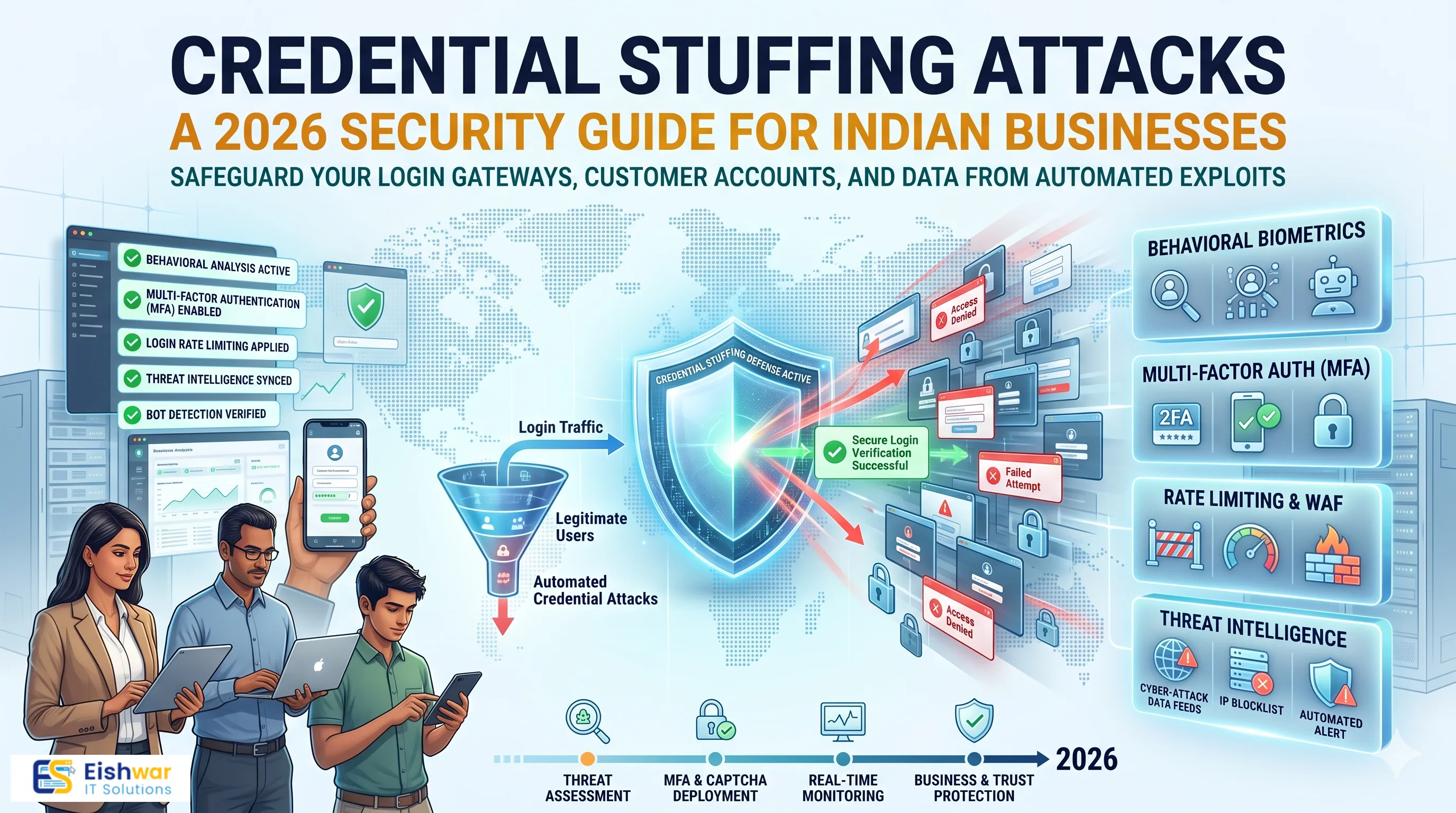
Credential Stuffing Attacks: A 2026 Security Guide for Indian Businesses
Introduction
Imagine waking up to find that your customers' accounts have been compromised—not because your website was hacked, but because attackers used login credentials stolen from another site. This is the stark reality of credential stuffing, a cyber threat that has surged in recent years. In 2026, Indian businesses are prime targets, with attackers exploiting the widespread reuse of passwords across platforms. The consequences can be devastating: financial losses, legal repercussions, and a permanent erosion of customer trust. This guide will walk you through what credential stuffing is, why it's a serious threat to your business, and how to protect your website and customers effectively. By the end, you'll have a clear, actionable roadmap to fortify your defenses against this insidious attack.
Main Section 1: Understanding Credential Stuffing and Its Impact on Indian Businesses
Credential stuffing is a type of cyberattack where hackers use automated tools to try large numbers of username-password combinations—often obtained from data breaches—on your website. The goal is to gain unauthorized access to user accounts. Unlike brute-force attacks, which guess passwords, credential stuffing relies on the fact that people often reuse the same passwords across multiple sites. If a user's credentials are leaked from one service, attackers will try them on your site, hoping for a match. This attack vector is particularly dangerous because it leverages legitimate credentials, making it harder to detect than random guessing.
Why Indian Businesses Are Vulnerable
India has seen a massive surge in internet users, with over 900 million people online. This growth has been accompanied by a corresponding increase in cybercrime. According to a 2025 report by the Indian Computer Emergency Response Team (CERT-In), credential stuffing attacks increased by 300% over the previous year. The reasons are clear: a large digital population, many of whom may not practice strong password hygiene, and a growing number of Indian businesses moving online without robust security measures. Additionally, the rapid adoption of digital payments and e-commerce has created a treasure trove of sensitive data that attackers are eager to exploit. Small and medium-sized businesses (SMBs) are especially vulnerable, as they often lack dedicated security teams and rely on basic defenses that are easily bypassed.
Real-World Examples
Consider the case of a popular Indian e-commerce platform that suffered a credential stuffing attack in 2024. Attackers used credentials from a previous data breach at a social media site to access customer accounts, make fraudulent purchases, and steal personal information. The company faced significant financial losses, legal repercussions, and a loss of customer trust that took months to rebuild. The attack not only impacted the bottom line but also led to a regulatory investigation and a mandate to compensate affected users.
Another example is a small Indian SaaS company that provides accounting software. Attackers used credential stuffing to access admin accounts, leading to a ransomware attack. The company had to pay a hefty ransom and still lost critical data, including client financial records. The incident forced the company to shut down operations for two weeks, and many clients switched to competitors. These cases highlight that no business is too small to be targeted—in fact, attackers often view SMBs as low-hanging fruit due to their weaker security posture.
Main Section 2: How Credential Stuffing Attacks Work
Understanding the mechanics of credential stuffing is the first step in defending against it. Here's a typical attack flow:
- Data Breach: Attackers obtain a large database of username-password pairs from a compromised website. This data is often sold on the dark web, with prices ranging from a few dollars to thousands, depending on the freshness and quality of the data.
- Automated Tools: Using tools like SentryMBA, Snipr, or OpenBullet, attackers automate the login process, trying the stolen credentials on multiple websites. These tools are highly configurable, allowing attackers to rotate user agents, use proxies, and mimic human behavior.
- Verification: The tools check for successful logins, often using proxies to avoid IP blocking. They may also use CAPTCHA-solving services, which employ human workers or AI to bypass challenges. This step is crucial for attackers to scale their operations without being detected.
- Account Takeover: Once a valid credential pair is found, attackers can take over the account, steal sensitive information, make unauthorized transactions, or use the account for further attacks, such as sending phishing emails to the victim's contacts.
The Role of Botnets
Attackers often use botnets—networks of compromised computers—to distribute the attack and avoid detection. This makes it difficult for simple rate-limiting measures to stop the attack, as each request may come from a different IP address. Botnets can be rented on the dark web for as little as $50 per hour, making them accessible to even low-skill attackers. The distributed nature of botnets also complicates incident response, as security teams must analyze traffic from thousands of unique IPs.
Why Traditional Defenses Fail
Traditional security measures like CAPTCHAs and rate limiting can slow down but not stop credential stuffing attacks. Attackers have evolved to use human-like behavior and residential proxies to bypass these measures. For instance, they can rotate IP addresses every few requests, making rate limiting ineffective. CAPTCHA-solving services can solve most challenges in under 10 seconds, rendering them a minor inconvenience. That's why a more sophisticated approach is needed—one that combines multiple layers of defense and leverages behavioral analytics to distinguish between humans and bots.
Main Section 3: Effective Strategies to Protect Your Website
Protecting your website from credential stuffing requires a multi-layered approach. Here are actionable strategies every Indian business should implement:
1. Enforce Strong Password Policies
Encourage users to create unique, complex passwords. Implement password strength meters and consider using password managers. However, remember that even strong passwords can be compromised if reused elsewhere. So, educate users on the importance of not reusing passwords. For example, you can display a warning when a user's password appears in known breach databases, using services like Have I Been Pwned. This proactive approach can prevent many attacks before they happen.
2. Implement Multi-Factor Authentication (MFA)
MFA adds an extra layer of security by requiring a second form of verification—such as a one-time password (OTP) sent to a mobile device or a biometric scan. This significantly reduces the risk of account takeover, even if credentials are compromised. In India, where mobile phones are ubiquitous, SMS-based OTPs are a practical option, but app-based authenticators (like Google Authenticator or Authy) are more secure because they are not susceptible to SIM-swapping attacks. For higher-security accounts, consider hardware tokens or biometric authentication.
3. Use Device Fingerprinting and Behavioral Analysis
Device fingerprinting tracks unique attributes of a user's device (browser, OS, screen resolution) to detect anomalies. Behavioral analysis monitors user actions—like typing speed or mouse movements—to spot automated bots. These techniques can identify and block suspicious login attempts in real-time. For instance, if a user typically logs in from a Windows machine with a specific screen resolution, a sudden login from a different device with a different fingerprint should trigger additional verification. Behavioral analysis can also detect patterns like rapid-fire login attempts, which are indicative of bot activity.
4. Deploy a Web Application Firewall (WAF) with Bot Mitigation
A WAF can filter out malicious traffic and block known bot patterns. Many WAFs now include bot mitigation features that can distinguish between human and bot traffic. Services like Cloudflare, AWS WAF, and Indian providers like Indusface offer such solutions. When choosing a WAF, look for features like IP reputation, rate limiting, and challenge-based responses (e.g., JavaScript challenges) that can block bots without affecting legitimate users. A well-configured WAF can absorb a large volume of attack traffic, preventing it from reaching your origin server.
5. Implement Rate Limiting and CAPTCHA Challenges
While not foolproof, rate limiting restricts the number of login attempts from a single IP address. CAPTCHA challenges can also deter simple bots. However, be aware that attackers use CAPTCHA-solving services, so these are not standalone solutions. Use them as part of a defense-in-depth strategy. For example, you can implement rate limiting at the application level and CAPTCHA only when suspicious behavior is detected, such as multiple failed login attempts from the same IP or device.
6. Monitor and Alert on Suspicious Activity
Set up monitoring to detect unusual login patterns, such as a single user logging in from multiple locations in a short time. Use alerting systems to notify your security team immediately when such anomalies occur. For example, if a user logs in from Mumbai and then from Delhi within 10 minutes, that's a red flag. Implement automated responses, such as temporarily locking the account or requiring additional verification. Regularly review login logs and audit trails to identify potential attacks early.
7. Educate Your Users
Your customers are your first line of defense. Provide them with security tips, such as using unique passwords and enabling MFA. Send out regular communications about the importance of cybersecurity. For instance, you can create a blog post or email newsletter that explains the risks of password reuse and how to enable MFA. Make it easy for users to report suspicious activity, and respond promptly to their concerns. An informed user base is less likely to fall victim to credential stuffing, which reduces the overall risk to your business.
8. Regularly Update Your Software
Ensure all software, including your CMS, plugins, and scripts, is up to date. Vulnerabilities in outdated software can be exploited to bypass security measures. For example, if you're using WordPress, keep the core, themes, and plugins updated to the latest versions. Enable automatic updates where possible, and conduct regular security audits to identify and patch vulnerabilities. Outdated software is a common entry point for attackers, so this simple step can prevent many attacks.
Expert Tips
To give you an edge, here are expert insights from leading cybersecurity professionals:
- Tip 1: Use a Password Blacklist – Maintain a list of known compromised passwords (like the "Have I Been Pwned" database) and prevent users from using them. This simple step can block many credential stuffing attempts. You can integrate this into your registration and password change flows, ensuring that users cannot set passwords that are already compromised.
- Tip 2: Implement Adaptive MFA – Instead of always requiring MFA, use risk-based authentication. For example, if a login attempt comes from a new device or location, trigger MFA; otherwise, allow a seamless login. This balances security and user experience, reducing friction for legitimate users while protecting against attacks.
- Tip 3: Adopt a Zero-Trust Model – Assume that any user or device could be compromised. Verify every request as if it originates from an open network. This means implementing strict access controls, continuous monitoring, and least-privilege principles. Even if credentials are stolen, the attacker's ability to move laterally is limited.
- Tip 4: Regularly Test Your Defenses – Conduct simulated credential stuffing attacks (with proper authorization) to identify weaknesses in your security posture. Use tools like Burp Suite or custom scripts to test your login endpoints. This proactive approach helps you uncover vulnerabilities before attackers do.
- Tip 5: Partner with a Security Vendor – If your team lacks expertise, consider outsourcing to a managed security service provider (MSSP) that specializes in bot management. These vendors offer 24/7 monitoring, threat intelligence, and rapid response, which can be invaluable for SMBs with limited resources.
Common Mistakes
Many Indian businesses inadvertently make mistakes that increase their vulnerability. Avoid these pitfalls:
- Ignoring the Threat: Believing that your business is too small to be targeted. Attackers often target small businesses because they have weaker security. In fact, a 2025 report by the Data Security Council of India found that 43% of cyberattacks in India target SMBs.
- Relying Only on CAPTCHA: As mentioned, CAPTCHAs can be bypassed. They should be part of a broader strategy, not the sole defense. Over-reliance on CAPTCHA can also frustrate legitimate users, leading to a poor user experience.
- Lack of User Education: Not informing customers about password hygiene and MFA. Users are often the weakest link, and a little education can go a long way in preventing attacks.
- Not Monitoring Logs: Failing to review login logs and audit trails, missing early signs of an attack. Regular log analysis can help you detect and respond to attacks before they cause significant damage.
- Using Outdated Security Tools: Not updating security software or using tools that are no longer effective against modern bots. Attackers constantly evolve their techniques, so your defenses must keep pace.
Future Trends
The threat landscape is constantly evolving. Here are trends to watch in 2026 and beyond:
- AI-Powered Attacks: Attackers will increasingly use AI to mimic human behavior, making bot detection harder. Defenders will also use AI to improve detection algorithms. Expect to see more machine learning models that can identify anomalies in real-time, but also more sophisticated attacks that can evade these models.
- Passkeys and Passwordless Authentication: As passkeys (like those from FIDO Alliance) gain adoption, the reliance on passwords will decrease, reducing the impact of credential stuffing. Passkeys use public-key cryptography and are resistant to phishing and credential theft, making them a promising solution for the future.
- Regulatory Pressure: Indian regulations like the Digital Personal Data Protection Act (DPDP) will force businesses to implement stronger security measures, including protection against credential stuffing. Compliance will become a key driver for security investments.
- Integration of Security into Development: DevSecOps practices will become standard, embedding security checks into the software development lifecycle. This means that security will no longer be an afterthought but an integral part of the development process, reducing the likelihood of vulnerabilities.
FAQs
- What is credential stuffing? Credential stuffing is a cyberattack where attackers use stolen username-password pairs from one website to gain unauthorized access to user accounts on another website, exploiting password reuse.
- How is credential stuffing different from a brute-force attack? Brute-force attacks try to guess passwords systematically, while credential stuffing uses known valid credentials from data breaches, making it more effective.
- Can credential stuffing be prevented entirely? While no defense is 100% foolproof, implementing MFA, bot mitigation, and user education can significantly reduce the risk.
- What should I do if my website is a victim of credential stuffing? Immediately reset affected user accounts, notify users, conduct a security audit, and implement stronger measures like MFA and monitoring.
- Are Indian SMBs at risk? Yes, SMBs are often targeted because they have weaker security. It's crucial to invest in basic protections like MFA and WAF.
- How can I check if my business email or domain has been compromised? Use tools like Have I Been Pwned to see if your email or domain appears in known data breaches.
- What is the role of a WAF in preventing credential stuffing? A WAF can block malicious traffic, detect bot patterns, and enforce rate limiting, reducing the volume of attack attempts.
Conclusion
Credential stuffing attacks are a serious and growing threat to Indian businesses. By understanding how they work and implementing a multi-layered defense strategy—including MFA, bot mitigation, and user education—you can significantly reduce your risk. Don't wait until you're a victim; take action today to secure your website and protect your customers' trust. The cost of prevention is far lower than the cost of a breach, both financially and in terms of reputation. Start by assessing your current security posture, then implement the strategies outlined in this guide. Remember, cybersecurity is not a one-time effort but an ongoing process.
CTA
Ready to fortify your website against credential stuffing and other cyber threats? Contact EishwarITSolution today for a comprehensive security assessment and tailored protection plans. Visit eishwar.com or call us at +91-XXXXXXXXXX to schedule a consultation. Our team of experts will help you identify vulnerabilities, implement robust defenses, and ensure your business stays safe in 2026 and beyond.