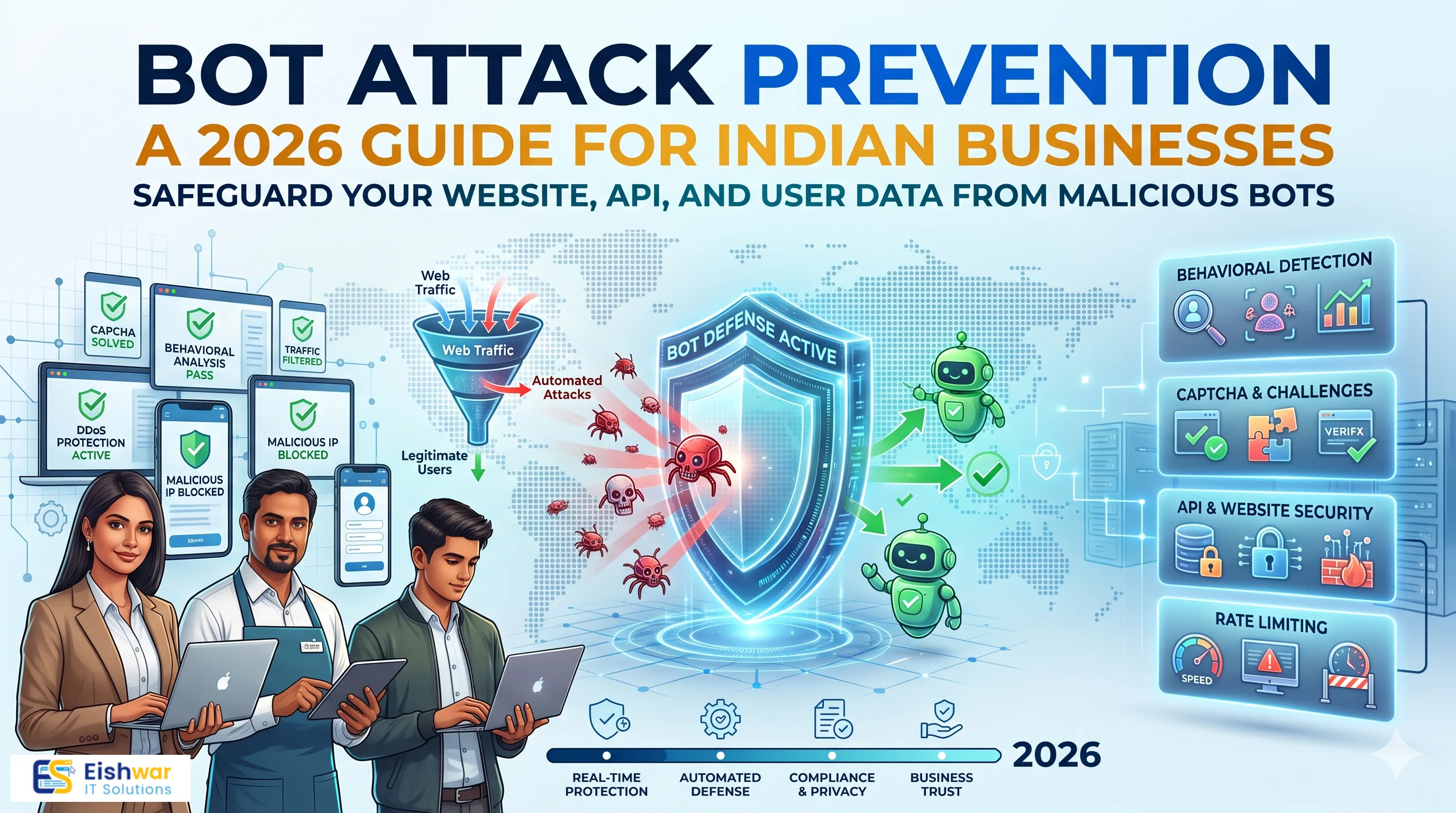
Bot Attack Prevention: A 2026 Guide for Indian Businesses
Introduction
In 2026, your website is under constant attack—not from humans, but from bots. These automated programs crawl, scrape, and exploit vulnerabilities at scale. For Indian businesses, the threat is real and growing. According to a recent report, bots now account for over 40% of all internet traffic, and nearly a third of that is malicious. From credential stuffing to DDoS, bots can cripple your website, steal data, and damage your brand reputation.
But here's the good news: you don't need to be a cybersecurity expert to defend your business. This guide will walk you through everything you need to know about bot attacks—what they are, how they work, and most importantly, how to protect your website. Whether you run an e-commerce store, a corporate site, or a service portal, these actionable tips will help you stay one step ahead.
Main Section 1: Understanding Bot Attacks – What Are They and Why Should You Care?
Before you can defend against something, you need to understand it. So, what exactly is a bot attack? In simple terms, a bot attack is an automated assault on your website using software programs (bots) to perform malicious tasks. These tasks can range from spamming your forms to crippling your server with traffic.
Types of malicious bots you need to know:
- Scrapers: These bots harvest your content, product prices, and customer data, often to undercut you or steal your intellectual property.
- Credential Stuffing Bots: They use stolen username-password pairs from other breaches to gain unauthorized access to your user accounts.
- DDoS (Distributed Denial of Service) Bots: They flood your website with traffic, overwhelming your server and making your site unavailable to legitimate users.
- Spam Bots: They fill your forms with junk submissions, pollute your databases, and can even distribute malware.
- Click Fraud Bots: They generate fake clicks on your ads, draining your advertising budget with no real leads.
In India, the impact is particularly severe. With the rapid digital transformation of businesses, cybercriminals see Indian websites as low-hanging fruit. A 2025 study found that India was among the top three countries targeted by bot attacks. For small and medium businesses, a single bot attack can mean lost revenue, damaged customer trust, and even legal consequences—especially with India's evolving data protection laws.
Why Indian businesses are prime targets:
- Many SMBs lack robust security infrastructure.
- High internet penetration and growing e-commerce adoption create a large attack surface.
- Regulatory compliance (like DPDP Act) demands strict data protection, making breaches costly.
Ignoring bot attacks is not an option. The cost of a single successful attack can be devastating. But with the right knowledge and tools, you can build a strong defense.
Main Section 2: How to Detect Bot Attacks – Signs Your Website is Under Attack
Early detection is key to minimizing damage. Bots are often designed to blend in with normal traffic, but they leave traces. Here are the most common signs that your website might be under bot attack:
1. Unusual Traffic Spikes
If your website suddenly experiences a massive surge in traffic that doesn't align with your marketing campaigns or seasonal trends, it could be a bot flood. Check your analytics for patterns—bots often come from a single IP range or have a high bounce rate.
2. Increased Failed Login Attempts
If you see a spike in failed login attempts, especially with the same usernames or passwords, it's likely a credential stuffing attack. Your login page is a prime target for bots.
3. Form Spam and Fake Registrations
If your contact forms are flooded with gibberish submissions, or you see a sudden increase in fake user registrations, spam bots are at work.
4. Slow Page Load Times
A sudden drop in website speed could indicate that bots are consuming your server resources. DDoS attacks often cause this, but even a small botnet can slow down your site.
5. Unknown Referral Traffic
If your analytics show traffic from suspicious domains or empty referrers, it could be bots crawling your site.
6. Anomalies in User Behavior
Bots often display patterns that differ from humans—like visiting multiple pages in milliseconds or clicking on elements that are not clickable. Use behavioral analytics tools to spot these anomalies.
Tools for bot detection: You don't need a security team to detect bots. Many affordable tools and services are available:
- Google Analytics: Look for high bounce rates, short session durations, and traffic from data centers.
- Security Plugins: If you use WordPress, plugins like Wordfence or Sucuri can flag suspicious activity.
- Bot Management Services: Cloudflare Bot Management, Akamai Bot Manager, or DataDome offer advanced detection using machine learning.
Once you've detected an attack, you need to act fast. The next section will show you how to prevent and mitigate these attacks effectively.
Main Section 3: How to Prevent and Mitigate Bot Attacks – Actionable Strategies
Now for the most important part: protecting your website. Here's a comprehensive approach to bot attack prevention, tailored for Indian businesses.
1. Implement CAPTCHA and reCAPTCHA
CAPTCHA (Completely Automated Public Turing test to tell Computers and Humans Apart) is a simple yet effective first line of defense. Google's reCAPTCHA v3 is particularly useful because it runs in the background and doesn't disrupt user experience. It assigns a score based on user behavior, allowing you to block suspicious traffic.
2. Use a Web Application Firewall (WAF)
A WAF sits between your website and the internet, filtering out malicious traffic. It can block bots based on IP reputation, rate limits, and known attack patterns. Cloudflare, AWS WAF, and Sucuri are excellent options. For Indian businesses, choose a provider with edge servers in India or nearby regions to minimize latency.
3. Enable Rate Limiting
Rate limiting restricts the number of requests a user (or IP) can make within a specific timeframe. This is crucial for preventing DDoS attacks and credential stuffing. You can set rate limits at the server level (using Nginx or Apache) or via your WAF.
4. Strengthen Authentication
For your login pages, implement multi-factor authentication (MFA) to add an extra layer of security. Even if bots steal passwords, they won't be able to access accounts without the second factor. Also, enforce strong password policies and use password managers.
5. Keep Your Software Updated
Bots often exploit known vulnerabilities in outdated software. Regularly update your CMS, plugins, and server software. Enable automatic updates where possible, and remove any unused plugins or themes.
6. Use a CDN (Content Delivery Network)
CDNs like Cloudflare or Amazon CloudFront can absorb massive traffic spikes and filter out malicious requests before they reach your server. They also improve site speed for legitimate users.
7. Monitor and Analyze Logs Regularly
Make it a habit to review your server logs and security reports. Look for patterns like repeated IPs, unusual URLs, or odd user-agent strings. Set up alerts for suspicious activities.
8. Block Known Bots
You can create a robots.txt file to disallow certain bots, but be aware that malicious bots often ignore it. Better to use IP blocklists and bot signature databases that are updated regularly.
9. Educate Your Team
Your employees should be aware of bot threats and follow security best practices. For instance, they should not click on suspicious links or share credentials.
10. Have an Incident Response Plan
Even with all precautions, a bot attack might succeed. Have a plan in place to respond quickly—who to contact, how to isolate the attack, and how to communicate with customers.
By implementing these strategies, you can significantly reduce the risk of bot attacks. But there are also common mistakes that many businesses make—let's look at those next.
Expert Tips
Here are some advanced tips from security experts to take your bot defense to the next level:
- Use Behavioral Analytics: AI-powered tools can learn how your users behave and flag anomalies that indicate bots. This is more effective than static rules.
- Challenge Suspicious Traffic: Instead of outright blocking, present a JavaScript challenge (like a proof-of-work) that bots struggle to solve. This is a technique used by many CDNs.
- Honeypot Traps: Add hidden form fields that humans won't fill but bots will. If the field is filled, it's a bot—block it silently.
- Regular Security Audits: Conduct periodic security audits to identify vulnerabilities before attackers do. You can hire professionals or use automated scanning tools.
- Backup Your Data: Regularly backup your website and databases. In case of a successful attack, you can restore your site quickly.
Common Mistakes
Avoid these pitfalls that can leave your website vulnerable:
- Ignoring Small Attacks: Even a low-level bot attack can be a sign of a larger one to come. Don't ignore unusual activity.
- Relying Only on CAPTCHA: CAPTCHA alone is not enough. Bots can bypass simple CAPTCHAs, and it hurts user experience.
- Not Updating Security Tools: Bot signatures evolve quickly. If your security tools are not updated, they may miss new threats.
- Overlooking Mobile Traffic: Bots can mimic mobile users. Ensure your security measures cover all device types.
- Failing to Monitor Third-Party Scripts: Third-party scripts (like analytics or ads) can be compromised and used to inject malicious code. Regularly review them.
Future Trends
The bot threat landscape is constantly evolving. Here's what to expect in the coming years:
- AI-Powered Bots: Attackers are using AI to make bots more human-like, making detection harder. Expect more sophisticated CAPTCHA-breaking bots.
- API Attacks: As more businesses expose APIs, bots will target these endpoints. Securing APIs will become crucial.
- Regulatory Pressure: With stricter data protection laws in India, businesses will be required to implement stronger security measures, including bot management.
- Zero-Trust Security: The zero-trust model, where every request is verified, will extend to web traffic, making bot attacks more difficult.
- Edge Computing Security: As more processing moves to the edge, security measures will be deployed there too, offering faster and more effective bot mitigation.
FAQs
1. What is a bot attack?
A bot attack is an automated attempt to disrupt, exploit, or damage a website using malicious software programs. These bots can perform various tasks like credential stuffing, DDoS attacks, content scraping, and spamming.
2. How do I know if my website is under bot attack?
Signs include unusual traffic spikes, failed login attempts, form spam, slow site performance, and unexpected referral traffic. Monitoring tools and analytics can help you spot these patterns.
3. What is the best way to stop bot attacks?
There is no single solution. A combination of CAPTCHA, WAF, rate limiting, strong authentication, and regular updates is recommended. Using a CDN with bot management features is also highly effective.
4. Are bot attacks illegal?
Yes, bot attacks are illegal in most jurisdictions, including India. They violate laws related to computer misuse, data protection, and often constitute cybercrime. You should report attacks to the authorities.
5. How much does bot protection cost?
Costs vary widely. Basic CAPTCHA and security plugins are free. WAF and CDN services start from around ₹500-₹2,000 per month for small businesses. Advanced bot management can cost more, but the investment is worth it compared to the cost of an attack.
6. Can bots affect my SEO?
Yes. Bots can scrape your content, causing duplicate content issues. DDoS attacks can make your site unavailable, leading to downtime that affects your rankings. Proper bot management helps protect your SEO.
Conclusion
Bot attacks are a serious threat, but they are not unbeatable. By understanding how bots operate, detecting them early, and implementing robust prevention measures, you can safeguard your website and your business. In 2026, proactive security is not a luxury—it's a necessity. Don't wait for an attack to happen; take action today.
CTA
Ready to secure your website against bot attacks? Contact EishwarITSolution for a free website security audit and personalized bot mitigation plan. Our experts will help you implement the right defenses so you can focus on growing your business with peace of mind.