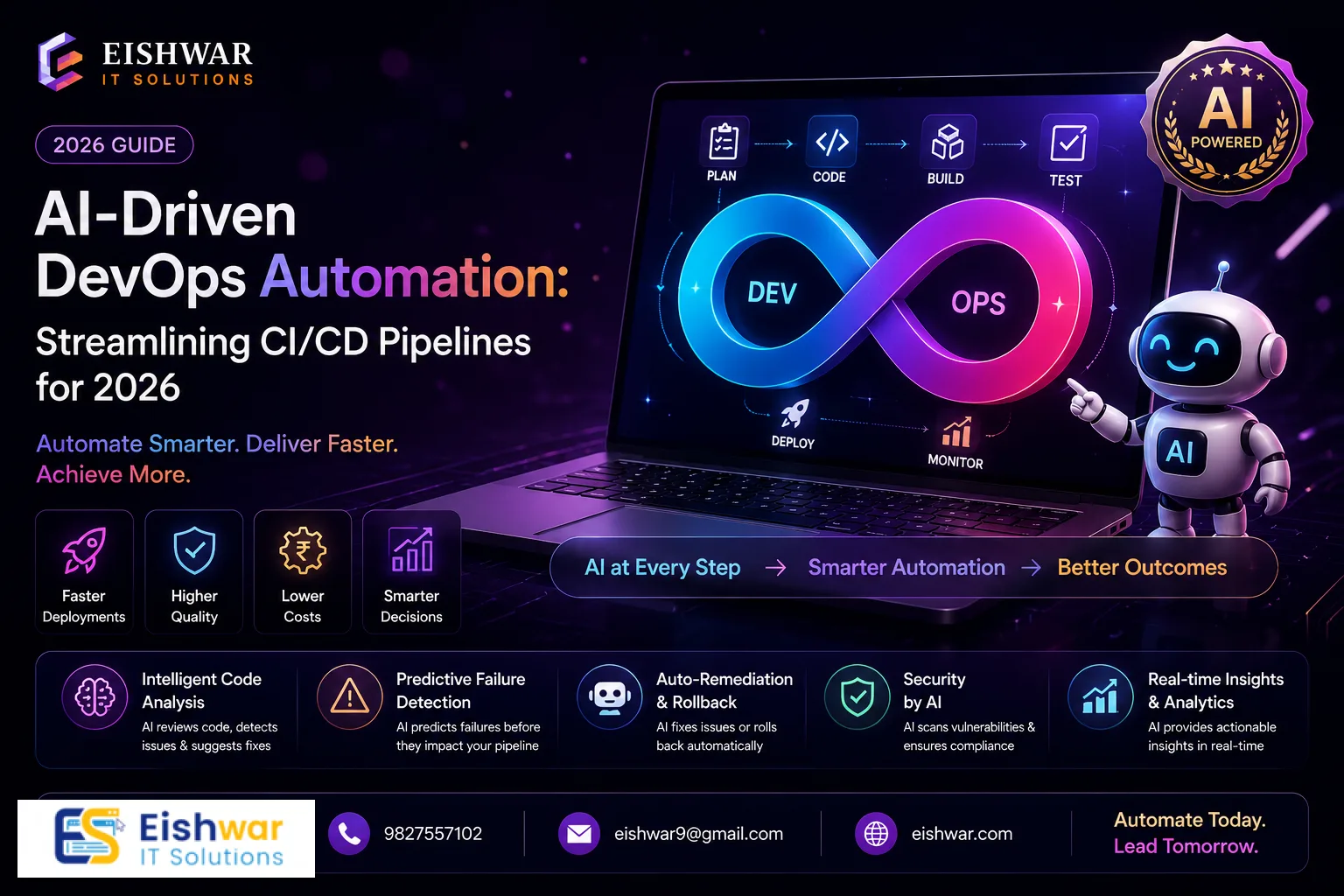
AI-Driven DevOps Automation: Streamlining CI/CD Pipelines for 2026
Introduction
In the fast-paced world of web and app development, speed and reliability are non-negotiable. As we step into 2026, Artificial Intelligence (AI) is no longer a futuristic concept—it's a practical tool reshaping how DevOps teams manage Continuous Integration and Continuous Deployment (CI/CD) pipelines. For business owners, marketers, and professionals in India, understanding AI-driven DevOps automation can be the key to staying competitive. At EishwarITSolution, we've seen firsthand how AI transforms chaotic workflows into streamlined, efficient processes. This blog dives into the practicalities of AI in CI/CD, offering actionable insights to help you automate smarter, not harder.
Consider this: a typical mid-sized e-commerce company in Mumbai might deploy code updates weekly, with manual testing consuming two days and frequent rollbacks due to overlooked bugs. By 2026, AI-driven pipelines can reduce that to daily deployments with near-zero failures. The shift isn't just about technology—it's about culture. Teams that embrace AI find themselves spending less time firefighting and more time innovating. For Indian businesses, where cost efficiency and rapid scaling are critical, AI in DevOps is a game-changer. Let's explore how you can leverage it.
Main Section 1: The Evolution of DevOps—Why AI Matters Now
DevOps has always been about bridging development and operations, but traditional CI/CD pipelines often struggle with bottlenecks, manual interventions, and unpredictable failures. In 2026, AI steps in to predict, prevent, and automate these pain points. Think of AI as your silent co-pilot—it analyzes historical data, identifies patterns, and makes real-time decisions to keep your pipeline flowing.
For example, AI-powered tools like Harness or GitLab CI with AI plugins can automatically detect code anomalies, roll back faulty deployments, and optimize resource allocation. This isn't just about saving time; it's about reducing human error and freeing your team to focus on innovation. Indian startups and enterprises alike are leveraging these tools to cut deployment times by up to 60%, according to recent industry reports. A practical tip: start by integrating AI into your build verification stage. If a commit introduces a pattern similar to a past bug, the AI can flag it before tests even run. This proactive approach prevents issues downstream.
Why now? The maturity of machine learning models, combined with affordable cloud computing, makes AI accessible to teams of all sizes. In 2020, implementing AI in DevOps required specialized data scientists. Today, platforms like AWS CodePipeline offer built-in ML recommendations that any DevOps engineer can use. For Indian businesses, this democratization means you don't need a massive budget to compete with global players.
Main Section 2: Key AI Features Transforming CI/CD Pipelines
Let's break down the specific AI capabilities that are making waves in DevOps automation:
- Predictive Analytics for Failure Prevention: AI models trained on past build logs can flag potential failures before they occur. For instance, if a code change resembles a previous bug, the system alerts the team or auto-rejects the commit. Tip: Ensure your build logs are structured and tagged with metadata (e.g., commit hash, environment) to improve model accuracy.
- Automated Testing Prioritization: Instead of running all tests, AI selects the most critical ones based on code changes, slashing test cycles by 40%. For example, if a developer modifies a payment module, the AI prioritizes payment-related tests over UI ones. This is especially useful for large monorepos common in Indian fintech startups.
- Intelligent Resource Scaling: AI dynamically adjusts cloud resources (e.g., AWS, Azure) during peak build times, reducing costs without sacrificing speed. A Delhi-based SaaS company saved 30% on cloud costs by using AI to predict build spikes and pre-provision instances.
- Self-Healing Deployments: When a deployment fails, AI can automatically roll back to the last stable version and notify the team, minimizing downtime. This feature is critical for e-commerce platforms during sales events like Diwali, where every minute of downtime means lost revenue.
Practical example: A Bengaluru-based fintech startup used AI-driven CI/CD to reduce deployment failures from 15% to under 2% within three months. They integrated a tool like CircleCI with AI insights, resulting in faster feature releases and happier customers. The key was starting with a single pipeline stage—testing prioritization—and expanding to predictive analytics after seeing results.
Main Section 3: Implementing AI-Driven DevOps in Your Organization
Ready to adopt AI in your CI/CD pipeline? Start with these steps:
- Assess Your Current Pipeline: Identify bottlenecks—slow tests, frequent rollbacks, manual approvals. Use metrics like deployment frequency and lead time. For instance, if your lead time from commit to production is over 24 hours, AI can help reduce it to under 2 hours.
- Choose the Right AI Tools: For small teams, consider cloud-native solutions like AWS CodePipeline with AI recommendations. For larger enterprises, explore Harness or Jenkins X with AI plugins. Tip: Evaluate tools based on integration with your existing stack (e.g., GitHub, Jira, Slack). A tool that doesn't integrate smoothly will create more work.
- Start Small: Pilot AI in one stage, such as testing or deployment. Measure improvements and scale gradually. For example, begin with automated rollbacks for critical services before expanding to all services.
- Train Your Team: Upskill developers and ops staff on AI fundamentals. EishwarITSolution offers tailored workshops for Indian businesses. A common mistake is assuming AI tools are plug-and-play; they require understanding of data inputs and model outputs.
- Monitor and Iterate: AI models need continuous feedback. Regularly review performance and adjust parameters. Set up dashboards to track metrics like false positives in failure predictions. If the model flags too many false alarms, retrain it with more recent data.
Remember, AI doesn't replace your team—it amplifies their capabilities. A Mumbai-based e-commerce company saw a 50% increase in developer productivity after implementing AI-driven code reviews and automated rollbacks. Developers spent less time debugging and more time building features.
Expert Tips
- Integrate AI Early: Don't wait for pipeline chaos. Embed AI at the design phase of your CI/CD strategy for maximum impact. For example, when setting up a new microservice, configure AI monitoring from day one.
- Use AI for Security: Combine DevOps with AI-driven security scanning (DevSecOps) to catch vulnerabilities in code before deployment. Tools like Snyk with AI can detect zero-day exploits in dependencies.
- Leverage Open Source: Tools like KubeFlow and Tekton offer AI capabilities without hefty licensing fees—perfect for Indian SMEs. Pair them with open-source ML libraries like TensorFlow for custom models.
- Focus on Data Quality: AI is only as good as its data. Ensure your build logs, test results, and deployment histories are clean and accessible. Implement data pipelines to centralize this data for AI training.
- Involve Stakeholders Early: Get buy-in from developers, QA, and operations teams. AI adoption fails when teams feel threatened. Show them how AI handles repetitive tasks, freeing them for creative work.
Common Mistakes
- Over-Automating Too Soon: Automating everything at once can lead to chaos. Start with one or two stages. For instance, automate testing prioritization first, then move to deployment rollbacks.
- Ignoring Team Training: Without proper training, AI tools become underutilized or misconfigured. Invest in workshops and documentation. A Pune-based startup saw their AI tool usage drop by 40% after the initial setup because no one knew how to interpret the alerts.
- Neglecting Monitoring: AI models drift over time. Regular monitoring is crucial to maintain accuracy. Set up automated retraining pipelines that update models monthly with new data.
- Choosing Tools Without Integration: Ensure AI tools seamlessly integrate with your existing stack (GitHub, Jira, Slack) to avoid silos. A tool that requires manual data exports will be abandoned.
- Underestimating Data Privacy: In India, with regulations like the Digital Personal Data Protection Act, ensure your AI tools comply with data handling norms. Anonymize sensitive data in logs before training models.
Future Trends
Looking ahead, AI-driven DevOps will evolve further. Expect AI to handle end-to-end pipeline orchestration, from code commit to production monitoring. Generative AI may soon write and test code autonomously, while AI-powered chatbots will assist developers in real-time. For example, a chatbot could analyze a build failure and suggest a fix based on similar past issues. In India, the rise of edge computing and 5G will demand even more intelligent CI/CD systems that can deploy to distributed environments. EishwarITSolution is already exploring these frontiers to keep our clients ahead. Another trend is AI-driven cost optimization: models that predict cloud spending based on deployment patterns, helping Indian businesses manage tight budgets. By 2027, we may see AI that automatically negotiates cloud pricing based on usage forecasts.
FAQs
1. What is AI-driven DevOps automation?
AI-driven DevOps automation uses artificial intelligence to optimize CI/CD pipelines, including predictive failure analysis, automated testing, and self-healing deployments. It leverages machine learning models trained on historical data to make real-time decisions, reducing manual intervention and improving reliability.
2. How does AI improve CI/CD pipeline efficiency?
AI reduces manual intervention, accelerates testing, prevents failures, and scales resources dynamically, leading to faster and more reliable deployments. For example, AI can cut test execution time by 40% by prioritizing critical tests, and reduce deployment failures by up to 80% through predictive analytics.
3. Is AI-driven DevOps suitable for small businesses in India?
Absolutely. Many AI DevOps tools offer scalable pricing and open-source options, making them accessible for startups and SMEs. Tools like GitLab CI with AI plugins have free tiers, and open-source solutions like KubeFlow can be self-hosted. Small businesses can start with a single AI feature, like automated rollbacks, and scale as they grow.
4. What are the best AI DevOps tools for 2026?
Popular tools include Harness, GitLab CI with AI plugins, CircleCI Insights, AWS CodePipeline with ML, and Jenkins X. For open-source options, consider KubeFlow and Tekton. The best tool depends on your stack—e.g., AWS CodePipeline integrates well with other AWS services, while Harness offers enterprise-grade AI features.
5. How can I start implementing AI in my DevOps pipeline?
Begin by assessing your current pipeline, choosing a pilot stage (e.g., testing), selecting a compatible AI tool, and training your team. For example, start with automated test prioritization using CircleCI Insights, measure the impact on test cycle time, and then expand to predictive failure analysis.
6. What are the risks of using AI in DevOps?
Risks include over-reliance on AI, data quality issues, and model drift. Mitigate by combining AI with human oversight and regular monitoring. For instance, set up a human-in-the-loop for critical deployments, and retrain AI models monthly to prevent drift. Also, ensure data privacy compliance, especially with Indian regulations.
7. How much does AI-driven DevOps cost?
Costs vary widely. Open-source tools are free but require setup effort. Cloud-native tools like AWS CodePipeline charge based on usage, typically $1 per pipeline per month plus compute costs. Enterprise tools like Harness can cost thousands per month but include advanced AI features. For Indian SMEs, starting with open-source or free tiers is recommended.
Conclusion
AI-driven DevOps automation is not just a trend—it's a necessity for businesses aiming to deliver high-quality web and app experiences at speed. By integrating AI into your CI/CD pipelines, you can reduce failures, cut costs, and empower your team to innovate. Whether you're a startup in Pune or an enterprise in Delhi, the time to act is now. At EishwarITSolution, we're committed to helping you navigate this transformation with tailored solutions. The future of DevOps is intelligent, proactive, and automated—don't let your pipeline be left behind.
CTA
Ready to supercharge your DevOps with AI? Contact EishwarITSolution today for a free consultation. Our experts will design a custom AI-driven CI/CD strategy for your business, from tool selection to team training. Don't get left behind—automate smarter in 2026!