Manufacturing Website Solutions: Streamline Operations & Showcase Capa
Published on: 13 Jun 2026
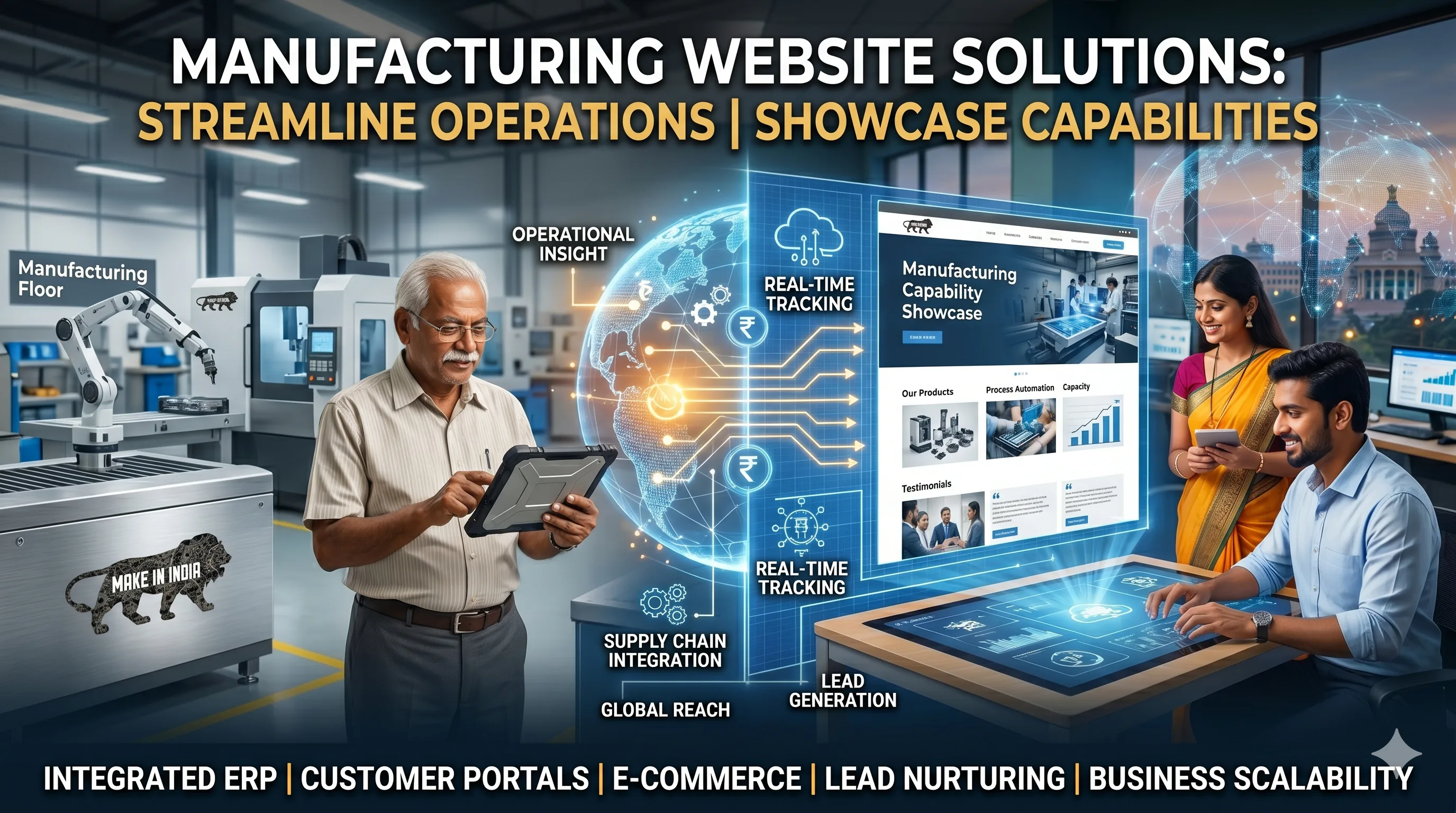
Manufacturing Website Solutions: Streamline Operations & Showcase Capabilities
Introduction
If you run a manufacturing business, you know that your website isn't just a digital brochure—it's a powerful tool that can streamline operations, attract the right buyers, and build trust. Yet, many manufacturing sites are clunky, outdated, or simply not built for their unique needs. That's where industry-specific website solutions come in. At EishwarITSolution, we specialize in crafting websites that speak the language of your industry. In this guide, we'll walk you through how a custom website can transform your manufacturing business, with practical tips and real-world examples. Whether you're a small job shop or a large OEM, the right digital presence can differentiate you in a competitive market. We'll cover everything from essential features to future trends, ensuring you have a roadmap to success.
Learn more about our Website services
Main Section 1: Why Manufacturing Companies Need Custom Website Solutions
Manufacturing is complex. You have multiple product lines, technical specifications, certifications, and a B2B sales cycle that demands credibility. Off-the-shelf templates just won't cut it. Here's why custom solutions matter:
- Showcase complex products: Use interactive 3D models, exploded views, or CAD downloads. For example, a machine tool builder can let engineers rotate and zoom into a CNC mill, inspecting every component. This reduces pre-sales questions and accelerates decision-making.
- Highlight certifications: ISO, FDA, or industry-specific badges build trust. Display them prominently on your homepage and product pages. A medical device manufacturer we assisted saw a 30% increase in inquiries after adding FDA and ISO 13485 logos with links to certificates.
- Streamline RFQ processes: Integrate quote request forms that capture detailed specs. Instead of generic contact forms, use dynamic fields that adapt based on product type. For instance, a sheet metal fabricator can ask for material thickness, finish, and quantity upfront, reducing back-and-forth emails.
- Integrate with ERP/CRM: Sync inventory, order status, and customer data. A custom integration with SAP or Microsoft Dynamics can show real-time stock levels on product pages, preventing overselling and improving customer satisfaction.
Example: A precision parts manufacturer we worked with saw a 40% increase in qualified leads after adding a product configurator and a live inventory check. The configurator allowed buyers to select tolerances, materials, and surface finishes, generating a unique part number and instant quote. This eliminated manual data entry and reduced quote turnaround time from 3 days to 2 hours.
Practical Tip: Start by auditing your current website. Identify pain points like high bounce rates on product pages or low conversion on contact forms. Use tools like Google Analytics and heatmaps to understand user behavior. Then, prioritize features that directly address these issues.
Main Section 2: Key Features of an Effective Manufacturing Website
Your manufacturing site should do more than look good. It must serve your sales and operations teams. Here are must-have features:
Product Catalog with Advanced Filtering
Let buyers filter by material, size, tolerance, or application. Include downloadable datasheets and CAD files. For example, a fastener manufacturer can allow filtering by thread size, material (stainless steel, brass), and coating (zinc, nickel). Each product page should have a 'Download CAD' button that triggers an email with the file, capturing leads. Ensure your catalog is SEO-optimized with unique meta descriptions for each product category.
👉 Don't wait for the perfect moment; turn your vision into reality today.
Free ConsultationClient Portal
Provide existing customers with order history, reorder options, and real-time production status. A client portal reduces support calls and builds loyalty. For instance, a packaging machinery company can let customers view machine manuals, schedule maintenance, and reorder spare parts. Use single sign-on (SSO) for seamless access. Implement role-based access so different users (procurement, engineering) see relevant data.
Case Studies & Technical Content
Show how you solved a problem for a client. Include before/after metrics. For example, a gear manufacturer can publish a case study on how they reduced noise levels by 15% for an automotive client. Use a structured format: challenge, solution, results. Include quotes from the client and high-resolution images. Repurpose these into PDFs for download to capture leads.
Mobile-Responsive Design
Plant managers and engineers often browse on tablets or phones. Ensure your site is fully responsive with touch-friendly navigation. Test on devices like iPad and Samsung Galaxy. Use large buttons for calls-to-action (CTAs) and avoid hover-only interactions. A mobile-optimized site can improve engagement by up to 50%.
Fast Loading Speed
Manufacturing sites often have heavy images; optimize for speed. Compress images without losing quality using tools like TinyPNG. Lazy-load images below the fold. Minimize JavaScript and CSS. Use a content delivery network (CDN) to serve your site faster globally. A 1-second delay can reduce conversions by 7%.
Actionable Tip: Use a content delivery network (CDN) to serve your site faster globally. For example, Cloudflare or AWS CloudFront can cache static assets and reduce latency. Also, implement browser caching for returning visitors.
Main Section 3: How to Build a Manufacturing Website That Converts
Follow these steps to create a site that drives real business results:
- Define your buyer personas: Engineers? Procurement managers? Tailor content for each. For engineers, focus on technical specs, tolerances, and certifications. For procurement, emphasize lead times, pricing, and reliability. Create separate landing pages for each persona with relevant CTAs.
- Map the customer journey: From discovery to quote to purchase. Ensure each step is clear. For example, a visitor might land on a blog post about CNC machining, then click to a product page, then request a quote. Use analytics to track drop-off points and optimize those pages.
- Invest in SEO: Target long-tail keywords like 'custom CNC machining services in India' or 'precision injection molding for automotive'. Conduct keyword research using tools like Ahrefs or SEMrush. Optimize title tags, meta descriptions, and header tags. Build backlinks from industry directories and trade publications.
- Use clear CTAs: 'Request a Quote', 'Download Spec Sheet', 'Talk to an Engineer'. Place CTAs above the fold and repeat them throughout the page. Use contrasting colors to make them stand out. A/B test different wording and placement.
- Add social proof: Client logos, testimonials, and industry awards. Display logos of well-known clients on your homepage. Use video testimonials for authenticity. Include trust badges like 'Member of National Association of Manufacturers'.
Example: A packaging machinery manufacturer added a 'Build Your Own Machine' configurator. It increased average order value by 25%. The configurator guided users through options like speed, material type, and automation level, generating a custom quote instantly. This interactive experience also reduced sales cycle time by 30%.
👉 Free Website Audit
Get Free AuditPractical Tip: Implement a lead scoring system. Assign points for actions like downloading a datasheet (10 points), visiting the pricing page (20 points), or requesting a quote (50 points). Focus sales efforts on high-scoring leads.
Expert Tips
- Tip 1: Include a 'Technical Resources' section with white papers, webinars, and videos. This positions you as a thought leader. For example, a white paper on '5 Ways to Reduce Machining Costs' can attract engineers. Gate these resources with a form to capture leads.
- Tip 2: Use schema markup for products and FAQs to improve search visibility. Implement Product schema for each product page with price, availability, and SKU. Use FAQ schema for your FAQ section to get rich snippets in search results.
- Tip 3: Integrate a live chat with a bot that can answer basic technical questions. For instance, a bot can answer 'What is your lead time for aluminum parts?' and escalate complex queries to a human. This improves response time and captures leads 24/7.
- Tip 4: Regularly update your site with new case studies and product innovations. Set a content calendar to publish at least one new case study per month. Update product pages with new certifications or capabilities. This signals to search engines that your site is active.
Common Mistakes
- Mistake 1: Using too much jargon without explaining it. Keep it accessible. For example, instead of 'We offer 5-axis CNC machining with 0.001mm tolerance', say 'We produce parts with extreme precision, down to 1/1000th of a millimeter'. Use a glossary for technical terms.
- Mistake 2: Hiding contact information. Make it easy to reach your sales team. Place phone number and email in the header and footer. Add a 'Contact Sales' button on every page. Include a map and directions to your facility.
- Mistake 3: Neglecting mobile users. Many decision-makers check sites on the go. Test your site on multiple devices. Use responsive design and avoid Flash. Ensure forms are easy to fill on mobile with auto-fill and large input fields.
- Mistake 4: Not tracking conversions. Use analytics to see what's working. Set up goals in Google Analytics for quote requests, downloads, and contact form submissions. Use UTM parameters for campaigns. Regularly review data to optimize.
Future Trends
The manufacturing website of tomorrow will be more interactive and personalized. Expect to see:
- AI-powered product recommendations based on browsing behavior. For example, if a user looks at stainless steel fasteners, the site can suggest related products like washers or nuts. This increases cross-selling opportunities.
- Augmented Reality (AR) for virtual product demos. A machinery manufacturer can let users place a 3D model of a conveyor system in their factory using a smartphone camera. This reduces the need for physical prototypes.
- Voice search optimization for hands-free queries on the shop floor. Optimize for natural language queries like 'find a supplier for titanium parts near me'. Use long-tail keywords in conversational tone.
- Blockchain for supply chain transparency displayed on public dashboards. A food processing equipment maker can show the origin of materials and production milestones. This builds trust with clients who require traceability.
Practical Tip: Start small with AI. Use a chatbot that learns from common queries. As you collect data, you can refine recommendations. For AR, consider a simple 360-degree view of products before investing in full AR.
👉 Free Homepage Demo
Book DemoFAQs
What is an industry-specific website solution?
An industry-specific website solution is a custom-built website designed to meet the unique needs of a particular industry, such as manufacturing. It includes features, content, and functionality tailored to that industry's audience and processes. For manufacturing, this might include product configurators, ERP integration, and client portals.
How much does a manufacturing website cost?
Costs vary based on complexity, features, and design. A basic site may start around ₹50,000, while a fully integrated e-commerce or portal site can go up to ₹5,00,000 or more. Factors include number of pages, custom functionality, and third-party integrations. Contact EishwarITSolution for a custom quote based on your requirements.
Can I integrate my ERP system with my website?
Yes, custom solutions allow seamless integration with popular ERPs like SAP, Oracle, or Microsoft Dynamics. This syncs inventory, orders, and customer data in real time. For example, when a customer places an order, it automatically updates in your ERP, reducing manual data entry and errors.
How long does it take to build a custom manufacturing website?
Typically 6-12 weeks, depending on the scope. A simple informational site may take 4-6 weeks, while a complex portal with integrations can take 12-16 weeks. The timeline includes discovery, design, development, testing, and deployment. We provide a detailed project plan during the consultation.
Do you offer ongoing maintenance?
Absolutely. We provide maintenance packages that include updates, security patches, backups, and content updates. Let's discuss your needs. Typical packages start at ₹5,000 per month for basic maintenance and go up to ₹25,000 for comprehensive support including SEO monitoring and performance optimization.
What if I need to add new products or features later?
Our custom solutions are built with scalability in mind. We use modular development so you can easily add new product categories, features, or integrations. For example, you can add a new product line with a few clicks using our content management system. We also offer training for your team.
How do you ensure my website is secure?
Security is a top priority. We implement SSL certificates, regular security audits, firewalls, and secure coding practices. For client portals, we use encryption and multi-factor authentication. We also provide regular security updates and monitoring as part of our maintenance packages.
Conclusion
Your manufacturing website is a strategic asset. By investing in a custom, industry-specific solution, you can streamline operations, showcase your capabilities, and attract the right clients. Don't settle for a generic site that doesn't reflect your expertise. Partner with EishwarITSolution to build a site that works as hard as you do. With the right features, content, and strategy, your website can become a 24/7 sales engine that drives growth and efficiency.
CTA
Ready to build a manufacturing website that drives results? Contact EishwarITSolution today for a free consultation. Let's create something powerful together. Our team will analyze your needs, provide a detailed proposal, and help you transform your digital presence.