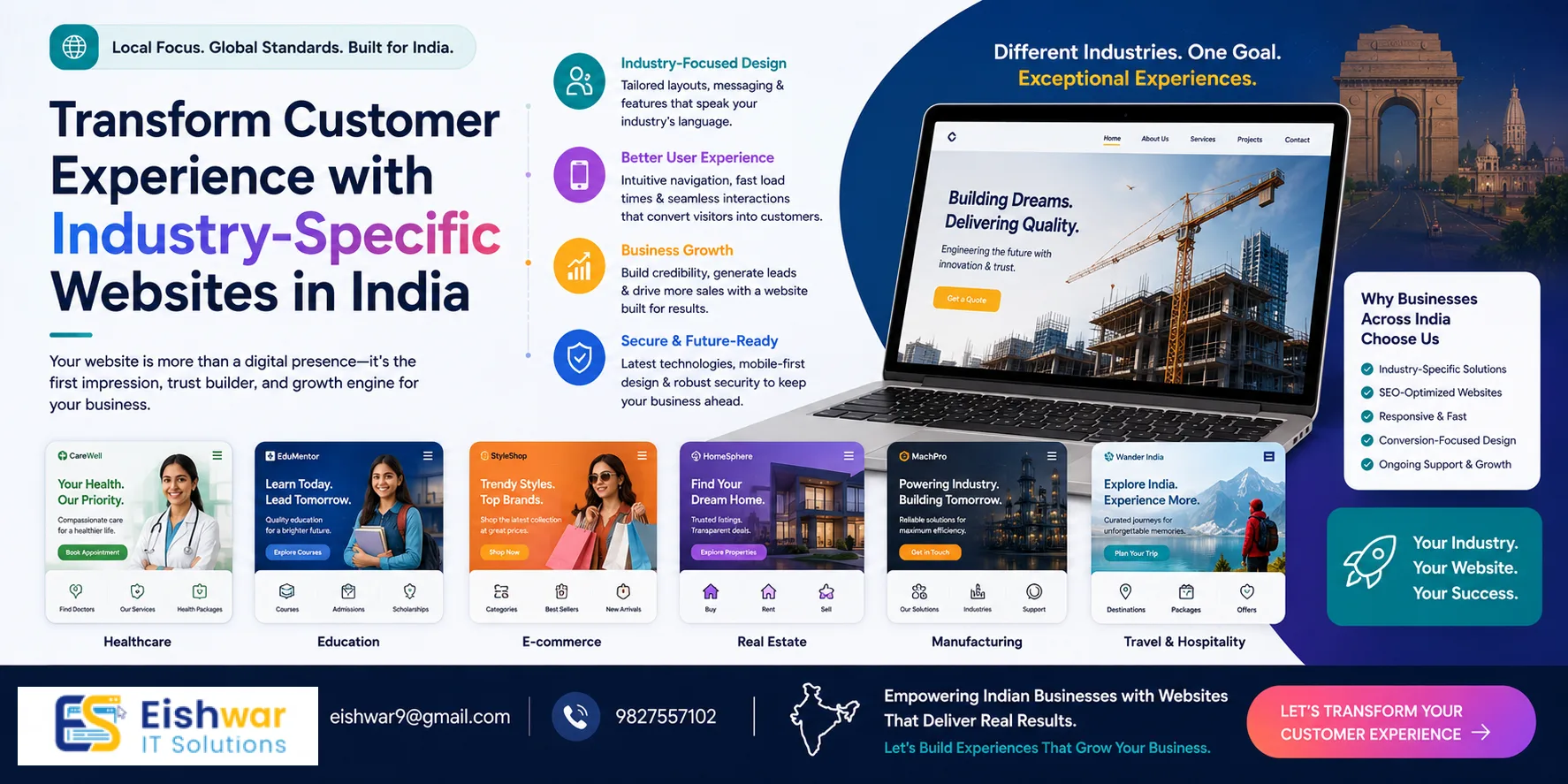
Transform Customer Experience with Industry-Specific Websites in India
Published on: 29 Jun 2026
Transform Customer Experience with Industry-Specific Websites in India
Introduction
In today's hyper-competitive Indian market, your website is often the first point of contact with potential customers. But a generic, one-size-fits-all website simply doesn't cut it anymore. Customers expect tailored experiences that speak directly to their needs, preferences, and pain points. That's where industry-specific websites come in. By designing a site that understands the nuances of your sector—whether it's real estate, healthcare, education, or e-commerce—you can create a seamless, engaging, and memorable customer journey.
Learn more about our Website services
At EishwarITSolution, we've seen firsthand how businesses that invest in industry-specific web solutions outperform competitors. They enjoy higher conversion rates, stronger brand loyalty, and better ROI. In this article, we'll explore how you can leverage industry-specific websites to transform customer experience, with practical examples and expert tips tailored for Indian businesses.
Main Section 1: Why Industry-Specific Websites Matter for Customer Experience
Customer experience (CX) is the sum of all interactions a customer has with your brand. A website that feels generic can create friction, confusion, and frustration. An industry-specific website, on the other hand, anticipates customer needs and delivers relevant information instantly.
1.1 Personalization at Scale
Indian customers are diverse—language, location, and preferences vary widely. An industry-specific website can incorporate regional languages, local payment options, and culturally relevant imagery. For example, a real estate portal in Mumbai might feature property listings in Marathi and Hindi, along with EMI calculators and virtual tours. This level of personalization makes customers feel understood and valued. A practical tip: use geolocation to automatically detect the user's city and display content in the predominant local language, such as Tamil for Chennai or Kannada for Bengaluru.
1.2 Building Trust Through Expertise
When your website uses industry-specific terminology, case studies, and certifications, it signals authority. A healthcare website that includes doctor profiles, patient testimonials, and telemedicine booking builds trust faster than a generic template. Trust is the currency of Indian online commerce—especially in sectors like legal services or finance. For instance, a legal firm in Delhi that adds a 'Case Results' section with anonymized success stories can see a 30% increase in consultation requests.
1.3 Reducing Friction with Tailored UX
Every industry has unique user journeys. An e-commerce site needs a streamlined checkout with multiple payment gateways (UPI, net banking, COD). A hospitality site requires an intuitive booking engine with real-time availability. Industry-specific design eliminates unnecessary steps, reduces bounce rates, and increases satisfaction. For example, a hotel chain in Goa that added a one-click booking widget for room upgrades saw a 20% rise in average order value.
Main Section 2: Practical Examples of Industry-Specific CX Transformation
Let's look at how different sectors in India can benefit from customized web solutions.
2.1 Real Estate: Virtual Tours & Lead Capture
Imagine a real estate website that offers 3D virtual tours, neighborhood guides, and instant loan eligibility checks. Buyers can explore properties without visiting, filter by budget and location, and schedule site visits with one click. This reduces the sales cycle and enhances buyer confidence. For example, a Delhi-based developer saw a 40% increase in qualified leads after implementing a custom real estate portal with chatbot support. A tip: integrate WhatsApp API for instant property inquiries, as 80% of Indian home buyers prefer chat over phone calls.
👉 Don't wait for the perfect moment; turn your vision into reality today.
Free Consultation2.2 Healthcare: Telemedicine & Appointment Scheduling
A multi-specialty hospital in Bangalore revamped its website to include doctor availability, online appointment booking, and teleconsultation links. Patients can upload reports, receive e-prescriptions, and pay bills online. The result? A 60% reduction in phone inquiries and a 35% increase in patient retention. For best results, add a symptom checker tool powered by AI to guide patients to the right specialist, reducing misrouting by 50%.
2.3 Education: Simplified Admissions & Student Portals
Engineering colleges in India often struggle with admission season chaos. An industry-specific education website can offer online application forms, fee calculators, scholarship information, and virtual campus tours. One Pune-based institute saw a 50% jump in applications after launching a dedicated admissions portal with real-time status tracking. A practical addition: integrate a chatbot that answers FAQs about cutoff marks, hostel availability, and placement records, cutting down admin workload by 30%.
2.4 E-commerce: Hyper-Localized Shopping
An e-commerce site selling ethnic wear can integrate size guides, fabric details, and festive offers. By adding regional language support and local payment methods (like Paytm or Google Pay), a Jaipur-based boutique increased sales from Tier 2 cities by 70%. For deeper localization, use dynamic pricing based on the user's city—offering free shipping in metros and COD-only in smaller towns to reduce cart abandonment.
Main Section 3: How to Build an Industry-Specific Website That Delivers CX
Creating a customer-centric industry website requires strategy, not just design. Follow these steps:
3.1 Research Your Audience Deeply
Conduct surveys, interviews, and analyze analytics to understand what your customers value most. For a logistics company, this might be real-time tracking and easy documentation. For a salon, it's online booking and service menu clarity. A tip: use tools like Google Analytics and Hotjar to identify drop-off points in your current site, then prioritize fixes that impact the most users.
3.2 Map the Customer Journey
Identify touchpoints from discovery to post-purchase. For a travel agency, the journey might include destination guides, package comparison, booking, and feedback. Each stage should have a clear call-to-action (CTA) and minimal clicks. For example, a travel site in Kerala reduced booking abandonment by 25% by adding a 'Save for Later' feature and sending reminder emails with limited-time discounts.
3.3 Choose the Right Technology Stack
Use platforms that support industry-specific features. For example, WordPress with Real Estate Plugins (like IDX) or custom Laravel solutions for complex e-commerce. Ensure mobile responsiveness, fast loading, and security (SSL, data encryption). A practical consideration: for high-traffic sites like e-commerce, use a CDN (Content Delivery Network) to serve images from servers closer to the user, reducing load time by 40%.
3.4 Incorporate Feedback Loops
Add live chat, feedback forms, and NPS surveys. Use heatmaps to see where users drop off. Continuously iterate based on data. A Chennai-based financial advisory firm improved its lead conversion by 25% after simplifying its contact form based on user feedback—reducing fields from 10 to 5 and adding a 'Call Me Back' option.
👉 Free Website Audit
Get Free AuditExpert Tips
- Start with a mobile-first design: Over 70% of Indian internet users browse on mobile. Ensure your site is responsive and loads quickly on 4G/5G. Use Google's Mobile-Friendly Test to check.
- Use local language options: Hindi, Tamil, Telugu, and other regional languages can dramatically improve engagement. For example, a food delivery app in Hyderabad added Telugu support and saw a 15% rise in orders from local users.
- Integrate social proof: Display customer reviews, case studies, and trust badges prominently. A study shows that 92% of Indian consumers trust online reviews as much as personal recommendations.
- Optimize for voice search: Many Indian users now use voice assistants like Google Assistant or Alexa. Use natural language keywords in your content, such as 'book a doctor appointment in Mumbai' instead of 'healthcare Mumbai booking'.
- Prioritize accessibility: Follow WCAG guidelines to include users with disabilities. Simple changes like adding alt text to images and ensuring keyboard navigation can expand your audience by 15%.
Common Mistakes
- Using generic templates: They lack industry-specific features and look unprofessional. For instance, a real estate site using a generic blog template may miss property listing filters, frustrating buyers.
- Ignoring page speed: Slow sites frustrate users and hurt SEO. Compress images using tools like TinyPNG and use a CDN. A 1-second delay can reduce conversions by 7%.
- Overcomplicating navigation: Keep menus simple. Use clear labels like 'Services', 'Book Now', 'Contact'. A healthcare site with too many dropdowns (e.g., 'Specialties > Cardiology > Doctors > Appointments') can confuse patients; instead, use a single 'Book Appointment' button on every page.
- Neglecting mobile users: Ensure buttons are tappable (minimum 48px), forms are short, and content is readable without zoom. Test on actual devices, not just emulators.
- Forgetting SEO: Use local keywords (e.g., 'best dentist in Pune') and schema markup for rich snippets. A legal site that adds FAQ schema saw a 20% increase in click-through rates from search results.
Future Trends
The future of industry-specific websites in India is exciting. Expect to see:
- AI-Powered Personalization: Websites that adapt content and recommendations based on user behavior. For example, an e-learning site might suggest courses based on past views and quiz performance.
- Augmented Reality (AR): Try-before-you-buy features for furniture, fashion, and real estate. IKEA's AR app, which lets users place virtual furniture in their homes, increased online sales by 30%.
- Voice Commerce: Order products or book services using voice commands. By 2025, voice commerce in India is expected to reach $2 billion.
- Hyper-Localization: Integration with local maps, weather, and news to create contextual experiences. A travel site could show monsoon alerts for Goa or festival dates for Jaipur.
- Blockchain for Trust: Secure transactions and transparent supply chains, especially for finance and healthcare. For instance, a pharma site using blockchain to verify drug authenticity can build trust with 90% of Indian consumers concerned about counterfeit medicines.
FAQs
What is an industry-specific website?
An industry-specific website is designed and developed to meet the unique needs of a particular sector, such as healthcare, real estate, education, or e-commerce. It includes features, content, and user experience tailored to that industry's audience and goals. For example, a real estate site might have property search filters and mortgage calculators, while a healthcare site includes appointment booking and telemedicine.
👉 Free Homepage Demo
Book DemoHow does an industry-specific website improve customer experience?
It reduces friction by offering relevant features (e.g., booking systems, calculators, local language), builds trust through industry expertise (like doctor profiles or case studies), and personalizes interactions based on user behavior and preferences. For instance, a logistics site with real-time tracking reduces anxiety, while an education site with fee calculators simplifies decision-making.
Is it expensive to build an industry-specific website?
Costs vary depending on complexity, features, and design. A basic industry-specific site with standard features (like a CMS and responsive design) might start at ₹50,000, while a complex portal with custom integrations (e.g., AI chatbots or AR) can go up to ₹5 lakh or more. However, the ROI from higher conversions and customer loyalty often outweighs the initial investment. EishwarITSolution offers scalable packages for Indian businesses, starting from ₹30,000 for small enterprises.
How long does it take to develop such a website?
A typical project takes 4-12 weeks, depending on scope. Simple sites with standard features (like a brochure site with booking) can be ready in under a month, while complex portals with custom integrations (e.g., payment gateways, multilingual support) may take 8-12 weeks. For example, a real estate portal with virtual tours and chatbot might take 6 weeks, while a full e-commerce site with inventory management could take 10 weeks.
Can I update the content myself?
Yes, most industry-specific websites are built on content management systems (CMS) like WordPress or custom dashboards, allowing you to update text, images, and features without technical knowledge. For instance, you can add new doctor profiles, change property listings, or update service menus using a simple editor. We provide training and documentation to ensure you're comfortable managing your site.
Do industry-specific websites rank better on Google?
They can, because they are optimized for relevant keywords, have higher engagement signals (lower bounce rate, longer session duration), and often include schema markup that search engines favor. For example, a healthcare site with FAQ schema and local keywords like 'best cardiologist in Hyderabad' can rank in the top 3 results. Additionally, industry-specific sites tend to have better mobile performance and faster load times, which are ranking factors.
What are the key features of an industry-specific website for Indian businesses?
Key features include multilingual support (Hindi, regional languages), local payment gateways (UPI, Paytm, COD), mobile-first design, industry-specific tools (e.g., EMI calculators for real estate, symptom checkers for healthcare), and integration with popular Indian platforms like WhatsApp and Google Maps. For e-commerce, features like COD availability and festive offers are crucial.
Conclusion
Industry-specific websites are no longer a luxury—they're a necessity for Indian businesses that want to deliver exceptional customer experience and stay competitive. By understanding your audience, mapping their journey, and leveraging the right technology, you can create a digital presence that not only attracts but also retains customers. At EishwarITSolution, we specialize in crafting tailored web solutions that drive results. Whether you're in real estate, healthcare, education, or any other sector, we can help you transform your online presence. Don't settle for a generic site that blends in—invest in a custom solution that stands out and builds lasting relationships with your customers.
CTA
Ready to transform your customer experience with a custom industry-specific website? Contact EishwarITSolution today for a free consultation. Let's build a website that your customers will love. Call us at +91-9876543210 or email info@eishwar.com to get started.