
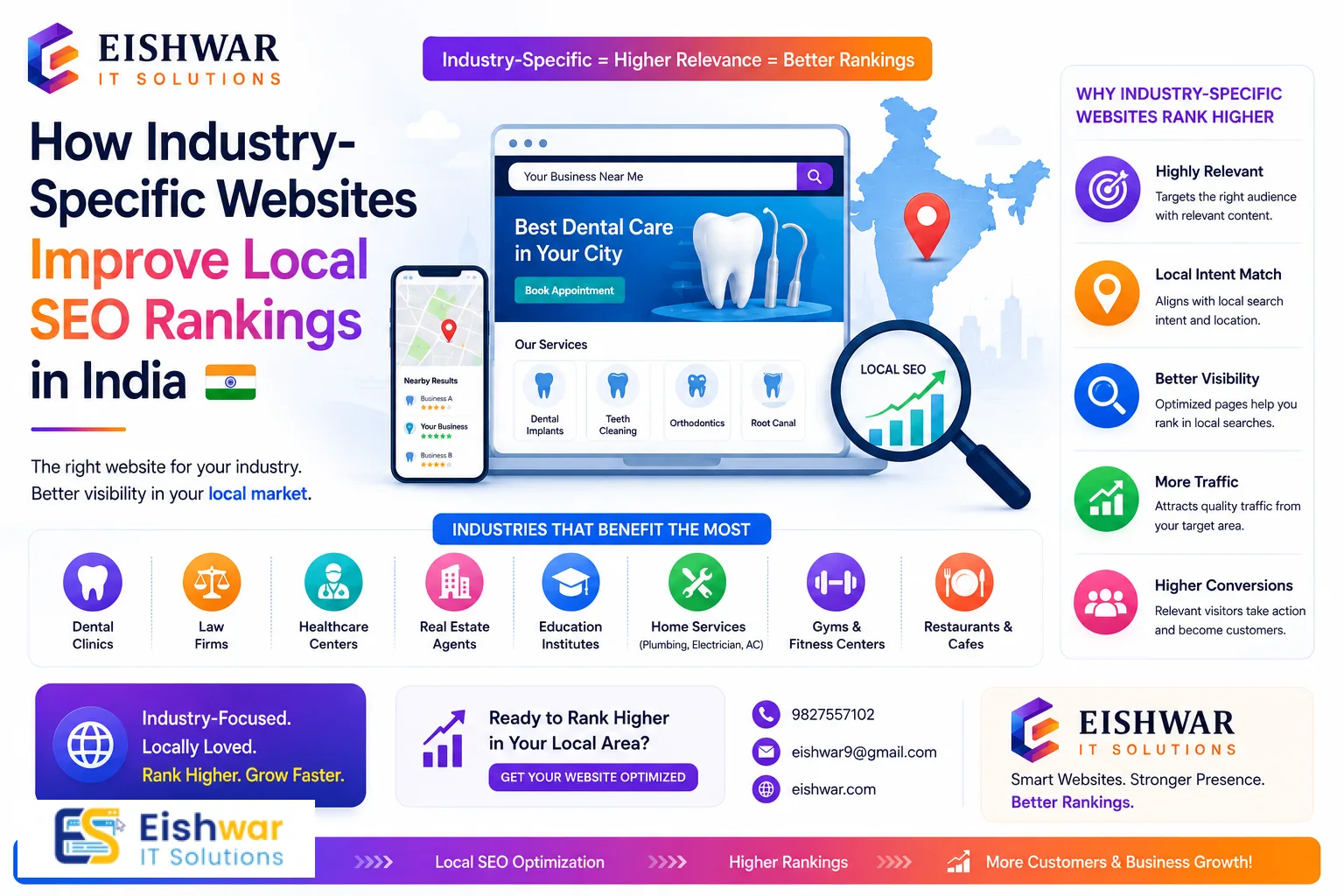
How Industry-Specific Websites Improve Local SEO Rankings in India
Published on: 22 Jun 2026
How Industry-Specific Websites Improve Local SEO Rankings in India
Introduction
In today's digital landscape, having a generic website is no longer enough—especially for businesses targeting local customers in India. Industry-specific websites, tailored to the unique needs of sectors like healthcare, real estate, education, and hospitality, offer a powerful advantage for local SEO. When your website speaks directly to your industry's audience and search intent, Google rewards you with higher rankings. In this guide, we'll explore how custom industry-specific website solutions from EishwarITSolution can boost your local search visibility, attract more qualified leads, and drive real business growth.
Learn more about our Website services
Main Section 1: The Connection Between Industry-Specific Websites and Local SEO
Local SEO is all about relevance, proximity, and prominence. An industry-specific website naturally aligns with these factors. For example, a dental clinic's website that includes terms like 'best dentist in Bangalore' and 'affordable root canal treatment' will rank higher than a generic business site. By focusing on industry-specific keywords, schema markup (like LocalBusiness and MedicalBusiness), and location-specific content, you signal to search engines that your site is a trusted authority in your niche.
Moreover, industry-specific sites tend to have higher engagement metrics—longer time on page, lower bounce rates—because they deliver exactly what users are looking for. Google interprets this as a positive user experience, further boosting your local rankings.
For instance, consider a real estate agency in Mumbai. A generic site might list properties without context, but an industry-specific site can include neighborhood guides, price trends for areas like Bandra or Andheri, and virtual tours. This depth of content not only helps users but also signals to Google that the site is a comprehensive resource. Similarly, a hospital website with detailed doctor profiles, patient testimonials, and service pages for specialties like cardiology or orthopedics will outperform a generic medical directory. The key is to marry industry expertise with local intent, creating a synergy that search engines reward.
Main Section 2: Key Features of an Industry-Specific Website That Boost Local SEO
Industry-specific websites incorporate features that generic sites lack. For instance, a real estate website might include property listings with location data, virtual tours, and neighborhood guides. An educational site could have course catalogs, admission forms, and campus maps. These features generate rich, location-specific content that search engines love.
Other critical elements include:
- Local Schema Markup: Adding structured data for your business type, address, phone number, and operating hours. For example, a restaurant can use Restaurant schema with menu and reservation data, while a clinic can use MedicalBusiness schema with accepted insurance details.
- Mobile Optimization: With over 70% of local searches happening on mobile, a responsive design is non-negotiable. Test your site on devices like the iPhone 14 or Samsung Galaxy S23 to ensure buttons are tappable and text is readable without zooming.
- Fast Loading Speed: Industry-specific sites often use optimized images and code, improving Core Web Vitals. Tools like Google PageSpeed Insights can help identify bottlenecks; aim for a score of 90+ on both mobile and desktop.
- Google My Business Integration: Seamlessly linking your website with your GMB profile for consistent NAP (Name, Address, Phone) data. Use plugins or APIs to sync updates automatically, such as when you add a new service or change hours.
- Industry-Specific Content Hubs: For example, a legal firm can create a blog with articles on 'How to File a Property Dispute in Delhi' or 'Understanding GST for Small Businesses,' which naturally attract local traffic.
By implementing these features, your website becomes a local SEO powerhouse. For a practical tip, consider adding a 'Book Appointment' button that integrates with a calendar tool like Calendly, reducing friction for users and increasing conversions.
👉 Don't wait for the perfect moment; turn your vision into reality today.
Free ConsultationMain Section 3: Practical Steps to Optimize Your Industry-Specific Website for Local SEO
Here are actionable steps you can take today:
- Conduct Local Keyword Research: Use tools like Google Keyword Planner or Ahrefs to find industry-specific terms with local intent (e.g., 'best IVF clinic in Mumbai'). Also, analyze competitors' keywords using tools like SEMrush to identify gaps.
- Create Location Pages: If you serve multiple cities, create dedicated pages for each location with unique content. For example, a chain of dental clinics can have pages like 'Dentist in Pune – Koregaon Park' and 'Dentist in Pune – Hinjewadi,' each with local testimonials and directions.
- Optimize Title Tags and Meta Descriptions: Include your primary keyword and city name in the title tag (e.g., 'Top Real Estate Agent in Delhi | Your Agency Name'). Keep meta descriptions under 160 characters and include a call-to-action like 'Call now for a free consultation.'
- Build Local Backlinks: Partner with local directories, industry associations, and community websites to earn authoritative links. For instance, a home services company can get listed on Justdial or Sulekha, while a school can collaborate with local parenting blogs.
- Encourage Customer Reviews: Positive reviews on Google and industry-specific platforms (e.g., Practo for healthcare) boost local rankings. Set up automated review requests via email or SMS after a service is completed.
- Leverage Social Proof: Showcase case studies and before-after examples. For a beauty salon, include photos of clients with captions like 'Hair transformation in South Delhi.'
For a seamless experience, consider working with a company like EishwarITSolution that specializes in industry-specific website development and local SEO integration. They can help you implement these steps efficiently, saving time and avoiding common pitfalls.
Expert Tips
We spoke with leading SEO experts to gather their top recommendations:
- Ravi Sharma, Digital Marketing Consultant: 'Don't just stuff keywords—create content that answers real questions your local customers ask. Think FAQs, how-to guides, and case studies. For example, a plumber can write 'How to Fix a Leaky Tap in 5 Steps' and optimize it for local search.'
- Priya Patel, SEO Specialist: 'Use Google Search Console to monitor your local performance. Regularly check for errors in your structured data. Also, track your GMB insights to see how users find you—whether through direct search, discovery, or branded queries.'
- Anand Gupta, Web Developer: 'Ensure your website's architecture is clean—use breadcrumbs, logical hierarchy, and internal links to distribute authority across pages. For instance, link from your homepage to service pages, then to location pages, creating a silo structure.'
- Meera Iyer, Local SEO Strategist: 'Don't underestimate the power of local citations. Use tools like Moz Local or BrightLocal to audit your NAP consistency across directories. Even a small discrepancy, like 'St.' vs. 'Street,' can hurt rankings.'
These insights can help you fine-tune your strategy for maximum impact. Implement them gradually and monitor results using analytics tools.
👉 Free Website Audit
Get Free AuditCommon Mistakes
Avoid these pitfalls when building your industry-specific website for local SEO:
- Using Duplicate Content: Copying content from other sites or using the same text for multiple location pages hurts rankings. Instead, write unique descriptions for each location, highlighting local landmarks or events.
- Ignoring Mobile Users: A non-responsive website will drive away potential customers and lower your search rank. Test your site on various devices and use Google's Mobile-Friendly Test tool.
- Neglecting Local Citations: Inconsistent NAP data across the web confuses search engines. Use tools like Moz Local to manage citations and ensure uniformity.
- Overlooking User Experience: Poor navigation, intrusive pop-ups, or slow load times increase bounce rates. For example, avoid full-screen pop-ups that block content on mobile.
- Forgetting to Update Content: Stale content signals irrelevance. Regularly refresh your blog posts, testimonials, and service pages. Set a schedule—e.g., update blog posts quarterly and review location pages annually.
- Keyword Cannibalization: Targeting the same keyword on multiple pages can confuse search engines. Use tools like Screaming Frog to identify and consolidate overlapping content.
By avoiding these mistakes, you'll build a stronger foundation for local SEO success. Remember, it's better to have a few high-quality pages than many thin ones.
Future Trends
The world of local SEO and industry-specific websites is evolving rapidly. Here's what to watch for:
- Voice Search Optimization: With the rise of voice assistants like Google Assistant and Alexa, optimizing for conversational queries like 'where is the best plumber near me' will become crucial. Use long-tail keywords and natural language in your content.
- AI-Powered Personalization: Websites that adapt content based on user behavior and location will see higher engagement and rankings. For example, an e-commerce site can show different products based on the user's city and browsing history.
- Video and Visual Search: Industry-specific websites with video tours, product demos, and high-quality images will gain an edge. Platforms like Google Lens allow users to search with images, so optimize your visuals with alt text and file names.
- Hyperlocal Targeting: Google is increasingly focusing on 'near me' searches. Including micro-location data (e.g., neighborhood names like 'Koramangala' or 'Connaught Place') can boost visibility. Also, consider creating content around local events or news.
- Core Web Vitals as Ranking Factors: Google's emphasis on page experience means that metrics like Largest Contentful Paint (LCP), First Input Delay (FID), and Cumulative Layout Shift (CLS) are critical. Optimize images, use lazy loading, and minimize JavaScript to improve scores.
Staying ahead of these trends will ensure your industry-specific website remains competitive in the Indian market. Invest in continuous learning and adapt your strategy as algorithms evolve.
👉 Free Homepage Demo
Book DemoFAQs
1. What is an industry-specific website?
An industry-specific website is designed and developed to meet the unique needs of a particular sector, such as healthcare, real estate, or education, with tailored features and content. For example, a hospital website includes doctor profiles, appointment booking, and patient portals, while a real estate site has property search filters and mortgage calculators.
2. How does an industry-specific website help with local SEO?
It aligns with local search intent, uses relevant keywords and schema markup, and provides a better user experience, all of which improve local rankings. Additionally, it attracts more qualified leads who are specifically looking for your services.
3. Can I convert my existing generic website into an industry-specific one?
Yes, but it often requires significant redesign and content overhaul. It's more effective to build a new site from scratch with industry-specific features. However, if you have a strong domain authority, you can migrate content gradually while maintaining SEO value.
4. How long does it take to see local SEO results after launching an industry-specific website?
Typically 3-6 months, depending on competition, content quality, and backlink profile. Consistent effort yields faster results. For competitive industries like real estate in metro cities, it may take 6-9 months.
5. Is it worth investing in an industry-specific website for a small business in India?
Absolutely. It helps you stand out, attract more qualified leads, and compete effectively against larger players in your local market. For example, a small bakery in Jaipur with a dedicated website featuring local delivery areas and customer reviews can outperform generic food delivery platforms.
6. What industries benefit the most from industry-specific websites?
Any industry with local customers—healthcare, real estate, legal, education, hospitality, and home services—benefits greatly. Even niche sectors like pet grooming or yoga studios can see significant improvements.
7. How do I choose the right schema markup for my industry?
Use Google's Structured Data Markup Helper to identify relevant schemas. For example, use 'LocalBusiness' for general businesses, 'MedicalBusiness' for clinics, 'Restaurant' for eateries, and 'EducationalOrganization' for schools. Test your markup with Google's Rich Results Test tool.
8. What is the role of social media in local SEO for industry-specific websites?
Social media signals don't directly impact rankings, but they drive traffic and engagement. Share your location-specific content on platforms like Facebook and Instagram, and encourage check-ins and reviews. This can indirectly boost your local SEO by increasing brand mentions and backlinks.
Conclusion
Industry-specific websites are not just a trend—they are a necessity for businesses serious about local SEO in India. By tailoring your site to your industry and local audience, you can achieve higher rankings, better user engagement, and more conversions. Remember, the key is to combine industry-specific features with solid SEO practices. Whether you're a dentist in Pune or a real estate agent in Delhi, the right website can transform your online presence. Start by auditing your current site, identifying gaps, and implementing the strategies outlined above. With patience and persistence, you'll see tangible results in local search visibility and business growth.
CTA
Ready to build an industry-specific website that dominates local search? Contact EishwarITSolution today for a free consultation. Our expert team will craft a custom solution tailored to your business needs and local SEO goals. Don't wait—your competitors aren't! Call us at +91-XXXXXXXXXX or email info@eishwar.com to get started.