
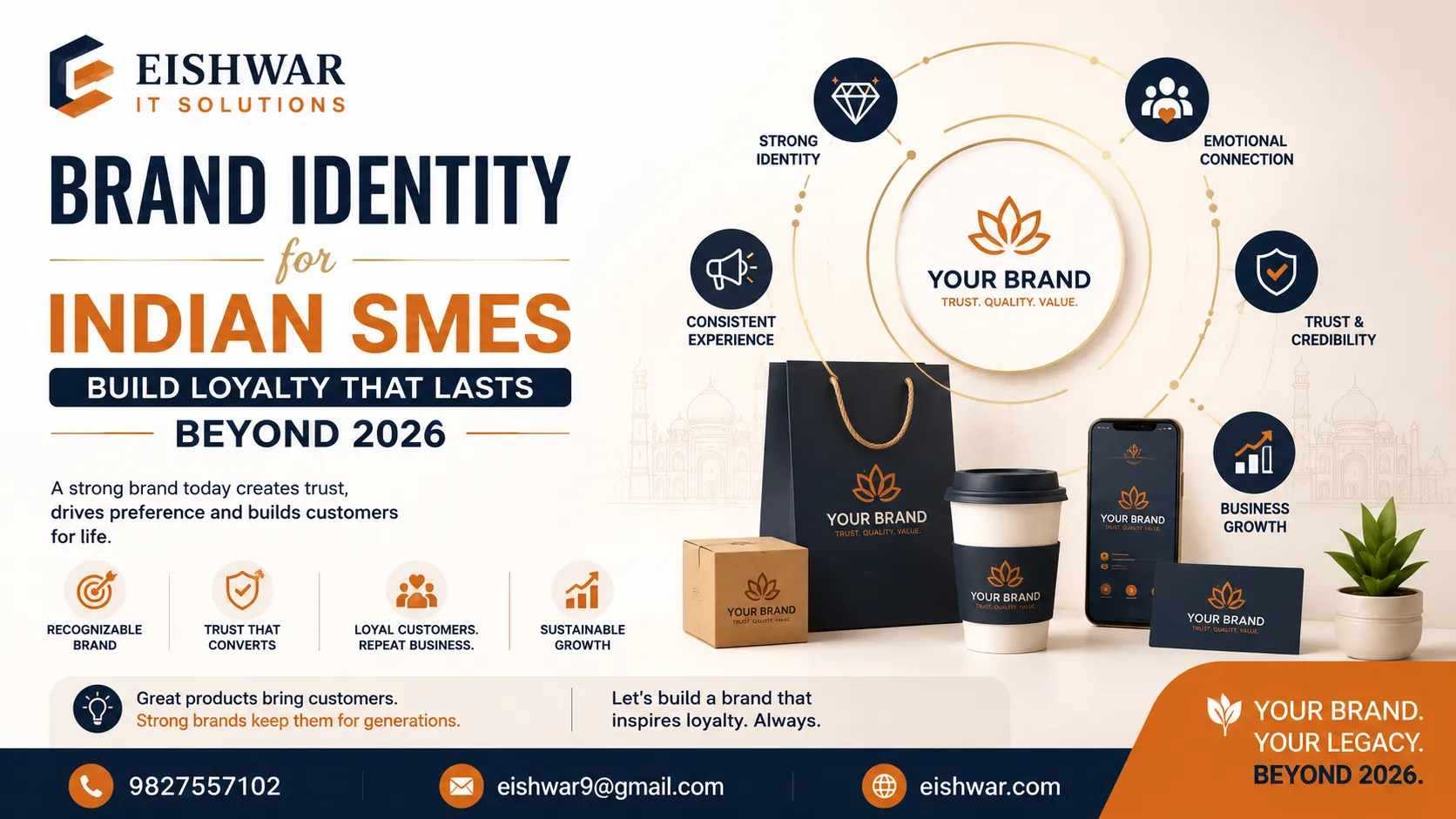
Brand Identity for Indian SMEs: Build Loyalty That Lasts Beyond 2026
Published on: 15 Jun 2026
Brand Identity for Indian SMEs: Build Loyalty That Lasts Beyond 2026
Introduction
In today's hyper-competitive Indian market, small and medium enterprises (SMEs) often struggle to stand out. With big brands dominating ad space and consumer attention, how can a small business build a brand that not only gets noticed but also earns lasting loyalty? The answer lies in crafting a brand identity that resonates deeply with your audience. This guide will walk you through practical steps to create a brand identity that drives customer loyalty, tailored specifically for Indian SMEs in 2026.
Learn more about our Website services
Consider this: A 2023 survey by LocalCircles found that 68% of Indian consumers prefer buying from brands they trust, even if it means paying a premium. For SMEs, trust isn't built through massive ad spends—it's built through consistent, authentic brand experiences. Whether you're a family-run chai stall in Mumbai or a tech startup in Bengaluru, your brand identity is the bridge between your business and your customer's heart. Let's explore how to build that bridge, brick by brick.
Main Section 1: The Core of Brand Identity – What Makes It Stick?
Your brand identity is more than a logo or a color palette. It's the personality, values, and promise your business represents. For Indian SMEs, authenticity is key. A brand identity that feels genuine and relatable builds trust, which is the foundation of loyalty.
Example: A local spice brand in Kerala that uses traditional recipes and eco-friendly packaging creates a story that customers love to share. This emotional connection turns buyers into brand ambassadors. Take 'Kerala Spice Co.'—they source directly from small farmers, use biodegradable packaging, and share the story of each spice's origin on their labels. Customers don't just buy turmeric; they buy a piece of Kerala's heritage.
Actionable Tip: Define your brand's mission, vision, and values in simple terms. Write a one-sentence brand promise that your team can repeat every day. For instance, 'We deliver fresh, organic produce within 24 hours of harvest, supporting local farmers.' This clarity guides every decision, from product development to customer service.
Practical Detail: To uncover your core identity, conduct a 'Brand Discovery Workshop' with your team. Ask questions like: Why did we start this business? What problem do we solve? How do we want customers to feel after interacting with us? Document the answers and distill them into three core values. For example, an SME in Jaipur selling handmade textiles might choose values like 'Craftsmanship,' 'Sustainability,' and 'Community.' These values then inform everything from packaging design to social media posts.
Main Section 2: Visual Identity and Consistency – The Silent Salesperson
Visual elements like your logo, typography, and imagery create a consistent look across all touchpoints. Consistency builds recognition, and recognition builds trust. For Indian SMEs, this means using the same colors and fonts on your website, social media, packaging, and even your storefront.
Example: A small organic tea brand from Darjeeling uses the same earthy tones and leaf motif on its website, tea boxes, and Instagram posts. Customers instantly recognize the brand, making them more likely to repurchase. 'Darjeeling Dew' uses a consistent palette of deep green and gold, with a hand-drawn leaf logo. Their Instagram feed mirrors their packaging, creating a seamless visual experience that reinforces their premium, natural positioning.
👉 Don't wait for the perfect moment; turn your vision into reality today.
Free ConsultationActionable Tip: Create a simple brand style guide (can be a one-page PDF) that outlines your logo usage, color codes, and tone of voice. Share it with everyone who creates content for your business. Include specifics: 'Use only these three fonts: Montserrat for headings, Lora for body text. Primary color: #2E5C3E (forest green). Secondary: #F5C542 (mustard yellow). Tone: Warm, knowledgeable, and respectful.'
Practical Detail: Consistency extends beyond digital. If your packaging uses a specific box design, ensure your e-commerce shipments use the same. If your storefront has a certain signage style, your delivery vehicle should match. For example, a small bakery in Pune uses the same pink-and-white striped pattern on its cake boxes, shopping bags, and delivery scooters. This creates a 'brand bubble' that customers recognize even from a distance. Use tools like Canva or Adobe Express to create templates for social media posts, ensuring every image has the same filter, logo placement, and font.
Main Section 3: Voice and Storytelling – Speak Your Customer's Language
Your brand voice is how you communicate with your audience. For Indian SMEs, using local languages or regional nuances can create a powerful connection. Storytelling that highlights your journey, challenges, and community impact makes your brand memorable.
Example: A small footwear brand in Agra shares stories of the artisans who handcraft each pair. This transparency and human touch build loyalty among customers who value craftsmanship. 'Agra Steps' posts weekly videos on Instagram showing artisans at work, explaining the stitching process, and sharing their personal stories. One post about a master craftsman who learned the trade from his grandfather garnered 10,000 shares and a flood of orders.
Actionable Tip: Write three brand stories: one about your founding, one about a customer success, and one about your community involvement. Use these in your content marketing. For the founding story, focus on the 'why'—what problem did you see, and what drove you to solve it? For the customer story, highlight a specific challenge and how your product or service made a difference. For community involvement, showcase a local initiative you support, like sponsoring a school event or cleaning a neighborhood park.
Practical Detail: Adapt your voice for different platforms. On WhatsApp Business, use a friendly, conversational tone with emojis and quick responses. On LinkedIn, adopt a more professional, thought-leadership tone. For example, a small accounting firm in Chennai uses Tamil phrases in its WhatsApp broadcasts to connect with local business owners, while its LinkedIn articles are in English with a focus on tax-saving tips. Use tools like Grammarly or Hemingway to ensure clarity, but always read your content aloud to check if it sounds like you.
Expert Tips
- Prioritize customer experience: Every interaction, from website navigation to post-purchase support, should reflect your brand identity. For instance, if your brand promises 'hassle-free service,' ensure your return policy is simple and your customer support responds within 2 hours.
- Leverage social proof: Encourage satisfied customers to leave reviews and share photos. User-generated content is a powerful trust signal. Create a hashtag for your brand (e.g., #MyKeralaSpice) and feature customer posts on your website and social media.
- Invest in a professional website: Your website is often the first impression. Ensure it loads fast, is mobile-friendly, and clearly communicates your brand promise. Use tools like Google PageSpeed Insights to test speed. Include a clear 'About Us' page that tells your story.
- Stay true to your values: If you claim to be eco-friendly, ensure your packaging and operations align. Inconsistency erodes trust. For example, if you use plastic bubble wrap despite claiming sustainability, customers will notice. Switch to recycled paper or biodegradable alternatives.
- Engage with your community: Respond to comments, participate in local events, and support local causes. Show that you care beyond profits. Host a 'Customer Appreciation Day' at your store or partner with a local NGO for a charity drive.
- Use data to refine: Track which brand messages resonate most. Use social media analytics to see which posts get the most engagement. A/B test different taglines or visuals to see what drives conversions.
Common Mistakes
- Copying competitors: Imitating big brands makes you look generic. Your uniqueness is your strength. Instead of trying to be the next 'Amul,' focus on what makes your ghee different—perhaps it's made from grass-fed cows in a specific region.
- Inconsistent branding: Changing colors, fonts, or tone across platforms confuses customers. If your logo has a specific shade of blue, use that exact hex code everywhere. Avoid using a casual tone on your website and a formal tone on your packaging.
- Ignoring feedback: Customer complaints are opportunities to improve. Ignoring them damages your brand reputation. Set up a simple feedback form on your website or use WhatsApp for Business to collect reviews. Respond to every complaint within 24 hours.
- Overcomplicating your message: Clear, simple communication works best. Avoid jargon. Instead of saying 'We leverage synergistic solutions,' say 'We help you save time and money.'
- Neglecting employee branding: Your team embodies your brand. Train them to live the brand values. If your brand promises 'friendly service,' ensure your delivery staff smile and say thank you. Conduct monthly training sessions on brand guidelines.
- Underestimating packaging: For product-based SMEs, packaging is a key brand touchpoint. Cheap, flimsy packaging can undermine a premium brand image. Invest in good-quality boxes, tissue paper, and stickers that reflect your brand.
Future Trends
By 2026, Indian SMEs will need to adapt to trends like hyper-personalization, AI-driven customer insights, and sustainable branding. Voice search and local language content will become even more important. Building a brand that is agile, authentic, and community-focused will be key to standing out.
👉 Free Website Audit
Get Free AuditHyper-personalization: Use customer data to tailor experiences. For example, a small clothing brand can send personalized style recommendations based on past purchases. Tools like Segment or even simple spreadsheets can help track preferences.
👉 Free Homepage Demo
Book DemoAI-driven insights: Chatbots and AI tools can analyze customer queries to identify common pain points. Use this data to refine your brand messaging. For instance, if customers frequently ask about sizing, create a detailed size guide and feature it prominently.
Sustainable branding: Indian consumers are increasingly eco-conscious. A 2024 report by Nielsen found that 73% of Indian consumers are willing to pay more for sustainable products. SMEs can leverage this by using recycled materials, reducing waste, and transparently sharing their sustainability efforts.
Voice and local language: With the rise of voice assistants like Alexa and Google Assistant in Indian languages, optimize your content for voice search. Use conversational keywords and phrases. Also, create content in regional languages—a small business in Gujarat can see a 40% increase in engagement by using Gujarati in its social media posts.
FAQs
1. What is brand identity, and why is it important for SMEs?
Brand identity is the collection of visual and verbal elements that define how a business presents itself to the world. For SMEs, a strong brand identity helps build trust, differentiate from competitors, and foster customer loyalty. It's the difference between a customer choosing your product over a similar one at a lower price.
2. How can a small business create a brand identity on a low budget?
Start by defining your brand values and story. Use free design tools like Canva for visuals. Be consistent across free platforms like social media and Google My Business. Focus on excellent customer service as a brand differentiator. For example, a local restaurant can build a strong brand by consistently delivering friendly service and using the same color scheme on its menu, signage, and social media.
3. How long does it take to build a strong brand identity?
Building brand recognition takes time—typically 6 months to 2 years of consistent effort. Loyalty builds gradually through repeated positive experiences. For example, a new SME might see initial traction in 3 months, but true brand loyalty often takes 12-18 months of consistent messaging and quality service.
4. Can an SME in a local market benefit from a global brand identity?
Yes, but localization is key. While your brand identity can have global appeal, ensure it respects local culture, language, and preferences to resonate with your target audience. For instance, a tech startup in India can use a modern, minimalist logo (global appeal) but communicate in Hindi or Tamil on social media (localization).
5. How do I measure brand loyalty?
Track repeat purchase rate, customer lifetime value (CLV), Net Promoter Score (NPS), and social media engagement. Surveys and feedback forms also provide insights. For example, if your repeat purchase rate is above 30%, that's a strong indicator of loyalty. Use tools like SurveyMonkey or Google Forms to collect NPS scores quarterly.
6. What role does a website play in brand identity for SMEs?
Your website is the digital storefront. It should reflect your brand's visual identity, tone, and values. A professional, easy-to-navigate website builds credibility and trust. Ensure it includes an 'About Us' page, clear product/service descriptions, customer testimonials, and a blog that shares your brand stories.
7. How can I ensure my brand stays relevant as trends change?
Stay agile by regularly reviewing customer feedback and market trends. Conduct quarterly brand audits to assess if your identity still resonates. Be willing to evolve—for example, if sustainability becomes more important to your audience, update your packaging and messaging accordingly. But always stay true to your core values.
Conclusion
Building a brand identity that drives customer loyalty is not a luxury for Indian SMEs—it's a necessity. By focusing on authenticity, consistency, and genuine connection, you can create a brand that stands out in 2026 and beyond. Start small, stay true to your values, and watch your community grow. Remember, every interaction is a chance to reinforce your brand. Whether it's a WhatsApp message, a product delivery, or a social media post, make it count.
CTA
Ready to build a brand identity that your customers will love? Contact Eishwar IT Solution today for a free brand audit and personalized strategy session. Let's make your brand unforgettable. Our team of experts will help you define your brand's core, create a visual identity, and craft a voice that resonates. Don't wait—your loyal customers are waiting.