
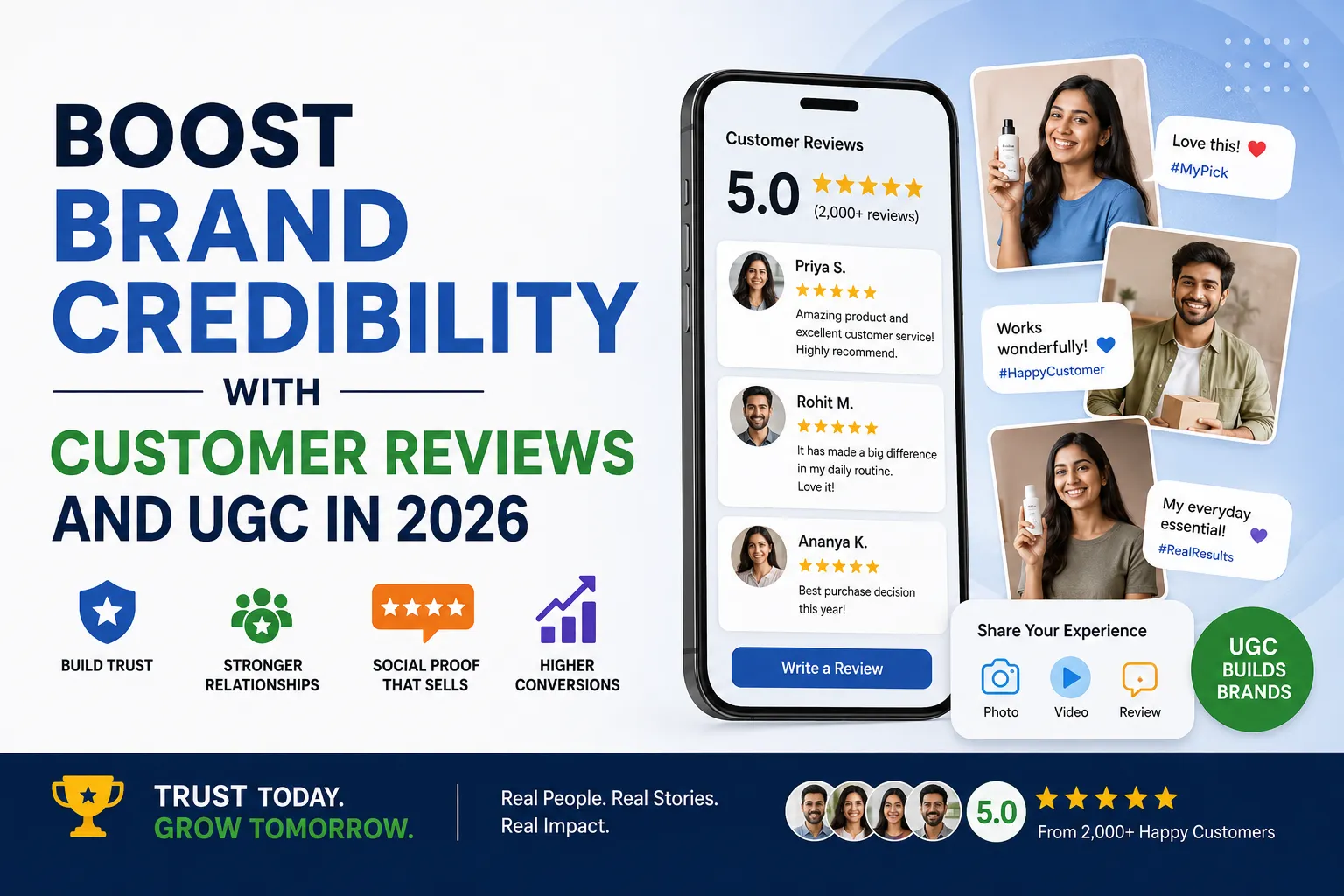
Boost Brand Credibility with Customer Reviews and UGC in 2026
Published on: 18 Jun 2026
Boost Brand Credibility with Customer Reviews and UGC in 2026
Introduction
In 2026, trust is the new currency. With consumers overwhelmed by ads and polished marketing, they increasingly turn to real voices—other customers—to make buying decisions. For Indian businesses, especially SMEs, customer reviews and user-generated content (UGC) are not just nice-to-haves; they are essential for building brand credibility. This guide will show you how to strategically collect, showcase, and leverage reviews and UGC to boost trust, improve SEO, and drive growth. As digital noise intensifies, authentic peer validation becomes the cornerstone of purchase decisions. Indian consumers, known for their community-driven mindset, rely heavily on word-of-mouth and online testimonials. By harnessing the power of reviews and UGC, you can cut through the clutter, establish authority, and create a loyal customer base that champions your brand organically.
Learn more about our Website services
Main Section 1: Why Customer Reviews and UGC Matter More Than Ever
Consumers today are skeptical. A study shows that 93% of consumers read online reviews before making a purchase. Reviews act as social proof, reducing perceived risk. User-generated content—photos, videos, testimonials—adds authenticity that polished brand content often lacks. For Indian audiences, peer recommendations carry immense weight, especially in local markets. When a customer sees a real person using your product, trust deepens. Moreover, Google rewards fresh, unique content, and UGC can boost your search rankings by up to 20%. In 2026, the landscape has evolved further: AI-generated content is ubiquitous, making human-created UGC even more valuable. A genuine photo of a customer wearing a saree from your boutique or a video of a family using your kitchen appliance resonates far more than a studio shoot. Additionally, reviews influence not just initial trust but also repeat purchases. A study by BrightLocal found that 76% of consumers trust online reviews as much as personal recommendations. For Indian SMEs, this is a game-changer—a single positive review on Google can bring in dozens of local customers searching for services like yours. UGC also fuels social commerce; platforms like Instagram and Facebook now allow direct shopping from user posts, turning every customer into a potential salesperson. The key is to recognize that reviews and UGC are not just marketing assets but strategic tools for long-term brand equity.
Main Section 2: How to Collect Authentic Reviews and UGC
Start by making it easy. Ask for reviews via email, SMS, or in-app prompts right after a purchase. Offer a small incentive—like a discount on the next order—but ensure the review remains honest. For UGC, create a branded hashtag and run a contest. For example, a local clothing brand can encourage customers to post photos wearing their outfits with #MyStyleStory. Feature the best entries on your website and social media. Always ask permission before reposting. Use tools like Google Reviews, Facebook Recommendations, and dedicated review platforms like Trustpilot or MouthShut for Indian markets. To maximize collection, implement a multi-channel strategy. Send a follow-up email 3-5 days post-purchase with a direct link to your Google Reviews page. For SMS, keep it short: "Hi [Name], how was your experience? Share your feedback here: [link]. Thank you!" For UGC, incentivize with a monthly prize—like a gift voucher—for the best customer photo or video. A local restaurant could run a "Foodie of the Month" contest where customers post pictures of their meals with a specific hashtag. Ensure you moderate submissions to maintain quality and relevance. Also, leverage offline touchpoints: include a QR code on product packaging that leads to a review page. For service-based businesses, ask for reviews immediately after service completion, while the experience is fresh. Remember, authenticity is paramount—never write reviews on behalf of customers or use bots. Instead, focus on making the process frictionless. Tools like Yotpo or Bazaarvoice can automate review requests and UGC curation, saving time while ensuring compliance. For Indian businesses, consider local platforms like LocalCircles or IndiaMART for B2B reviews. The goal is to create a steady stream of fresh, genuine content that reflects real customer experiences.
👉 Don't wait for the perfect moment; turn your vision into reality today.
Free ConsultationMain Section 3: Showcasing Reviews and UGC to Build Trust
Display reviews prominently on your homepage, product pages, and checkout pages. Use a widget to show real-time reviews. Create a dedicated “Testimonials” page. For UGC, build a gallery on your site—this not only builds trust but also keeps content fresh. Embed customer videos on product pages. A local restaurant could show a video of a customer enjoying a meal. On social media, share UGC regularly, tagging the creator. This builds community and encourages more submissions. Ensure you respond to reviews—both positive and negative—to show you value feedback. Strategic placement is crucial. On product pages, place reviews near the "Add to Cart" button to reduce purchase hesitation. Use a carousel of UGC images on your homepage to immediately convey social proof. For e-commerce sites, implement a "Customer Photos" section where shoppers can filter by product variant—this helps potential buyers visualize the product in real life. Consider using a review aggregator like Trustpilot to display a composite rating across your site. For B2B brands, case studies and detailed testimonials work well; include metrics like "increased sales by 30%" to add credibility. On social media, create a weekly "Customer Spotlight" series where you feature one user's story in depth. This not only honors the customer but also provides relatable content for your audience. Respond to every review within 24-48 hours. For positive reviews, thank the customer and personalize your response—mention a specific detail they shared. For negative reviews, apologize publicly and offer a solution, then take the conversation offline. This transparency builds trust with both the reviewer and other customers watching. Additionally, use UGC in your advertising: a Facebook ad featuring a real customer testimonial often outperforms a polished brand ad. The key is to make UGC and reviews an integral part of your brand narrative, not an afterthought.
Expert Tips
- Automate the ask: Use email workflows to request reviews 3-5 days after purchase. Tools like Mailchimp or Klaviyo can trigger these automatically based on purchase data.
- Feature diverse voices: Showcase reviews from different demographics—age, location, gender—to appeal to a wider audience. For example, a skincare brand can feature reviews from teenagers, working professionals, and seniors.
- Use schema markup: Add review schema to your product pages to get star ratings in search results. This can increase click-through rates by up to 35%.
- Create a UGC hub: A dedicated page on your site for customer photos and stories boosts SEO and trust. Include filters for product categories and a submission form for new content.
- Leverage video reviews: Short video testimonials from customers are highly persuasive. Encourage customers to record a 30-second video using their phone—no professional equipment needed.
- Integrate UGC into email marketing: Include a customer photo or review in your newsletter to add authenticity. For example, a monthly "Customer Favorites" email featuring top-rated products with real photos.
- Monitor sentiment: Use tools like Brand24 or Mention to track mentions of your brand and engage with UGC across platforms. This helps you identify brand advocates and potential issues early.
Common Mistakes
- Deleting negative reviews: This backfires. Instead, respond professionally and resolve the issue publicly. Deleting reviews can lead to distrust and even penalties from review platforms.
- Using fake reviews: This destroys trust instantly. Always use genuine feedback. In 2026, AI tools can detect fake reviews, and platforms are cracking down with fines.
- Not asking for permission: Always get consent before reposting customer content to avoid legal issues. A simple DM or email asking "Can we share your photo?" suffices.
- Ignoring reviews: Not responding to reviews signals that you don’t care about customer feedback. Even a simple "Thank you" goes a long way.
- Over-optimizing UGC: Let the content feel natural, not overly polished or scripted. Authenticity is the whole point of UGC.
- Focusing only on positive reviews: A mix of positive and constructive reviews builds credibility. Customers are suspicious of perfect ratings.
- Neglecting mobile optimization: Ensure review displays and UGC galleries are mobile-friendly, as most Indian consumers browse on phones.
Future Trends
In 2026, expect more AI-powered tools that analyze UGC for sentiment and trends. Live video reviews and shoppable UGC will become mainstream. Indian brands will increasingly use local language reviews to build deeper connections. Voice search will also impact how reviews are consumed—optimize for conversational queries like "What is the best phone under 15000?" Blockchain may emerge to verify review authenticity, combating fake reviews. Additionally, augmented reality (AR) will allow customers to virtually try products and share their experiences as UGC. For example, a furniture brand could let customers see a sofa in their living room via AR and then share a screenshot as a review. Social commerce platforms like Instagram and YouTube will integrate review features directly, making it easier for users to purchase from UGC. Indian brands should also prepare for the rise of micro-influencers—customers with small but engaged followings—who can generate authentic UGC that resonates locally. Finally, privacy regulations will tighten, so ensure your UGC collection practices comply with India's Digital Personal Data Protection Act. Staying ahead of these trends will position your brand as innovative and trustworthy.
👉 Free Website Audit
Get Free Audit👉 Free Homepage Demo
Book DemoFAQs
How do I encourage customers to leave reviews?
Make it easy by sending a direct link via email or SMS shortly after purchase. Offer a small incentive like a discount code or entry into a giveaway. Always thank them for their time. Personalize the request by mentioning the product they bought. For example, "Hi Priya, we hope you love your new kurta! Share your experience and get 10% off your next order." Timing matters—ask when satisfaction is high, such as right after delivery or after a positive customer service interaction.
What is the best way to respond to negative reviews?
Respond promptly, apologize sincerely, and offer to resolve the issue offline. This shows other customers that you care about service. Never get defensive. Acknowledge the specific problem—e.g., "We're sorry your order arrived late. We've addressed this with our logistics team." Then provide a direct contact (email or phone) for further discussion. Follow up publicly once resolved to show you took action. This turns a negative into a demonstration of excellent customer service.
Can UGC really improve my SEO?
Yes. UGC adds fresh, keyword-rich content to your site. Google sees this as a signal of relevance. Also, user-generated reviews often contain long-tail keywords that help you rank for specific queries. For example, a review saying "This organic face wash worked for my acne-prone skin" can help you rank for "organic face wash for acne." Additionally, UGC increases dwell time and reduces bounce rate, both positive SEO signals. Ensure you implement schema markup to maximize visibility.
Should I feature negative reviews on my website?
It can be beneficial. Displaying a mix of positive and constructive reviews builds authenticity. Just ensure you respond to negative ones and show improvement. A study by Reevoo found that displaying negative reviews can increase conversion rates by up to 67% because it makes the positive reviews more credible. However, filter out abusive or irrelevant reviews. Use a moderation system to maintain quality while preserving authenticity.
What platforms are best for collecting reviews for Indian businesses?
Google Reviews is essential for local SEO. Also consider Facebook Recommendations, Trustpilot, MouthShut, and industry-specific platforms like Zomato for restaurants or Justdial for services. For B2B, IndiaMART and TradeIndia are popular. For niche products, consider platforms like Nykaa for beauty or Amazon for e-commerce. Diversify across platforms to reach different audience segments. Always claim your business listings and actively manage them.
How can I measure the ROI of reviews and UGC?
Track metrics like conversion rate from product pages with reviews vs. without, increase in organic traffic after adding UGC, and engagement rates on social media posts featuring UGC. Use tools like Google Analytics to measure referral traffic from review platforms. Also monitor brand sentiment and repeat purchase rates. A simple calculation: compare average order value for products with reviews vs. those without. Typically, products with reviews see 10-20% higher conversion rates.
What legal considerations should I keep in mind for UGC?
Always obtain explicit permission before reposting customer content. This can be done via a direct message, email, or a terms-of-use checkbox during submission. Clearly state how you will use the content (e.g., on website, social media, ads). In India, comply with the Digital Personal Data Protection Act by informing users about data usage. Avoid editing UGC in a way that misrepresents the original context. For contests, have clear rules and disclaimers. Consult a legal expert for comprehensive compliance.
Conclusion
Customer reviews and UGC are powerful tools to build brand credibility in 2026. By collecting authentic feedback, showcasing it strategically, and engaging with your audience, you can create a trust loop that drives sales and loyalty. Start small, stay genuine, and watch your brand reputation soar. Remember, every review is a conversation, and every piece of UGC is a story—embrace them to humanize your brand and foster a community of advocates. In a world where trust is scarce, your customers' voices are your greatest asset. Implement these strategies today, and you'll not only survive but thrive in the competitive Indian market.
CTA
Ready to build a brand that customers trust? Contact EishwarITSolution today for a free consultation on how we can help you integrate customer reviews and UGC into your branding strategy. Let’s grow together. Our team specializes in creating customized review collection workflows, UGC campaigns, and SEO-optimized content strategies tailored for Indian businesses. Don't let your brand's potential go untapped—reach out now and start turning customers into your best marketers.