Zero-Party Data: The New Goldmine for Indian Marketers in 2026
Introduction
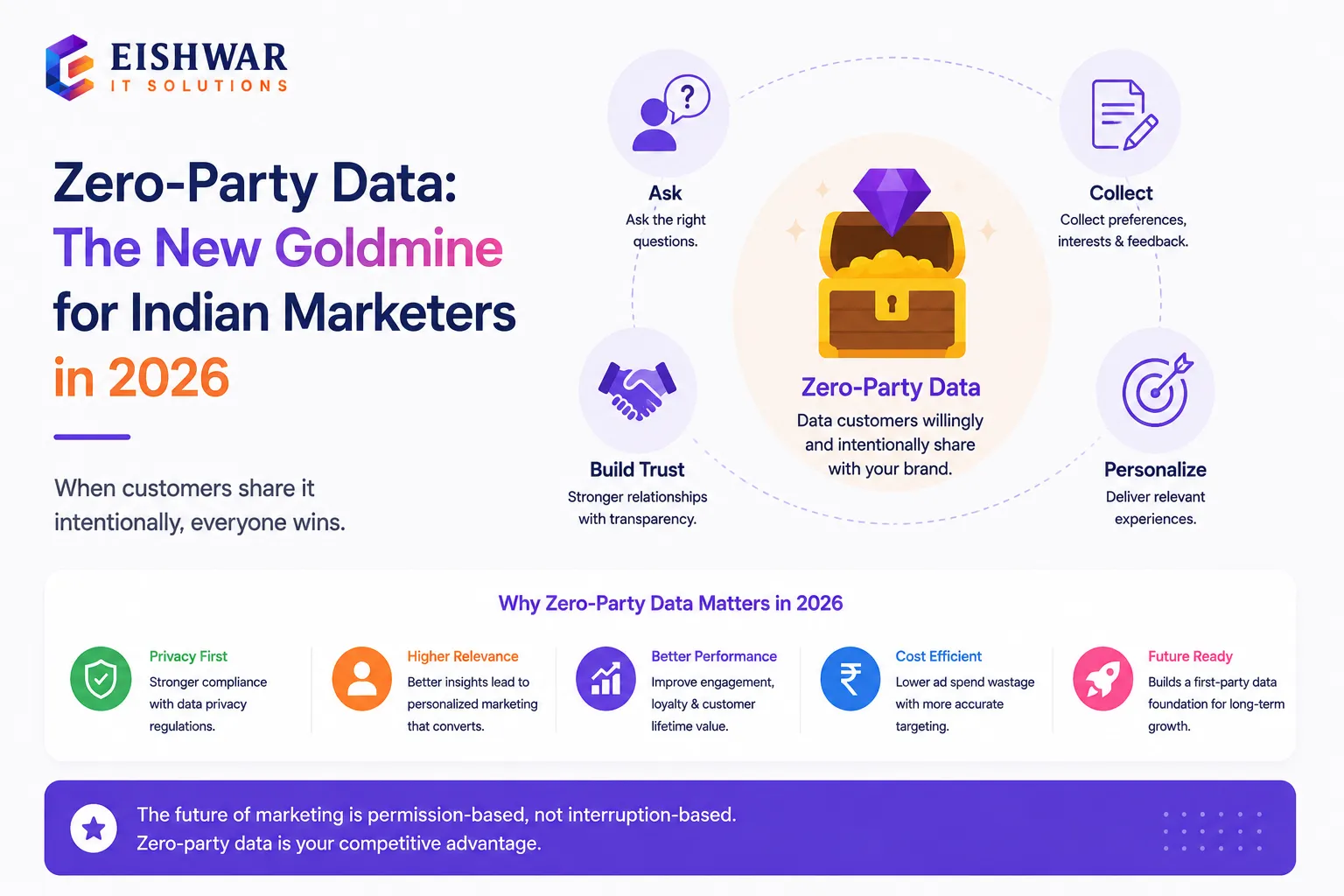
In 2026, the Indian digital marketing landscape is undergoing a seismic shift. With third-party cookies crumbling and privacy regulations tightening, marketers are scrambling for sustainable alternatives. Enter zero-party data—information that customers proactively and intentionally share with brands. Unlike first-party data (observed behavior) or second-party data (shared partnerships), zero-party data is a direct gift from your audience: preferences, purchase intentions, personal context, and feedback. For Indian business owners, marketers, and professionals, this isn't just a trend—it's the new goldmine. In this article, we'll explore why zero-party data matters, how to collect it ethically, and how to turn it into measurable ROI—all while respecting the unique cultural and regulatory nuances of India.
Consider this: a 2025 report by Deloitte India found that brands leveraging zero-party data saw a 2.5x increase in customer lifetime value compared to those relying solely on third-party data. The shift is not just about compliance; it's about building deeper, more meaningful connections with a diverse and rapidly digitizing population. From the bustling streets of Mumbai to the emerging e-commerce hubs in Tier 2 cities like Lucknow and Coimbatore, the opportunity is immense—but only for those who approach it with strategy and empathy.
Main Section 1: What is Zero-Party Data and Why It Matters in India
Zero-party data refers to information a customer deliberately and proactively shares with a brand. Think quiz answers, preference center selections, wishlist items, or explicit feedback. In India, where trust is paramount and digital literacy varies widely, zero-party data offers a bridge. It respects user autonomy and builds a consent-based relationship.
Why is this crucial in 2026? For one, India's Digital Personal Data Protection Act (DPDPA) 2023 is now fully enforced, penalizing non-compliance with fines up to ₹250 crore for serious breaches. Second, Indian consumers—especially Gen Z and millennials—are increasingly privacy-aware. A 2025 survey by LocalCircles found that 78% of Indian internet users prefer brands that ask before using their data, and 62% have abandoned a purchase due to unclear data practices. Zero-party data aligns perfectly with these expectations. It's also highly accurate: when a customer tells you they prefer email over WhatsApp, you know it's true—no guesswork, no inference errors.
Practical example: An Indian e-commerce brand like Nykaa could use a short 'beauty profile' quiz to ask about skin type, concerns, and preferred brands. The data is zero-party, and the brand can then recommend hyper-personalized products. The result? Higher conversion rates (up to 3x, according to McKinsey) and lower churn. Another example: A regional grocery delivery app in Kerala could ask customers about dietary restrictions (e.g., Jain, vegan, gluten-free) and then send curated weekly offers. This builds loyalty and reduces waste.
For Indian marketers, the cultural angle is key. In a country where relationships are valued over transactions, asking for data feels intrusive unless framed as a conversation. Zero-party data turns data collection into a dialogue—a win-win where the customer gets value (e.g., a personalized discount or a tailored recommendation) and the brand gets actionable insights.
Main Section 2: How to Ethically Collect Zero-Party Data in the Indian Market
Collecting zero-party data is an art, not a science. The key is to offer clear value in exchange for information. Indian audiences respond well to gamification, discounts, and exclusive access. Here are proven strategies:
- Interactive Quizzes & Surveys: Use tools like Typeform or SurveyMonkey to create fun, branded quizzes. Example: 'What's Your Leadership Style?' for a B2B software firm. Offer a personalized report as a reward. For a B2C brand, a 'Find Your Perfect Saree' quiz can drive engagement and capture size, color, and fabric preferences.
- Preference Centers: Let users choose their communication channels, frequency, and topics. This reduces unsubscribe rates and improves deliverability. For instance, a travel company like MakeMyTrip could let users select 'budget trips,' 'luxury getaways,' or 'adventure travel'—then send only relevant emails.
- Loyalty Programs with Data Layers: Ask members to share their birthday, favorite product categories, or dietary preferences for tailored rewards. A coffee brand like Blue Tokai could ask about roast preference (light, medium, dark) and offer a free sample on the birthday month.
- Wishlist & Save for Later: These actions are zero-party data gold. A customer adding a 'Diwali saree' to a wishlist signals intent and preference. Brands can then send reminders when the item is on sale or suggest complementary accessories.
- Post-Purchase Feedback: After a purchase, ask 'How did you hear about us?' or 'What made you choose this product?' This builds a feedback loop and captures intent data. For example, a customer who says 'I bought this for my mother's birthday' signals gifting intent for future campaigns.
Important: Always be transparent about how you'll use the data. Use simple language in Hindi or regional languages if needed. Example: 'We'll use your answers to recommend better products. You can update anytime.' Also, consider offering a small incentive—like a 10% discount code or entry into a lucky draw—to encourage participation. A 2024 study by Epsilon India showed that 45% of Indian consumers are more likely to share data if they receive an immediate benefit.
Pro tip: Start with a single data point. For a new visitor, ask just their preferred product category. Over time, use progressive profiling to gather more details. This reduces friction and builds trust gradually.
Main Section 3: Turning Zero-Party Data into Actionable Marketing Campaigns
Collecting data is only half the battle. The real power lies in activation. Here's how Indian marketers can leverage zero-party data for campaigns that resonate:
- Hyper-Personalized Emails: Segment your list based on stated preferences. If a customer said 'I love budget travel,' send them deals on hostels and local experiences, not luxury resorts. Use dynamic content blocks to personalize subject lines and product recommendations. For example, a fitness brand like Cult.fit could send workout tips to those who selected 'weight loss' and nutrition plans to those who chose 'muscle gain.'
- Dynamic Website Content: Use tools like Google Optimize or VWO to show different homepage banners based on user's past preferences. Example: A returning visitor who selected 'men's formal wear' sees a new collection of blazers, while another who chose 'ethnic wear' sees a Diwali collection. This increases time on site and conversion rates.
- Retargeting with Consent: Use zero-party data to create custom audiences for Facebook and Google Ads. Since the customer gave explicit permission, ad relevance and CTR skyrocket. For instance, a customer who indicated interest in 'organic skincare' can be retargeted with ads for a new organic face wash—without feeling spied on.
- Product Recommendations: E-commerce platforms like Shopify and Magento allow you to build recommendation engines using customer-provided data. Example: 'Based on your style quiz, we think you'll love these kurtas.' This is far more effective than generic 'you might also like' suggestions based on browsing history alone.
- Predictive Analytics: Combine zero-party data with first-party behavior to predict next purchase. A customer who said 'I'm planning a wedding' might need bridal wear, venue services, and catering—all in one ecosystem. Brands like WeddingWire India use this to create personalized wedding planning timelines and vendor recommendations.
Case study: A mid-sized Indian D2C brand, 'The Whole Truth Foods', used a simple 'health goal' quiz on their site. Customers selected goals like weight loss, muscle gain, or gut health. The brand then sent tailored recipe ideas and product bundles. Result: 40% increase in email click-through rates and 25% higher average order value within 3 months. The key was that the data was used immediately and consistently—not just stored in a database.
Another example: A local jewelry store in Jaipur used a 'style preference' quiz on Instagram (via a link in bio) to ask about metal type (gold, silver, rose gold) and occasion (wedding, daily wear, festive). They then sent personalized WhatsApp messages with curated collections. The response rate was 35%, compared to 5% for generic broadcast messages.
Expert Tips
Here are actionable tips from industry leaders on mastering zero-party data in India:
- Start Small, Scale Fast: Begin with one data collection point (e.g., a preference center on your website). Test, iterate, then expand to quizzes and interactive content. Don't try to build a full system overnight.
- Respect Regional Nuances: India is not a monolith. Use local languages, festivals (Diwali, Pongal, Eid), and payment preferences (UPI, COD) to make your data requests culturally relevant. A brand targeting Tamil Nadu should offer quizzes in Tamil and reference Pongal, not just Diwali.
- Integrate with Your CRM: Use tools like HubSpot, Zoho, or Salesforce to tag contacts with zero-party data fields. This ensures every team—from sales to support—has context. For example, a customer service agent can see that a caller prefers Hindi and has a gluten-free diet, enabling better assistance.
- Measure Trust Metrics: Track opt-in rates, preference center engagement, and feedback completion rates. These indicate how much your audience trusts you. A declining opt-in rate may signal that your value exchange is weak or your data requests are too intrusive.
- Always Provide a 'Why': Before asking for data, explain the benefit. Example: 'Tell us your favorite genre to get movie recommendations tailored just for you.' For a food delivery app: 'Share your dietary preferences so we can suggest dishes you'll love.'
- Leverage Social Proof: Show how others have benefited from sharing data. For instance, 'Join 10,000 customers who get personalized offers every week by completing their profile.'
Common Mistakes
Avoid these pitfalls when implementing zero-party data strategies in India:
- Asking Too Much Too Soon: Don't request 20 fields on the first interaction. Start with 2-3 questions and progressively profile users over time. A common mistake is treating the first visit as a full data dump—this leads to abandonment.
- Ignoring Data Hygiene: Zero-party data can become stale. Regularly prompt users to update their preferences (e.g., 'Is your style still the same?'). A customer's preference for 'budget travel' may change to 'luxury' as their income grows.
- Using It for Spam: Just because a customer shared data doesn't mean they want daily emails. Respect frequency preferences and honor opt-outs immediately. Over-communication is a quick way to erode trust.
- Not Securing Data: Zero-party data is still personal data. Encrypt it, limit access, and comply with DPDPA. A breach can destroy trust overnight, especially in a market like India where data privacy concerns are rising.
- Treating It as a One-Time Fix: Zero-party data is not a campaign tactic; it's a long-term relationship strategy. Integrate it into your overall marketing stack and update it regularly. Brands that treat it as a one-off survey miss the ongoing value.
- Ignoring Offline Channels: In India, many transactions still happen offline. Use QR codes in stores to link to digital preference centers. A customer scanning a code on a shirt can say 'I like this, send me offers on similar styles.' This bridges online and offline data.
Future Trends
What's next for zero-party data in India? Here are three trends to watch in 2026 and beyond:
- AI-Powered Personalization at Scale: Machine learning models will use zero-party data to predict customer needs in real-time, even before they articulate them. Imagine a travel app that knows you prefer window seats and vegetarian meals—because you told it once. Indian startups like 'Zeta' are already building such models for banking and fintech.
- Voice and Conversational Data: With the rise of voice assistants in Indian languages (Hindi, Tamil, Bengali), brands will collect zero-party data through natural conversations. 'Alexa, order my usual' is a form of zero-party data. Marketers need to design voice interfaces that ask for preferences in a friendly, non-intrusive way.
- Blockchain-Based Consent Management: Decentralized identity solutions will let customers control their data across brands. Indian startups like 'Polygon' are already exploring this. Marketers will need to adapt to a permission-based ecosystem where customers can revoke access instantly.
- Integration with Offline Retail: QR codes in stores can link to digital preference centers. A customer scanning a code on a shirt can say 'I like this, send me offers on similar styles.' This bridges online and offline data, creating a unified customer view.
- Hyper-Localization: Zero-party data will enable hyper-local campaigns. For example, a brand can ask 'Which neighborhood do you live in?' and then send offers for nearby stores. This is particularly powerful in cities like Delhi, Mumbai, and Bengaluru, where preferences vary by locality.
FAQs
What is zero-party data in simple terms?
Zero-party data is information a customer voluntarily and intentionally shares with a brand. For example, filling out a quiz about your skincare routine or telling a brand your favorite color. It's like a customer handing you a cheat sheet about themselves—no guessing required.
How is zero-party data different from first-party data?
First-party data is observed behavior—like pages visited, items clicked, or past purchases. Zero-party data is explicitly stated preferences. Both are valuable, but zero-party data is more accurate and builds trust because the customer chose to share it. For instance, a customer might browse luxury items (first-party) but say they prefer budget options (zero-party)—the latter is their true intent.
Is zero-party data legal in India under DPDPA?
Yes, zero-party data is fully compliant with India's Digital Personal Data Protection Act (DPDPA) as long as you obtain explicit consent, inform the customer about usage, and allow them to withdraw consent anytime. It actually aligns better with the law than inferred data, which can be challenged under the 'purpose limitation' principle.
What are some tools to collect zero-party data?
Popular tools include Typeform, SurveyMonkey, Qualtrics for quizzes and surveys; HubSpot and Zoho for preference centers; and loyalty platforms like Yotpo or Smile.io. For e-commerce, wishlist plugins and post-purchase feedback tools also work well. For Indian businesses, consider using WhatsApp Business API for conversational data collection.
Can small Indian businesses benefit from zero-party data?
Absolutely. Even a local restaurant can ask customers about dietary preferences (vegan, Jain, gluten-free) via a simple Google Form. Then send personalized offers via WhatsApp or SMS. It's low-cost and builds loyalty. Start with one small data point—like favorite cuisine—and grow from there. A small boutique in Pune used a 'style quiz' on Instagram to collect preferences and saw a 20% increase in repeat purchases within two months.
How do I ensure customers trust me with their data?
Transparency is key. Clearly explain why you're collecting data and how it benefits the customer. Use simple language, offer an incentive (like a discount), and provide an easy way to update or delete data. Also, showcase your privacy policy prominently and comply with DPDPA. Building trust takes time, but it's the foundation of zero-party data success.
What are the costs involved in implementing zero-party data strategies?
Costs vary. Basic tools like Google Forms are free. Mid-range tools like Typeform or SurveyMonkey cost ₹1,000-₹5,000 per month. Enterprise CRM integrations (HubSpot, Salesforce) can cost more, but many offer free tiers for small businesses. The real investment is in time and strategy—designing the right questions and activating the data. ROI typically comes within 3-6 months through improved conversion and retention.
Conclusion
Zero-party data is not a passing fad—it's the future of ethical, effective marketing in India. By asking customers what they want and respecting their answers, you build trust, improve ROI, and future-proof your business against privacy regulations. The brands that start collecting and activating zero-party data today will be the ones leading their industries in 2026 and beyond. Don't wait for the cookie to crumble—start the conversation with your customers now. Remember, in a market as diverse and dynamic as India, the brands that listen will be the ones that win.
CTA
Ready to harness the power of zero-party data for your Indian business? At EishwarITSolution, we specialize in data-driven marketing strategies that respect privacy and deliver results. Contact us today for a free consultation and discover how we can help you turn customer insights into growth. Let's build a marketing strategy that your customers will thank you for.