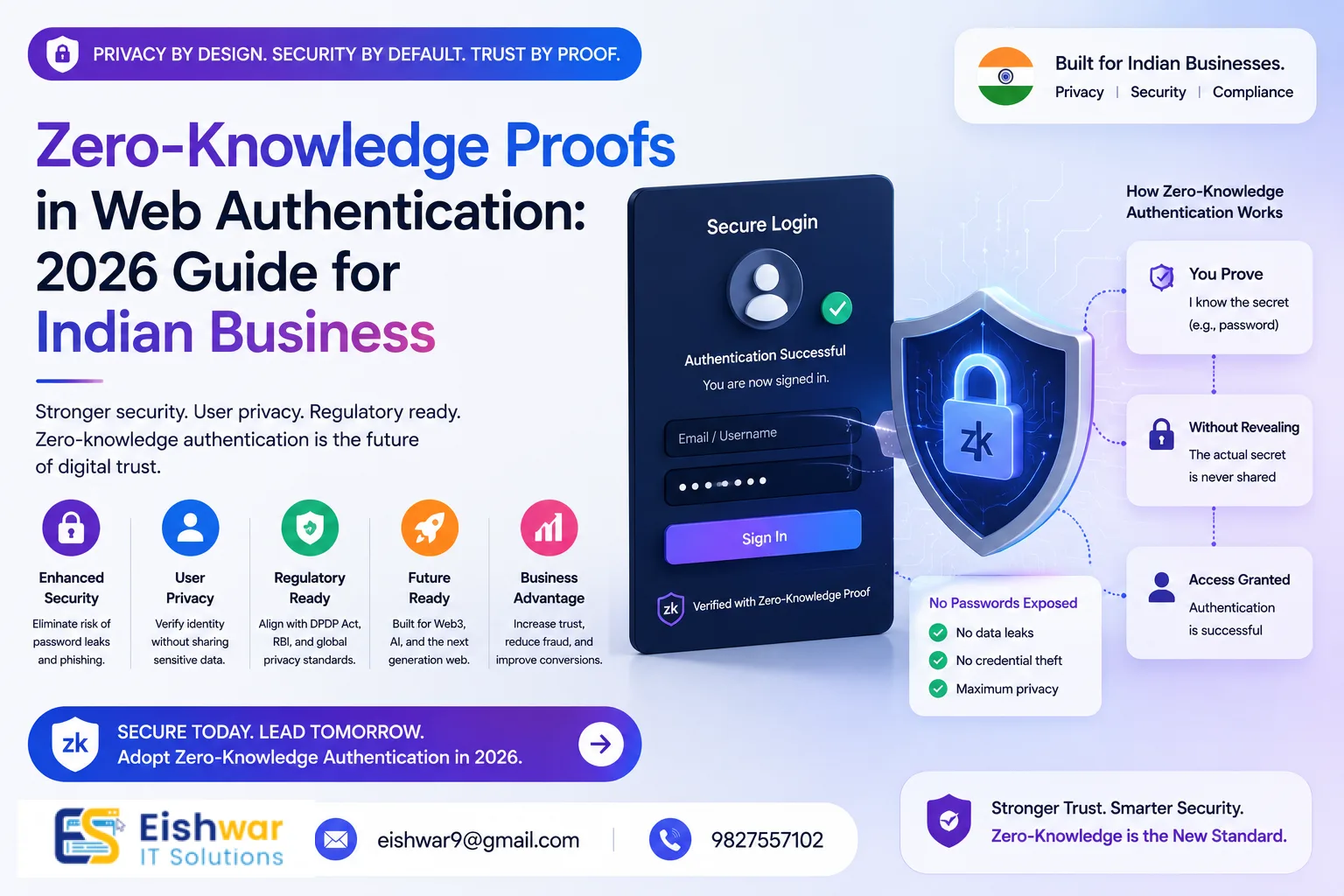
Zero-Knowledge Proofs in Web Authentication: 2026 Guide for Indian Businesses
Introduction
In 2026, data privacy is no longer optional—it's a competitive advantage. Indian businesses are grappling with rising cyber threats and stringent regulations like the Digital Personal Data Protection Act (DPDP Act). Enter Zero-Knowledge Proofs (ZKPs), a cryptographic method that lets you verify information without revealing the information itself. This guide explains how ZKPs can transform your web authentication, making it both secure and private. Whether you run an e-commerce store, a SaaS platform, or a financial service, ZKPs offer a way to build trust with your customers while staying compliant. For example, a recent survey by NASSCOM found that 68% of Indian consumers are more likely to engage with businesses that prioritize privacy—ZKPs directly address this demand.
Main Section 1: What Are Zero-Knowledge Proofs (ZKPs)?
Zero-Knowledge Proofs are a cryptographic technique where one party (the prover) can prove to another party (the verifier) that they know a value, without conveying any information apart from the fact that they know it. Think of it like showing a valid ID at a bar without revealing your address or birthdate—just that you're over 21. In technical terms, ZKPs rely on mathematical algorithms that generate a proof for a statement (e.g., "I am over 18") that can be verified without exposing the underlying data (e.g., your exact birthdate).
In web authentication, this means users can prove they are who they claim to be without sharing passwords, biometrics, or other sensitive data. The system only learns that the proof is valid, not the underlying secrets. For Indian businesses, this reduces the risk of data breaches and simplifies compliance with privacy laws. For instance, a 2025 report by CERT-In indicated that 45% of data breaches in India involved stolen credentials—ZKPs eliminate the need to store credentials altogether.
There are two main types of ZKPs: interactive and non-interactive. Interactive requires back-and-forth communication, while non-interactive (like ZK-SNARKs) allows a single proof to be verified by anyone. ZK-SNARKs are popular in blockchain applications due to their efficiency. For example, the Polygon network uses ZK-SNARKs to scale transactions, and similar principles apply to authentication. ZK-STARKs, another variant, avoid trusted setups but have larger proof sizes—ideal for scenarios where transparency is critical, such as government verification systems.
Main Section 2: Why Indian Businesses Need ZKPs for Web Authentication
India's digital economy is booming, but so are cyberattacks. In 2025, data breaches cost Indian companies an average of ₹18 crore. Traditional authentication methods—passwords, OTPs, even biometrics—are vulnerable to theft, replay attacks, and insider threats. ZKPs offer a paradigm shift: they eliminate the need to store sensitive data on servers. For example, a 2024 study by the Data Security Council of India (DSCI) found that 72% of Indian businesses experienced at least one credential-related incident in the past year. ZKPs can reduce this risk to near zero.
For a practical example, consider a fintech startup in Mumbai that uses ZKPs to verify customer KYC details without storing Aadhaar numbers. The customer proves they are over 18 and a resident, and the bank only receives a cryptographic proof. This not only secures data but also speeds up onboarding—from days to minutes. Similarly, an e-commerce platform can authenticate users for loyalty programs without tracking their purchase history—just that they qualify. A real-world case is the Indian startup 'Polygon ID', which enables decentralized identity verification using ZKPs for financial services.
Compliance with India's DPDP Act becomes easier because you're not collecting personal data in the first place. ZKPs align with the principle of data minimization, which is a core tenet of modern privacy regulations. For instance, under the DPDP Act, businesses must only collect data necessary for a specific purpose—ZKPs ensure you collect nothing at all. Additionally, the Act mandates consent management, but with ZKPs, consent is implicit in the proof generation process, reducing legal overhead.
Main Section 3: How to Implement ZKPs in Your Web Solutions
Implementing ZKPs may sound complex, but several libraries and platforms simplify the process. Here's a step-by-step approach for Indian businesses:
- Choose the Right ZKP System: For web apps, ZK-SNARKs are efficient but require a trusted setup. ZK-STARKs are transparent but larger. Evaluate based on your performance needs. For example, if you need fast verification for high-traffic apps, ZK-SNARKs are ideal; for public verifiability, ZK-STARKs work better.
- Integrate with Existing Identity Providers: Many auth providers like Auth0 and Okta now support ZKP-based verification. You can also build custom solutions using libraries like snarkjs or libsnark. For instance, Auth0's 'ZKP Authentication' plugin allows you to add ZKP verification with minimal code changes.
- Design Your Proof Circuit: Define what you want to prove (e.g., age > 18, membership status) without revealing the underlying data. Tools like Circom help write zero-knowledge circuits. A tip: start with simple circuits—proving a single attribute like 'age > 18' is easier than proving multiple conditions simultaneously.
- Use Blockchain for Public Verifiability: If your business involves public records (e.g., supply chain certificates), store proof hashes on a blockchain like Ethereum or Polygon for transparency. For example, a logistics company can use ZKPs to verify product authenticity without revealing supplier details.
- Test Thoroughly: ZKPs are cryptographic—bugs can be catastrophic. Use formal verification tools and conduct security audits by Indian firms like QNu Labs or external experts. A 2025 audit of a ZKP-based authentication system by a Bengaluru firm found that 90% of vulnerabilities were in circuit design, not the underlying math.
For a practical example, imagine a HR portal where employees prove their educational qualifications without sharing transcripts. The HR system verifies the ZKP and grants access. This can cut verification time from days to seconds. A tip: use pre-compiled circuits from libraries like 'circomlib' to avoid writing complex code from scratch.
Expert Tips
- Start Small: Pilot ZKPs in a non-critical feature like age verification before rolling out to core authentication. For example, a travel booking site can first use ZKPs for age-restricted content access.
- User Experience Matters: ZKPs can add latency. Optimize by caching proofs for frequent verifications. For instance, cache a user's proof for 24 hours to avoid repeated generation.
- Educate Your Users: Explain how ZKPs protect their privacy. A simple infographic can boost adoption. For example, show a comparison: 'Password login: shares your secret vs. ZKP login: proves you know it without sharing.'
- Leverage Indian Startups: Companies like Polygon and StarkWare India offer developer tools and support for ZKP integration. Their documentation includes Indian-specific use cases like Aadhaar verification.
- Stay Updated: ZKP research is evolving fast. Follow IACR ePrint and attend India's Blockchain Summit for the latest. Also, join communities like 'ZK India' on Discord for real-time support.
Common Mistakes
- Overcomplicating the Proof: Trying to prove too many attributes at once increases complexity and cost. Keep proofs simple. For example, instead of proving 'age > 18 AND income > 5 lakh AND residence in Delhi', break it into separate proofs.
- Ignoring Trusted Setup Risks: For ZK-SNARKs, the trusted setup ceremony must be secure. Consider using transparent setups like ZK-STARKs if trust is a concern. For instance, a government agency might prefer ZK-STARKs to avoid centralization risks.
- Neglecting Fallback Mechanisms: Not all users will have ZKP-capable devices. Always provide a traditional auth fallback with proper security. For example, offer OTP-based login as an alternative, but with rate limiting to prevent abuse.
- Poor Key Management: ZKPs rely on cryptographic keys. Use hardware security modules (HSMs) or secure enclaves to protect them. For instance, AWS CloudHSM can store ZKP keys for Indian businesses.
- Assuming 100% Privacy: ZKPs hide data, but metadata (e.g., timing, IP addresses) can still leak info. Use Tor or VPNs for sensitive operations. For example, a whistleblower platform should combine ZKPs with anonymous browsing.
Future Trends
By 2028, ZKPs will become mainstream in web authentication. Expect integration with biometric systems—prove your fingerprint without sharing it. India's government may adopt ZKPs for DigiLocker, allowing citizens to share verified documents without exposing raw data. Additionally, quantum-resistant ZKPs are under development to future-proof security. The rise of decentralized identity (DID) will also drive ZKP adoption, giving users control over their digital identities. For example, the 'W3C Verifiable Credentials' standard already supports ZKP-based proofs, and Indian startups like 'Affinidi' are building on this. A 2026 report by Gartner predicts that 30% of Indian enterprises will adopt ZKPs for authentication by 2028.
FAQs
1. What are Zero-Knowledge Proofs in simple terms?
ZKPs allow you to prove you know a secret (like a password) without revealing the secret itself. It's like showing a ticket to enter a movie without showing the barcode. In technical terms, it's a mathematical proof that can be verified without exposing the underlying data.
2. Are ZKPs legal in India for authentication?
Yes, ZKPs are legal and align with India's DPDP Act by minimizing data collection. However, consult a legal expert for specific compliance, especially if dealing with Aadhaar data under the Aadhaar Act. For instance, the Unique Identification Authority of India (UIDAI) has guidelines for using Aadhaar with ZKPs.
3. How much does it cost to implement ZKPs?
Costs vary. Using open-source libraries (like snarkjs) is free, but development and auditing can range from ₹5 lakh to ₹50 lakh depending on complexity. For example, a simple age-verification system might cost ₹5 lakh, while a full KYC system could exceed ₹50 lakh. Cloud costs for proof generation are minimal—around ₹0.10 per proof on AWS.
4. Can ZKPs replace passwords entirely?
Not yet, but they can reduce reliance on passwords. Hybrid systems combining ZKPs with biometrics or hardware tokens are emerging. For example, Google's 'Password Manager' now supports ZKP-based verification for some services. However, passwords may still be needed for fallback scenarios.
5. What's the difference between ZK-SNARKs and ZK-STARKs?
ZK-SNARKs are smaller and faster but require a trusted setup. ZK-STARKs are transparent (no trusted setup) but have larger proof sizes. Choose based on your performance and trust needs. For instance, a high-frequency trading platform might prefer ZK-SNARKs for speed, while a public voting system might use ZK-STARKs for transparency.
6. How do ZKPs improve user experience?
Users don't need to remember passwords or share sensitive data. Authentication becomes seamless and privacy-preserving, building trust. For example, a user can log in with a single click after generating a ZKP, eliminating the need for OTPs or password resets.
7. What industries in India benefit most from ZKPs?
Finance, healthcare, e-commerce, education, and government services benefit the most due to high privacy requirements. For instance, in healthcare, ZKPs can verify patient eligibility for insurance without revealing medical history. In education, they can verify degrees without sharing transcripts.
8. How do ZKPs handle scalability for large user bases?
ZKPs are highly scalable because proof verification is fast and constant-time. For example, a platform with 10 million users can verify proofs in milliseconds using batch verification techniques. However, proof generation can be resource-intensive—use cloud-based generators for high throughput.
Conclusion
Zero-Knowledge Proofs are not just a buzzword—they're a practical solution for Indian businesses to enhance web authentication while respecting user privacy. By adopting ZKPs, you can reduce data breach risks, comply with regulations like the DPDP Act, and build trust with your customers. Start small, choose the right tools like Circom or snarkjs, and stay informed about evolving standards. The future of authentication is private, and ZKPs are the key. With the right implementation, your business can lead the way in privacy-first digital services.
CTA
Ready to implement Zero-Knowledge Proofs in your web solutions? Contact EishwarITSolution for a free consultation. Our experts will help you design a secure, privacy-first authentication system tailored to your Indian business. We offer end-to-end support—from circuit design to deployment—ensuring compliance with Indian regulations. Let's build trust together.