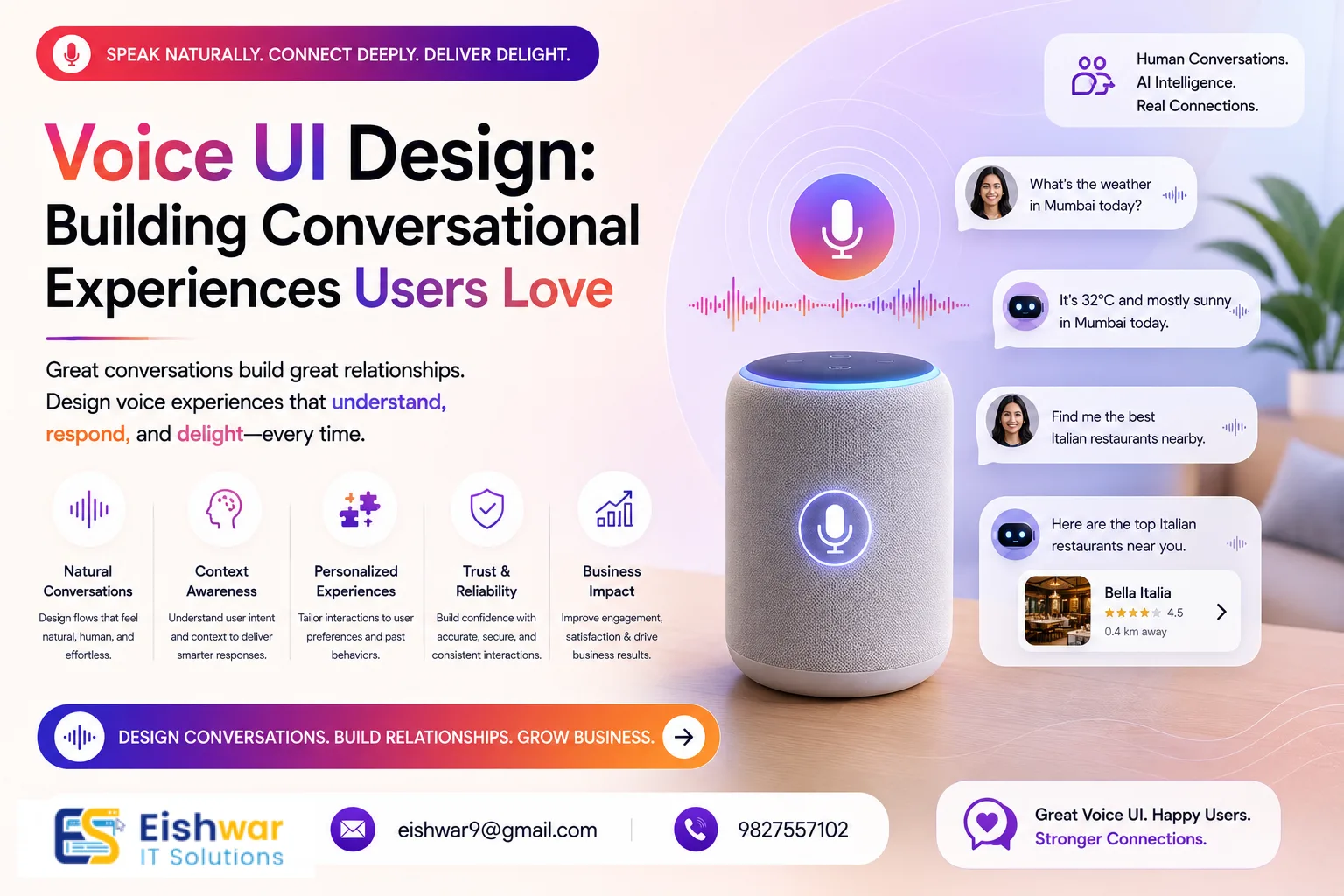
Voice UI Design: Building Conversational Experiences Users Love
Introduction
Imagine asking your phone to book a cab, your smart speaker to order groceries, or your car to navigate to the nearest EV charging station. Voice commands are no longer sci-fi—they're everyday reality. In India, voice search is exploding, with over 200 million users expected to use voice assistants by 2026. Yet many businesses still treat voice UI as an afterthought, often relegating it to a simple command-and-response system that frustrates users.
At EishwarITSolution, we've seen firsthand how thoughtful voice user interface (VUI) design can boost user engagement by up to 40%, reduce friction in customer journeys, and open new revenue streams through voice commerce and support. In this comprehensive guide, we'll walk you through the principles, pitfalls, and future of designing conversational experiences that users actually enjoy—backed by real-world examples and data from user behaviour analytics.
Main Section 1: Why Voice UI Matters Now More Than Ever
The Rise of Voice-First Interactions
Voice interfaces are moving from novelty to necessity. From Google Assistant to Amazon Alexa, users are embracing hands-free interactions for tasks like setting reminders, checking weather, or controlling smart home devices. In India, where mobile-first and low-literacy segments are huge, voice offers a more inclusive experience. For instance, a farmer in rural Maharashtra can use a voice-enabled app to check crop prices without needing to read or type. This democratization of technology is driving adoption across demographics.
User Behaviour Analytics Reveals the Shift
Data from user behaviour analytics tools like Hotjar, Mixpanel, and custom event tracking shows that voice queries are more conversational and intent-rich. Users ask full questions like "Where can I find the best biryani near me?" instead of typing "biryani near me." This shift demands a new design approach—one that understands natural language, context, and user intent. For example, a food delivery app that optimizes for voice might see a 25% increase in order completion rates because users can quickly specify preferences without scrolling through menus.
Business Benefits for Indian Enterprises
For business owners, voice UI can reduce support costs by automating common queries (e.g., "What's my order status?"), increase conversion rates through personalized recommendations, and improve accessibility for users with disabilities. A well-designed voice experience can differentiate your brand in a crowded market. Consider a telecom company that uses voice to help users recharge plans—by reducing steps from five to two, they saw a 30% drop in call center volume.
Main Section 2: Core Principles of Effective VUI Design
1. Design for Conversational Flow
Unlike visual interfaces, voice has no back button. Every interaction should feel like a natural dialogue. Use confirmation prompts ("You said Mumbai, correct?") and error recovery ("I didn't catch that, could you repeat?") to keep users on track. For example, a banking app might say, "I heard you want to transfer ₹5,000 to account ending 1234. Is that correct?" This reduces errors and builds trust.
2. Keep It Concise and Contextual
Users expect brevity. A voice response should be 2-3 sentences max. Use contextual awareness—if the user asks "What's the weather?" and they're in Delhi, don't ask for location again. Instead, respond with "It's 32°C and sunny in Delhi today." This saves time and feels intuitive. For e-commerce, a voice assistant could say, "Your last order was biryani from Paradise. Want to reorder?" based on purchase history.
3. Prioritise Inclusivity with Multilingual Support
India's linguistic diversity demands VUI that understands Hindi, Tamil, Bengali, and more. Use natural language processing (NLP) that handles code-switching (e.g., "Mujhe pizza chahiye"). For example, a travel booking app might support "Mujhe Delhi se Mumbai ka ticket chahiye" and seamlessly process the request. This inclusivity can expand your user base by 50% in non-English speaking regions.
4. Use Persona and Tone
Give your voice assistant a personality. A banking app might need a formal tone ("Your account balance is ₹25,000"), while a food delivery app can be friendly ("Hey! Your biryani is on its way!"). Consistency builds trust. For instance, a healthcare app using a calm, empathetic tone for appointment reminders saw higher adherence rates compared to a robotic one.
Main Section 3: Integrating User Behaviour Analytics into VUI Design
Tracking Voice Interactions
Use analytics to measure task completion rates, fallback frequency (how often users get stuck), and conversation length. Tools like Google Analytics for Actions or custom event tracking can reveal drop-off points. For example, if 40% of users abandon a voice checkout after the payment step, you might need to simplify the authentication process or add a visual confirmation.
A/B Testing Voice Flows
Test different prompts and responses. For example, try "Would you like a discount?" vs. "I see you saved ₹500 last time—want to use that offer?" Data shows personalised prompts increase conversion by 30%. A travel app could test two versions of a flight booking flow: one with step-by-step confirmation and one with a single "Book it" command. Analytics will reveal which leads to higher satisfaction and fewer errors.
Iterate Based on Real User Behaviour
Let behaviour analytics guide your design. If many users ask "What can you do?" after onboarding, add a help prompt earlier. If they frequently correct a misheard word, improve pronunciation models. For instance, a music streaming app noticed users often said "Play some jazz" but the system played "Jazz" by Queen. By analysing fallback logs, they updated their NLP to prioritize genre over artist name, reducing errors by 60%.
Expert Tips
- Start with a narrow use case: Don't try to do everything. Focus on 3-5 core tasks your users actually need voice for, like checking order status or booking appointments. This reduces complexity and improves accuracy.
- Design for failure gracefully: Users will make mistakes. Plan for misunderstandings with clear, helpful fallback messages like "I didn't understand. Please say 'yes' or 'no'." Avoid generic responses like "Sorry, I can't do that."
- Use visual cues when possible: On screens, combine voice with buttons or cards to reduce cognitive load. For example, a voice search result could display a list of options on screen while the assistant reads the top result aloud.
- Test with real users in local languages: What works in English may fail in Hindi. Run usability tests with your target audience to catch cultural nuances and pronunciation issues.
- Monitor sentiment: Analyse user tone and frustration levels using sentiment analysis tools to improve responses. If users sound annoyed, the system could offer to transfer to a human agent.
Common Mistakes
- Overpromising and underdelivering: Don't make your voice assistant sound smarter than it is. Set clear expectations by saying "I can help with orders and support" rather than "I can do anything."
- Ignoring privacy concerns: Users worry about recordings. Be transparent about data usage and offer opt-out options. For example, a smart speaker could say, "This conversation is recorded to improve my responses. You can delete recordings in settings."
- Designing for ideal scenarios only: Account for background noise, accents, and varying internet speeds. Test in noisy environments like a busy kitchen or a moving car to ensure robustness.
- Forgetting the visual context: A voice-only experience is different from a screen+voice one. Design for both by providing visual fallbacks (e.g., text on screen) when voice fails.
- Not using analytics to improve: Without data, you're guessing. Use user behaviour analytics to refine every interaction, from welcome messages to error handling.
Future Trends
Voice + AI Personalisation
AI will enable hyper-personalised voice experiences. Imagine a voice assistant that knows your coffee order, preferred news topics, and even your mood from your tone. For example, a smart speaker could say, "You sound stressed. Would you like to hear some calming music?" This level of personalisation will drive deeper engagement.
Voice Commerce in India
With UPI and digital payments booming, voice commerce (v-commerce) will grow. Users will say "Order my usual groceries" and complete payments via voice authentication. Companies like Flipkart are already testing voice-based shopping for regional languages, making it easier for users in tier-2 and tier-3 cities to shop online.
Multimodal Interfaces
Voice will blend with visual, touch, and gesture inputs. For example, a smart mirror might show your calendar while you say "What's my first meeting?" This multimodal approach reduces cognitive load and makes interactions more natural.
Emotionally Intelligent VUI
Future VUI will detect frustration or excitement and adjust responses accordingly. A user who sounds angry might get a more empathetic reply like "I understand this is frustrating. Let me connect you to a human agent." This will improve user satisfaction and reduce churn.
FAQs
- What is the difference between VUI and GUI?
VUI (Voice User Interface) relies on speech for interaction, while GUI (Graphical User Interface) uses visual elements like buttons and menus. VUI is hands-free and more natural for certain tasks like driving or cooking, but GUI is better for complex data entry.
- How can small businesses afford VUI design?
Start with no-code platforms like Voiceflow or use existing APIs (Google Dialogflow, Amazon Lex) which offer free tiers. Focus on one high-impact use case first, like automating FAQ responses, to see ROI before scaling.
- Is voice UI secure for financial transactions?
With proper authentication (voice biometrics, PIN) and encryption, yes. Always comply with RBI guidelines and data privacy laws like the Digital Personal Data Protection Act. For example, a banking app might require a voice PIN for high-value transfers.
- What languages should my VUI support in India?
Prioritise Hindi, English, and one regional language relevant to your audience, like Tamil for South India or Bengali for East India. Use analytics to see which languages your users prefer based on voice query data.
- How do I measure the success of a voice interface?
Track task completion rate, user retention, fallback rate, and customer satisfaction scores (CSAT). Compare with baseline metrics from your current UI. For example, if voice reduces average handling time by 20%, it's a success.
- Can voice UI work for B2B products?
Absolutely. Voice can streamline CRM data entry, automate reporting, and enhance field service operations. B2B users value speed and convenience—a sales rep could say "Log meeting with Acme Corp" to update records hands-free.
Conclusion
Voice UI is not a passing trend—it's a fundamental shift in human-computer interaction. For Indian businesses, embracing VUI design can unlock new audiences, improve user satisfaction, and give you a competitive edge. By combining thoughtful design with user behaviour analytics, you can create voice experiences that feel less like talking to a machine and more like talking to a helpful assistant. The key is to start small, test often, and let data guide your decisions. Whether you're a startup or an enterprise, the time to invest in voice is now. The future of UX is conversational—and it's speaking your language.
CTA
Want to design a voice interface that your users will love? Contact EishwarITSolution for a free consultation. Our team of UX/UI experts and data analysts will help you build a conversational experience that drives results. Let's talk!