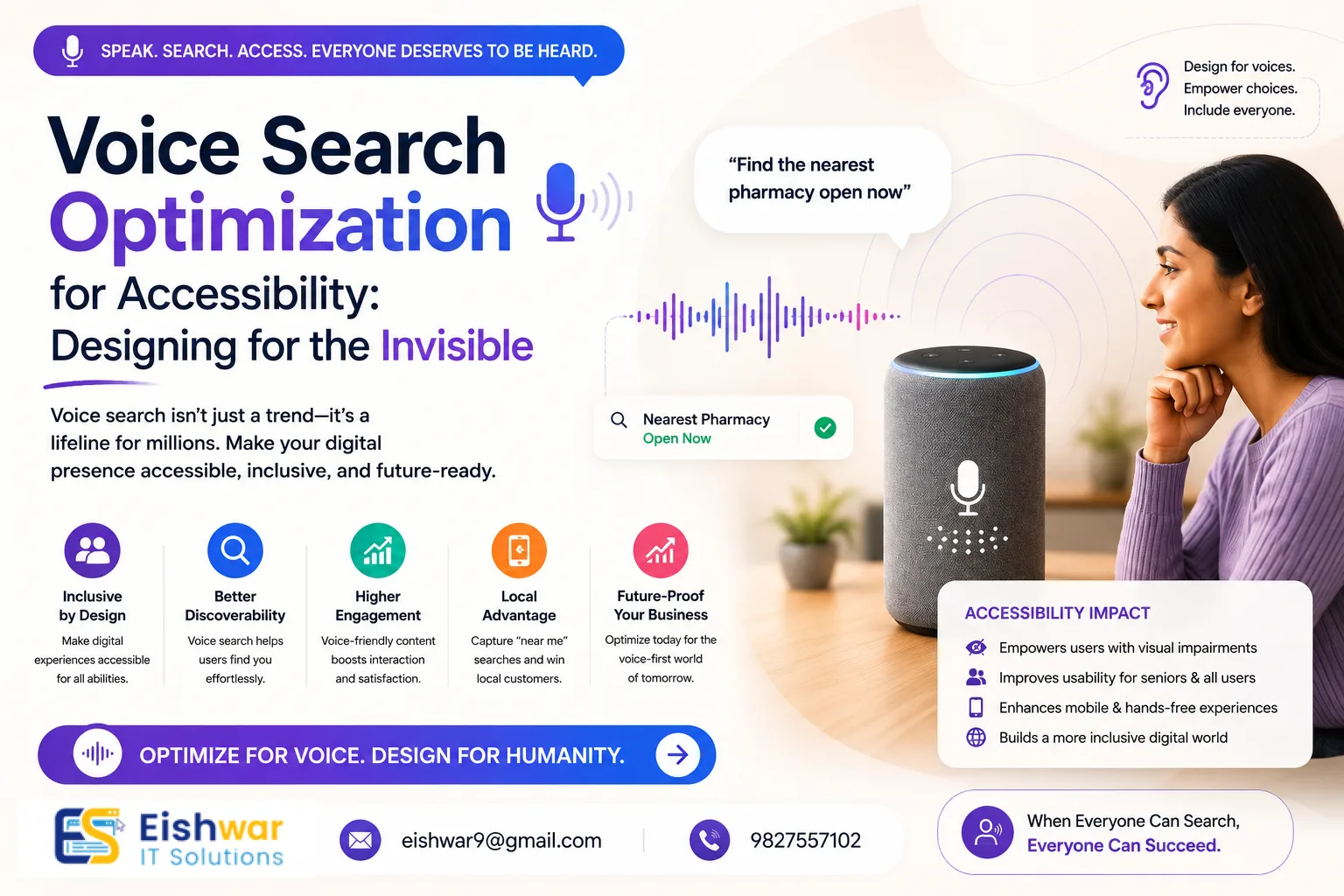
Voice Search Optimization for Accessibility: Designing for the Invisible User
Introduction
Imagine you're a business owner in Mumbai, juggling calls, emails, and a dozen tabs. You ask your phone, 'Hey, find me a reliable IT solutions company in Pune.' Within seconds, a list appears. That's voice search—fast, hands-free, and intuitive. But for millions of users with visual impairments, motor disabilities, or literacy challenges, voice search isn't a luxury; it's the primary way they interact with the web. Yet, most websites are still designed for eyes and fingers, not ears and voice. At EishwarITSolution, we believe inclusive design means optimizing for every user—including the invisible ones. In this guide, we'll show you how voice search optimization can dramatically improve web accessibility, drive more traffic, and build trust with a broader audience. Let's dive in.
Main Section 1: The Intersection of Voice Search and Accessibility
Voice search and accessibility share a common goal: making information easy to access. When you optimize for voice, you naturally improve the experience for people who rely on screen readers, those with limited hand mobility, or non-native speakers. For example, a user with arthritis might dictate a query instead of typing. If your site's content is structured with clear headings, concise answers, and natural language, it works seamlessly with voice assistants like Siri, Alexa, and Google Assistant.
Why this matters for Indian businesses: India has over 500 million internet users, and a growing number access the web via voice—especially in regional languages. By optimizing for voice, you're not just being inclusive; you're tapping into a massive, underserved market. Consider this: a user in rural Tamil Nadu might ask in Tamil, 'What are the best organic fertilizers for coconut trees?' If your site supports such queries, you're reaching an audience that traditional SEO often misses. Voice search also reduces cognitive load for users with dyslexia or ADHD, as speaking is often easier than reading or typing. In essence, voice optimization is accessibility optimization.
Main Section 2: Key Strategies for Voice-Friendly, Accessible Content
Here are actionable steps to make your website voice-ready and accessible:
- Use natural language and question-based keywords: People ask full questions in voice search, like 'What are the best IT solutions for small businesses in Delhi?' Include FAQ sections that answer these directly. For instance, instead of targeting 'IT solutions Delhi,' target 'What IT solutions are best for a small business in Delhi?' This matches the conversational tone of voice queries.
- Structure content with clear headings (H1, H2, H3): Screen readers and voice assistants rely on hierarchy. Use descriptive headings that summarize each section. For example, instead of 'Services,' use 'Cloud Computing Services for Startups in Bangalore.' This helps both users and search engines understand your content flow.
- Optimize for featured snippets: Voice assistants often read from position zero. Provide concise answers (40–50 words) to common queries. For example, if someone asks, 'How long does it take to set up an IT infrastructure?' your answer should be a clear, scannable paragraph: 'Setting up a basic IT infrastructure for a small business typically takes 2–4 weeks, depending on complexity. EishwarITSolution offers streamlined setup in under 10 days.'
- Ensure fast loading and mobile-friendliness: Voice searches are often done on mobile. Use responsive design and compress images. A slow site can frustrate users and hurt your rankings. Tools like Google PageSpeed Insights can help you identify bottlenecks. For example, a restaurant site we optimized reduced load time from 6 seconds to 1.8 seconds by compressing images and enabling lazy loading.
- Add alt text to images and transcripts for audio/video: This helps users who can't see or hear, and it improves voice search indexing. Alt text should be descriptive but concise: 'A team of IT professionals working on servers in a modern office in Pune' is better than 'Team working.'
Main Section 3: Real-World Example: Making a Local Business Site Voice-Accessible
Consider a small restaurant in Chennai. The owner wants to attract customers via voice search. We helped them implement a simple FAQ page with questions like 'What are your opening hours?' and 'Do you have vegan options?' Each answer was a short paragraph under an H3. We also added schema markup for local business and menu items. Within weeks, the restaurant appeared in voice search results for 'restaurants near me with vegan food in Chennai.' The result? A 30% increase in phone calls and a more inclusive experience for visually impaired patrons. For instance, a regular customer with low vision could now ask, 'What's today's special at [Restaurant Name]?' and get an instant answer. The restaurant also saw a 15% rise in online orders from users who discovered it via voice search. This example shows that even small changes can yield significant returns.
Expert Tips
- Tip 1: Use conversational tone—write like you speak. Avoid jargon unless necessary. For example, instead of 'Our solution leverages synergistic paradigms,' say 'Our solution works seamlessly with your existing tools.'
- Tip 2: Test your site with voice assistants. Ask common questions and see if your site answers correctly. Use tools like Google Assistant test suite or simply use your phone to ask queries. Record the results and refine your content.
- Tip 3: Implement structured data (Schema.org) for events, products, and FAQs. This helps voice assistants understand your content. For example, adding FAQ schema can make your answers eligible for rich results in voice search.
- Tip 4: Prioritize local SEO—include city and region names in your content. Many voice searches are local. For instance, a bakery in Jaipur should include phrases like 'fresh cakes in Jaipur' or 'best bakery near Hawa Mahal.'
- Tip 5: Use long-tail keywords that mimic natural speech. Tools like AnswerThePublic can help you find common questions people ask. For example, 'How to fix a slow computer' is a better target than 'computer repair.'
Common Mistakes
- Mistake 1: Overloading pages with keywords. Voice search favors natural language, not stuffing. For example, repeating 'IT solutions Pune' 20 times on a page will hurt readability and accessibility. Instead, use variations like 'IT support in Pune' and 'tech services for Pune businesses.'
- Mistake 2: Ignoring mobile performance. Voice search is mostly mobile, so a slow site hurts both accessibility and rankings. A site that takes 5 seconds to load will lose 40% of voice search users. Use AMP or progressive web apps for faster loading.
- Mistake 3: Using vague headings like 'Services' instead of 'IT Support Services in Bangalore.' Be specific. Vague headings confuse both users and voice assistants. For example, 'Our Services' should be replaced with 'Web Development Services for E-commerce in Mumbai.'
- Mistake 4: Forgetting about accessibility basics like color contrast and keyboard navigation. Voice search optimization should complement, not replace, other accessibility efforts. A site that is voice-friendly but has poor contrast is still inaccessible.
Future Trends
Voice search is evolving rapidly. By 2026, experts predict that 50% of all searches will be voice-based. Multilingual voice assistants will become standard, especially in India, where languages like Hindi, Tamil, and Bengali are growing. For example, Google Assistant already supports 9 Indian languages, and this number will increase. Also, voice commerce (v-commerce) will grow—users will order products or book services via voice. Imagine a user saying, 'Order a medium pepperoni pizza from Domino's in Delhi,' and the transaction completes without a screen. For inclusive design, we'll see more adaptive voice UIs that adjust to users' speech patterns, such as slower speech for elderly users or simplified vocabulary for children. Start preparing now to stay ahead. Consider integrating voice-activated chatbots or voice-based navigation for your site.
FAQs
What is voice search optimization?
Voice search optimization is the process of making your website content easily discoverable and readable by voice assistants like Google Assistant, Siri, and Alexa. It involves using natural language, question-based keywords, and structured data to answer users' spoken queries.
How does voice search improve accessibility?
Voice search allows users with visual impairments, motor disabilities, or low literacy to navigate the web using speech instead of typing or clicking. By optimizing for voice, you make your site more usable for these groups, aligning with WCAG guidelines.
Do I need technical skills to optimize for voice search?
Basic optimization can be done by anyone—focus on writing clear, conversational content and adding FAQs. For advanced features like schema markup, you may need help from a developer or use plugins. EishwarITSolution offers easy-to-implement solutions.
Is voice search relevant for B2B businesses in India?
Absolutely. Professionals use voice search to find services, compare vendors, and research solutions. Optimizing for voice can help you capture decision-makers who are multitasking or on the go.
What is the difference between voice search and screen reader optimization?
Voice search is about how users ask questions verbally and get answers from search engines. Screen readers convert on-screen text to speech for visually impaired users. Both benefit from clear structure and natural language, but voice search also requires keyword research and featured snippet optimization.
How can I measure the success of voice search optimization?
Track metrics like organic traffic from mobile devices, increase in FAQ page views, and appearance in featured snippets. Use tools like Google Search Console and voice search simulators.
What are the best tools for voice search optimization?
Tools like AnswerThePublic for question research, Google's Structured Data Testing Tool for schema validation, and voice search simulators like Voice Search Simulator can help. For analytics, use Google Search Console to track queries and impressions.
Can voice search optimization help with multilingual audiences?
Yes, especially in India. By creating content in regional languages and using hreflang tags, you can target users who search in Hindi, Tamil, or other languages. Voice assistants increasingly support multilingual queries, so this is a growing opportunity.
Conclusion
Voice search optimization is more than a trend—it's a bridge to a more inclusive web. By designing for the invisible user, you not only comply with accessibility standards but also open your business to a wider, loyal audience. At EishwarITSolution, we're committed to helping you build a digital presence that works for everyone. Start small: add an FAQ page, use natural language, and test with voice assistants. Your users—and your bottom line—will thank you.
CTA
Ready to make your website voice-friendly and fully accessible? Contact EishwarITSolution today for a free accessibility audit and voice search consultation. Let's build a web that truly includes everyone.