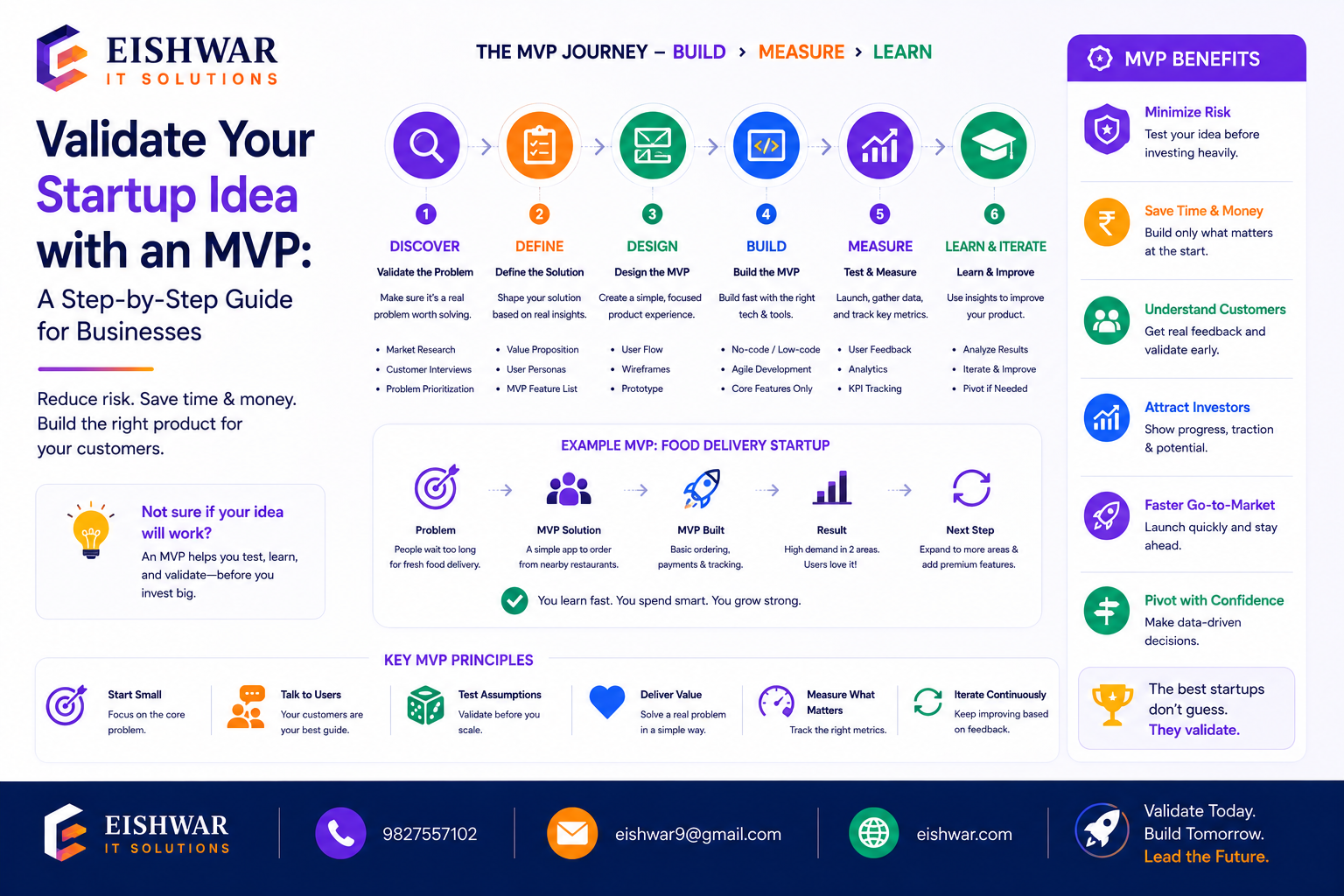
Validate Your Startup Idea with an MVP: A Step-by-Step Guide for Indian Entrepreneurs
Introduction
Every great startup begins with a bold idea. But in India’s fast-paced, competitive market—where over 50,000 startups compete for attention—a great idea alone isn’t enough. You need to validate it before pouring time, money, and resources into full-scale development. That’s where a Minimum Viable Product (MVP) comes in.
An MVP is the simplest version of your product that delivers core value to early adopters. It helps you test assumptions, gather feedback, and avoid building something nobody wants. In this guide, we’ll walk you through a step-by-step process to validate your startup idea using an MVP—with practical tips and real examples from the Indian startup ecosystem. Whether you’re a first-time founder in Bengaluru or a seasoned entrepreneur in Mumbai, this playbook will help you move from idea to product-market fit with confidence.
Main Section 1: Why MVP Validation Matters for Indian Startups
India is home to over 50,000 startups, but nearly 90% fail within the first five years. The top reason? Lack of market need. Building a full product without validation is like cooking a feast for guests who may not show up—wasteful and disheartening.
An MVP helps you:
- Test demand before investing heavily. For example, a simple landing page with a signup form can reveal if there’s real interest in your solution.
- Gather real user feedback to refine your product. Early adopters often provide insights that no amount of market research can uncover.
- Attract early investors with proof of traction. Angel investors and VCs in India are more likely to fund a startup with 100 paying users than one with a polished pitch deck.
- Save money and time by focusing on what works. Instead of spending ₹10 lakhs on a full app, you can validate with ₹50,000 and iterate.
For example, Zomato started as a simple website listing restaurant menus—a far cry from the food delivery giant it is today. They validated the concept of online restaurant discovery before expanding. Similarly, Ola began with just a handful of cars in Mumbai, manually connecting drivers and riders to test demand. These examples show that even the biggest unicorns started with a tiny, focused MVP.
Main Section 2: Step-by-Step Process to Validate Your Startup Idea with an MVP
Step 1: Define Your Core Hypothesis
Start by identifying the riskiest assumption behind your idea. Is it that people want your solution? Will they pay for it? Write down one clear hypothesis. For instance: “Small business owners in Mumbai will pay for an AI-powered accounting tool that saves them 5 hours per week.” This hypothesis is testable and specific. Avoid vague statements like “People need better accounting software.” Drill down to the core value proposition.
Practical tip: Use the “If…then…” format. Example: “If I offer a free trial of my accounting tool to 50 small business owners, then at least 20 will sign up for a paid plan within 30 days.” This makes your hypothesis measurable.
Step 2: Identify Your Target Audience
Who are your early adopters? Create a detailed profile: demographics, pain points, and where they hang out online. For Indian startups, focus on Tier 1 and Tier 2 city users who are early tech adopters. For example, if you’re building a fintech app for gig workers, your target might be 25-35 year old delivery partners in Delhi who use smartphones daily and struggle with irregular income.
Practical tip: Use tools like Google Forms or Typeform to survey 20-30 people from your target audience. Ask open-ended questions about their biggest challenges. This will validate whether your problem is real and worth solving.
Step 3: Build the Simplest MVP
Your MVP should have only the core feature that solves the primary problem. Use no-code tools like Bubble, Webflow, or even a landing page with a signup form. For example, a prototype can be a clickable Figma mockup or a simple chatbot on your website. The goal is to test your hypothesis, not to build a perfect product.
Practical example: A founder in Pune wanted to create a platform for freelance graphic designers. Instead of building a full marketplace, he created a WhatsApp group where he manually matched designers with clients. This “concierge MVP” validated demand in just two weeks, with 50 signups and 10 paid projects.
Step 4: Set Success Metrics
Define what “validated” looks like. Common metrics include: number of signups, engagement rate, customer feedback scores, or willingness to pay. For example, aim for 100 signups in 30 days or a 20% conversion rate from free trial to paid. Be realistic—early-stage validation doesn’t require thousands of users, just enough to prove demand.
Practical tip: Use the “One Metric That Matters” (OMTM) approach. For a B2B SaaS, it might be demo requests. For a consumer app, it could be daily active users. Focus on one metric to avoid analysis paralysis.
Step 5: Launch and Gather Feedback
Release your MVP to a small group—friends, family, or a targeted community on platforms like LinkedIn, Product Hunt, or Indian startup forums like YourStory or StartupIndia. Use surveys and interviews to collect qualitative feedback. Pay attention to what users love and what they ignore. For example, if users rave about a specific feature but ignore others, that’s a signal to double down.
Practical tip: Set up a feedback loop using tools like Hotjar (for heatmaps) or Google Forms. Ask three questions: “What problem did this solve for you?”, “What was missing?”, and “Would you pay for this?”. The last question is the most critical.
Step 6: Analyze and Iterate
Crunch the numbers. Did you hit your success metrics? If yes, plan your next iteration—add more features, expand to new cities, or optimize your pricing. If not, pivot or refine your hypothesis. Remember, failure to validate is still valuable—it saves you from building the wrong product. For instance, if you aimed for 100 signups but only got 10, it’s time to revisit your target audience or value proposition.
Practical tip: Use a simple spreadsheet to track your metrics weekly. If after four weeks you’re not seeing progress, consider a pivot. Many successful startups, like Slack, pivoted after their initial MVP failed to gain traction.
Main Section 3: Real-World Examples of Successful MVP Validation in India
Ola
Ola started as a small website and app in Mumbai, offering only a few cars. They validated demand by manually connecting drivers with passengers. The founder, Bhavish Aggarwal, personally handled customer calls to understand pain points. Today, it’s a multi-billion dollar ride-hailing platform. The key takeaway: start small, test manually, and scale only after validation.
Freshworks
Freshworks began as a simple customer support tool for small businesses. Their MVP was a basic ticketing system with no integrations or analytics. They validated the need for affordable SaaS solutions in India before expanding globally. Today, Freshworks is a publicly traded company worth billions. Their lesson: focus on a single pain point (customer support) and solve it better than anyone else.
Urban Company
Urban Company (formerly UrbanClap) started with a single service—home cleaning—in Delhi. They tested the model manually, booking appointments via phone and coordinating with service partners. After validating demand, they expanded to other cities and services. Now they offer hundreds of services across cities. The insight: start with one service, nail the execution, then expand.
Expert Tips
- Start with a landing page: Create a simple page explaining your idea and include a “Get Early Access” button. Run Facebook or Google ads to drive traffic. Measure click-through and signup rates. For example, a landing page for a meal-kit delivery service might get 500 visits and 50 signups—that’s a 10% conversion rate, indicating demand.
- Use social media for validation: Post your concept in relevant Facebook groups or LinkedIn communities. Ask for honest feedback. Indian entrepreneur groups are particularly active and supportive. For instance, the “Startup India” Facebook group has over 100,000 members who can provide quick feedback.
- Run a smoke test: Sell your MVP before it’s built. Use a tool like Gumroad or a simple payment link. If people pay, you have validation. For example, a founder sold a “pre-order” for a productivity app at ₹999 and got 20 orders in a week—proof of willingness to pay.
- Leverage no-code tools: Platforms like Bubble, Adalo, and Glide let you build functional MVPs in days without coding. This is ideal for non-technical founders. For example, a no-code app for booking local tutors can be built in a weekend using Glide.
- Keep feedback loops short: Aim for weekly iterations based on user input. The faster you learn, the quicker you can adapt. Use tools like Trello or Notion to track feedback and prioritize changes.
Common Mistakes
- Building too much too soon: Adding too many features defeats the purpose of an MVP. Stick to the core value proposition. For example, don’t add payment gateways, analytics dashboards, and social login in version one—just the core feature.
- Ignoring negative feedback: Don’t dismiss criticism. It often contains the most valuable insights for improvement. If users say your interface is confusing, listen and simplify.
- Targeting too broad an audience: Focus on a niche segment first. Broad validation is harder and less actionable. For instance, instead of “all small businesses,” target “restaurants in Delhi with 10-50 employees.”
- Not defining clear success metrics: Without measurable goals, you can’t know if your idea is validated. Set specific targets like “50 signups in 2 weeks” or “30% open rate on emails.”
- Over-relying on friends and family: They may give biased feedback. Seek real strangers who represent your target market. Use online communities or paid surveys to get unbiased opinions.
Future Trends
As we move further into 2026, MVP validation is becoming more data-driven and automated. AI tools can now analyze user behavior and predict product-market fit. For example, platforms like Mixpanel and Amplitude offer AI-driven insights on user retention and engagement. Indian startups are increasingly using no-code platforms and AI-powered analytics to speed up validation. We also see a rise in “micro-MVPs”—ultra-slim versions tested in hyper-local markets before scaling. For instance, a startup in Chennai might test a food delivery app in just one neighborhood before expanding city-wide. Additionally, the use of generative AI for creating realistic prototypes and mockups is reducing the time to launch from weeks to days.
FAQs
1. What is an MVP, and why is it important for Indian startups?
An MVP (Minimum Viable Product) is the simplest version of your product that delivers core value. It’s important because it helps you test your idea with minimal investment, gather real feedback, and avoid building something no one wants. In India’s competitive market, where resources are scarce, an MVP is your best bet for survival.
2. How long should it take to build an MVP?
With no-code tools, an MVP can be built in 2–4 weeks. For more complex products, expect 4–8 weeks. The key is speed—get it into users’ hands as soon as possible. For example, a landing page MVP can be ready in a day, while a functional app might take a month.
3. Can I validate my idea without building anything?
Yes! Use landing pages, surveys, interviews, or even manual “concierge” services to test demand. Many Indian startups validate ideas by simply talking to potential customers and running small ad campaigns. For instance, a founder might offer a free consultation service to test if people are willing to pay for a solution.
4. How do I know if my MVP is successful?
Set clear success metrics upfront, such as number of signups, engagement rate, or willingness to pay. If you hit those targets, your idea is validated. If not, iterate or pivot. For example, if you aimed for 100 signups in 30 days and got 120, that’s a success. If you got only 10, it’s time to rethink.
5. What are the best no-code tools for building an MVP in India?
Popular no-code tools include Bubble (web apps), Glide (mobile apps), Adalo (mobile apps), Webflow (websites), and Zapier (automation). They are affordable and don’t require coding skills. For example, Bubble costs around ₹2,000 per month for a basic plan, making it accessible for bootstrapped startups.
6. How much does it cost to build an MVP?
Costs vary widely. A simple MVP can cost as little as ₹10,000–₹50,000 using no-code tools. Custom development may range from ₹1–5 lakhs. Focus on the cheapest way to test your core hypothesis. For instance, a WhatsApp-based MVP costs nothing but your time.
7. What if my MVP fails?
Failure is valuable! It means you avoided investing in a bad idea. Use the insights to pivot to a new concept or refine your approach. Many successful startups failed their first MVP. For example, Ola’s initial model of aggregating cabs faced challenges, but they iterated based on feedback and succeeded.
8. How do I find early adopters for my MVP in India?
Use platforms like LinkedIn, Facebook groups (e.g., “Startup India”), and forums like YourStory. Also, consider offline events like meetups or networking sessions in your city. For example, a fintech startup might find early adopters at a local entrepreneur meetup in Bengaluru.
9. Should I charge for my MVP from day one?
Not necessarily. You can start with a free trial to build a user base, then introduce pricing later. However, charging early can validate willingness to pay. For instance, a SaaS tool might offer a 14-day free trial followed by a ₹999/month plan.
10. How do I handle negative feedback from my MVP?
Embrace it! Negative feedback is a goldmine for improvement. Categorize feedback into “critical issues” (fix immediately) and “nice-to-haves” (address later). For example, if users complain about slow loading times, prioritize performance optimization.
Conclusion
Validating your startup idea with an MVP is not just a smart move—it’s essential for survival in India’s competitive market. By following the steps outlined in this guide, you can test your assumptions, gather real feedback, and build a product that people actually want. Remember, the goal is not perfection but learning. Start small, iterate fast, and let your users guide your journey. Whether you’re building a fintech app in Bengaluru or a food delivery service in Delhi, an MVP is your ticket to turning a bold idea into a thriving business.
CTA
Ready to build your MVP and validate your startup idea? Contact EishwarITSolution today for expert MVP development services tailored for Indian entrepreneurs. Let’s turn your idea into a success story!