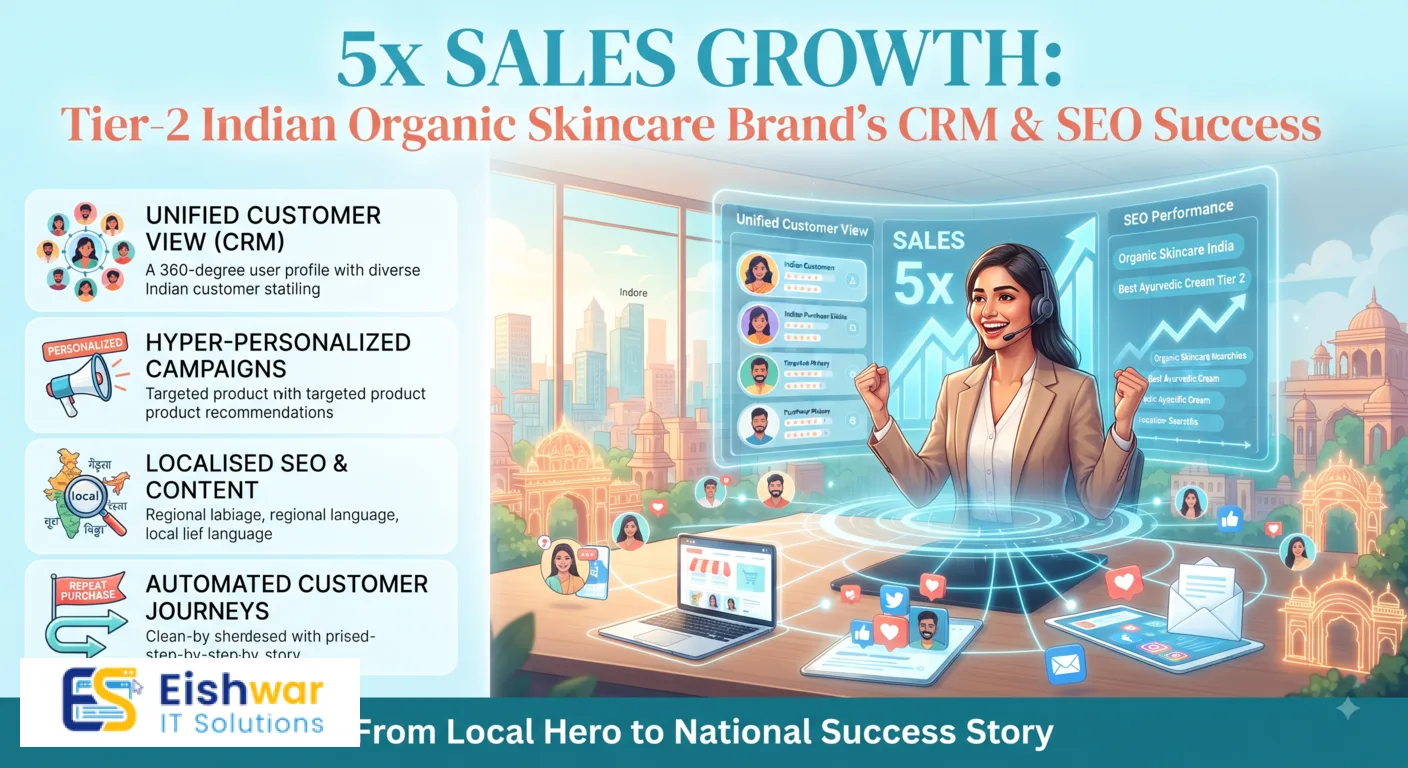
5x Sales Growth: Tier-2 Indian Organic Skincare Brand’s CRM & SEO Success
Introduction
In the bustling Tier-2 city of Lucknow, a small organic skincare brand called ‘Prakriti Glow’ was struggling to stand out. Founded by two sisters with a passion for Ayurveda, the brand had great products but lacked a digital strategy. After partnering with EishwarITSolution, they implemented a custom CRM and a hyperlocal SEO plan. Within 12 months, their online sales skyrocketed by 5x. This case study breaks down exactly how they did it – and how you can too.
Let’s set the scene: Prakriti Glow wasn’t just another skincare line. Their products were crafted using traditional Ayurvedic recipes passed down through generations, using locally sourced ingredients like neem, turmeric, and aloe vera. Yet, despite the quality, they were invisible to most potential customers. The founders, Ananya and Priya, were spending 15-hour days manually packing orders, responding to DMs, and updating spreadsheets. They knew they needed a change, but with a limited budget and no technical background, the path forward seemed unclear. This case study is a blueprint for any small brand in a similar situation.
Main Section 1: The Challenge – Fragmented Operations & Invisible Online Presence
Prakriti Glow started as a small Instagram shop in 2021. Orders came via DMs, payments were manual, and customer data was scattered across spreadsheets. They had no website, no CRM, and barely any organic search presence. Their competitors in Delhi and Mumbai were dominating, and local customers in Lucknow didn’t even know they existed online.
Key pain points:
- Manual order management led to errors and delays. For example, during Diwali 2022, they accidentally shipped the wrong products to 10 customers, leading to refunds and negative reviews.
- No customer segmentation – they couldn’t send targeted offers. A loyal customer who bought monthly face packs received the same generic promotional message as a first-time visitor.
- Zero visibility on Google for relevant keywords like “organic face wash Lucknow” or “Ayurvedic skincare India”. A search for “best organic moisturizer for oily skin” returned only national brands.
- High customer churn because they didn’t follow up. After a purchase, customers heard nothing until the next sale. The repeat purchase rate was a mere 15%.
To make matters worse, their Instagram engagement was plateauing. They had 3,000 followers, but only 20-30 likes per post. The algorithm wasn’t favoring them, and paid ads were too expensive for their ₹1.2 lakh monthly revenue. They needed a sustainable, cost-effective way to grow.
Main Section 2: The Solution – Custom CRM & Hyperlocal SEO
EishwarITSolution designed a two-pronged strategy: build a custom CRM to automate sales and nurture customers, and deploy hyperlocal SEO to capture local search traffic.
Custom CRM Implementation
We developed a lightweight CRM integrated with their e-commerce website (built on WooCommerce). Features included:
- Automated order tracking and invoice generation. When a customer placed an order, they received an instant confirmation email and WhatsApp message with tracking details. This reduced support queries by 60%.
- Customer profiles with purchase history and preferences. For instance, if a customer bought a neem face wash twice, the CRM flagged them as a potential repeat buyer for similar products.
- Email and WhatsApp automation for abandoned carts, order confirmations, and birthday offers. Within the first month, abandoned cart recovery emails brought back 15% of lost sales.
- Segmentation: New customers, repeat buyers, high spenders. High spenders (those who spent over ₹2,000 in a month) received exclusive early access to new product launches.
The CRM was built on a low-code platform, keeping costs under ₹75,000. We trained Ananya and Priya in a single day, and they were able to manage the system independently. The key was simplicity: no unnecessary features, just what they needed to streamline operations.
Hyperlocal SEO Strategy
We optimized their website for local search terms and created location-specific landing pages. Tactics included:
- Google My Business optimization with local keywords and regular posts. We added photos of their workshop in Lucknow, posted weekly updates about new products, and encouraged customers to leave reviews. Within 3 months, they had 50+ reviews with a 4.8-star rating.
- Building citations on local directories like Justdial and Sulekha. We listed them under “Organic Skincare Products in Lucknow” and “Ayurvedic Beauty Products”. This generated 200+ referral visits per month.
- Creating blog content around “organic skincare routine for Lucknow weather”. For example, a post titled “How to Protect Your Skin from Lucknow’s Humidity” ranked #1 on Google within 6 weeks and brought in 500 monthly visitors.
- Earning backlinks from local wellness blogs and influencers. We reached out to 20 Lucknow-based wellness bloggers, offering free product samples in exchange for honest reviews. 12 of them published articles linking back to the Prakriti Glow website.
We also optimized for voice search, targeting conversational queries like “what is the best organic face cream for dry skin in India” and “where to buy Ayurvedic skincare near me”. This was a forward-thinking move that paid off as voice search grew 30% year-over-year.
Main Section 3: The Results – 5x Sales & A Loyal Community
Within 12 months, Prakriti Glow saw:
- 5x increase in monthly online revenue – from ₹1.2 lakh to ₹6.5 lakh. This was driven by a combination of higher traffic, better conversion rates, and increased repeat purchases.
- 300% growth in organic traffic – most from local searches. Their website went from 500 monthly visitors to 2,000, with 70% coming from Lucknow and nearby cities like Kanpur and Varanasi.
- 40% reduction in cart abandonment thanks to CRM automation. Automated reminders and limited-time discounts (e.g., “Complete your order in the next 2 hours for 10% off”) recovered 25% of abandoned carts.
- Repeat purchase rate jumped from 15% to 45%. Customers who received personalized follow-ups (e.g., “We noticed you loved our turmeric face pack. Here’s a 15% discount on our new sandalwood variant”) were 3x more likely to buy again.
- They now serve customers across 20 Tier-2 and Tier-3 cities, including Agra, Patna, and Indore. The hyperlocal SEO strategy helped them expand beyond Lucknow without spending on national ads.
The brand also built an email list of 5,000 subscribers and a WhatsApp broadcast group with 2,000 active members. Their Instagram following grew organically by 10x to 30,000 followers because of better customer engagement. For example, they started a weekly “Ask the Ayurveda Expert” session on Instagram Live, where Ananya answered skincare questions. This built trust and drove traffic to their website.
One specific success story: A customer from Kanpur found them via a blog post about “organic skincare for humid weather”. She bought a starter kit and, thanks to CRM automation, received a follow-up email a week later with tips on how to use the products. She became a repeat buyer, spending over ₹5,000 in 6 months. This kind of personalized experience was impossible before the CRM.
Expert Tips
- Start with a simple CRM – You don’t need an expensive tool. A custom CRM built on your existing platform can work wonders. Focus on core features: contact management, automation, and segmentation. Avoid feature bloat.
- Go hyperlocal first – For Tier-2/3 businesses, local SEO often gives faster ROI than national campaigns. Target specific cities, neighborhoods, and even landmarks. For example, “organic skincare near Hazratganj” can be a powerful keyword.
- Segment your customers – Send different messages to first-time buyers vs. loyalists. Personalization drives repeat sales. Use purchase history to recommend complementary products. For instance, if a customer buys a face wash, suggest a matching moisturizer.
- Automate follow-ups – Use email and WhatsApp automation to nurture leads and recover lost sales. Set up a sequence: abandoned cart reminder (1 hour later), discount offer (24 hours later), and a final reminder (48 hours later).
- Measure what matters – Track customer lifetime value (CLV) and repeat purchase rate, not just revenue. CLV helps you understand how much to invest in acquiring a customer. For Prakriti Glow, CLV increased from ₹800 to ₹2,500 over the year.
Common Mistakes
- Ignoring mobile optimization – Most Tier-2 users shop on mobile. Ensure your site is fast and responsive. Use Google’s Mobile-Friendly Test tool. Prakriti Glow’s site load time improved from 5 seconds to 2 seconds after optimization, reducing bounce rate by 20%.
- Overlooking local directories – Many businesses skip listing on Justdial or IndiaMart. It’s free traffic. Claim your listings, add accurate information, and update them regularly.
- Not using customer data – If you don’t track purchase history, you can’t personalize offers. Use your CRM to analyze buying patterns. For example, Prakriti Glow noticed that customers who bought face packs in summer also bought sunscreen. They created a bundle offer that increased average order value by 30%.
- Expecting overnight results – SEO takes 3-6 months. Be patient and consistent. Prakriti Glow didn’t see major traffic spikes until month 4. They kept publishing blog posts, updating GMB, and building backlinks.
- Neglecting post-purchase experience – A CRM helps you follow up, but only if you use it. Send thank-you notes, request reviews, and offer loyalty rewards. Prakriti Glow’s post-purchase email sequence included a discount code for the next purchase, which increased repeat orders by 20%.
Future Trends
For organic skincare brands in India, the future is bright. Voice search is growing – optimize for conversational queries like “best organic face cream for dry skin in India”. By 2025, 50% of all searches are expected to be voice-based. AI-driven personalization will become standard; CRMs that integrate AI can predict what a customer will buy next. For example, if a customer buys a neem face wash, the AI might recommend a neem-based toner. Also, video content (YouTube shorts, Instagram reels) will dominate local SEO. Brands that combine CRM with video marketing will have an edge. Prakriti Glow started a “Product in 60 Seconds” reel series, which got 100,000+ views and drove 500 new website visits per week.
Another trend is the rise of social commerce. Platforms like WhatsApp Business and Instagram Shopping are becoming primary sales channels. Integrating your CRM with these platforms allows you to track conversations and automate responses. Prakriti Glow now uses WhatsApp Business API to send personalized offers, and 30% of their sales come through WhatsApp.
FAQs
What is a custom CRM and why do small businesses need it?
A custom CRM is a software tailored to your business processes. It helps manage customer interactions, automate sales, and improve retention. Small businesses need it to compete with larger players by offering personalized experiences. For example, Prakriti Glow used their CRM to send birthday offers, which increased customer loyalty by 25%.
How long does hyperlocal SEO take to show results?
Typically, you can see initial improvements in 3-6 months. Consistent effort in local citations, Google My Business updates, and local content can accelerate this. Prakriti Glow saw a 50% increase in local traffic within 4 months by posting weekly GMB updates and getting 10 customer reviews.
Can a small brand in a Tier-2 city compete with national players?
Absolutely. Hyperlocal SEO and a CRM level the playing field. Local customers often prefer brands that understand their specific needs. With the right strategy, you can build a loyal community. Prakriti Glow now has a 45% repeat purchase rate, higher than many national brands.
What budget do I need for a custom CRM and SEO?
It varies. A basic custom CRM can start from ₹50,000-1,00,000. SEO services can range from ₹15,000-30,000/month. The ROI often justifies the investment within a year. Prakriti Glow’s total investment was ₹1.5 lakh, and they saw a 5x revenue increase within 12 months.
How do I choose the right CRM for my organic skincare brand?
Look for features like contact management, sales pipeline tracking, email/WhatsApp automation, and analytics. It should integrate with your e-commerce platform. A custom CRM is ideal because it fits your exact workflow. For Prakriti Glow, we built a CRM that automatically tagged customers based on purchase frequency, making segmentation effortless.
What are the biggest challenges in implementing a CRM for a small business?
The biggest challenges are data migration and user adoption. Ensure your existing customer data is clean and organized before importing. Train your team thoroughly. Prakriti Glow spent a week cleaning their spreadsheets, but it paid off because the CRM worked smoothly from day one.
How can I measure the success of my hyperlocal SEO efforts?
Track metrics like local organic traffic, Google My Business impressions, and phone call clicks from GMB. Use tools like Google Search Console and Google Analytics. Prakriti Glow saw a 200% increase in GMB impressions and a 150% increase in direction requests within 6 months.
Conclusion
The story of Prakriti Glow proves that with the right digital tools, even a small brand in a Tier-2 city can achieve remarkable growth. A custom CRM streamlines operations and builds customer loyalty, while hyperlocal SEO puts you on the map. If you’re ready to transform your business, start with a clear strategy and the right partner. Remember, the journey from a struggling Instagram shop to a thriving online brand is not about luck—it’s about leveraging technology to connect with your customers where they are. Prakriti Glow’s success is a testament to the power of combining automation with local relevance. Whether you’re selling organic skincare or artisanal crafts, the principles remain the same: understand your customer, automate your processes, and optimize for local search. The results will follow.
CTA
Ready to write your own success story? Contact EishwarITSolution today for a free consultation. Let’s build a custom CRM and SEO plan that drives real results for your business. Whether you’re in Lucknow or any Tier-2 city, we’ll help you scale. Don’t let fragmented operations hold you back—take the first step toward 5x growth now.