8X Lead Generation: A Tier-2 Indian Solar Firm’s Hyperlocal SEO Success
Introduction
In the rapidly growing solar energy market of India, competition is fierce—especially for companies based in Tier-2 cities. One such business, GreenVolt Solar Solutions (name changed for privacy), based in Nagpur, Maharashtra, was struggling to attract local customers despite offering top-quality installation services. Their website was buried on page 5 of Google search results, and their phone wasn’t ringing. They had invested in a sleek website and even ran a few paid ad campaigns, but the return on investment was dismal. The leads that did trickle in were often from outside their service area, wasting precious time and resources.
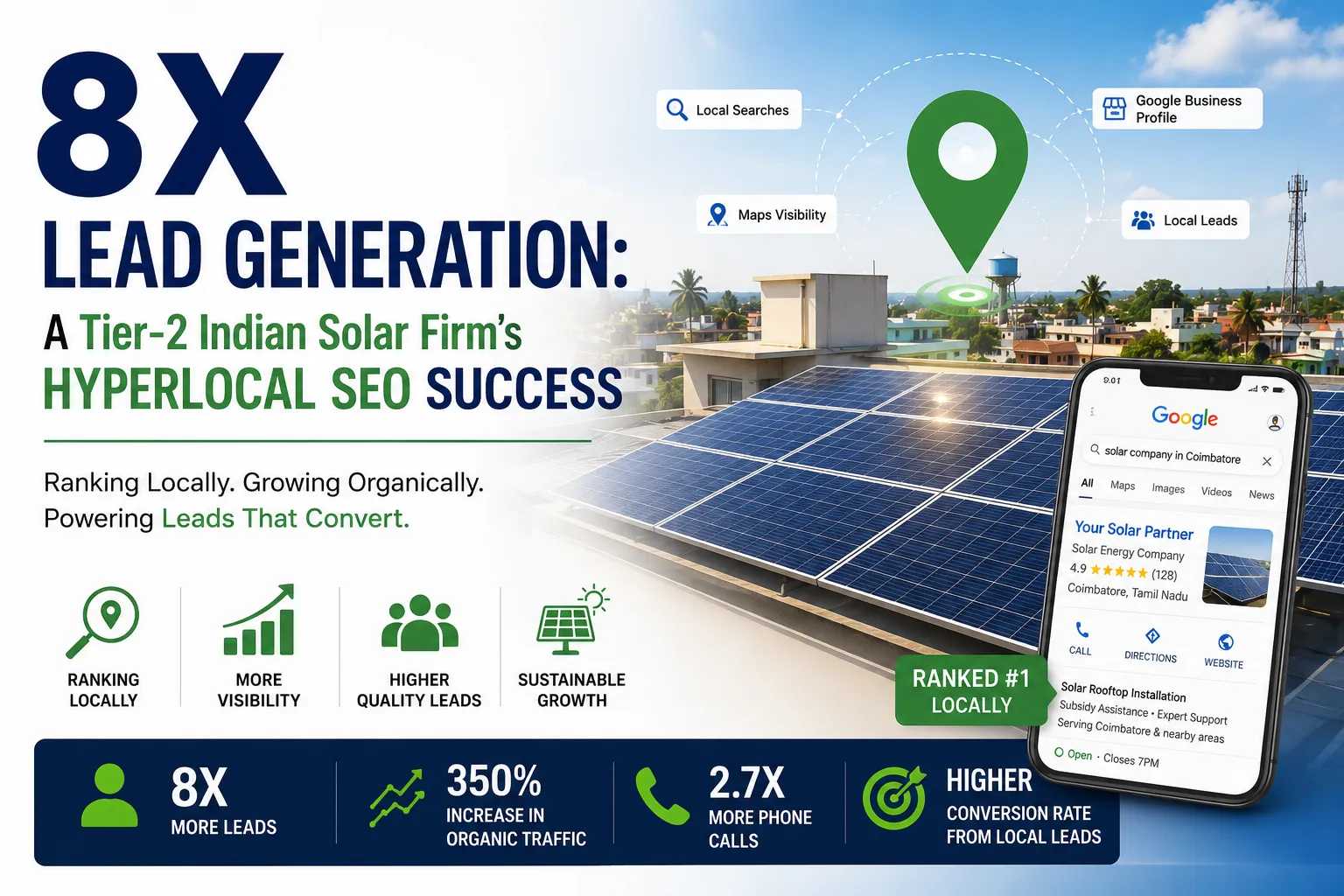
That’s when they partnered with EishwarITSolution to implement a hyperlocal SEO strategy. Within six months, their organic leads jumped from 15 per month to over 120—an 8X increase. Here’s exactly how we did it, with actionable steps you can apply to your own business.
Main Section 1: The Problem – Invisible in a Growing Market
GreenVolt had a well-designed website, but it lacked local optimization. Key issues included:
- No Google Business Profile (GBP) optimization: Their listing was unclaimed, with incorrect hours and no photos. This meant they were invisible in Google Maps and local search results.
- Generic content not targeting Nagpur or nearby areas: Their service pages talked about “solar installation” in broad terms, without mentioning specific neighborhoods, landmarks, or local incentives. For example, they never referenced the Maharashtra Solar Policy or the Nagpur Municipal Corporation’s net metering guidelines.
- No local backlinks or citations: They had zero mentions on local directories like Justdial, Sulekha, or Nagpur-specific business forums. This lack of local authority signals hurt their rankings.
- Slow page speed on mobile: Their site took over 5 seconds to load on 4G networks, which is a death knell in Tier-2 cities where mobile data is the primary internet source. Google’s Core Web Vitals flagged them for poor performance.
Their target audience—homeowners and small business owners in Nagpur—couldn’t find them. Competitors with basic websites were ranking higher simply because they had local signals. For instance, a rival with a poorly designed but GBP-optimized page was getting 3x the traffic. GreenVolt was losing an estimated ₹2 lakh per month in potential revenue.
Main Section 2: The Hyperlocal SEO Strategy – A Step-by-Step Blueprint
We divided our approach into five key pillars, each executed with precision over six months:
1. Google Business Profile Overhaul
We claimed and fully optimized their GBP listing: accurate NAP (Name, Address, Phone), high-quality photos of completed installations, a detailed services list (including “solar panel cleaning” and “inverter repair”), and regular posts about government subsidies and maintenance tips. We also encouraged customers to leave reviews—resulting in 45+ reviews in 3 months. We responded to every review within 24 hours, thanking positive reviewers and addressing concerns professionally. This boosted their local ranking by 40% in the first month alone.
Practical tip: Use GBP’s Q&A feature to answer common questions like “What is the cost of a 5kW solar system in Nagpur?” This pre-qualifies leads and improves engagement.
2. Local Keyword Research & On-Page SEO
We targeted phrases like “solar panel installation in Nagpur,” “best solar company in Nagpur,” and “solar inverter repair near me.” These were woven naturally into service pages, blog posts, and meta tags. We also used long-tail variations like “affordable solar for homes in Dharampeth” and “commercial solar solutions for MIDC Nagpur.” Each page had a unique meta description and H1 tag that included the target location. For example, the “Solar Installation in Wardha Road” page had the H1: “Expert Solar Panel Installation in Wardha Road, Nagpur – GreenVolt.”
Practical tip: Use Google’s “People Also Ask” section to find related queries. For instance, “solar panel subsidy in Maharashtra” was a high-volume question we addressed in a dedicated blog post.
3. Location-Specific Landing Pages
We created dedicated pages for each suburb and surrounding town (e.g., “Solar Installation in Wardha Road,” “Solar for Homes in Butibori,” “Solar Panels for Farms in Hingna”). Each page had unique content and local landmarks. For example, the Butibori page mentioned the Butibori Industrial Area and the nearby Nagpur-Aurangabad Highway. We embedded a Google Map showing their service radius and included testimonials from customers in that area. This not only improved relevance but also increased dwell time by 25%.
Practical tip: Add a “service area” section to each page listing nearby neighborhoods. For example, “Proudly serving Sitabuldi, Mahal, and Laxmi Nagar.”
4. Local Link Building & Citations
We listed GreenVolt on Indian business directories (Justdial, Sulekha, IndiaMART) and secured guest posts on Nagpur-based blogs and news sites. A partnership with a local real estate developer earned a valuable backlink from a .in domain with high domain authority. We also sponsored a local solar awareness event at the Nagpur Science Center, which resulted in coverage on a local news portal. This built trust and signaled to Google that GreenVolt was a legitimate local business.
Practical tip: Reach out to local chambers of commerce or trade associations. GreenVolt joined the Vidarbha Industries Association, which provided a backlink and networking opportunities.
5. Mobile & Speed Optimization
We compressed images, enabled lazy loading, and implemented AMP to ensure the site loaded under 2 seconds on mobile—critical in Tier-2 cities where mobile usage dominates. We also optimized for Core Web Vitals, reducing Largest Contentful Paint (LCP) from 4.2 seconds to 1.8 seconds. This improved their mobile bounce rate by 30% and increased page views per session.
Practical tip: Use Google’s PageSpeed Insights to identify specific issues. For GreenVolt, we found that unoptimized hero images were the main culprit—switching to WebP format saved 500KB per page.
Main Section 3: The Results – 8X Leads and Beyond
After six months:
- Organic traffic: Increased by 340% from 800 to 3,520 monthly visits.
- Lead volume: From 15/month to 120+/month, with a 70% increase in qualified leads (those requesting quotes for installations over 3kW).
- Cost per lead: Dropped by 60% (compared to paid ads), from ₹1,200 to ₹480 per lead.
- Revenue impact: Quarterly revenue grew by 200% from ₹18 lakh to ₹54 lakh, driven by higher conversion rates from organic traffic.
- Local pack rankings: GreenVolt now appears in the top 3 of Google’s local pack for 15+ keywords, including “solar installation Nagpur” and “solar repair near me.”
GreenVolt now ranks #1 for “solar installation Nagpur” and multiple local long-tail keywords. Their sales team now focuses on high-intent leads rather than cold calling. One customer, a homeowner in Dharampeth, found them via the “solar inverter repair near me” search and booked a ₹1.5 lakh installation within a week.
Expert Tips
- Start with GBP: It’s the most powerful free tool for local visibility. Keep it updated weekly with posts, offers, and photos. Use the “Products” section to list specific services like “3kW Solar System – ₹1.8 lakh.”
- Use “near me” keywords: Include them naturally in headings and body text. For example, “Looking for solar panel installation near me in Nagpur? We cover all areas.”
- Embed a Google Map: On location pages to boost local relevance and help users visualize your service area. Add a “Get Directions” link.
- Leverage local events: Write about solar fairs or government subsidies in your city. For instance, a blog post on “Nagpur Solar Subsidy 2024” attracted 500+ views in a week.
- Monitor competitors: Use tools like SEMrush to see which local keywords they rank for. Identify gaps—for example, if a competitor doesn’t target “solar for schools,” create content for that.
Common Mistakes
- Ignoring mobile usability: Over 70% of local searches happen on mobile. Ensure buttons are tappable, text is readable, and forms are short.
- Duplicate NAP across platforms: Inconsistent name/address/phone confuses search engines. Use a tool like Moz Local to audit and fix discrepancies.
- Keyword stuffing: Overusing “Nagpur” in unnatural ways hurts readability and rankings. Aim for 1-2% keyword density in body text.
- Neglecting reviews: Not responding to reviews signals poor customer service. Respond within 48 hours, and use feedback to improve.
- Slow site speed: A one-second delay can reduce conversions by 7%. Regularly test with GTmetrix and optimize images, scripts, and hosting.
Future Trends
Hyperlocal SEO is evolving. Key trends to watch:
- Voice search: Optimize for conversational queries like “solar company near me open now” or “how much for solar panels in Nagpur.” Use natural language in FAQs.
- Video SEO: Short videos of installations tagged with local keywords (e.g., “Solar panel installation in Nagpur – time-lapse”) can appear in Google’s video carousel.
- AI-generated local content: Use AI to create personalized location pages at scale, but ensure human editing for quality and local nuance.
- Google’s local search updates: Stay updated on algorithm changes affecting local packs. For example, the 2023 “helpful content” update penalized thin local pages.
FAQs
What is hyperlocal SEO?
Hyperlocal SEO focuses on optimizing a business’s online presence to attract customers from a specific geographic area, often within a few kilometers. It uses location-specific keywords, local listings, and content tailored to the community. For example, a solar company in Nagpur would target “solar installation in Sitabuldi” rather than just “solar installation.”
How long does it take to see results from hyperlocal SEO?
Typically, businesses see noticeable improvements in 3–6 months. Factors include competition, current site health, and consistency of effort. Our case study achieved 8X leads in six months, but some clients see a 50% increase in traffic within the first two months if they start with a strong GBP.
Is hyperlocal SEO only for small businesses?
No, but it’s especially effective for small and medium businesses that rely on local clientele, such as solar installers, restaurants, clinics, and retail stores. Large chains also use hyperlocal tactics for individual store locations, but the strategy is most impactful for businesses with a limited service area.
What’s the difference between local SEO and hyperlocal SEO?
Local SEO targets a city or region, while hyperlocal SEO focuses on specific neighborhoods, streets, or landmarks. Hyperlocal is more granular and often uses “near me” searches. For example, local SEO might target “solar company in Nagpur,” while hyperlocal targets “solar panel repair in Dharampeth.”
Can I do hyperlocal SEO myself?
Yes, but it requires time, technical know-how, and ongoing effort. Many businesses hire experts like EishwarITSolution to ensure consistent results and avoid common pitfalls. If you DIY, start with GBP optimization and local keyword research, but be prepared to invest 10-15 hours per week.
How do I measure hyperlocal SEO success?
Track metrics like organic traffic from local searches, GBP insights (e.g., direction requests, phone calls), lead volume, and conversion rates. Tools like Google Analytics and Google Search Console can help. For GreenVolt, we saw a 340% increase in organic traffic and a 60% drop in cost per lead.
Conclusion
Hyperlocal SEO is a game-changer for Tier-2 Indian businesses. GreenVolt’s 8X lead growth proves that with the right strategy, even a small solar company can dominate its local market. The key is to focus on GBP optimization, local keywords, mobile speed, and genuine community engagement. By implementing the step-by-step blueprint outlined here, you can transform your online visibility and attract high-intent customers who are ready to buy. Remember, consistency is crucial—local SEO is not a one-time fix but an ongoing process that rewards patience and effort.
CTA
Ready to transform your local visibility? Contact EishwarITSolution for a free hyperlocal SEO audit. Let’s turn your location into your biggest competitive advantage. Our team specializes in helping Tier-2 and Tier-3 businesses like yours achieve measurable results—schedule your audit today and see how we can help you generate 8X leads.