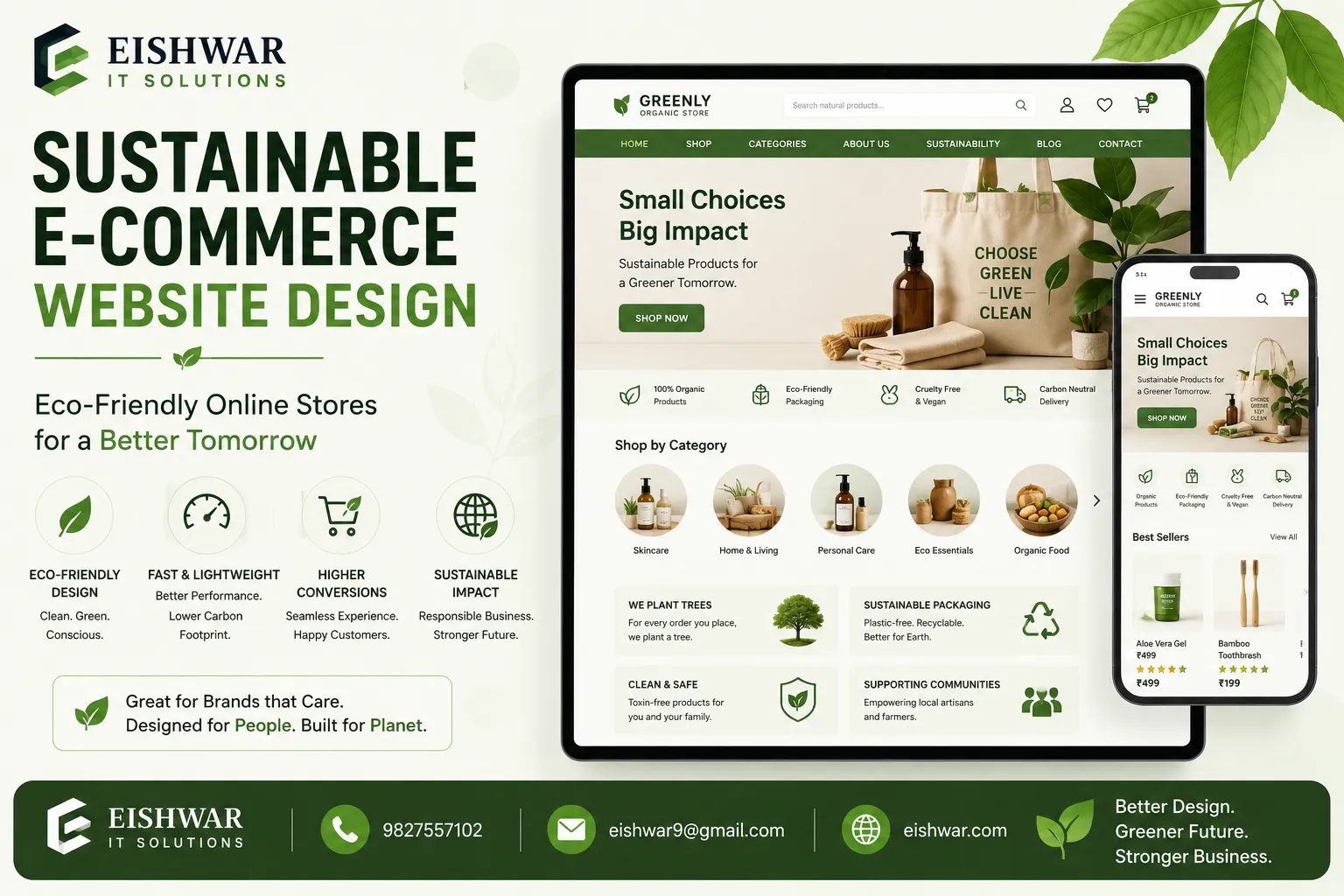
Sustainable E-commerce Website Design: How to Build an Eco-Friendly Online Store in India
Introduction
Indian consumers are increasingly prioritizing sustainability. A 2025 survey by NielsenIQ found that 78% of Indian shoppers prefer brands with clear environmental commitments. Your e-commerce website's design plays a crucial role in communicating those values—and even in reducing your digital carbon footprint. This shift isn't just a passing trend; it's a fundamental change in buyer behavior, driven by growing awareness of climate change and a desire for responsible consumption. For instance, a recent study by LocalCircles revealed that 65% of Indian online shoppers are willing to pay a premium for products from eco-friendly brands, highlighting the tangible business opportunity. Your website is often the first touchpoint, and its design can either reinforce or undermine your sustainability message.
At EishwarITSolution, we help business owners like you create high-performing, visually stunning e-commerce sites that are also environmentally responsible. This guide walks you through actionable strategies for building a sustainable e-commerce website that resonates with Indian audiences and drives conversions. Whether you're launching a new store or revamping an existing one, these principles will help you reduce your digital carbon footprint while boosting user experience and sales.
Main Section 1: Why Sustainable E-commerce Website Design Matters for Indian Businesses
The Rise of Eco-Conscious Consumers in India
From metro cities like Mumbai and Delhi to tier-2 towns like Jaipur and Lucknow, Indian buyers are asking tough questions: Is this brand green? Does it use sustainable packaging? Is its website energy-efficient? A sustainable website design answers these questions before they're asked. Consider the example of a small organic food brand based in Pune that revamped its site to include a sustainability dashboard showing real-time carbon savings from optimized images and green hosting. Within three months, their conversion rate increased by 22%, and they received numerous positive comments about their transparency. This isn't an isolated case; brands that align their digital presence with their environmental values see higher trust and loyalty. Moreover, Indian consumers are increasingly sharing their eco-friendly finds on social media, creating organic word-of-mouth marketing that amplifies your reach.
Digital Carbon Footprint: The Hidden Cost
Every page load, image download, and video stream consumes energy. The internet accounts for about 3.7% of global greenhouse emissions—more than the aviation industry. By optimizing your e-commerce site, you directly reduce energy consumption and appeal to environmentally conscious shoppers. For example, a typical e-commerce page with unoptimized images and heavy scripts can emit as much as 5 grams of CO2 per visit. If your store gets 10,000 visits per month, that's 50 kg of CO2 annually—equivalent to driving 200 kilometers in a car. By implementing sustainable design practices, you can cut this by 50-70%, making a real difference. Additionally, faster-loading sites improve user experience, reducing bounce rates and increasing the likelihood of repeat purchases.
Competitive Advantage in the Indian Market
Brands that embrace sustainability see higher customer loyalty and better SEO rankings. Google favors fast, lightweight sites. A sustainable design is a win-win for the planet and your profit. In India, where e-commerce is projected to reach $350 billion by 2030, standing out is crucial. By adopting green web practices, you differentiate your brand in a crowded market. For instance, a home decor store in Jaipur that switched to a lightweight theme and green hosting saw a 30% improvement in page speed and a 18% increase in organic traffic within two months. This competitive edge is especially valuable for small and medium businesses looking to compete with larger players.
Main Section 2: Six Key Strategies for Sustainable E-commerce Design
1. Choose Green Web Hosting
Select a hosting provider powered by renewable energy or that offsets carbon emissions. Indian providers like Hostinger and Bluehost offer green hosting options. Look for certifications like 'CarbonNeutral' or 'Green Web Foundation' membership. For example, Hostinger's data centers in India use energy-efficient hardware and purchase renewable energy certificates. When choosing a host, also consider server location—using a local data center reduces latency and energy consumption from data transmission. A practical tip: ask your provider for their energy mix and carbon offsetting practices. Some hosts even provide a dashboard showing your site's energy usage, which you can share with customers to build trust.
2. Optimize Images and Videos
Large media files increase load times and energy use. Use next-gen formats like WebP and AVIF. Compress images with tools like TinyPNG. Lazy load videos and images so they only load when visible. Example: A fashion store reduced page weight by 40% and saw a 15% increase in conversions. For product images, use responsive images that serve different sizes based on the user's device. A good practice is to keep image file sizes under 100 KB for thumbnails and under 500 KB for full-size images. For videos, consider using compressed formats like H.265 and provide a poster image that loads first. Additionally, use a CDN with image optimization features, such as Cloudflare or Imgix, to automate compression and format conversion.
3. Minimize Code and Scripts
Bloted code slows down your site and wastes energy. Use clean, efficient HTML/CSS/JS. Remove unused plugins. Consider a lightweight framework like Tailwind CSS. For e-commerce platforms, choose themes optimized for performance. For example, a Shopify store selling handmade crafts reduced its JavaScript payload by 60% by removing unnecessary tracking scripts and using a minimal theme. This cut page load time from 4.2 seconds to 1.8 seconds, leading to a 12% increase in sales. Regularly audit your site with tools like Lighthouse to identify unused CSS and JavaScript. Also, consider using server-side rendering for dynamic content to reduce client-side processing.
4. Implement Dark Mode
Dark mode reduces energy consumption on OLED screens (up to 30% savings). Offer a toggle so users can switch. It also enhances readability in low light—a favorite among night shoppers. For instance, an electronics store in Bangalore added a dark mode option and saw a 8% increase in average session duration, as users found it easier on the eyes during evening browsing. When implementing dark mode, ensure proper contrast ratios and test on different devices. You can also use CSS media queries to automatically enable dark mode based on the user's system preferences, with a manual override option.
5. Simplify User Journeys
Fewer clicks mean less energy. Streamline navigation, reduce steps to checkout, and use predictive search. Example: A home decor store cut checkout from 5 steps to 3, reducing bounce rate by 12% and page loads by 20%. This not only saves energy but also improves conversion rates. Practical tips: use a progress indicator during checkout, offer guest checkout, and pre-fill shipping information for returning customers. Also, consider using a single-page checkout if feasible. For navigation, use clear categories and a search bar with autocomplete to help users find products quickly. A well-designed user journey can reduce the number of page loads by 30-40%, significantly cutting energy consumption.
6. Use Sustainable Fonts and Colors
System fonts like Arial or Roboto load faster than custom fonts. Choose a color palette that requires less energy to display—darker backgrounds with lighter text are more efficient. Avoid excessive gradients and animations. For example, a beauty brand switched from a custom font to a system font stack and saw a 0.5-second reduction in load time. In terms of colors, using a dark background with light text can reduce energy consumption on OLED screens by up to 30%. However, ensure readability and accessibility. Use tools like WebAIM's contrast checker to meet WCAG guidelines. Also, limit the use of animations and transitions, as they require additional processing power. If you must use animations, use CSS animations instead of JavaScript for better performance.
Main Section 3: Measuring and Communicating Your Sustainability Efforts
Track Your Digital Carbon Footprint
Use tools like Website Carbon Calculator or Ecograder to measure your site's emissions. Aim for a rating of 'A' or better. Share your results transparently on an 'Our Green Commitment' page. For instance, a clothing brand in Delhi created a live counter on their site showing the CO2 saved by their green hosting and optimized design. This not only educated customers but also encouraged them to share the page on social media, driving traffic. Regularly monitor your footprint and set reduction goals. You can also use tools like Google Analytics to track page load times and energy usage estimates.
Tell Your Story
Indian consumers love authenticity. Create a dedicated sustainability page explaining your hosting choice, design practices, and future goals. Use real metrics—like 'Our site runs on 100% renewable energy' or 'We reduced page weight by 35%.' For example, a spice seller in Kerala shared a blog post detailing their journey to a greener website, including challenges and lessons learned. This post received over 5,000 shares and led to a 25% increase in newsletter sign-ups. Be specific and avoid vague claims. Include photos of your team or your green hosting provider's data center if possible. Also, update this page regularly with new achievements.
Leverage Badges and Certifications
Display badges like 'Green Hosted' or 'Carbon Neutral Website' near your footer or checkout. These visual cues build trust instantly. For example, a jewelry store in Mumbai added a 'Certified Green Website' badge from the Green Web Foundation and saw a 10% increase in checkout completion rates. Ensure that the badges link to verification pages so customers can learn more. You can also create your own badges if you don't have third-party certifications. Place them strategically, such as on product pages and during checkout, to reinforce your commitment at key decision points.
Expert Tips
- Start with an audit: Use GTmetrix or Lighthouse to identify performance bottlenecks. Fix the worst offenders first. For example, if your site has large images, compress them immediately. Prioritize changes that have the biggest impact on load time and energy use.
- Educate your team: Train developers and content creators on sustainable design principles. Small changes add up. Hold regular workshops and share resources like the Sustainable Web Design guide. Encourage your team to think about energy efficiency in every decision.
- Prioritize mobile: Over 70% of Indian e-commerce traffic comes from mobile. Optimize for smaller screens and slower connections. Use responsive design, compress images for mobile, and test on 3G/4G networks. Consider using AMP (Accelerated Mobile Pages) for key pages.
- Use a CDN: Content Delivery Networks reduce server load and speed up delivery—cutting energy use. Choose a CDN with green credentials, such as Cloudflare's sustainable network. CDNs also help with caching, reducing the number of requests to your server.
- Consider a static site generator: For smaller stores, static sites (like Hugo or Jekyll) use far less energy than dynamic CMS platforms. They serve pre-built pages, eliminating database queries and server-side processing. This can reduce energy consumption by up to 80% compared to a traditional CMS.
- Implement caching: Use browser caching and server-side caching to reduce repeated data transfers. Set appropriate cache headers for static assets. This can significantly reduce page load times for returning visitors.
- Monitor and iterate: Sustainability is an ongoing process. Regularly review your site's performance and carbon footprint. Set quarterly goals and track progress. Use A/B testing to see how design changes affect both user experience and energy use.
Common Mistakes
- Overusing autoplay videos: They consume huge bandwidth and energy. Replace with click-to-play thumbnails. For example, a furniture store replaced an autoplay hero video with a static image and saw a 20% reduction in page load time.
- Ignoring image optimization: Uploading full-resolution images directly from your camera slows down your site and wastes energy. Always compress and resize images before uploading. Use tools like ImageOptim or Squoosh.
- Too many third-party scripts: Analytics, chat widgets, and social buttons each add load. Audit and remove unnecessary ones. For instance, a book store removed three unused tracking scripts and reduced page load time by 1.2 seconds.
- Not testing on slow connections: India has varying internet speeds. Test your site on 3G/4G to ensure it loads quickly everywhere. Use Chrome DevTools to simulate slower connections. A site that loads in 2 seconds on fiber might take 10 seconds on 3G, leading to high bounce rates.
- Greenwashing: Don't claim sustainability without proof. Be honest about your efforts and progress. For example, if you only use green hosting but haven't optimized images, say so. Customers appreciate transparency and are more likely to trust you if you're upfront about your journey.
- Forgetting accessibility: Sustainable design should also be inclusive. Ensure your site is usable for people with disabilities. Use semantic HTML, provide alt text for images, and ensure good color contrast. This also improves SEO and user experience.
Future Trends
By 2026, sustainable design will become a baseline expectation. Expect AI-driven optimization that automatically reduces energy usage based on user behavior. For example, AI could adjust image quality based on the user's connection speed or device. Blockchain for transparent carbon tracking may also emerge, allowing customers to see the exact carbon footprint of their purchase. Indian e-commerce sites that adopt green design now will lead the market. Additionally, we may see more regulations around digital sustainability, similar to the EU's energy efficiency directives. Early adopters will have a competitive advantage in compliance and customer trust.
FAQs
What is sustainable e-commerce website design?
It's the practice of creating online stores that minimize energy consumption, reduce digital carbon footprint, and communicate environmental responsibility through design choices like green hosting, optimized media, and efficient code. This includes everything from choosing a green web host to using dark mode and simplifying user journeys.
How can I make my e-commerce site more eco-friendly?
Start by switching to green hosting, compressing images, removing unused plugins, enabling dark mode, and simplifying your checkout process. Measure your carbon footprint with free tools and share your progress. For example, use the Website Carbon Calculator to get a baseline, then implement changes and track improvements.
Does sustainable design affect SEO?
Yes, positively. Faster load times, better mobile performance, and lower bounce rates all improve SEO. Google rewards efficient, user-friendly sites. Sustainable design practices like image optimization and code minification directly contribute to better Core Web Vitals, which are ranking factors.
What are the best green hosting providers in India?
Hostinger, Bluehost, and GreenGeeks offer renewable energy-powered hosting with good performance for Indian audiences. Check for local data centers to reduce latency. For example, Hostinger has data centers in Mumbai and Singapore, ensuring fast load times for Indian users.
How do I measure my website's carbon footprint?
Use free tools like Website Carbon Calculator (websitecarbon.com) or Ecograder. They analyze your site's energy usage and give a rating. Aim for a grade of A or B. For a more detailed analysis, consider using tools like Beacon or the Green Web Foundation's API.
Can I promote my sustainability efforts on social media?
Absolutely. Share your carbon footprint score, hosting choice, and design changes. Use hashtags like #SustainableEcommerce #GreenWebDesign #EcoFriendlyIndia. Authentic stories drive engagement. For example, post a before-and-after comparison of your site's load time and carbon emissions, and encourage followers to share their own tips.
How much does it cost to implement sustainable design?
Many changes are low-cost or free. Switching to green hosting may cost the same as regular hosting. Image compression and code optimization can be done with free tools. The main investment is time and training. However, the long-term savings from reduced energy costs and improved SEO often outweigh the initial effort.
What are the biggest challenges in sustainable e-commerce design?
Common challenges include balancing aesthetics with performance, educating the team, and avoiding greenwashing. It can be tempting to add heavy visuals for impact, but sustainable design requires trade-offs. Start with small changes and iterate. Also, be transparent about your journey to build trust.
Conclusion
Sustainable e-commerce website design is not just a trend—it's a business imperative for Indian brands that want to win the trust of eco-conscious consumers. By adopting green hosting, optimizing media, simplifying code, and communicating transparently, you can reduce your digital impact while boosting performance and conversions. The journey to a greener website is ongoing, but every step counts. Start with an audit, implement a few key changes, and measure your progress. As more Indian consumers prioritize sustainability, your efforts will pay off in customer loyalty, SEO rankings, and a healthier planet.
At EishwarITSolution, we specialize in building e-commerce sites that are fast, beautiful, and sustainable. Ready to make your online store greener?
CTA
Ready to design a sustainable e-commerce website that attracts eco-conscious Indian buyers? Contact EishwarITSolution today for a free consultation. Let's build a store that's good for your business and the planet. Our team will help you audit your current site, recommend changes, and implement a sustainable design that drives results. Don't wait—start your green journey now.