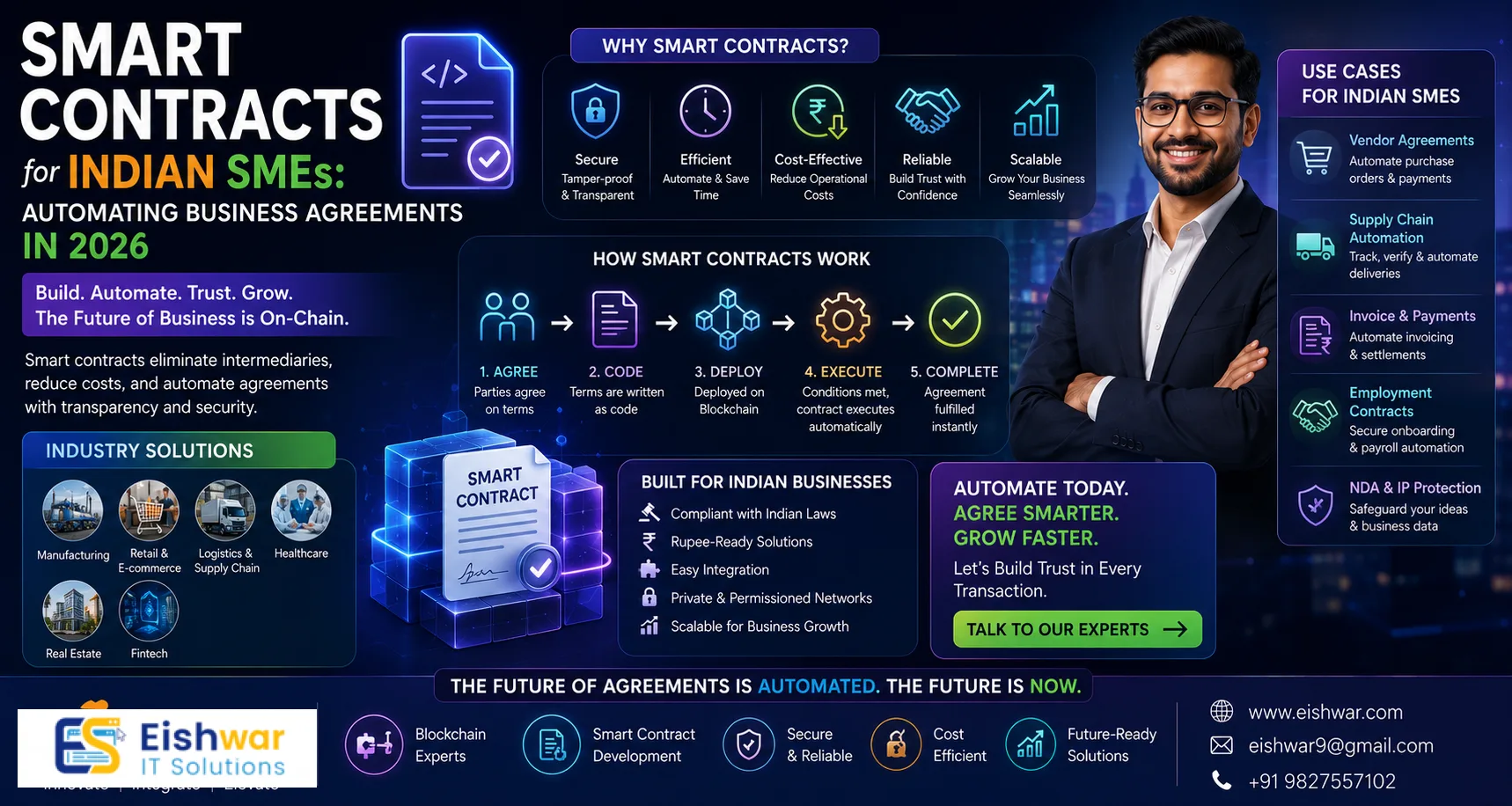
Smart Contracts for Indian SMEs: Automating Business Agreements in 2026
Introduction
Running an SME in India means juggling dozens of agreements—vendor contracts, rental leases, employment terms, and payment schedules. Each one requires manual oversight, legal checks, and follow-ups. In 2026, smart contracts offer a way to automate these processes, reduce paperwork, and cut costs. Think of them as self-executing contracts with the terms directly written into code. They run on blockchain, so once conditions are met, the agreement executes automatically—no middlemen, no delays. For Indian business owners, this means faster deals, fewer disputes, and lower overheads. In this guide, we'll explore how smart contracts work, why they matter for Indian SMEs, and how to start using them today.
Consider the daily reality of a small business owner in Mumbai or Bengaluru: you spend hours chasing payments, verifying deliveries, and managing paper trails. According to a 2025 report by the Indian SME Chamber, manual contract management costs SMEs an average of ₹1.2 lakh annually per business in administrative overhead. Smart contracts can slash this by up to 70%, freeing you to focus on growth. The technology is no longer futuristic—it's here, and it's practical.
What Are Smart Contracts and Why Should Indian SMEs Care?
A smart contract is a digital agreement that automatically executes when predefined conditions are satisfied. For example, a supplier receives payment as soon as a shipment is delivered. The contract is stored on a blockchain, making it transparent, tamper-proof, and accessible to all parties. Unlike traditional contracts that require manual verification, smart contracts use code to enforce terms, eliminating the need for intermediaries like lawyers or banks for routine transactions.
For Indian SMEs, the benefits are significant. Manual contract management can cost thousands of rupees annually in legal fees, printing, and administrative time. Smart contracts eliminate many of these costs. They also build trust—especially important when dealing with new partners or remote transactions. In a country where business disputes often arise from delayed payments or misinterpreted terms, smart contracts provide clarity and automation.
Consider a small textile manufacturer in Surat that supplies fabric to multiple retailers. Instead of chasing payments, the manufacturer can use a smart contract that releases funds automatically upon delivery confirmation. This reduces friction and improves cash flow. A real-world example: a Jaipur-based handicraft exporter implemented smart contracts for international orders, reducing payment settlement time from 45 days to 3 days, and cutting dispute resolution costs by 60%.
Moreover, smart contracts align with India's push toward digital transformation. The government's National Blockchain Framework, launched in 2024, encourages adoption across sectors. For SMEs, this means access to a growing ecosystem of tools, grants, and training programs.
Real-World Use Cases for Indian SMEs
Smart contracts aren't just for large corporations. Here are practical applications for Indian SMEs:
- Supplier Payments: Automate payment releases when goods are delivered and verified. For example, a Bengaluru-based electronics retailer uses a smart contract that triggers payment to its supplier once a GPS-enabled tracking system confirms delivery at the warehouse. This eliminates manual invoice processing and reduces payment delays by 80%.
- Rental Agreements: For office or warehouse space, smart contracts can handle monthly rent payments and security deposits. A Delhi-based co-working space operator uses smart contracts to automate rent collection from 50+ tenants, including late fees and deposit refunds, saving 15 hours of administrative work per month.
- Freelancer Contracts: Pay freelancers automatically when they submit approved work. A Pune-based digital marketing agency uses a smart contract that releases payment to a freelance graphic designer once the client approves the design via a linked platform. This ensures timely payments and reduces disputes over scope.
- Subscription Services: Manage recurring billing for SaaS or membership businesses. A Chennai-based SaaS startup uses smart contracts to handle monthly subscriptions, automatically adjusting pricing based on usage tiers and sending reminders for renewals.
- Escrow Services: Hold funds in escrow until both parties fulfill their obligations. A Mumbai-based real estate broker uses smart contracts for property transactions, holding the buyer's deposit until the seller transfers the title deed, verified through a government-linked blockchain registry.
These use cases are especially relevant in India's fast-growing digital economy, where trust and speed are critical. For instance, the Indian e-commerce sector, projected to reach $350 billion by 2030, relies heavily on automated agreements between sellers, logistics providers, and payment gateways. Smart contracts can streamline these interactions, reducing friction and fraud.
How to Get Started with Smart Contracts for Your SME
Starting with smart contracts doesn't require deep technical expertise. Here's a step-by-step approach:
- Identify a simple agreement: Choose a repetitive, low-risk contract like a monthly payment or delivery confirmation. For example, start with a fixed-price supplier contract where payment is triggered upon delivery confirmation via a barcode scan.
- Choose a platform: Ethereum, Polygon, and Binance Smart Chain are popular options. For Indian businesses, Polygon offers low transaction fees (often under ₹1 per transaction) and a growing ecosystem of Indian developers. Alternatively, consider Hyperledger Fabric for private, permissioned networks if you need more control over data privacy.
- Draft the contract terms: Work with a legal expert to convert your agreement into code. Many platforms provide templates. For instance, OpenZeppelin offers pre-audited templates for common use cases like token sales, escrow, and payment splitting. Customize these with your specific terms, such as payment thresholds or delivery milestones.
- Deploy and test: Use a testnet to simulate the contract before going live. Platforms like Remix IDE allow you to write, test, and debug smart contracts in a browser. Test with dummy data and multiple scenarios—like late deliveries or partial payments—to ensure the contract handles exceptions gracefully.
- Monitor and iterate: Track performance and refine as needed. Use blockchain explorers like Etherscan or Polygonscan to monitor transactions. Set up alerts for contract events, such as payment triggers or failures. Based on data, adjust parameters like payment thresholds or dispute resolution timelines.
Platforms like OpenZeppelin offer pre-audited smart contract templates that reduce risk. For Indian SMEs, partnering with a local blockchain consultancy like EishwarITSolution can simplify the process. They provide end-to-end services, from contract design to deployment and maintenance, with pricing starting at ₹25,000 for basic implementations.
Expert Tips for Indian Business Owners
- Start small: Pilot a single contract before scaling. For example, automate one supplier payment cycle and measure time savings before expanding to all vendors.
- Prioritize security: Use audited contracts and avoid custom code unless reviewed by experts. A 2025 study by the Indian Cyber Security Agency found that 40% of smart contract vulnerabilities in SMEs stem from unverified custom code. Always get a third-party audit from firms like CertiK or Hacken.
- Involve legal counsel: Smart contracts are legally binding in many jurisdictions, including India under the IT Act. Ensure your contract includes a governing law clause specifying Indian jurisdiction. Work with a lawyer experienced in blockchain law to draft the legal wrapper around the code.
- Educate your team: Ensure everyone understands how the contract works. Conduct a 30-minute training session for your staff on how to interact with the contract—like submitting delivery proofs or triggering payments. Use simple dashboards that hide the blockchain complexity.
- Keep a backup: Maintain traditional records until the system is proven. For the first six months, keep parallel paper invoices and manual logs. This provides a fallback if the smart contract fails and helps you compare efficiency gains.
- Leverage government incentives: Check for state-level blockchain adoption grants. For example, the Telangana government offers subsidies of up to 50% on blockchain implementation costs for SMEs under its Blockchain District initiative.
Common Mistakes to Avoid
- Overcomplicating: Don't try to automate everything at once. Focus on high-value, low-risk agreements. A common mistake is attempting to automate multi-party contracts with complex conditions, leading to bugs. Start with a simple two-party payment contract.
- Ignoring gas fees: Transaction costs can add up. Choose a cost-effective blockchain. On Ethereum, a single transaction can cost ₹500 during peak times, while Polygon costs less than ₹1. For high-volume contracts, consider layer-2 solutions like Arbitrum or Optimism.
- Skipping testing: Always test on a testnet to catch bugs. A 2024 survey found that 30% of smart contract failures in Indian SMEs were due to untested edge cases, such as integer overflow or incorrect date handling. Use tools like Truffle or Hardhat for automated testing.
- Neglecting dispute resolution: Include a mechanism for human intervention if something goes wrong. For example, add a multi-signature requirement for high-value transactions, where both parties must approve a release. Alternatively, include an arbitration clause that triggers a manual review if a dispute arises.
- Assuming complete automation: Some steps still require human oversight, like verifying delivery. For instance, a smart contract can't automatically confirm that a shipment contains the correct items—it needs an oracle (a trusted data source) or manual input. Plan for hybrid workflows where humans verify key conditions.
- Ignoring regulatory compliance: Ensure your smart contract complies with Indian tax laws, such as GST requirements. For example, if a contract triggers payment, it should also generate a GST invoice automatically. Consult a tax expert to integrate compliance features.
Future Trends: Smart Contracts in India by 2026 and Beyond
By 2026, smart contracts will become more accessible thanks to user-friendly platforms and government initiatives like the National Blockchain Framework. We can expect integration with AI for dynamic contract adjustments—for example, automatically adjusting payment terms based on real-time market data or supplier performance scores. Increased adoption in supply chain finance will enable SMEs to access working capital faster, with smart contracts acting as collateral for loans. Standardization of legal frameworks will reduce ambiguity, with the Indian government likely issuing guidelines for smart contract enforceability by 2027. Indian SMEs that adopt early will gain a competitive edge through efficiency and trust, especially as larger corporations demand automated agreements from their vendors.
Another trend is the rise of decentralized identity (DID) systems, where smart contracts verify parties' credentials automatically. For instance, a smart contract could check a supplier's GST registration or ISO certification before releasing payment, reducing fraud. Additionally, cross-chain interoperability will allow SMEs to use smart contracts across different blockchains, expanding their reach. By 2028, we may see smart contracts integrated with India's Unified Payments Interface (UPI), enabling seamless fiat-to-crypto payments for international trade.
FAQs
Are smart contracts legally binding in India?
Yes, smart contracts can be legally binding in India under the Indian Contract Act, 1872, and the Information Technology Act, 2000. However, it's advisable to consult a legal expert to ensure compliance, especially for cross-border agreements or complex terms. The enforceability depends on the clarity of the code and the presence of a legal wrapper that defines jurisdiction and dispute resolution.
How much does it cost to deploy a smart contract?
Costs vary by platform. On Ethereum, deployment can cost $50–$200 in gas fees. On Polygon, it's often less than $1. Development costs range from ₹10,000 to ₹1,00,000 depending on complexity. For example, a simple payment contract on Polygon might cost ₹15,000 total, including legal review and testing. Ongoing maintenance costs are minimal, typically under ₹5,000 per year for monitoring and updates.
Do I need to know coding to use smart contracts?
Not necessarily. Many platforms offer no-code tools and templates, such as OpenZeppelin's wizard or Thirdweb's dashboard. However, for custom contracts, you may need a developer or a service provider like EishwarITSolution. No-code tools are ideal for standard use cases like payment automation, while custom development is needed for unique business logic.
What happens if the smart contract fails?
Most failures are due to coding errors or unforeseen conditions. That's why testing on a testnet is critical. Include a kill switch or fallback mechanism to pause the contract if needed. For example, add a multi-signature requirement where both parties must approve a pause. Also, consider using a circuit breaker pattern that halts execution if an anomaly is detected. In case of failure, revert to manual processes and use the contract's audit trail to resolve disputes.
Can smart contracts be modified after deployment?
Standard smart contracts are immutable once deployed. However, you can design them with upgradeable patterns using proxy contracts. This allows changes while preserving the contract's history. For example, use the OpenZeppelin Upgradeable Contracts library to create a proxy that delegates calls to a new implementation. This is useful for fixing bugs or adding features, but requires careful management to avoid security risks.
What are the tax implications of using smart contracts for payments?
Smart contracts that trigger payments are subject to GST and income tax in India. Ensure your contract generates a GST invoice automatically and records the transaction for tax filing. Consult a tax professional to integrate compliance features, such as automatic TDS deduction. For cross-border payments, consider the tax treaty implications and use smart contracts that comply with RBI's guidelines on foreign remittances.
How do I ensure data privacy in smart contracts?
Blockchain is transparent by default, so sensitive data should not be stored directly in the contract. Use off-chain storage solutions like IPFS or Arweave for private data, and store only hashes on-chain. For compliance with India's Digital Personal Data Protection Act, 2023, implement encryption and access controls. Consider using zero-knowledge proofs to verify conditions without revealing underlying data.
Conclusion
Smart contracts offer Indian SMEs a practical way to automate agreements, reduce costs, and build trust. By starting small, choosing the right platform, and involving legal experts, you can leverage this technology to streamline operations. The future of business agreements is digital, and 2026 is the perfect time to begin. With government support, growing ecosystem, and proven benefits, smart contracts are no longer a luxury—they're a necessity for competitive SMEs. Take the first step today and transform how you do business.
CTA
Ready to automate your business agreements? Contact EishwarITSolution today for a free consultation on smart contract implementation tailored for Indian SMEs. Let's build a smarter, more efficient future together. Our team of blockchain experts and legal advisors will guide you from concept to deployment, ensuring your contracts are secure, compliant, and cost-effective. Schedule your free 30-minute consultation now.