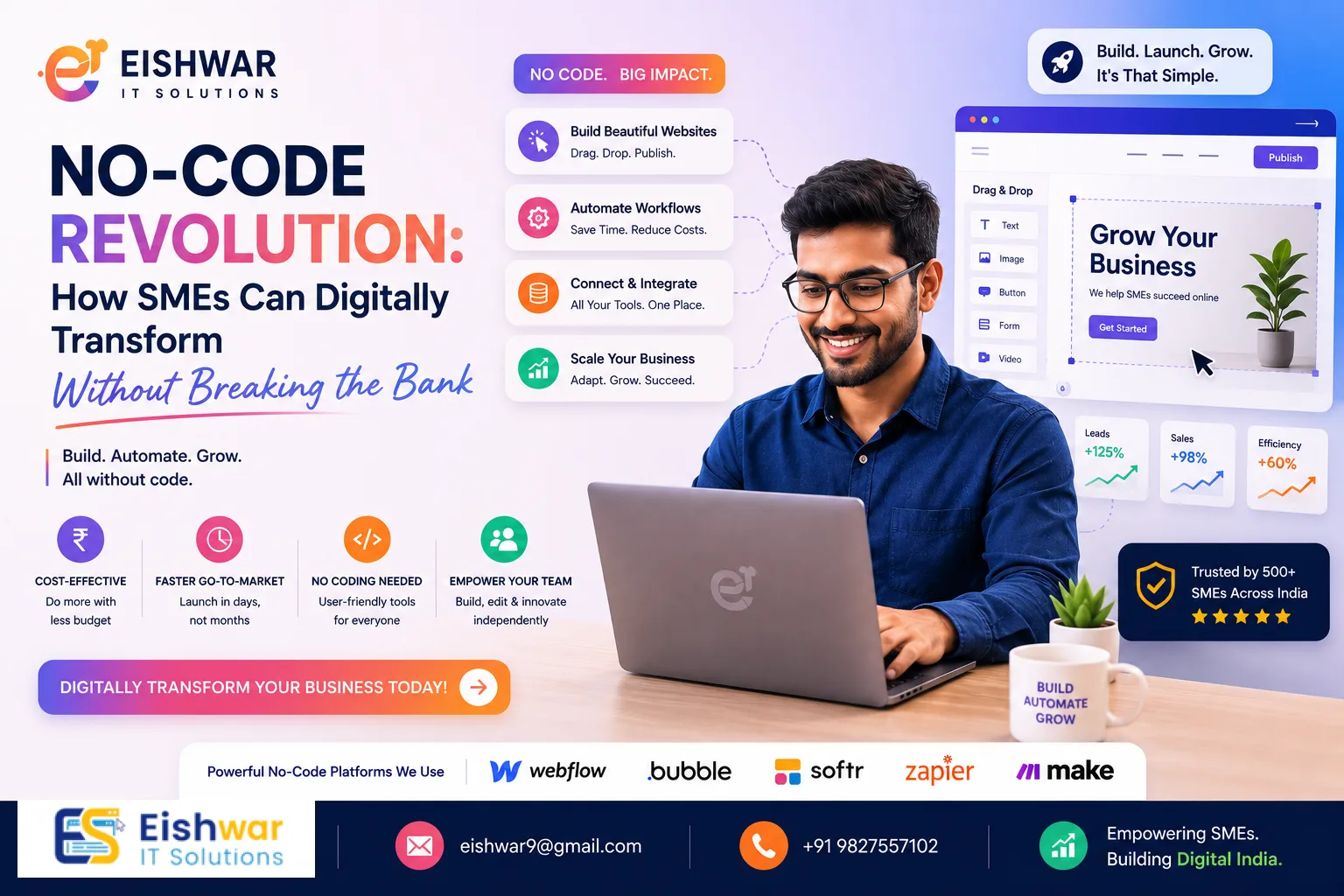
No-Code Revolution: How SMEs Can Digitally Transform Without Breaking the Bank
Introduction
Digital transformation is no longer a luxury reserved for large corporations with deep pockets and dedicated IT teams. For small and medium enterprises (SMEs) in India, staying competitive in today's fast-paced market means adopting digital tools—but tight budgets and limited technical expertise often make it feel out of reach. Enter no-code platforms. These intuitive, drag-and-drop solutions let you build apps, automate workflows, and manage data without writing a single line of code. At EishwarITSolution, we've seen firsthand how SMEs across sectors—from retail to logistics—use no-code to slash costs, boost efficiency, and unlock new growth opportunities. In this comprehensive guide, we'll show you how to leverage no-code for your digital transformation journey, with practical examples, actionable tips, and a step-by-step roadmap. Whether you're a small business owner in Mumbai or a growing startup in Bangalore, this guide is your blueprint for affordable innovation.
Main Section 1: What Is No-Code and Why It Matters for SMEs
No-code platforms are visual development environments that allow non-technical users to create software applications through graphical user interfaces and configuration instead of traditional programming. Think of it as building with LEGO blocks—you snap together pre-built components like forms, databases, and integrations to create custom solutions tailored to your business needs. Unlike traditional development, which requires months of coding and testing, no-code empowers you to prototype, iterate, and deploy in days or even hours.
For SMEs, no-code is a game-changer for several reasons. First, it dramatically reduces reliance on expensive IT teams or external developers, which can cost upwards of ₹50,000 per project for simple tools. Second, it accelerates project timelines from months to days, allowing you to respond quickly to market changes or customer demands. Third, it empowers business owners and non-technical staff to innovate directly, fostering a culture of problem-solving and agility. According to Gartner, by 2025, 70% of new applications developed by enterprises will use low-code or no-code technologies. For Indian SMEs, this means democratizing access to technology that was once reserved for big players, leveling the playing field in industries like e-commerce, manufacturing, and services.
Practical Example: A local retail store in Mumbai used a no-code platform called Glide to build a simple inventory management system in just two days. Previously, the owner spent 10 hours per week manually updating a spreadsheet and reconciling stock levels. The new app, built from a Google Sheets template, automatically syncs sales data, sends low-stock alerts via WhatsApp, and generates weekly reports. The result? A 70% reduction in manual work and a 15% decrease in stockouts within the first month.
Tip: Start by identifying a single, repetitive task that consumes more than 5 hours per week. That's your low-hanging fruit for no-code adoption.
Main Section 2: Top No-Code Tools for SME Digital Transformation
Here are some proven no-code tools that can kickstart your transformation, along with specific use cases and pricing insights:
- Bubble: A powerful platform for building fully functional web applications and marketplaces. Ideal for creating customer portals, booking systems, or even multi-vendor platforms. Example: A small travel agency in Goa built a custom booking system with payment integration in 3 days, replacing a costly third-party solution. Pricing: Free tier available; paid plans start at $25/month.
- Zapier: The king of automation, connecting over 5,000 apps (like Gmail, Slack, QuickBooks, and WhatsApp) to automate repetitive tasks. Example: Auto-save email attachments to Google Drive, create Trello cards from form submissions, or send SMS reminders for invoice payments. Pricing: Free tier includes 100 tasks/month; paid plans start at $19.99/month for 750 tasks.
- Airtable: A spreadsheet-database hybrid that combines the familiarity of Excel with the power of a relational database. Perfect for CRM, inventory tracking, project management, or event planning. Example: A Delhi-based consulting firm uses Airtable to manage client projects, track billable hours, and generate invoices automatically. Pricing: Free tier with 1,200 records; paid plans start at $10/month.
- Glide: Turns Google Sheets into mobile apps with zero coding. Great for employee directories, order tracking, or customer feedback forms. Example: A restaurant chain in Bangalore created a mobile app for staff to view daily menus, update inventory, and report issues, all synced in real-time. Pricing: Free tier for basic apps; paid plans start at $32/month.
- Monday.com: A visual project management tool with robust automation capabilities for task assignment, status updates, and notifications. Example: A Pune-based marketing agency automated its content approval workflow, reducing turnaround time by 50%. Pricing: Free tier for up to 2 users; paid plans start at $8/user/month.
These tools offer free tiers or affordable plans, making them accessible for SMEs with limited budgets. Start with one tool that addresses your biggest pain point—like automating invoice reminders with Zapier—and expand from there. Remember, the goal is not to adopt all tools at once but to build a stack that grows with your business.
Main Section 3: Step-by-Step Plan to Implement No-Code in Your SME
Follow this practical roadmap to integrate no-code into your operations without overwhelming your team:
- Identify a Bottleneck: Pick one repetitive task that eats up time and causes frustration. Common examples include manual data entry, customer follow-ups, inventory reconciliation, or report generation. Quantify the time spent—e.g., "I spend 8 hours per week on order confirmations."
- Choose the Right Tool: Based on your need, select a no-code platform. For automation, Zapier or Make (formerly Integromat). For a simple app, Glide or Bubble. For database management, Airtable. Research free trials and templates to test fit.
- Build a Prototype: Spend 2-4 hours creating a basic version using templates or tutorials. Test it with a small team or a single process. For example, if you're automating email responses, set up a Zapier workflow that triggers when a new order is placed in your e-commerce platform.
- Iterate and Scale: Gather feedback from users and refine the solution. Once successful, apply the same approach to other areas. Create a "no-code library" of reusable components (e.g., a standard form template) to speed up future projects.
- Train Your Team: Offer short tutorials or share resources from the platform's community. Most no-code tools have extensive online communities, YouTube channels, and documentation. Assign a "no-code champion" within your team to lead adoption.
Example in Action: A Delhi-based logistics SME automated order confirmation emails and tracking updates using Zapier. They connected their order management system (a Google Sheet) to Gmail and WhatsApp Business. Within a week, they reduced customer service calls by 40%, saving 15 hours of staff time per week. The total cost? Zero—they used the free tier of Zapier and existing tools.
Tip: Use a simple project management tool like Trello or Notion to track your no-code initiatives. Create columns for "Ideas," "In Progress," and "Live" to visualize progress.
Expert Tips
- Start Small, Think Big: Don't try to digitize everything at once. Focus on one process that delivers quick wins and visible ROI. Success breeds momentum.
- Leverage Templates: Most no-code platforms offer ready-made templates for common use cases like invoicing, CRM, or project tracking. Customize them to fit your needs rather than building from scratch.
- Involve Non-Tech Staff: Encourage team members—from sales to operations—to suggest processes they want automated. They know the pain points best and will be more invested in adoption.
- Monitor ROI: Track metrics like time saved, error reduction, and customer satisfaction. For example, if automation saves 5 hours per week at ₹500/hour, that's a clear return of ₹2,500/week or ₹1.3 lakh/year.
- Document Your Workflows: Create simple documentation (e.g., a Google Doc or video) for each no-code solution you build. This ensures continuity if a team member leaves or you need to scale.
Common Mistakes
- Over-engineering: Building complex solutions for simple problems. Stick to minimal viable products—add features only when needed. A simple Zapier workflow is often better than a custom app.
- Ignoring Security: Ensure any tool you use complies with data protection laws (e.g., Indian IT Act, 2000, and upcoming Digital Personal Data Protection Act). Avoid storing sensitive customer data (like Aadhaar numbers or payment details) on unsecured platforms. Use tools with encryption and access controls.
- Lack of Training: A tool is only as good as its users. Invest time in onboarding—even a 30-minute session can make a difference. Create a "cheat sheet" for common tasks.
- Not Planning for Scale: Choose platforms that can grow with your business. Check if paid plans offer more capacity, advanced features, or dedicated support. For example, Airtable's free tier limits records to 1,200, which may be insufficient for growing inventories.
- Underestimating Maintenance: No-code solutions require occasional updates—e.g., when APIs change or your business processes evolve. Assign someone to review workflows quarterly.
Future Trends
No-code is evolving rapidly, and SMEs that stay ahead will reap significant benefits. Expect AI integration—like automatically generating workflows based on user behavior or using natural language to describe what you want (e.g., "Create a form that collects customer feedback and sends it to Slack"). Also, more industry-specific no-code solutions will emerge, such as for healthcare (patient scheduling), education (student portals), or agriculture (supply chain tracking). For Indian SMEs, the rise of local no-code platforms tailored to regional languages (Hindi, Tamil, etc.) and compliance with Indian tax laws (GST) will be a boon. Additionally, no-code will merge with IoT, enabling small factories to automate machine monitoring and predictive maintenance without coding. Finally, expect no-code to become a standard skill in job descriptions, much like Excel proficiency today.
FAQs
1. Is no-code secure for my business data?
Yes, if you choose reputable platforms with encryption (both at rest and in transit), access controls (like role-based permissions), and compliance with Indian data protection norms, such as the IT Act and DPDP Act. Always review privacy policies and avoid storing highly sensitive data (e.g., payment card details) unless the platform is PCI-DSS compliant. For extra security, use no-code tools that integrate with your existing secure databases.
2. Can I build a customer-facing app with no-code?
Absolutely. Platforms like Bubble and Glide allow you to build fully functional web and mobile apps with custom branding, user authentication, payment gateways (via Stripe or Razorpay), and even push notifications. For example, a small fitness studio in Pune built a member app for class bookings and progress tracking in under a week using Bubble.
3. How much does it cost to start with no-code?
Many tools offer free plans with limited features. For example, Zapier's free tier includes 100 tasks per month, Airtable's free tier supports 1,200 records, and Glide's free tier allows basic apps with up to 500 rows. Paid plans start around $8–$32/month for SMEs, which is significantly cheaper than hiring a developer (₹50,000+ per project). Start with free tiers and upgrade as your needs grow.
4. Do I need any technical skills to use no-code?
No. No-code platforms are designed for non-technical users—business owners, marketers, operations managers, and even interns. Basic computer literacy (like using spreadsheets and web browsers) is enough. Most platforms offer interactive tutorials, video courses, and active community forums (e.g., Bubble's forum has 50,000+ members). You can also find freelancers on platforms like Upwork for complex setups.
5. How do I convince my team to adopt no-code?
Start with a pilot project that solves a real pain point—like automating a tedious manual task. Show tangible benefits, such as time saved (e.g., "This automation saves us 10 hours per week") or error reduction. Involve team members in the selection process by asking for their input on which processes to automate. Celebrate early wins with a team shout-out or a small reward. Also, share success stories from other SMEs to build excitement.
6. Can no-code replace traditional software development entirely?
No, but it can handle 80% of common business needs. For highly complex, custom, or performance-critical applications (e.g., a real-time analytics engine or a large-scale ERP), traditional coding may still be necessary. However, no-code is excellent for internal tools, customer portals, automation, and prototypes. Think of it as a complement, not a replacement.
7. What if my no-code platform goes out of business?
This is a valid concern. To mitigate risk, choose established platforms with a track record (e.g., Bubble, Zapier, Airtable) and a large user base. Always export your data regularly (most platforms offer CSV or API exports). For critical workflows, consider using open-source no-code tools like N8N or Appsmith, which you can self-host. Also, document your workflows so you can rebuild on another platform if needed.
Conclusion
No-code platforms are leveling the playing field for SMEs in India. They offer a fast, affordable, and practical path to digital transformation—without the need for expensive developers or complex IT projects. By starting small, choosing the right tools, and involving your team, you can automate processes, improve customer experience, and drive growth. At EishwarITSolution, we're here to guide you every step of the way. Whether you're just exploring no-code or ready to build your first app, our team can help you identify opportunities, select tools, and implement solutions that deliver real results. Ready to take the leap?
CTA
Ready to transform your SME with no-code? Contact EishwarITSolution today for a free consultation. Let’s build a custom digital strategy that fits your budget and goals—no coding required.