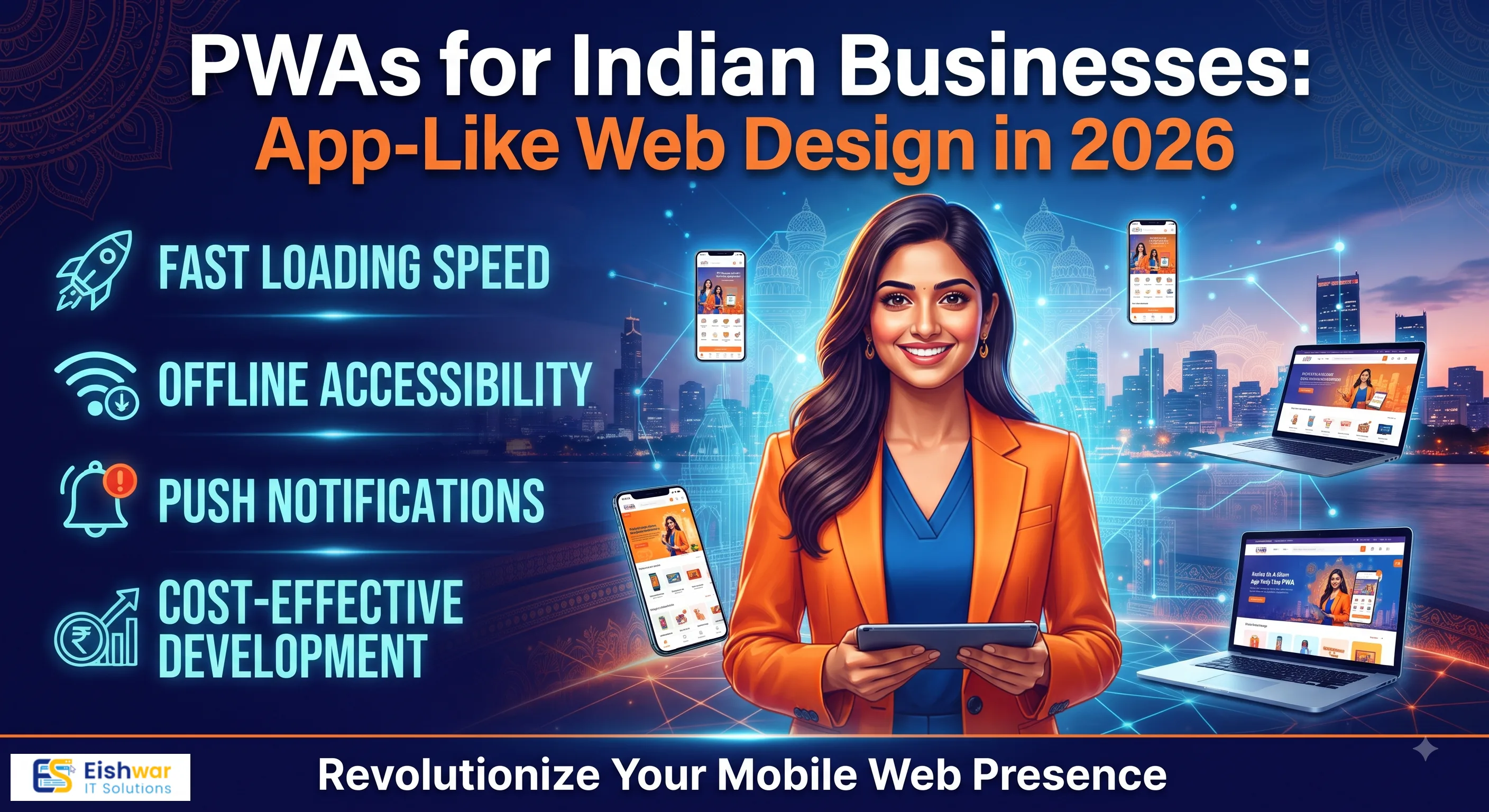
PWAs for Indian Businesses: Blending App-Like Experience with Website Design in 2026
Introduction
Imagine a website that loads instantly, works offline, and feels like a native app—without the hassle of app store downloads. That’s the power of Progressive Web Apps (PWAs). For Indian business owners, marketers, and professionals, PWAs are not just a trend; they are a game-changer in 2026. With India’s mobile-first audience expecting speed and reliability, PWAs bridge the gap between a traditional website and a mobile app. In this guide, we’ll explore how you can leverage PWAs to enhance user experience, improve conversions, and stay ahead of the competition.
Main Section 1: What Are Progressive Web Apps (PWAs)?
A Progressive Web App is a type of application software delivered through the web, built using common web technologies including HTML, CSS, and JavaScript. It is intended to work on any platform that uses a standards-compliant browser. PWAs are designed to be reliable, fast, and engaging. They can be added to a user’s home screen, send push notifications, and work offline or on low-quality networks. For Indian businesses, this means reaching users in areas with spotty connectivity without sacrificing user experience.
Main Section 2: Why PWAs Are Crucial for Indian Businesses in 2026
India has over 800 million internet users, with a majority accessing the web via mobile devices. However, network speeds and data costs remain concerns. PWAs solve these issues by caching content and reducing data usage. They also improve engagement: studies show PWAs can increase conversion rates by up to 36%. For example, an e-commerce site using a PWA can offer a seamless shopping experience even on 2G networks, reducing bounce rates and boosting sales. Additionally, PWAs are indexable by Google, improving SEO performance.
Main Section 3: How to Design a PWA for Your Indian Audience
Designing a PWA requires a mobile-first approach. Start with a responsive layout that adapts to any screen size. Use a service worker to cache assets and enable offline functionality. Focus on performance: compress images, minify code, and leverage lazy loading. Implement a web app manifest to define how your app appears on the home screen. For Indian users, prioritize local languages and culturally relevant design elements. Test on multiple devices and networks to ensure reliability. Tools like Lighthouse can help audit your PWA performance.
Expert Tips
- Prioritize Offline Functionality: Ensure key pages like product listings or contact info are accessible offline.
- Leverage Push Notifications: Use them wisely to re-engage users without being intrusive.
- Optimize for Speed: Aim for under 3 seconds load time. Use CDNs and image optimization.
- Test on Indian Networks: Simulate 2G/3G speeds to see real-world performance.
- Include Local Languages: Support Hindi, Tamil, Bengali, etc., to widen reach.
Common Mistakes
- Ignoring Service Workers: Without them, offline features won’t work.
- Overloading with Notifications: Too many push notifications can annoy users and lead to uninstalls.
- Poor Mobile UX: Don’t just shrink desktop design; rethink navigation for touch.
- Neglecting SEO: PWAs need proper meta tags and structured data to rank well.
- Skipping Cross-Browser Testing: Ensure compatibility with Chrome, Firefox, and Samsung Internet.
Future Trends
In 2026, PWAs are evolving with features like Web Bluetooth, WebUSB, and improved storage APIs. Integration with AI for personalized offline content is on the rise. We can expect PWAs to become the default for e-commerce and news platforms in India. The line between apps and websites will blur further, making PWAs a standard for mobile-first businesses.
FAQs
- What is a PWA? A Progressive Web App is a website that behaves like a native app, offering offline access, push notifications, and fast loading.
- Do PWAs work on all browsers? Yes, PWAs work on any modern browser, but some features like push notifications may vary.
- Can PWAs be indexed by Google? Absolutely. Google treats PWAs like any other website, so SEO best practices apply.
- How much does it cost to build a PWA? Costs vary, but PWAs are generally cheaper than native apps since they reuse existing web code.
- Is a PWA suitable for e-commerce? Yes, many e-commerce sites use PWAs to improve mobile conversion rates and user experience.
- Do I need to submit my PWA to an app store? No, PWAs are distributed via the web, but users can add them to their home screen.
Conclusion
Progressive Web Apps are no longer optional for Indian businesses aiming to dominate the mobile-first market. By blending the best of web and app experiences, PWAs offer speed, reliability, and engagement that traditional websites can’t match. Start your PWA journey today and watch your conversions soar.
CTA
Ready to build a PWA for your business? Contact EishwarITSolution for a free consultation. Let’s create an app-like experience that drives results.