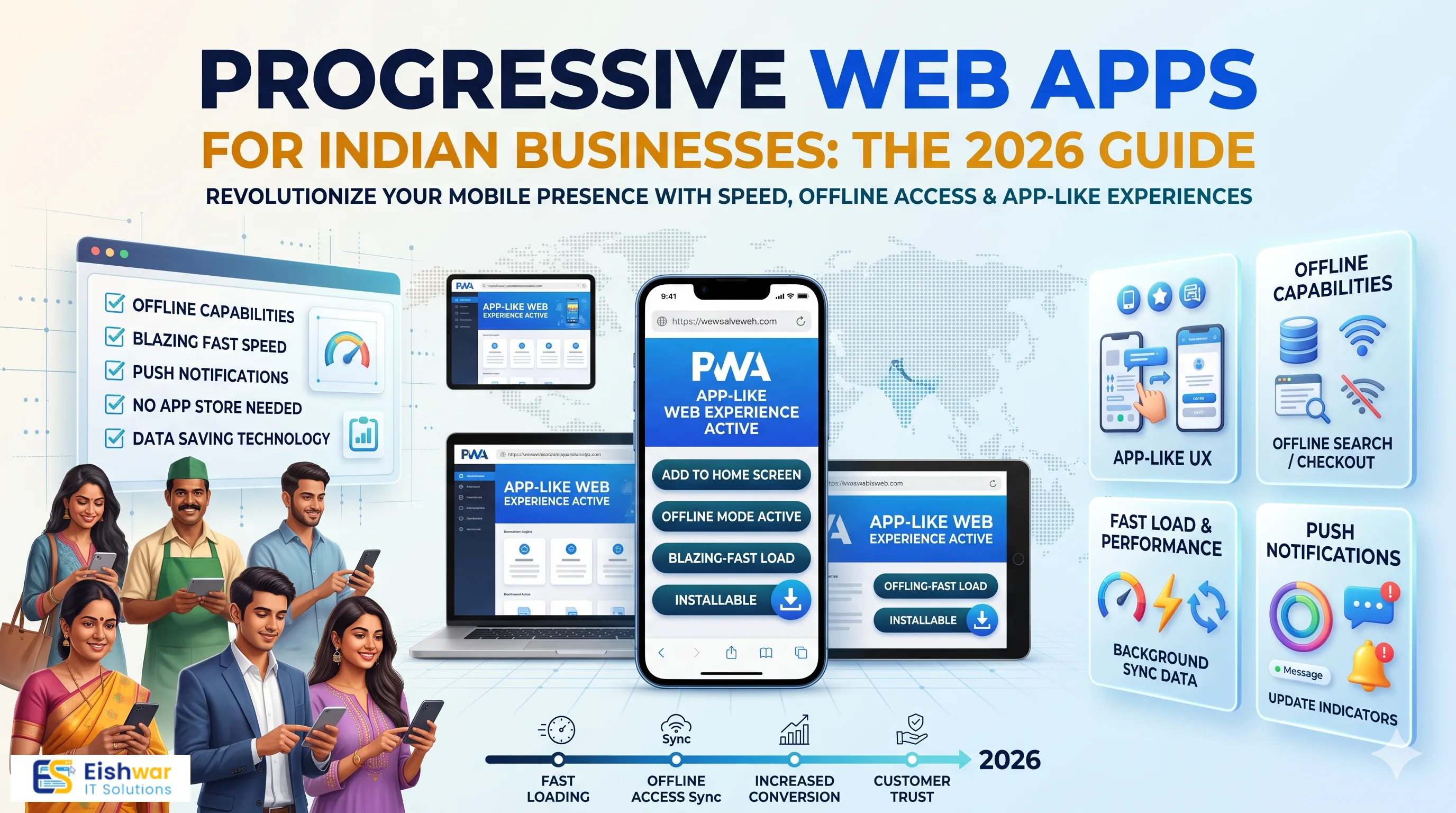
Progressive Web Apps for Indian Businesses: The 2026 Guide
Introduction
In the fast-paced digital world of 2026, Indian businesses are constantly looking for ways to stand out and provide seamless user experiences. With over 700 million smartphone users in India, the mobile-first approach is no longer optional—it's a necessity. But here's the catch: users are impatient. They expect fast loading, offline access, and a smooth experience—something traditional websites often fail to deliver.
Enter Progressive Web Apps (PWAs). They combine the best of websites and native apps, offering an app-like experience directly through the browser. For Indian businesses, PWAs are a game-changer, especially in regions with fluctuating internet connectivity. This guide will walk you through everything you need to know about PWAs, why they matter for your business, and how to implement them effectively in 2026.
What Are Progressive Web Apps (PWAs)?
A Progressive Web App is a type of application software delivered through the web, built using common web technologies including HTML, CSS, and JavaScript. It works in any browser and is designed to be responsive, fast, and reliable. PWAs are progressive because they work for every user, regardless of browser choice, and they enhance progressively with modern features.
Key characteristics of a PWA include:
- Installable: Users can 'Add to Home Screen' without visiting an app store.
- Offline Capability: Service workers enable offline functionality.
- App-like Interface: Full-screen mode and smooth navigation.
- Push Notifications: Engage users even when they're not on the site.
- Fast Loading: Instant loading regardless of network conditions.
In simple terms, a PWA gives your users the feel of a native app, but without the hassle of downloading it from an app store. For Indian businesses, this means lower friction and higher user engagement.
Why Indian Businesses Should Care About PWAs in 2026
India is a diverse market with unique challenges: patchy internet connectivity, high data costs, and a vast range of devices. PWAs are tailor-made for such conditions. Here's why your business should jump on the PWA bandwagon in 2026:
1. Better Performance in Low-Bandwidth Areas
Many parts of India still suffer from slow internet speeds. PWAs are designed to load quickly even on 2G or 3G networks. They use caching to serve content instantly, ensuring your visitors don't bounce due to slow loading times. This is crucial for retaining users in tier-2 and tier-3 cities.
2. Cost-Effective Alternative to Native Apps
Developing a native app for iOS and Android can be costly and time-consuming. PWAs eliminate the need for multiple codebases. You build one PWA that works across all devices and platforms. For Indian SMBs with limited budgets, this is a huge advantage.
3. Increased Engagement and Retention
Push notifications and the ability to add to home screen keep your brand at the top of your customers' minds. Studies show that PWAs can increase user engagement by up to 3x compared to traditional websites. In a competitive market like India, this can be a differentiator.
4. Better SEO and Discoverability
PWAs are indexed by search engines like regular websites, making them easier to find than native apps. This is a significant advantage for businesses looking to improve their local search visibility in India.
How PWAs Differ from Native Apps and Traditional Websites
To fully grasp the value of PWAs, it's important to understand how they compare to other options:
PWAs vs. Native Apps
- Installation: Native apps require app store download; PWAs are just a click away.
- Cost: Native apps require separate development for iOS and Android; PWAs are cross-platform.
- Offline: Both work offline, but PWAs don't need extra storage.
- Discoverability: PWAs are indexed by search engines; native apps are not.
- User Experience: Native apps have deeper device integration, but PWAs are catching up.
PWAs vs. Traditional Websites
- Speed: PWAs load faster due to caching.
- Engagement: PWAs offer push notifications and app-like interactions.
- Offline: PWAs work offline; traditional websites don't.
- Development: PWAs require more advanced tech, but not much more.
For most Indian businesses, PWAs offer the perfect balance between reach, cost, and user experience.
Key Features of a PWA: What Makes It 'App-Like'?
Let's dive deeper into the features that make PWAs so powerful:
1. Service Workers
Service workers are scripts that run in the background, handling network requests and caching. They enable offline functionality and fast loading. Think of them as a middleman between your website and the network.
2. Web App Manifest
This JSON file gives the browser information about your app—name, icons, colors, and how it should appear when installed. It's what makes the 'Add to Home Screen' possible.
3. HTTPS
PWAs require secure connections to ensure data integrity and user security. This is non-negotiable, but it's also a good practice for any website.
4. Push Notifications
You can send notifications to users even when they're not actively browsing. This helps in re-engaging customers with offers, updates, and reminders.
Step-by-Step Implementation of a PWA for Your Indian Business
Ready to make your website a PWA? Here's a simplified step-by-step process:
Step 1: Audit Your Current Website
Assess your current site's performance, mobile-friendliness, and user experience. Tools like Google Lighthouse can give you a PWA score and identify areas for improvement.
Step 2: Secure Your Site with HTTPS
If you're not already on HTTPS, now's the time. You'll need an SSL certificate—most hosting providers offer free options like Let's Encrypt.
Step 3: Create a Web App Manifest
Add a manifest.json file to your site, specifying your app's name, icons, colors, and display mode. This is crucial for the installable experience.
Step 4: Register a Service Worker
Write a service worker script that caches your core assets (HTML, CSS, JS) and handles offline requests. Start simple—cache the homepage and key pages first.
Step 5: Add Icons and Splash Screens
Design icons that look great on various devices and sizes. Also, create a splash screen that appears when your PWA launches.
Step 6: Test and Optimize
Use tools like Lighthouse and real-device testing to ensure everything works smoothly. Optimize for different network speeds and devices.
Step 7: Deploy and Monitor
Launch your PWA and monitor its performance using analytics. Track user engagement, loading times, and conversion rates.
Expert Tips for Maximizing PWA Success in India
Here are some insights from web development experts to help you get the most out of your PWA:
1. Prioritize Core Pages
Not every page needs to be cached. Focus on your most important pages—homepage, product pages, and checkout—to ensure the best performance where it matters most.
2. Use Lazy Loading
Load images and videos only when they're about to enter the viewport. This reduces initial load time and saves data for users on limited plans.
3. Implement Effective Push Notifications
Don't spam your users. Send relevant, timely notifications that add value. For example, notify them about order updates or exclusive offers tailored to their interests.
4. Keep User Experience Consistent
Your PWA should feel like a natural extension of your brand. Maintain consistent design, tone, and functionality across all pages.
5. Leverage Local SEO
Since PWAs are indexed by search engines, optimize your content for local keywords. Include location-based terms and create content that resonates with Indian audiences.
Common Mistakes to Avoid When Building a PWA
Even with the best intentions, it's easy to make mistakes. Here are common pitfalls Indian businesses should avoid:
1. Ignoring Offline Experience
Some businesses create a PWA but fail to handle offline scenarios properly. Users should see a helpful message or cached content when offline, not a blank screen.
2. Overcomplicating the Manifest
Keep your manifest simple. Ensure the name, icons, and colors are correct. A poorly configured manifest can result in a bad installation experience.
3. Neglecting Performance Optimization
A PWA that is slow is no better than a traditional website. Optimize images, minify code, and use caching strategies to ensure lightning-fast loads.
4. Not Testing on Real Devices
Emulators are useful, but nothing beats testing on actual devices used by your target audience. India has a wide range of Android devices—test on lower-end models too.
5. Forgetting About Analytics
Without tracking, you can't measure success. Use analytics to understand user behavior, identify bottlenecks, and make data-driven improvements.
Future Trends: The Evolution of PWAs in 2026 and Beyond
PWAs are not a passing trend; they are evolving rapidly. Here's what the future holds:
1. Enhanced Capabilities
With new APIs, PWAs will gain access to more device features—like Bluetooth, NFC, and even file system access. This will make them even more powerful for business use cases.
2. Integration with AI and Machine Learning
Imagine PWAs that can personalize content in real-time based on user behavior. AI will play a significant role in making PWAs smarter and more intuitive.
3. Improved Performance on Low-End Devices
As web technologies advance, PWAs will become even more efficient, ensuring smooth performance on budget smartphones—a crucial factor for the Indian market.
4. Voice and Gesture Control
With the rise of voice search and gesture-based interactions, PWAs will adapt to support these new input methods, making them more accessible.
5. Greater Adoption by Indian Enterprises
Large Indian companies are starting to realize the benefits of PWAs. Expect to see more enterprise-level PWAs in sectors like e-commerce, fintech, and education.
Frequently Asked Questions (FAQs)
1. What is a Progressive Web App (PWA)?
A PWA is a type of web application that uses modern web capabilities to provide an app-like experience. It is reliable, fast, and engaging, and can be installed on a user's device directly from the browser.
2. How is a PWA different from a native app?
A PWA is built with web technologies and runs in a browser, while a native app is developed for a specific platform (iOS/Android) and installed via an app store. PWAs are cross-platform and don't require app store approval.
3. Do PWAs work on all devices?
Yes, PWAs are designed to be responsive and work on any device with a modern browser, including desktops, tablets, and smartphones.
4. Can PWAs work offline?
Yes, thanks to service workers, PWAs can cache content and allow users to access the app even without an internet connection.
5. Are PWAs good for SEO?
Absolutely. PWAs are indexed by search engines like regular websites, and their fast loading times can positively impact your SEO rankings.
6. How much does it cost to build a PWA?
The cost varies depending on complexity. For a basic PWA, you might spend anywhere from ₹50,000 to ₹2,00,000. More complex ones can cost more. However, it's often cheaper than developing separate native apps.
Conclusion
Progressive Web Apps are no longer just a buzzword—they are a strategic necessity for Indian businesses in 2026. They offer a cost-effective, user-friendly, and SEO-friendly solution that addresses the unique challenges of the Indian digital landscape. Whether you're an e-commerce store, a service provider, or a content platform, PWAs can help you deliver a superior user experience, boost engagement, and ultimately drive growth.
Don't wait for your competitors to steal the show. Start exploring PWA development for your business today and give your users the app-like experience they deserve.
Ready to Transform Your Website into a PWA?
At EishwarITSolution, we specialize in building cutting-edge web solutions tailored to Indian businesses. Our team of experts can help you design and implement a PWA that meets your unique needs and exceeds your users' expectations. Contact us today for a free consultation and take the first step towards a faster, more engaging web presence.
CTA
Ready to transform your website into a PWA? Contact EishwarITSolution today for a free consultation and start building your app-like web experience.