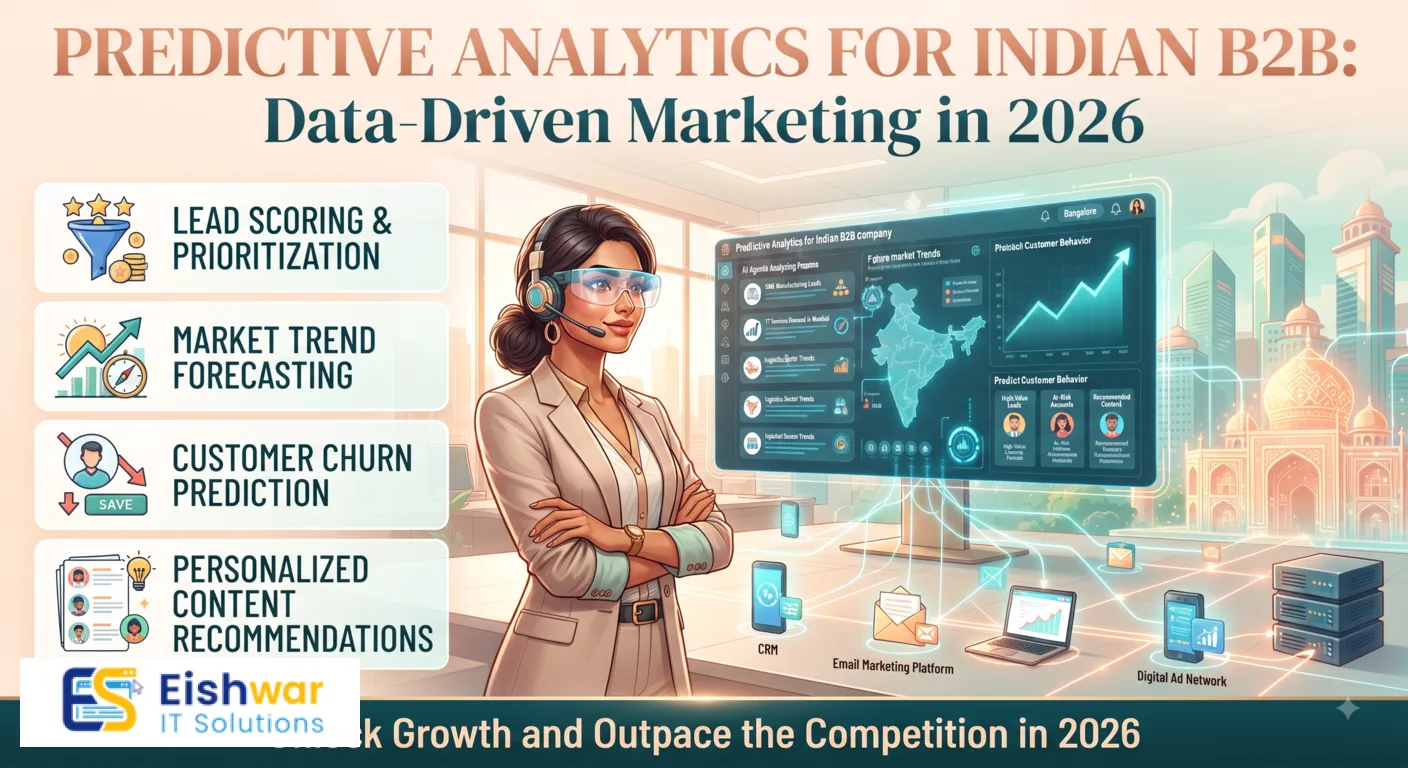
Predictive Analytics for Indian B2B: Data-Driven Marketing in 2026
Introduction
Imagine knowing exactly which leads will convert, which customers are about to churn, and which marketing channel will bring the highest ROI—before it happens. That’s the power of predictive analytics. In 2026, Indian B2B marketers are moving beyond gut feelings and spreadsheets. They are leveraging AI-driven models to forecast trends, personalize outreach, and make smarter decisions. This article explores how predictive analytics is reshaping B2B marketing in India and provides actionable steps to implement it in your business.
The Indian B2B market is at a tipping point. With over 50 million SMEs and a rapidly digitizing economy, the volume of data generated daily is staggering. Yet, many businesses still rely on intuition or outdated methods. Predictive analytics bridges this gap, offering a systematic way to extract value from data. For instance, a Pune-based automotive parts supplier used predictive models to identify dormant accounts that were likely to re-engage, resulting in a 40% increase in reactivation rates within six months. This is not just about technology; it’s about survival in a hyper-competitive landscape.
Main Section 1: What is Predictive Analytics and Why It Matters for Indian B2B?
Predictive analytics uses historical data, statistical algorithms, and machine learning to identify the likelihood of future outcomes. For B2B marketers in India, this means understanding which prospects are most likely to buy, which content resonates, and when to engage. With the explosion of digital data from CRM, social media, and website analytics, Indian businesses have a goldmine of information. Predictive analytics turns that data into a competitive edge.
Why now? India’s B2B landscape is becoming increasingly competitive. Companies that rely on intuition are being outpaced by those using data. According to a recent report, businesses using predictive analytics see a 15-20% increase in marketing ROI. For Indian SMEs and enterprises alike, this is a game-changer. Consider the example of a Mumbai-based logistics firm that implemented predictive analytics to forecast demand spikes during festival seasons. By pre-positioning inventory and adjusting marketing spend, they reduced delivery delays by 30% and increased customer satisfaction scores by 18%. The key is that predictive analytics doesn’t just tell you what happened; it tells you what will happen, allowing you to act proactively rather than reactively.
Another critical factor is the unique nature of Indian B2B transactions. Unlike B2C, where purchases are often impulsive, B2B decisions involve multiple stakeholders, longer sales cycles, and higher ticket sizes. Predictive analytics helps navigate this complexity by identifying patterns in decision-making. For example, a Bangalore-based SaaS company discovered that leads who attended two webinars and downloaded a whitepaper were 5x more likely to convert than those who only visited the website. This insight allowed them to prioritize outreach efforts and shorten the sales cycle by 20%.
Main Section 2: Key Applications of Predictive Analytics in Indian B2B Marketing
1. Lead Scoring and Prioritization
Not all leads are created equal. Predictive lead scoring uses past conversion data to rank leads by likelihood to buy. For example, a SaaS company in Bangalore can analyze which website visits, email clicks, and demo requests correlate with closed deals. Sales teams then focus on high-scoring leads, increasing efficiency and conversion rates. A practical tip: Start by defining what a “qualified lead” means for your business. For a Delhi-based IT services firm, a lead was considered qualified if they had a budget over ₹50 lakhs and a decision-maker involved. By feeding this into a predictive model, they improved lead-to-opportunity conversion by 35% in just three months.
2. Customer Churn Prediction
Losing a customer hurts. Predictive models can flag accounts showing early signs of churn—like reduced logins or support tickets—so you can intervene with retention offers. A logistics firm in Mumbai used this to reduce churn by 25% in one quarter. They implemented a system where accounts with a churn probability above 70% received a personalized discount or a dedicated account manager call. The result? Customer lifetime value increased by 15% within six months. For Indian B2B companies, where customer acquisition costs can be high, retaining existing clients is often more profitable than chasing new ones.
3. Campaign Optimization
Which email subject line drives opens? Which ad creative gets clicks? Predictive analytics tests multiple variables and recommends the best combination. For a Delhi-based manufacturing company, this led to a 30% increase in email engagement. They used A/B testing combined with predictive models to determine that emails sent on Tuesday mornings with subject lines containing “exclusive offer” had the highest open rates. By automating this insight, they saved 10 hours per week on manual testing and saw a 12% boost in demo requests.
4. Personalization at Scale
Indian B2B buyers expect personalized experiences. Predictive analytics enables you to tailor content, product recommendations, and pricing based on individual behavior and demographics. A Chennai-based IT services firm used predictive personalization to boost cross-selling by 18%. They analyzed past purchase patterns and identified that clients who bought cloud services were 60% more likely to also need cybersecurity solutions. By sending targeted emails with relevant case studies, they increased average deal size by ₹2 lakhs per client.
Main Section 3: How to Implement Predictive Analytics in Your B2B Strategy
Start small and scale. Here’s a step-by-step plan:
- Clean Your Data: Predictive models are only as good as the data you feed them. Ensure your CRM, website analytics, and sales data are accurate and integrated. For example, remove duplicate entries, standardize field formats, and fill in missing values. A Hyderabad-based e-commerce platform spent two weeks cleaning their data and saw a 25% improvement in model accuracy.
- Define Your Goals: Are you looking to increase conversions, reduce churn, or optimize ad spend? Clear objectives guide model selection. For instance, if your goal is to reduce churn, focus on historical data of customers who left and those who stayed. A Pune-based startup defined their goal as “reduce churn by 20% in Q3,” which helped them choose a logistic regression model over a more complex neural network.
- Choose the Right Tools: Platforms like HubSpot, Salesforce Einstein, or Indian tools like LeadSquared and Zoho Analytics offer built-in predictive features. For custom models, consider Python or R with cloud ML services like AWS SageMaker or Google AI Platform. A mid-sized manufacturing company in Gujarat used Zoho Analytics’ predictive add-on to forecast sales trends, costing them just ₹50,000 per year—a fraction of custom development.
- Build and Train Models: Use historical data to train models. Start with simple regression or decision tree algorithms, then move to neural networks if needed. For lead scoring, a random forest model often works well. A Bangalore-based fintech company trained a model on 10,000 past leads and achieved 85% accuracy in predicting conversions within two weeks.
- Integrate and Act: Embed predictions into your daily workflows—for example, automatically routing high-scoring leads to sales or triggering retention emails for at-risk accounts. Use APIs to connect your CRM with the model. A Delhi-based consulting firm integrated their predictive model with Salesforce, so sales reps received daily alerts on which accounts to call first, increasing call-to-meeting conversion by 22%.
- Monitor and Iterate: Predictive models degrade over time. Regularly retrain with new data and track performance metrics like precision and recall. Set up a monthly review process. A Chennai-based logistics company noticed their churn model’s accuracy dropped from 85% to 70% after six months. By retraining with recent data, they restored it to 82% within a week.
Expert Tips
- Start with a single use case: Don’t try to predict everything at once. Pick one pain point, like lead scoring, and master it. A Mumbai-based agency started with churn prediction and, after seeing a 20% reduction, expanded to campaign optimization.
- Involve sales early: Predictive analytics is not just for marketing. Get sales team feedback on lead quality and model outputs. A Bangalore-based software firm held weekly meetings with sales to refine their lead scoring model, resulting in a 30% increase in sales acceptance of leads.
- Focus on interpretability: In India, stakeholders may be skeptical of black-box models. Use explainable AI techniques to show why a lead scored high. For example, use SHAP values to highlight key features like “visited pricing page” or “downloaded case study.” A Delhi-based startup used this approach to convince their CEO to invest in predictive tools.
- Leverage Indian datasets: Use local data sources like GST filings, UPI transaction patterns, or industry-specific databases for richer models. A Pune-based manufacturer incorporated GST data to predict demand for raw materials, reducing inventory costs by 15%.
- Build a cross-functional team: Include data scientists, marketers, and IT staff. A Hyderabad-based company formed a team of three people—a data analyst, a marketing manager, and a sales VP—to oversee their predictive analytics initiative, ensuring alignment across departments.
Common Mistakes
- Ignoring data quality: Garbage in, garbage out. Incomplete or outdated data leads to inaccurate predictions. For example, a Chennai-based firm used CRM data with 30% missing phone numbers, resulting in a churn model that was only 50% accurate. After cleaning, accuracy jumped to 78%.
- Overfitting the model: A model that performs perfectly on historical data may fail on new data. Use cross-validation to avoid this. A Bangalore-based startup overfitted their lead scoring model, achieving 99% accuracy on training data but only 60% on new leads. After applying k-fold cross-validation, they achieved a more realistic 80% accuracy.
- Neglecting privacy compliance: India’s Digital Personal Data Protection Act 2023 requires consent and data minimization. Ensure your predictive models comply. For instance, avoid using sensitive personal data like caste or religion in models. A Delhi-based company faced a ₹10 lakh fine for using unconsented data; they now anonymize all data before analysis.
- Not acting on insights: Even the best predictions are useless if not integrated into decision-making. Build automated triggers. A Mumbai-based firm had a churn model but no automated email system; they lost 50 at-risk accounts before implementing triggers. After automation, they saved 80% of those accounts.
- Underestimating model maintenance: Models need regular updates. A Pune-based company didn’t retrain their model for a year, and its accuracy dropped from 85% to 55%. They now retrain quarterly.
Future Trends
By 2028, predictive analytics will become even more accessible with no-code AI platforms. Expect real-time predictions embedded in every marketing tool. Indian B2B marketers will use predictive models to forecast market trends, optimize pricing dynamically, and even predict customer lifetime value with high accuracy. The rise of edge computing will allow predictions to happen faster, even on mobile devices used by field sales teams in rural India. For example, a sales rep in a remote village could use a mobile app that predicts which farmer cooperatives are likely to buy agricultural equipment, based on real-time weather and crop price data. Additionally, integration with IoT devices will enable predictive maintenance models for manufacturing equipment, reducing downtime by up to 40%. The adoption of generative AI will also allow marketers to create personalized content at scale, with predictive models determining which message resonates best with each segment.
FAQs
- What is predictive analytics in B2B marketing? Predictive analytics uses historical data and AI to forecast future customer behaviors, such as likelihood to purchase or churn. It helps marketers prioritize efforts and optimize campaigns.
- How can small Indian businesses afford predictive analytics? Many affordable tools like Zoho Analytics, LeadSquared, and Google Cloud AutoML offer tiered pricing. Start with free trials and scale as you see ROI. For example, Zoho Analytics starts at ₹1,500 per month, and LeadSquared offers plans from ₹10,000 per month. Some open-source tools like Python’s scikit-learn are free but require technical expertise.
- What data do I need to start? At minimum, CRM data (lead source, interactions, deal outcomes), website analytics (page visits, time on site), and email engagement (opens, clicks). For richer models, include social media activity, support ticket history, and third-party data like industry reports. A good starting point is to have at least 1,000 historical records for training.
- How accurate are predictive models? Accuracy varies by use case and data quality. Typically, well-trained models achieve 70-90% accuracy for lead scoring. For churn prediction, accuracy ranges from 60-85%. It’s important to measure not just accuracy but also precision and recall to avoid false positives.
- Is predictive analytics only for large enterprises? No. SMEs can benefit just as much. Cloud-based tools make it accessible without huge upfront investment. For instance, a small logistics company in Jaipur used a free trial of HubSpot’s predictive lead scoring and saw a 15% increase in conversions within two months. The key is to start with a specific problem and use affordable tools.
- How long does it take to implement predictive analytics? Depending on complexity, implementation can take from 2 weeks to 3 months. Simple lead scoring models can be set up in 2-4 weeks if data is clean. Custom models with multiple data sources may take 2-3 months. Plan for ongoing maintenance.
- What are the risks of using predictive analytics? Risks include data privacy violations, model bias, and over-reliance on automation. Mitigate by complying with DPDP Act 2023, auditing models for bias, and always having human oversight. For example, a model that historically favored leads from metro cities might ignore rural opportunities; regular audits can correct this.
Conclusion
Predictive analytics is not a futuristic concept—it’s a practical tool that Indian B2B marketers can use today to gain a competitive edge. By turning data into actionable insights, you can improve lead conversion, reduce churn, and optimize campaigns. The key is to start small, focus on data quality, and integrate predictions into your daily workflow. The future of B2B marketing is data-driven, and predictive analytics is your compass. As the Indian market continues to digitize, those who embrace predictive analytics will not only survive but thrive, turning uncertainty into opportunity.
CTA
Ready to transform your B2B marketing with predictive analytics? Contact EishwarITSolution for a free consultation. Our experts will help you identify the right use case, choose the best tools, and build a custom predictive model that drives real results. Don’t let data sit idle—turn it into your biggest asset. Whether you’re a startup in Bangalore or a manufacturing giant in Gujarat, we have the expertise to guide you. Schedule your free 30-minute call today and take the first step toward data-driven success.