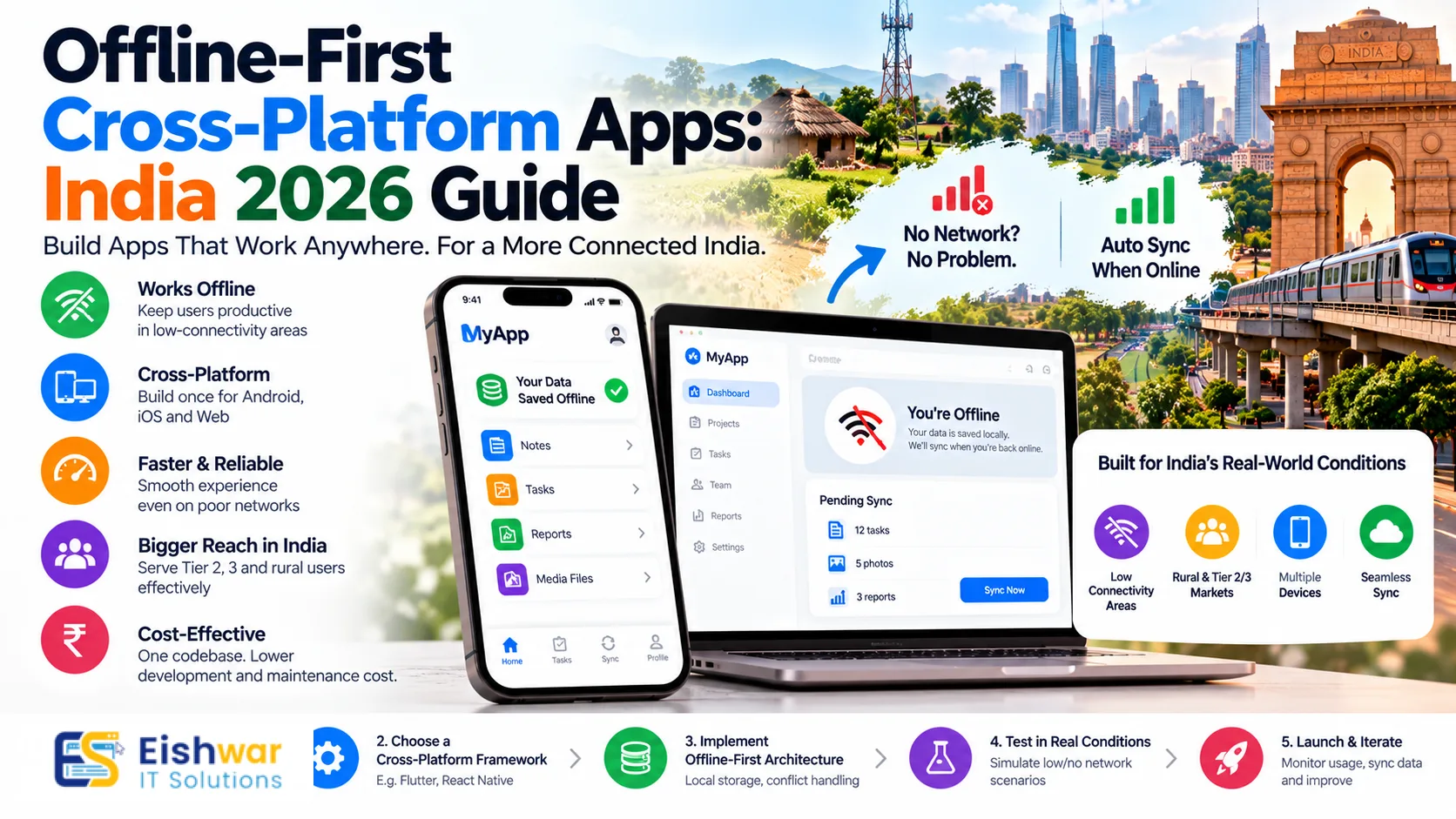
Offline-First Cross-Platform Apps: India 2026 Guide
Introduction
Indian mobile users live with a simple contradiction: they expect instant digital experiences, yet network quality still changes block by block. A customer in Mumbai may open your app in a basement showroom. A field sales agent in Nashik may work in a low-signal village. A D2C shopper on a train may lose connectivity mid-checkout. If your app collapses when the network drops, you lose revenue, trust, and repeat usage.
That is why offline-first cross-platform apps are becoming a serious business strategy in 2026. Instead of treating offline mode as a backup, offline-first apps store data locally, let users complete core tasks without internet, and sync seamlessly when connectivity returns. When built with Flutter, React Native, or modern web app frameworks, one offline-ready architecture can serve Android, iOS, and web users.
This guide is for business owners, marketers, and professionals who want practical results. You will learn why offline-first matters in India, how the architecture works, what implementation roadmap to follow, and which mistakes can quietly kill your ROI.
Main Section 1: Why Offline-First Cross-Platform Apps Matter in India
Network reality is not uniform
5G rollout is expanding, but coverage, indoor signal strength, and congestion remain uneven. Users in metros still face dead zones in malls, trains, basements, and old buildings. Users in smaller cities and rural markets may switch between 4G and 2G throughout the day. An app that demands a stable connection excludes a large part of your market.
Offline-first cross-platform apps solve this by treating connectivity as optional for critical journeys. Users can browse products, fill forms, capture leads, scan invoices, update inventory, or complete lessons. The app saves changes locally and syncs later. This creates a smoother experience regardless of where the user is.
Business impact is measurable
- Higher conversions: Shoppers can add to cart, apply coupons, and place orders even with weak signal, reducing cart abandonment.
- Better field productivity: Sales and service teams can update CRM records, log visits, and upload photos without waiting for network bars.
- Stronger retention: Apps that work reliably become part of daily routines, especially for B2B, logistics, healthcare, and education.
- Lower support cost: Fewer failed submissions and lost data mean fewer support tickets and refund requests.
- Trust and brand equity: When an app respects a user's time and network constraints, users remember it.
Cross-platform makes offline-first more practical
Building separate offline logic for Android and iOS doubles cost and creates inconsistent behavior. Cross-platform frameworks let you define one local database strategy, one sync engine, and one conflict-resolution model. Flutter and React Native both support mature local storage libraries, background tasks, and encrypted databases. PWAs can add service workers and IndexedDB for browser-based offline access.
For Indian businesses, this means faster rollouts, lower maintenance, and a consistent experience across devices. Whether you serve customers, channel partners, or internal teams, offline-first cross-platform apps can become a competitive advantage in 2026.
Main Section 2: Core Architecture of an Offline-First Cross-Platform App
Offline-first is not just turning on a cache. It is a data strategy. Here is the architecture that works for most Indian business apps.
1. Local database as the source of truth
The app should read and write to a local database first, then sync to the server. Popular choices include SQLite, Realm, WatermelonDB, Hive, and Isar. Your choice depends on data complexity, query needs, encryption requirements, and framework support.
For example, a field service app can store job cards, customer details, spare parts, and photos locally. The technician completes the job even with no signal. The app marks records as pending and syncs when the device reconnects.
2. Sync engine with queues and delta updates
A good sync engine handles more than uploading data. It should:
- Queue changes made offline and retry automatically.
- Send only changed fields, not entire records, to save bandwidth.
- Download updates in batches to reduce battery and data usage.
- Pause and resume based on network type or user settings.
- Show sync status clearly so users know what is saved and what is pending.
Delta sync is especially important in India, where users are sensitive to mobile data consumption. Sending a full product catalog every time is wasteful. Sending only price or stock changes is smart.
3. Conflict resolution that protects business logic
When two devices edit the same record offline, conflicts happen. Common strategies include last-write-wins, version numbers, field-level merging, and CRDTs for collaborative data. Last-write-wins is simple but risky for inventory or payments. For financial data, use server-side validation and audit logs.
Example: A distributor updates stock to 50 units while a salesperson marks 10 units sold offline. The sync engine must merge these changes correctly, not overwrite one with the other. Define rules per entity, not one global rule.
4. Offline authentication and security
Users should not be logged out simply because the network dropped. Cache tokens securely, use refresh tokens with sensible expiry, and allow biometric unlock where needed. Encrypt local databases, especially if they contain customer PII, payment details, or health data.
For Indian businesses, DPDP Act compliance matters. Collect only what you need, store it securely, and give users clear controls. Offline storage does not remove legal responsibility. It increases the need for encryption and access control.
5. Media and file handling
Photos, videos, and documents are often the heaviest part of an offline app. Compress images before saving, use resumable uploads, and store media in a separate queue from text data. A delivery app can capture proof of delivery offline and upload the image when the driver reaches a stable network.
6. UI patterns that build confidence
Users need to know what is happening. Use clear labels like Saved offline, Syncing, and Synced. Avoid silent failures. Show pending items in a dedicated screen. Let users retry manually if needed. These small design choices reduce anxiety and support calls.
7. Backend readiness
Your server must support idempotent APIs, timestamps, versioning, and conflict-aware endpoints. Firebase, Supabase, and custom Node.js or Python APIs can all work. GraphQL can help fetch exactly what changed. The key is to design sync as a product feature, not an afterthought.
Main Section 3: Implementation Roadmap and ROI for Indian Businesses
You do not need to rebuild everything at once. A phased approach lowers risk and proves value faster.
Step 1: Map critical offline journeys
Identify the 3 to 5 tasks users must complete without internet. For a D2C brand, it may be browsing, adding to cart, and placing a COD order. For a logistics company, it may be scanning shipments and capturing signatures. For an edtech app, it may be downloading lessons and taking quizzes. Focus on high-value journeys first.
Step 2: Define data ownership and sync rules
Decide which data lives on the device, which lives on the server, and which needs conflict resolution. Create a simple table: entity, offline read, offline write, sync direction, conflict rule, retention. This document prevents expensive confusion later.
Step 3: Choose the right cross-platform stack
Flutter offers strong performance and a consistent UI across Android and iOS. React Native has a large ecosystem and works well for teams with JavaScript expertise. For web-first businesses, a PWA with service workers can be a cost-effective starting point. The best stack is the one your team can maintain and extend.
Step 4: Build a thin slice MVP
Do not build every feature offline. Build one complete journey from start to finish. Test it with real users in real network conditions. A field team in Pune or a customer group in Lucknow can reveal issues that lab testing misses.
Step 5: Test for low-end devices and poor networks
Use network throttling to simulate 2G, 3G, and fluctuating 4G. Test on budget Android phones with limited storage and RAM. Check battery usage from background sync. Ensure the app does not drain data or battery, or users will uninstall it.
Step 6: Measure business and technical metrics
- Task completion rate offline vs online
- Sync success rate and average sync time
- Crash-free sessions
- Support tickets related to data loss or failed submissions
- Retention and repeat usage among users in low-network areas
- Field team productivity, such as jobs completed per day
Where ROI comes from
Offline-first cross-platform apps create ROI in three ways. First, revenue protection: fewer abandoned carts and failed transactions. Second, productivity: field and operations teams complete more work per day. Third, cost avoidance: less rework, fewer support calls, and lower data usage complaints.
For a mid-sized Indian business, even a 5% improvement in field completion rates or checkout success can justify the investment. The key is to measure before and after, not just ship the feature.
Expert Tips
- Start with the sync UX, not the database. Users forgive offline limits if the app communicates clearly.
- Design for intermittent connectivity, not just full offline. Most Indian users face unstable networks, not zero network.
- Use field teams as testers. They know real-world conditions better than any QA lab.
- Keep payloads small. Compress images, paginate lists, and send deltas.
- Encrypt local data. Device theft is a real risk, especially for enterprise apps.
- Log sync events. You need visibility into failures to fix them quickly.
- Give users control. Let them choose Wi-Fi-only sync for heavy files.
- Plan for app updates. Database migrations must work even when users update after weeks offline.
Common Mistakes
- Treating offline as caching. A cache is read-only. Offline-first supports writes and sync.
- Ignoring conflict resolution. Two offline edits can corrupt inventory, bookings, or payments.
- Syncing everything on app open. This drains battery, data, and patience.
- No visible sync status. Users assume data is lost and stop trusting the app.
- Testing only on high-end phones. Budget devices are common across India.
- Forgetting security. Local databases need encryption and access controls.
- Building separate logic for each platform. This defeats the cross-platform advantage.
- Skipping legal review. DPDP Act and sector rules still apply to offline data.
Future Trends
Offline-first cross-platform apps will evolve quickly between 2026 and 2028. Expect local-first software principles to go mainstream, with CRDTs making real-time collaboration possible even after offline edits. On-device AI will let apps summarize, classify, and recommend without sending data to the cloud. Edge computing will bring sync closer to users, reducing latency for Indian cities and towns.
We will also see more intelligent sync engines that learn from network patterns. An app may pre-sync stock updates before a salesperson enters a low-network area. PWAs will close the gap with native apps for many business use cases. At the same time, data protection rules will make encrypted local storage and transparent consent standard requirements, not nice-to-haves.
FAQs
What is an offline-first cross-platform app?
It is an app built with a single codebase for multiple platforms that stores data locally and allows core tasks without internet. Changes sync automatically when connectivity returns.
Is offline-first only for rural users?
No. Urban users also face basements, lifts, trains, flights, and network congestion. Offline-first improves reliability everywhere.
Which framework is best for offline-first apps in India?
Flutter and React Native are both strong choices. The best framework depends on your team skills, performance needs, and backend. Many Indian businesses choose Flutter for UI consistency and React Native for JavaScript ecosystem fit.
How do you handle data conflicts when two users edit offline?
Use version numbers, timestamps, field-level merges, or CRDTs depending on the data. Financial and inventory records should have server-side validation and audit trails.
Does offline-first increase development cost?
It adds upfront architecture work, but it often reduces long-term support costs and increases completion rates. A phased MVP keeps the initial investment manageable.
How does offline-first relate to DPDP Act compliance?
Offline storage still contains personal data, so you must encrypt it, limit collection, and give users control. The DPDP Act applies regardless of whether data is on a server or a device.
Conclusion
Offline-first cross-platform apps are no longer a niche technical choice. In India, they are a practical response to how people actually use mobile devices. Networks fluctuate, devices vary, and users expect progress even when connectivity fails. By putting local data and smart sync at the center, you can protect revenue, empower field teams, and build trust.
The businesses that win in 2026 will not be the ones with the flashiest features. They will be the ones whose apps work when it matters most. Start with one critical journey, design for intermittent connectivity, and measure the business impact. You will quickly see why offline-first is a growth strategy, not just an engineering detail.
CTA
Ready to build an offline-first cross-platform app for your business? EishwarITSolution helps Indian businesses plan, design, and develop reliable mobile apps that perform in real-world network conditions. Visit eishwar.com or contact our team to discuss your project. Let us turn poor connectivity into a competitive advantage.