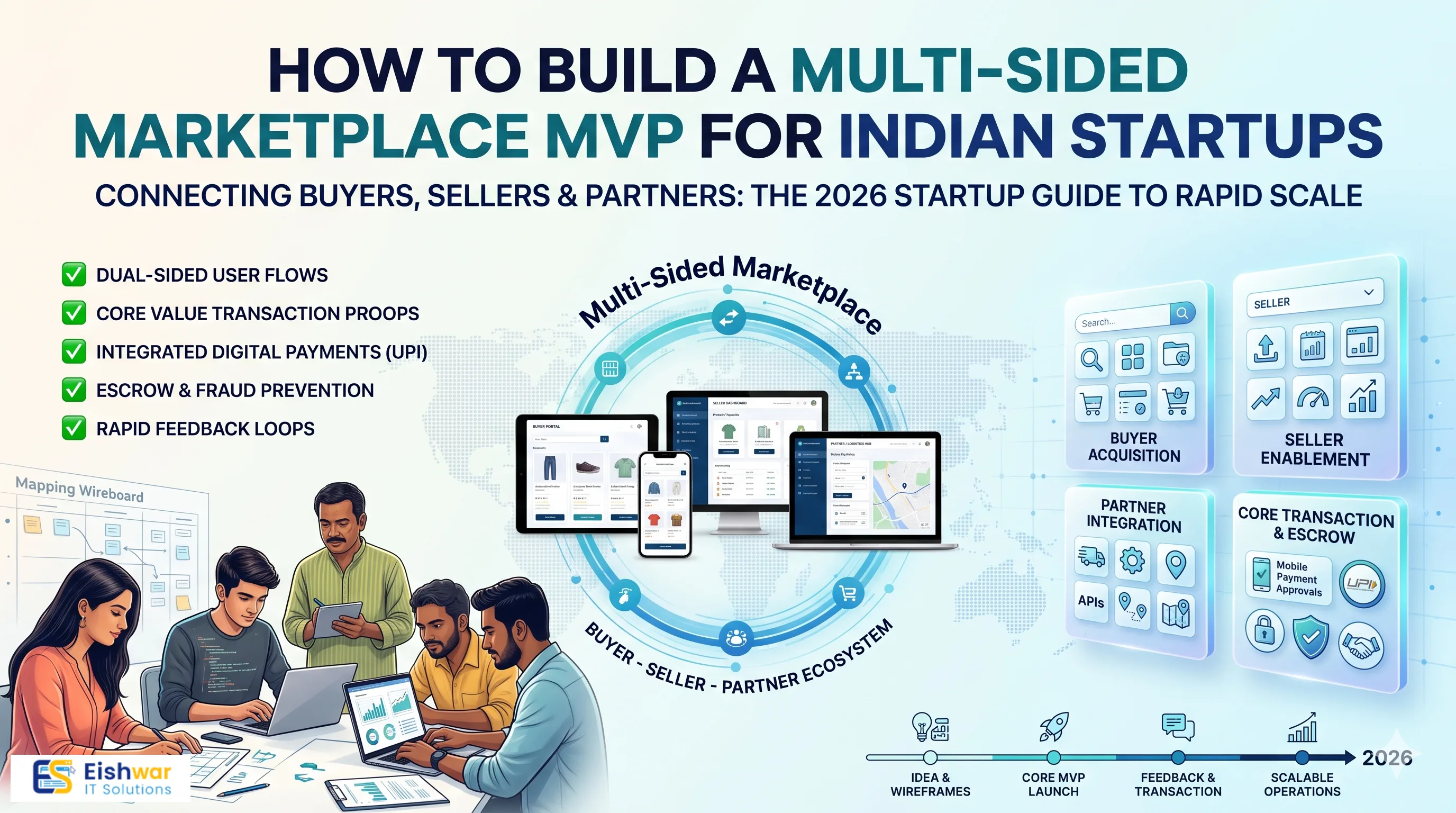
How to Build a Multi-Sided Marketplace MVP for Indian Startups
Introduction
India's marketplace economy is booming. From hyperlocal services to B2B supply chains, multi-sided platforms are transforming how Indians buy, sell, and connect. The numbers are staggering: the Indian online marketplace sector is projected to reach $200 billion by 2026, driven by increasing internet penetration, smartphone adoption, and digital payment infrastructure like UPI. But building a marketplace is not like building a typical SaaS product. You have two (or more) distinct user groups to serve, each with their own needs, motivations, and pain points. That's why a multi-sided marketplace MVP (Minimum Viable Product) is the smartest way to start.
In this guide, we'll walk you through the essential steps to build a multi-sided marketplace MVP tailored for the Indian market. We'll cover everything from identifying your core value proposition to validating both sides of your platform, choosing the right tech stack, and avoiding common pitfalls. Whether you're a founder, product manager, or developer, this guide will give you a clear roadmap to launch your marketplace MVP successfully. We'll also share practical examples from real Indian startups and expert tips to help you navigate the unique challenges of the Indian ecosystem.
Main Section 1: Understanding the Multi-Sided Marketplace Model
A multi-sided marketplace connects two or more interdependent groups—like buyers and sellers, or service providers and customers. The platform creates value by reducing transaction costs, enabling trust, and facilitating exchanges. In India, examples include Urban Company (services), Meesho (resellers), and IndiaMART (B2B). Each of these platforms has succeeded by focusing on a specific niche and solving a distinct problem for both sides.
For your MVP, you need to focus on the core interaction that delivers value. Don't try to solve every problem at once. Start with a single, high-demand use case and expand later. For instance, if you're building a marketplace for freelance tutors, don't start with all subjects and all age groups. Focus on, say, math tutoring for class 10 students in a specific city. This narrow focus allows you to achieve density and gather meaningful feedback.
Key Components of a Marketplace MVP
- Supply side: The providers—sellers, service professionals, or content creators. In India, supply often includes informal sectors like local artisans, gig workers, and small retailers. Understanding their needs is crucial.
- Demand side: The consumers—buyers, clients, or users seeking the offering. In India, demand can be highly price-sensitive and value-conscious, so your value proposition must be clear.
- Platform: The web or mobile interface that connects both sides. Given the mobile-first nature of Indian internet users, a responsive web app or a lightweight mobile app is essential.
- Transaction mechanism: How payments, bookings, or orders are handled. UPI is the most popular payment method, but cash on delivery still holds a significant share in many segments.
- Trust and safety: Reviews, ratings, verification, and dispute resolution. In India, trust is a major factor. Your MVP must include basic trust elements like profile verification and ratings to gain early adoption.
In India, trust is a major factor. Your MVP must include basic trust elements like profile verification and ratings to gain early adoption. For example, Urban Company's rigorous background checks and training programs have been instrumental in building trust for home services.
Main Section 2: Steps to Build Your Multi-Sided Marketplace MVP
Step 1: Validate the Core Value Proposition
Before writing any code, talk to potential users on both sides. Conduct interviews, surveys, and landing page tests. For example, if you're building a marketplace for freelance graphic designers, validate that businesses actually struggle to find reliable designers and that designers need a steady stream of clients. Use tools like Google Forms, Typeform, or even WhatsApp to gather feedback. In India, personal networks and local communities are great for initial validation. You can also leverage platforms like YourStory, Product Hunt, or local startup meetups to get feedback from early adopters.
Practical tip: Create a simple landing page with a clear value proposition and a 'Join Waitlist' button. Run targeted ads on Facebook or Instagram to gauge interest. If you get a significant number of sign-ups (e.g., 500+), that's a strong signal. For example, the founders of Meesho initially validated their idea by manually helping women resellers sell products on WhatsApp, proving demand before building the full platform.
Step 2: Choose the Right Tech Stack
For a marketplace MVP, you need a stack that's fast to develop, scalable, and cost-effective. Popular choices:
- Frontend: React, Next.js, or Vue.js for a responsive web app. Next.js is particularly good for SEO, which is crucial for organic growth.
- Backend: Node.js, Python (Django/Flask), or Ruby on Rails. Node.js is great for real-time applications, while Django offers a robust admin panel out of the box.
- Database: PostgreSQL or MongoDB for flexibility. PostgreSQL is ideal for relational data like transactions, while MongoDB is good for flexible product listings.
- Payments: Razorpay, Instamojo, or Paytm for Indian payment gateways. These support UPI, cards, net banking, and wallets, and offer easy integration.
- Cloud: AWS, Google Cloud, or Vultr for hosting. AWS is the most popular but can be complex; Vultr offers simple pricing and good performance.
Consider using no-code/low-code tools like Bubble or FlutterFlow to speed up development, especially if you're not technical. These platforms allow you to build a functional MVP in weeks, and you can later migrate to a custom stack if needed. For example, many Indian startups have launched successful MVPs using Bubble, including marketplaces for local services and rental products.
Step 3: Build the MVP with Core Features Only
Your MVP should include only the essential features that allow the core transaction to happen. For a marketplace, that means:
- User registration and profiles (with basic verification like phone OTP)
- Listing creation (for supply side) – allow providers to add their services/products with photos, descriptions, and pricing
- Search and filters (for demand side) – enable users to find what they need by category, location, price, etc.
- Basic messaging or contact mechanism – a simple chat or contact form to facilitate communication
- Payment integration (if applicable) – integrate a payment gateway to handle transactions securely
- Ratings and reviews – allow users to rate and review providers after a transaction
Avoid building advanced features like recommendation engines, chat bots, or complex analytics. You can add them later based on user feedback. For example, when Urban Company started, it only had a simple booking form and a list of service providers. They didn't have in-app chat or AI-based matching until much later.
Step 4: Seed Both Sides of the Marketplace
The biggest challenge is the chicken-and-egg problem. You need supply to attract demand, and vice versa. Here are some proven strategies for India:
- Manual seeding: Onboard service providers or sellers manually, even if it's not scalable initially. Visit local markets, call potential providers, and help them create listings. This personal touch can be very effective in building initial supply.
- Use your network: Reach out to local business associations, trade groups, or social media communities. For example, if you're building a marketplace for wedding photographers, join photography groups on Facebook and offer free featured listings.
- Offer incentives: Provide discounts, free listings, or featured spots to early adopters. For instance, you could offer the first 50 sellers a 'Verified' badge for free.
- Partner with existing players: Collaborate with local businesses or influencers to bring in supply. For example, if you're building a hyperlocal delivery marketplace, partner with a few local grocery stores and deliver to a small user base.
For example, if you're building a hyperlocal delivery marketplace, start by partnering with a few local grocery stores and deliver to a small user base. This allows you to test the entire flow and gather feedback before scaling.
Step 5: Launch and Iterate Based on Feedback
Launch your MVP to a small group of users (a pilot) in a specific city or community. Monitor how they interact, collect feedback, and make quick improvements. Use analytics tools like Google Analytics, Mixpanel, or Hotjar to track user behavior. Pay attention to metrics like activation rate, retention, and transaction completion rate.
In India, it's common to see startups launch in one metro city first, perfect the model, and then scale to other regions. This approach reduces risk and allows you to tailor your offering to local preferences. For example, Dunzo started in Bengaluru and only expanded to other cities after proving the model.
Practical tip: Set up a feedback loop with early users. Conduct follow-up calls, send surveys, and create a WhatsApp group for beta testers. This direct line of communication can provide invaluable insights.
Main Section 3: Case Study – A Hyperlocal Services Marketplace
Let's say you're building a platform that connects home appliance repair technicians with customers in Pune.
MVP scope: A simple web app where customers can book a technician for AC repair, washing machine repair, or fridge repair. Technicians can register with their skills and availability.
Key features:
- Technician profiles with photos, ratings, and service areas
- Customer booking form with service type and date/time
- Razorpay payment integration for upfront or post-service payment
- Admin dashboard to manage bookings and technician assignments
Seed strategy: The founder personally contacts 20 local technicians and offers free listing for 3 months. Simultaneously, they run Facebook ads targeting Pune homeowners with a discount on first booking. They also visit local appliance stores to leave flyers and build partnerships.
Result: Within 6 weeks, they have 50 technicians and 200 bookings. They learn that customers prefer to call rather than book online, so they add a click-to-call button. They also discover that customers want transparent pricing, so they add fixed-price packages for common services. Additionally, they notice that technicians with 'Verified' badges get more bookings, prompting them to invest in a simple verification process.
This MVP approach allows them to validate demand and refine their offering without over-investing in features. They can now confidently expand to other cities with a proven playbook.
Expert Tips
- Focus on one city first: Don't try to cover all of India from day one. Pick a specific geography where you can achieve density. Density is key for liquidity in marketplaces.
- Build a concierge MVP: Instead of a fully automated platform, you can manually match supply and demand. For example, a WhatsApp-based concierge service that connects users with providers. This is a low-cost way to test the concept and understand user needs deeply.
- Prioritize the supply side initially: In most marketplaces, supply is harder to build. Ensure you have enough providers to meet demand. You can even act as a middleman initially to control quality.
- Use local payment methods: Indians prefer UPI, net banking, and cash on delivery. Integrate popular gateways like Razorpay and Paytm to build trust. Also, consider offering multiple payment options at checkout.
- Invest in trust signals: Display verified badges, customer reviews, and transparent pricing to overcome the trust barrier. In India, a 'Verified' badge can significantly increase conversion rates.
- Leverage vernacular support: With the rise of internet users in non-metro cities, offering your platform in Hindi and other regional languages can give you a competitive edge. Tools like Google Translate or hiring bilingual support can help.
- Plan for mobile-first: Ensure your MVP is fully responsive and loads fast on low-end devices. Many Indians access the internet via mobile, and a poor mobile experience can kill adoption.
Common Mistakes
- Building too many features: Your MVP should be minimal. Avoid adding features that don't directly support the core transaction. Every extra feature adds time and cost.
- Ignoring the chicken-and-egg problem: Don't expect both sides to come automatically. You need a deliberate seeding strategy. Many startups fail because they launch without a plan to attract supply.
- Neglecting mobile experience: Many Indians access the internet via mobile. Ensure your MVP is fully responsive and loads fast on low-end devices. Test on various devices and networks.
- Not planning for trust and safety: Without basic verification and review systems, your marketplace may lose credibility. Implement at least phone verification and a rating system from day one.
- Scaling too quickly: Expanding to multiple cities before validating the model is a common mistake. Perfect your playbook in one market first, then replicate.
- Underestimating operational complexity: Marketplaces often require manual intervention, especially in the early days. Be prepared to handle customer support, dispute resolution, and quality control manually.
Future Trends
The future of multi-sided marketplaces in India is bright, but it's evolving. Here are some trends to watch:
- AI-powered matching: Using AI to match supply and demand more efficiently, like recommending the best service provider based on past behavior. This can improve user experience and reduce search time.
- Voice interfaces: With the rise of voice search and local language support, marketplaces that offer vernacular interfaces will reach a wider audience. Voice-based booking could become popular in the future.
- Sustainability focus: Marketplaces that promote eco-friendly products or services will gain traction. Indian consumers are becoming more environmentally conscious.
- Blockchain for trust: Though still nascent, blockchain can offer transparent and tamper-proof ratings and reviews. This could be a game-changer for trust in marketplaces.
- Integration with local ecosystems: Marketplaces that integrate with local payment networks, logistics, and government services (like UPI and ONDC) will have a competitive edge. ONDC (Open Network for Digital Commerce) is a government initiative that aims to democratize e-commerce, and integrating with it can provide access to a larger user base.
FAQs
1. What is a multi-sided marketplace MVP?
A multi-sided marketplace MVP is a minimal version of a platform that connects two or more user groups (e.g., buyers and sellers) with just enough features to validate the core value proposition. It focuses on the essential transaction and allows you to test the market with minimal resources. The goal is to learn what works and what doesn't before investing heavily in development.
2. How much does it cost to build a marketplace MVP in India?
Costs vary widely based on complexity and development partner. A basic MVP can cost anywhere from ₹3 lakh to ₹15 lakh or more. Using no-code tools can reduce costs to under ₹1 lakh. It's best to define your core features first and get quotes from multiple developers. Remember to factor in ongoing costs like hosting, payment gateway fees, and maintenance.
3. How long does it take to build a marketplace MVP?
With a clear scope and an experienced team, a marketplace MVP can be built in 4 to 12 weeks. No-code platforms can shorten this to 2-4 weeks. The key is to avoid feature creep and focus on the essential flow. For example, a simple booking marketplace with basic profiles and payments can be built in 6 weeks with a dedicated team.
4. How do I solve the chicken-and-egg problem?
Start by manually seeding one side. For example, if you're building a ride-sharing marketplace, onboard drivers first by offering incentives. Then, attract riders with a reliable service. You can also use a concierge approach where you manually fulfill both sides until you have enough users. This approach was used by many successful startups like Airbnb, which initially helped hosts take professional photos to attract guests.
5. What are the best payment gateways for Indian marketplaces?
Razorpay, Paytm, Instamojo, and Cashfree are popular choices. They support UPI, cards, net banking, and wallets. For marketplaces that need escrow or split payments, RazorpayX and PayU offer advanced solutions. For example, if you're building a marketplace where you take a commission from each transaction, you'll need a gateway that supports split payments.
6. How do I ensure trust and safety in my marketplace?
Implement basic verification like phone OTP and government ID checks for providers. Display ratings and reviews prominently. Offer a clear dispute resolution process. In India, trust is a major barrier, so investing in these features early is crucial. You can also consider partnering with background verification services to build credibility.
7. Should I build a web app or a mobile app for my MVP?
For an MVP, a responsive web app is usually sufficient and more cost-effective. It works on all devices and can be indexed by search engines. However, if your target users are heavy mobile users and you need features like push notifications, a mobile app might be better. You can start with a web app and later build a mobile app based on user feedback.
Conclusion
Building a multi-sided marketplace MVP for India is an exciting but challenging journey. The key is to start small, validate both sides, and iterate quickly. Focus on delivering value for the core transaction, build trust, and be prepared to adapt based on real user feedback. With the right approach, your marketplace can become a thriving platform that connects millions of Indians. Remember, the most successful marketplaces are those that solve a real problem for both sides and continuously improve based on data. So, take the first step today, and don't be afraid to learn from failures.
CTA
Ready to build your multi-sided marketplace MVP? At EishwarITSolution, we specialize in developing scalable MVP web solutions for Indian startups. Our team has experience in building marketplaces for various industries, from hyperlocal services to B2B platforms. Contact us today for a free consultation and quote. Let's turn your idea into a reality!