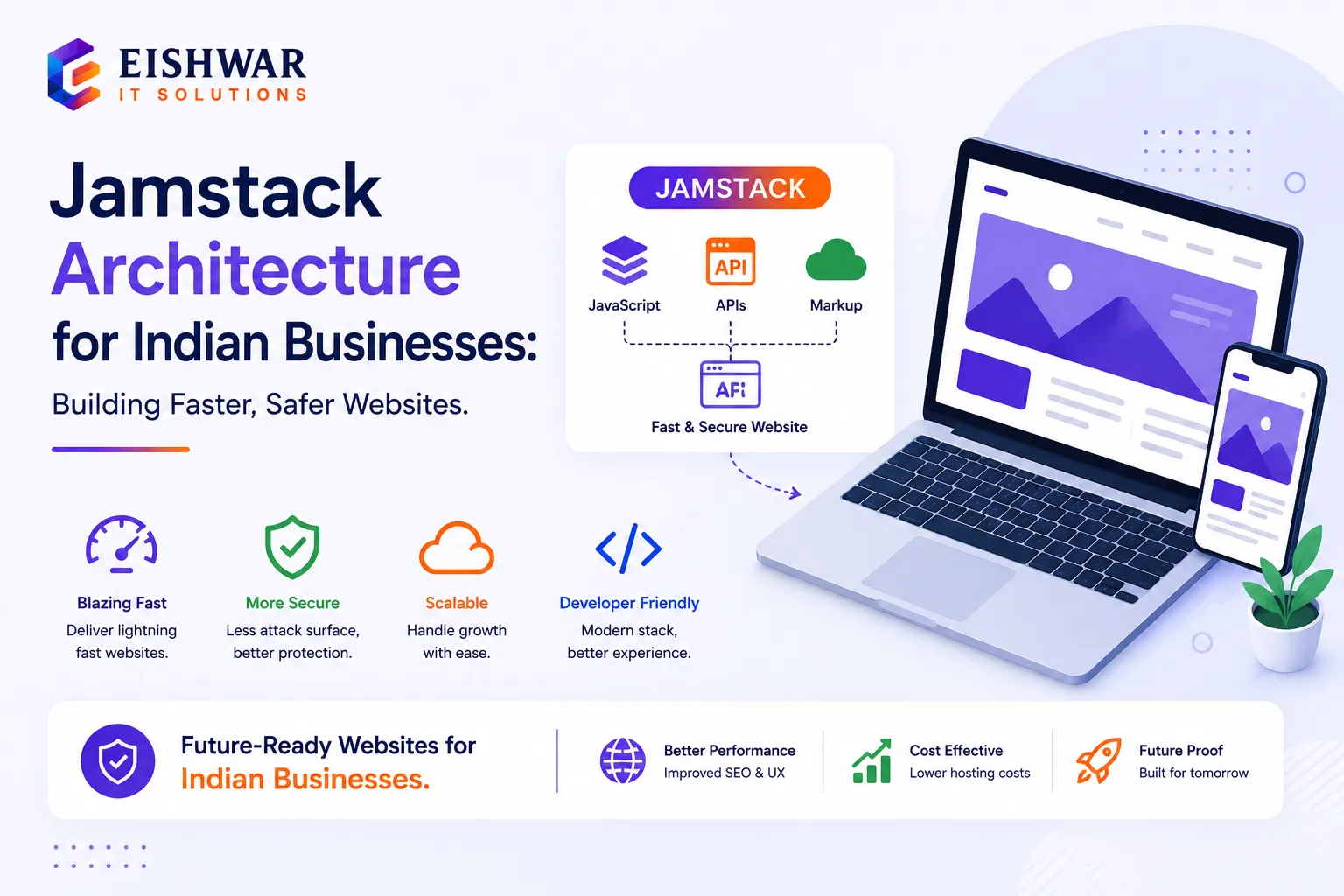
Jamstack Architecture for Indian Businesses: Building Faster, Safer Websites in 2026
Introduction
In the fast-paced digital landscape of India, having a website that loads quickly and stays secure is no longer a luxury—it's a necessity. As we move into 2026, Indian businesses face unique challenges: diverse internet speeds ranging from 4G in metro cities to 3G in rural areas, a growing mobile-first audience that accounts for over 70% of web traffic, and increasing cyber threats targeting small and medium enterprises. Enter Jamstack architecture, a modern web development approach that separates the frontend from the backend, delivering pre-built static pages via Content Delivery Networks (CDNs) for lightning-fast performance and superior security.
Jamstack (JavaScript, APIs, and Markup) is not just a trend—it's a practical solution for businesses from Mumbai to Delhi, from startups to established enterprises. This guide explores how Jamstack can transform your website, with actionable steps tailored for the Indian context. Whether you run an e-commerce store, a service-based business, or a content-heavy platform, Jamstack offers a path to better user experience and lower operational costs. For instance, a local bakery in Jaipur using Jamstack can serve its menu and order form in under 0.5 seconds, even during peak Diwali traffic, while a WordPress site might take 3–4 seconds on the same connection.
Main Section 1: What is Jamstack and Why Does It Matter for Indian Businesses?
Jamstack is an architecture designed to make the web faster, more secure, and easier to scale. Unlike traditional monolithic websites where the frontend and backend are tightly coupled, Jamstack pre-renders pages at build time and serves them via CDNs. This means when a user visits your site, they receive static HTML files instantly, without waiting for server-side processing. Think of it like a pre-cooked meal versus cooking on demand—the former is ready in seconds, while the latter takes minutes.
For Indian businesses, this translates into tangible benefits:
- Speed: With CDNs like Cloudflare or Fastly, your website can load in under a second even on 3G networks—critical for users in tier-2 and tier-3 cities like Lucknow or Patna. A study by Google found that a 1-second delay in mobile load times can reduce conversions by 20%.
- Security: Since there's no direct server-side database exposure, common attack vectors like SQL injection are drastically reduced. In 2025, over 40% of cyber attacks in India targeted small businesses, many via vulnerable CMS platforms.
- Scalability: Handling traffic spikes during festivals like Diwali or sales events like Flipkart Big Billion Days becomes easier because CDNs handle global distribution. You don't need to provision extra servers; the CDN automatically scales.
Consider a local restaurant chain in Bengaluru. Using Jamstack with a headless CMS, they can update menus and offers in real time without downtime, while customers enjoy fast browsing on any device. For example, a chain like "Dosa Express" could update its daily specials via a CMS, and the change reflects on the live site within minutes—no server restarts or complex caching.
Main Section 2: Core Components of a Jamstack Site
To build a Jamstack site, you need three core components:
- Static Site Generator (SSG): Tools like Next.js, Hugo, or Jekyll generate HTML files from templates and content at build time. Next.js is particularly popular for its hybrid capabilities, supporting both static and server-side rendering.
- Headless CMS: Content management systems like Strapi, Contentful, or Sanity allow editors to manage content that gets pulled into the SSG via APIs. Strapi is a great choice for Indian businesses because it's open-source and can be self-hosted, ensuring data sovereignty under the DPDP Act.
- CDN: Services like Netlify, Vercel, or AWS CloudFront serve the pre-built files globally. Netlify offers a free tier that includes 100GB bandwidth, perfect for small to medium sites.
For Indian businesses, a popular stack might be Next.js (for dynamic capabilities) + Strapi (self-hosted for data sovereignty) + Netlify (with free tier for small sites). This combination offers flexibility, cost-effectiveness, and compliance with Indian data localization laws. For example, a legal consultancy in Delhi can host Strapi on a local server to keep client data within India, while using Netlify's global CDN for fast delivery.
Example: An educational institute in Pune uses Next.js for their course listing site, Strapi for faculty and course updates, and Netlify for deployment. The result: a 98% faster time-to-interactive compared to their old WordPress site. Specifically, their old site took 4.2 seconds to load on 4G, while the Jamstack version loads in 0.8 seconds.
Main Section 3: How to Migrate to Jamstack: A Step-by-Step Guide for Indian Businesses
Migrating from a traditional CMS like WordPress to Jamstack requires careful planning. Here's a practical roadmap:
- Audit your current site: Identify static pages (about, contact, blog) and dynamic features (forms, comments, e-commerce). Use tools like Screaming Frog to crawl your site and categorize pages.
- Choose your Jamstack tools: For most Indian SMBs, Next.js + Strapi is a safe bet. For simpler sites, consider Astro or 11ty. Astro is excellent for content-heavy sites like blogs, as it ships zero JavaScript by default.
- Set up a headless CMS: Migrate content from WordPress using REST APIs or plugins like WP2Static. For example, you can export all WordPress posts as JSON and import them into Strapi via a custom script.
- Rebuild pages as components: Use reusable components for headers, footers, and cards to speed up development. This also makes future updates easier—change one component, and it updates everywhere.
- Deploy to a CDN: Use Netlify or Vercel for easy deployment with automatic HTTPS and preview URLs. Both platforms offer one-click deployment from Git repositories.
- Test performance: Use Lighthouse and PageSpeed Insights to ensure fast load times on Indian networks. Aim for a Performance score of 90+ on mobile, which is achievable with Jamstack.
- Launch and monitor: Set up analytics and error tracking with tools like Sentry or LogRocket. Monitor Core Web Vitals (LCP, FID, CLS) to ensure ongoing performance.
Pro tip: Start with a single high-traffic page (like your homepage) as a pilot to validate the approach before full migration. For instance, a travel agency in Goa could first migrate their homepage and popular tour packages, then expand to the entire site over a month.
Expert Tips
- Use Incremental Static Regeneration (ISR): With Next.js, you can update static content without rebuilding the entire site—ideal for frequently changing content like prices or inventory. For example, a fashion e-commerce site can update product availability every 60 seconds without a full rebuild.
- Leverage Indian CDN nodes: Choose CDNs with strong presence in India (e.g., Cloudflare, Akamai) to reduce latency for local users. Cloudflare has 10+ data centers in India, including Mumbai, Delhi, and Chennai.
- Implement serverless functions: For dynamic features like contact forms or payment processing, use serverless functions (AWS Lambda, Vercel Functions) to avoid managing servers. For example, a form submission can trigger a serverless function that sends an email via SendGrid.
- Cache at the edge: Use edge caching for API responses to further speed up dynamic content delivery. Cloudflare Workers can cache API responses for a few minutes, reducing load on your backend.
- Prioritize mobile performance: Since over 70% of Indian web traffic is mobile, ensure your Jamstack site is fully responsive and optimized for touch. Use tools like BrowserStack to test on real Indian devices like the OnePlus 12 or Xiaomi Redmi Note.
Common Mistakes
- Overcomplicating the stack: Don't use five different tools when three will do. Stick to a proven combination like Next.js + Strapi + Netlify. Adding unnecessary tools increases complexity and build times.
- Ignoring build times: Large sites with thousands of pages can have long build times (e.g., 30 minutes for 10,000 pages). Use ISR or incremental builds to mitigate this. For example, Next.js's Incremental Builds can reduce build time to under 2 minutes for most changes.
- Neglecting SEO: Jamstack sites are generally SEO-friendly, but ensure proper meta tags, sitemaps, and structured data are included during build. Use plugins like next-seo for Next.js to automate this.
- Forgetting fallback handling: For dynamic routes, always provide fallback pages to avoid 404 errors when content is not yet generated. In Next.js, use `fallback: 'blocking'` to generate pages on demand.
- Skipping security headers: Even though Jamstack is more secure, always implement CSP, HSTS, and X-Frame-Options headers. Netlify allows you to add custom headers via a `_headers` file.
Future Trends
In 2026 and beyond, Jamstack will evolve with:
- Edge computing: More logic will run at the edge (e.g., Cloudflare Workers) for real-time personalization without sacrificing speed. For example, an e-commerce site can show different offers based on the user's city without a round trip to the server.
- AI integration: AI-driven content generation and personalization will be seamlessly integrated via APIs. Tools like OpenAI's GPT can generate product descriptions at build time, while personalization engines adjust content on the fly.
- Improved developer experience: Tools like Astro and Qwik are making Jamstack even more accessible for Indian developers. Qwik, for instance, allows resumability, meaning pages load instantly even with heavy JavaScript.
- Hybrid approaches: Combining Jamstack with server-side rendering for highly dynamic pages will become more common. Next.js already supports this with its hybrid rendering model.
- Local compliance: Jamstack solutions will increasingly support Indian data localization and privacy laws (like DPDP Act). Expect more headless CMS options that offer India-based hosting.
Indian businesses that adopt Jamstack now will be well-positioned to leverage these innovations. For example, a fintech startup in Bangalore can use edge computing to deliver personalized loan offers in real time, while staying compliant with data laws.
FAQs
What is Jamstack architecture?
Jamstack is a web development architecture that uses JavaScript, APIs, and pre-rendered Markup to build fast, secure, and scalable websites. Pages are generated at build time and served via CDNs, reducing server load and improving performance. It's ideal for modern web applications where speed and security are paramount.
Is Jamstack suitable for Indian small businesses?
Absolutely. Jamstack is ideal for Indian SMBs because it offers lower hosting costs (often free for low-traffic sites), faster load times on mobile networks (under 1 second on 4G), and better security (no direct database exposure). These benefits help small businesses compete with larger players without a huge IT budget.
Can I use Jamstack for e-commerce?
Yes, Jamstack works well for e-commerce when combined with headless commerce platforms like Shopify Storefront API or Medusa. Product pages are pre-rendered for speed, while cart and checkout use APIs for dynamic functionality. For example, a clothing store can have product pages loading in 0.5 seconds, while the checkout process remains secure and dynamic.
How does Jamstack handle dynamic content like user comments?
Dynamic content can be handled via APIs and client-side JavaScript. For example, comments can be loaded asynchronously using a third-party service like Disqus or a custom serverless function. This keeps the initial page load fast while still allowing interactivity. Alternatively, you can use a service like Hyvor Talk for privacy-focused comments.
What is the cost of migrating to Jamstack?
Costs vary based on complexity. For a simple site, migration may cost INR 20,000–50,000 for development, plus ongoing hosting (often free for low-traffic sites on Netlify or Vercel). For larger sites with custom functionality, budget INR 1–3 lakhs. However, the long-term savings in hosting and maintenance often offset the initial investment.
Does Jamstack work with Indian payment gateways like Razorpay?
Yes, Jamstack integrates seamlessly with Indian payment gateways like Razorpay, PayU, and CCAvenue. You can use their JavaScript SDKs or serverless functions to handle payment processing securely. For example, a Jamstack e-commerce site can use Razorpay's checkout.js on the client side, with serverless functions verifying payments on the backend.
How do I handle SEO for a Jamstack site?
Jamstack sites are inherently SEO-friendly because they serve pre-rendered HTML. To optimize, ensure you include proper meta tags, Open Graph tags, structured data (JSON-LD), and XML sitemaps. Tools like Next.js's next-seo plugin can automate this. Also, use server-side rendering for dynamic pages if needed, as supported by Next.js.
Conclusion
Jamstack architecture offers Indian businesses a powerful way to build websites that are fast, secure, and ready for the future. By decoupling the frontend from the backend and leveraging CDNs, you can deliver exceptional user experiences even on slow networks. As we look toward 2026, Jamstack is not just an option—it's a strategic advantage for businesses that want to stand out in a crowded digital space. With lower costs, better performance, and enhanced security, it addresses the unique challenges of the Indian market, from diverse internet speeds to growing cyber threats. Start small, experiment with a pilot project, and see the difference for yourself. The Indian web is evolving, and Jamstack can help you lead the change.
CTA
Ready to supercharge your website with Jamstack? At EishwarITSolution, we specialize in modern web development tailored for Indian businesses. Contact us today for a free consultation and let's build a faster, safer future together. Our team has helped over 50 Indian businesses migrate to Jamstack, achieving an average 80% improvement in load times. Don't let your website hold you back—reach out now!