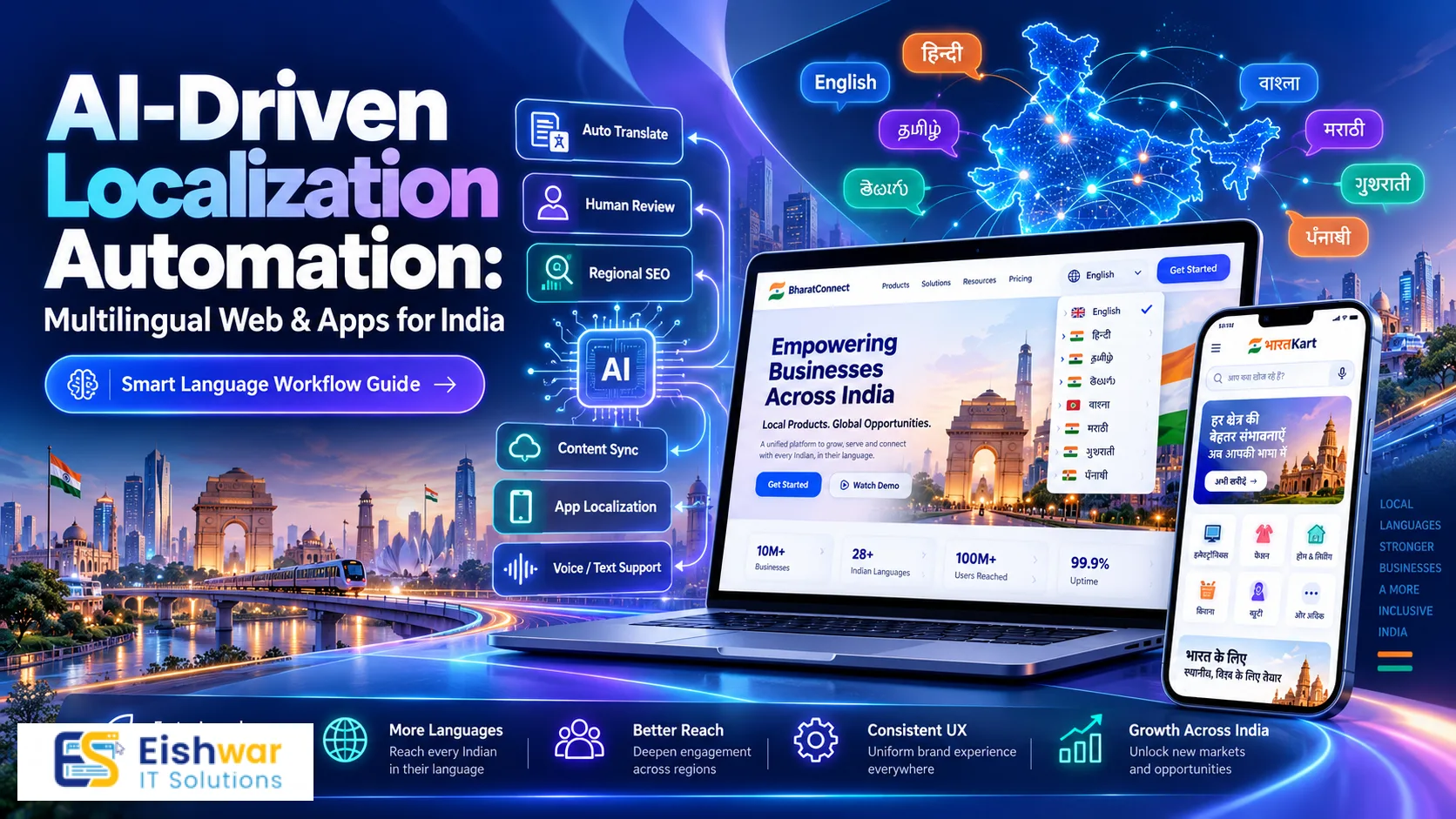
AI-Driven Localization Automation: Multilingual Web & Apps for India
Introduction
India is not a single market. It is a collection of languages, cultures, buying habits, and trust signals. A customer in Chennai may prefer Tamil. A buyer in Kolkata may feel more comfortable in Bengali. A professional in Pune may switch between Marathi and English. Yet many Indian businesses still launch websites and apps in English only.
That gap is expensive. If your web or app experience ignores language, you lose attention, trust, and conversions. Traditional localization - hiring translators, managing spreadsheets, and manually updating every screen - is too slow for modern release cycles.
AI-driven localization automation changes the equation. It combines machine translation, large language models, translation management systems, and automated workflows to deliver multilingual experiences faster, cheaper, and at scale. For business owners, marketers, and professionals in India, this is not a nice-to-have. It is a growth lever for 2026 and beyond.
Main Section 1: Why AI-Driven Localization Automation Matters for Indian Businesses
The multilingual opportunity is bigger than English
Only a small fraction of Indian internet users are comfortable reading English. Most users prefer content in Hindi, Tamil, Telugu, Bengali, Marathi, Gujarati, Kannada, Malayalam, Punjabi, Odia, and other languages. When your website or app speaks their language, you reduce friction instantly. You also increase time on site, feature adoption, and repeat usage.
E-commerce, fintech, edtech, SaaS, healthcare, and travel businesses feel this most. A checkout page in Hindi or Tamil can outperform an English-only funnel. A loan app with Marathi guidance can reduce drop-offs. A learning app with regional language explanations can improve completion rates.
Speed is a competitive advantage
Manual localization can take weeks or months per language. AI-driven localization automation compresses that timeline. You can extract strings, translate them with AI, review them with humans, and deploy them through your CI/CD pipeline. New features can go live in multiple languages on the same release cycle.
This speed matters in India. Festivals, regional campaigns, and local offers create short windows of opportunity. If your app only supports English during Diwali or Pongal, you miss the moment. Automation helps you localize campaign pages, push notifications, and in-app messages within hours, not weeks.
Cost efficiency without losing quality
AI translation handles repetitive, high-volume content at a fraction of manual cost. Human translators then focus on high-impact areas: headlines, legal text, brand slogans, and culturally sensitive messages. This hybrid model - AI plus human review - gives you scale and quality.
For Indian businesses, this is especially valuable. You may need ten languages for a national campaign, but not every page needs the same level of polish. AI-driven localization automation lets you route content by priority. Product descriptions can use AI-first translation. Legal disclaimers can trigger senior review. Marketing copy can go through transcreation.
Main Section 2: How AI-Driven Localization Automation Works: A Practical Workflow
Step 1: Extract and centralize content
Start by identifying every text element in your web and app experience. This includes buttons, menus, error messages, emails, push notifications, metadata, alt text, and help articles. Use a translation management system or localization platform that connects to your code repository, CMS, and app store listings.
Automated string extraction prevents missed content. You can set up rules to detect new strings in pull requests. When a developer adds a new button, the localization workflow starts automatically. This removes the manual spreadsheet chaos that slows most teams.
Step 2: Use AI with context, not just words
Basic machine translation often fails because it lacks context. AI-driven localization automation adds context. You can provide glossaries, style guides, product descriptions, screenshots, and previous translations. Modern LLMs can then generate translations that match tone, formality, and brand voice.
For example, a fintech app may need formal Hindi for compliance messages but friendly Hinglish for young users. A fashion brand may want playful Tamil for Instagram campaigns and neutral Tamil for checkout. Context-aware AI can handle these variations when you feed it the right instructions.
Step 3: Keep humans in the loop
AI is not a replacement for human judgment. It is a force multiplier. Human reviewers should check cultural nuance, idioms, legal accuracy, and emotional tone. In India, language changes by region, generation, and community. A phrase that works in Delhi may feel off in Chennai.
Use a tiered review model. AI-first for low-risk content. AI plus native reviewer for medium-risk content. Full human transcreation for high-risk content like brand campaigns, legal terms, and financial disclosures. This keeps costs predictable while protecting your brand.
Step 4: Automate testing and deployment
Localization does not end with translation. Text expansion can break layouts. Right-to-left languages like Urdu need different formatting. Date formats, currencies, and number systems vary. Automated visual testing can compare screenshots across languages and flag overflow, truncation, or missing strings.
Connect localization to your CI/CD pipeline. When translations are approved, they should deploy automatically to your web app, mobile app, and CMS. This continuous localization approach keeps every language in sync with your latest release.
Step 5: Measure and improve
Track language-specific metrics: conversion rate, bounce rate, session duration, support tickets, and feature adoption. Use A/B testing to compare AI-translated pages with human-reviewed pages. Feed performance data back into your glossary and style guide.
The goal is a learning loop. Every campaign, user review, and support conversation improves future translations. Over time, your localization engine becomes a competitive asset.
Main Section 3: Building a Localization Automation Stack for Web & Apps
Choose the right tools
You do not need a single magic tool. You need an integrated stack. Translation management systems like Lokalise, Crowdin, Phrase, Smartling, and Transifex support automation workflows. Machine translation engines from Google Cloud, Microsoft Azure, Amazon, and modern LLMs can handle bulk translation. Your CMS, repository, and app store connections tie everything together.
For Indian businesses, look for platforms that support Indian languages, glossary management, screenshot context, and API access. Also check data residency and compliance features if you handle personal data under India's DPDP Act.
Integrate with your development workflow
Localization should be part of development, not an afterthought. Use CLI tools, webhooks, and APIs to connect your repository to the translation system. Developers should see missing translations as part of the build process. Product managers should review translations in context before release.
For mobile apps, automate app store metadata localization. For web apps, connect your CMS so marketers can localize landing pages without developer help. For customer support, automate help center translation and chatbot responses in regional languages.
Protect quality and compliance
Quality assurance should include linguistic QA, functional QA, and cultural QA. Linguistic QA checks grammar and terminology. Functional QA checks that the app works after translation. Cultural QA checks images, colors, gestures, and examples for local relevance.
Compliance matters too. Financial, healthcare, and educational content may require accurate legal language. AI-driven localization automation should include approval workflows, audit trails, and role-based access. This is especially important for regulated Indian industries.
Measure ROI clearly
Calculate the cost per language, time to market, conversion lift, and support cost reduction. A multilingual experience often pays for itself through higher conversion and lower acquisition costs. For example, if a Hindi checkout page increases conversion by 15%, the revenue impact can fund localization for several more languages.
Do not treat localization as a cost center. Treat it as a revenue channel. The businesses that localize early will own the regional customer relationship before competitors catch up.
Expert Tips
- Start with high-impact screens. Localize onboarding, checkout, search, and support first. These drive revenue and trust.
- Build a glossary early. Define brand terms, product names, and technical words. This keeps AI translations consistent.
- Use screenshots. Context improves AI translation quality. Screenshots help translators and models understand where text appears.
- Localize beyond text. Adapt currency, payment methods like UPI and COD, date formats, addresses, and festival references.
- Test with real users. Run small regional campaigns before a full rollout. User feedback reveals nuance that tools miss.
- Automate but do not abandon. Keep native speakers on your team for review and cultural insight.
- Track language-specific SEO. Localized URLs, hreflang tags, and translated metadata help you rank in regional search results.
Common Mistakes
- Translating word for word. Literal translation kills tone. Use transcreation for marketing and emotional content.
- Ignoring context. A button label may need different translations depending on the screen. Context is everything.
- Neglecting layout testing. German and Hindi text can expand. Tamil and Bengali may need different line heights. Test visual layouts.
- Treating all languages the same. India is diverse. A single Hindi translation may not serve all Hindi-speaking regions equally well.
- Skipping human review. AI can hallucinate or miss cultural sensitivity. Always review high-risk content.
- Localizing only the website. Apps, emails, push notifications, app store listings, and support content also need localization.
- Forgetting SEO. If your localized pages have English metadata, you lose regional search traffic.
Future Trends
Real-time localization. AI will translate user-generated content, chat, and support tickets in real time. This will make global and regional collaboration feel seamless.
Voice and video localization. As voice interfaces grow, AI will dub videos, clone voices, and localize audio at scale. Indian language voice experiences will become a major differentiator.
Personalized language experiences. Instead of one Hindi version, apps may adapt language based on user behavior, location, and preferences. A user in Mumbai may see Marathi and English mixed naturally.
Autonomous localization pipelines. Future systems will detect new content, translate it, test it, and deploy it without manual triggers. Humans will focus on strategy and quality.
Compliance-aware AI. Localization tools will include built-in checks for DPDP Act requirements, financial regulations, and accessibility standards. This will reduce legal risk for Indian businesses.
Culture-aware AI. Models will better understand festivals, regional humor, and social norms. They will help brands avoid embarrassing mistakes and build deeper trust.
FAQs
What is AI-driven localization automation?
AI-driven localization automation uses artificial intelligence, machine translation, and workflow automation to translate and adapt web and app content for multiple languages. It combines AI speed with human review for quality.
Is AI translation good enough for Indian languages?
AI translation has improved significantly for major Indian languages like Hindi, Tamil, Telugu, Bengali, and Marathi. However, high-impact content like legal, financial, and brand messaging should still go through native human review.
How much does localization automation cost?
Costs vary by language, content volume, and quality level. AI-first translation can reduce costs by 30% to 70% compared to manual translation. A hybrid model with human review costs more but delivers better quality for critical content.
Can I localize my mobile app without rebuilding it?
Yes. Most modern apps use string files and localization frameworks. AI-driven localization automation can update these files and deploy translations through your release pipeline without rebuilding the core app logic.
How long does it take to launch a new language?
With automation, a basic language rollout can happen in days or weeks. A full localized experience with human review, testing, and SEO optimization may take four to eight weeks depending on content volume.
Does localization help SEO in India?
Yes. Localized content, translated metadata, and hreflang tags help search engines serve the right language version to regional users. This can increase organic traffic and conversions.
What should I localize first?
Start with onboarding, checkout, search, error messages, and support content. These screens have the highest impact on user trust and revenue.
Conclusion
India's digital future will be multilingual. Businesses that treat language as a core part of their web and app experience will win trust, engagement, and revenue. AI-driven localization automation makes that possible without enormous budgets or endless manual work.
The smart approach is hybrid: let AI handle scale, speed, and repetitive content. Let humans handle nuance, culture, and high-stakes messaging. Connect localization to your development, CMS, and marketing workflows. Measure results by language and keep improving.
Whether you run an e-commerce store, a fintech app, a SaaS platform, or a service business, localization is no longer optional. It is a growth strategy. Start small, automate intelligently, and expand as you learn.
CTA
Ready to launch multilingual web and app experiences for Indian users? EishwarITSolution helps businesses plan, automate, and scale AI-driven localization workflows. Contact us today for a localization audit and a practical roadmap for 2026.