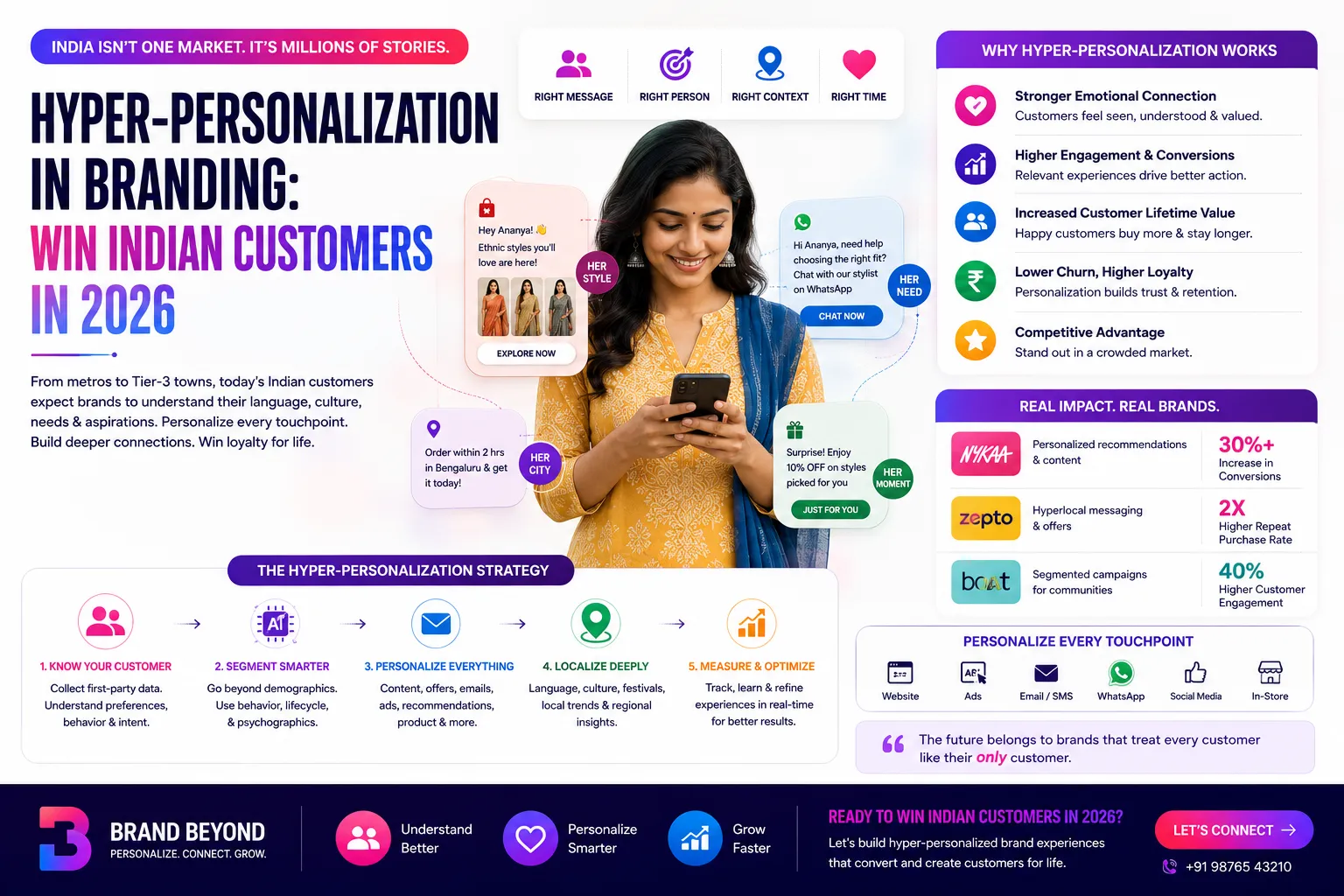
Hyper-Personalization in Branding: How Indian Businesses Can Win Customer Hearts in 2026
In the fast-evolving Indian market, generic branding no longer cuts it. Customers expect brands to know them, understand their needs, and deliver tailored experiences. Enter hyper-personalization—a strategy that uses data and technology to create deeply relevant interactions. This guide explores how Indian businesses can harness hyper-personalization to build lasting customer relationships in 2026.
Introduction
Imagine walking into a store where the staff greets you by name, remembers your last purchase, and suggests products you’ll love. That’s the offline version of hyper-personalization. Online, it means using browsing history, purchase patterns, and even real-time location to tailor every touchpoint. For Indian businesses, this is no longer a luxury—it’s a necessity. With rising competition and increasingly discerning customers, personalization can be the difference between a one-time buyer and a loyal advocate.
In 2026, hyper-personalization goes beyond using a customer’s name in an email. It’s about anticipating needs, offering relevant content, and creating seamless experiences across channels. Let’s dive into how you can implement this for your brand.
Main Section 1: Understanding Hyper-Personalization
Hyper-personalization uses real-time data and AI to deliver individualized experiences. Unlike basic personalization (like using a first name), it leverages behavioral data, contextual signals, and predictive analytics. For example, an e-commerce site might show different homepage banners based on your past clicks, or a streaming service recommends shows you haven’t watched yet.
Why does it matter? A study by McKinsey found that personalization can reduce acquisition costs by up to 50%, lift revenue by 5-15%, and increase marketing spend efficiency by 10-30%. In India, where digital adoption is skyrocketing, customers are hungry for brands that respect their time and preferences.
Key components of hyper-personalization include:
- Data Collection: Gather first-party data via website behavior, purchase history, and surveys. For instance, a local grocery app can track which vegetables a customer buys weekly and suggest seasonal alternatives.
- AI and Machine Learning: Use algorithms to predict preferences and automate recommendations. A fashion brand could use AI to suggest outfits based on weather and past purchases.
- Omnichannel Integration: Ensure consistent personalization across web, mobile, email, and social media. A customer who abandons a cart on mobile should see the same items recommended on desktop.
- Privacy Compliance: Be transparent about data use and comply with India’s Digital Personal Data Protection Act. Always provide clear opt-in options and easy data deletion requests.
Main Section 2: Practical Steps for Indian Businesses
Ready to implement hyper-personalization? Here’s a step-by-step approach tailored for Indian SMEs and startups.
1. Start with First-Party Data
Since third-party cookies are fading, focus on data you own. Use tools like Google Analytics, CRM systems, and social media insights. For instance, a local restaurant can track repeat orders and dietary preferences to suggest new dishes. A small bakery might note that a customer orders eggless cakes every month and send a reminder before festivals.
2. Segment Your Audience Smartly
Don’t just segment by age or location. Use behavioral segments like “frequent buyers,” “cart abandoners,” or “deal seekers.” For a fashion brand, this could mean sending different offers to trend-followers vs. budget shoppers. A practical tip: Create a segment of “high-value customers” who spend above ₹5000 monthly and offer them exclusive previews.
3. Personalize Content and Offers
Create dynamic content blocks on your website. A travel agency could show different holiday packages based on the visitor’s past searches—Kerala for nature lovers, Goa for beach enthusiasts. Use email automation to send birthday discounts or product replenishment reminders. For example, a pet supply store can email cat food offers to cat owners and dog food offers to dog owners.
4. Leverage Real-Time Triggers
Set up automated responses to actions. If a customer browses a product but doesn’t buy, send a follow-up email with a limited-time discount within 24 hours. If they abandon the cart, offer free shipping or a small discount. A real example: An online bookstore can trigger a “You left these books behind” email with a 10% off code.
5. Test and Optimize
A/B test different personalization strategies. For example, test whether a “recommended for you” section on your homepage increases click-through rates. Use analytics to refine continuously. Start with one element, like email subject lines, and measure open rates before scaling.
Main Section 3: Real-World Examples from India
Several Indian brands are already excelling at hyper-personalization. Let’s look at a few.
Example 1: Nykaa
The beauty e-tailer uses purchase history and browsing data to recommend products. Their app shows personalized skincare routines based on skin type and concerns. They also send birthday gifts and early access to sales for loyal customers. A customer who buys sunscreen regularly gets alerts when new SPF products launch.
Example 2: Zomato
Zomato personalizes restaurant recommendations based on past orders, location, and time of day. Their “Order Again” feature makes reordering effortless. They also send personalized push notifications for favorite cuisines—like “Your favorite biryani place has a new offer!” during lunch hours.
Example 3: Tata CLiQ
This fashion platform uses AI to suggest outfits based on previous purchases and browsing. They offer personalized discounts on birthdays and anniversaries, driving repeat purchases. For instance, a customer who bought a formal shirt might receive recommendations for matching trousers.
These examples show that hyper-personalization doesn’t require a massive budget. Start small, focus on data you have, and scale as you learn.
Expert Tips
- Prioritize Privacy: Always ask for consent before collecting data. Make privacy a brand value. For example, display a clear cookie consent banner and explain how data improves experience.
- Use Behavioral Over Demographics: Actions speak louder than age or location. Focus on what customers do, not who they are. A 60-year-old who buys gaming accessories is more valuable than a 20-year-old who only browses.
- Integrate Offline and Online: If you have a physical store, use QR codes or loyalty cards to track in-store behavior and link it to online profiles. A clothing store can send personalized offers based on items tried in the fitting room.
- Start with One Channel: Don’t try to personalize everything at once. Begin with email or your website, then expand. A small business can start with personalized email subject lines and gradually add website recommendations.
- Measure What Matters: Track metrics like customer lifetime value, repeat purchase rate, and net promoter score. Avoid vanity metrics like open rates alone; focus on conversion impact.
Common Mistakes
- Over-Personalization: Creeping customers out by knowing too much. Balance personalization with discretion. For example, avoid referencing sensitive data like health conditions without explicit consent.
- Ignoring Mobile: Most Indians access the internet via mobile. Ensure your personalization works on small screens. Test email layouts and website responsiveness on various devices.
- Using Stale Data: Personalization based on old data can backfire. Keep your data fresh and update segments regularly. A customer who bought baby products two years ago may no longer need them.
- Neglecting Customer Feedback: Use surveys and reviews to understand what customers actually want, not just what data says. A simple post-purchase survey can reveal preferences data might miss.
- Lack of Testing: Assuming one-size-fits-all. Continuously test and refine your approach. What works for one segment may fail for another.
Future Trends
Hyper-personalization will evolve rapidly. Here’s what to watch for in 2026 and beyond:
- AI-Generated Content: Tools like ChatGPT will create personalized emails, product descriptions, and even video scripts. A travel brand could generate a custom itinerary video for each customer.
- Voice Personalization: With smart speakers growing, brands will tailor voice interactions based on user history. A customer asking “What’s for dinner?” could get recipe suggestions from their favorite cuisine.
- Predictive Personalization: AI will anticipate needs before the customer even expresses them, like auto-ordering groceries based on consumption patterns. A milk delivery service could predict when a customer runs out and send a reminder.
- Hyper-Localization: Use location data to offer region-specific promotions, especially important in diverse India. A food delivery app could suggest local delicacies based on the user’s city.
- Ethical Personalization: Brands that prioritize transparency and data ethics will win trust and loyalty. For example, allowing customers to view and delete their data easily builds credibility.
FAQs
- What is hyper-personalization? Hyper-personalization uses real-time data and AI to deliver individualized experiences, going beyond basic personalization like using a customer’s name. It adapts based on behavior, context, and preferences.
- How is it different from personalization? Personalization often uses static segments (e.g., age group), while hyper-personalization adapts in real-time based on behavior and context. For example, a basic personalization might send a generic birthday email, while hyper-personalization sends a discount on a product the customer recently viewed.
- Is hyper-personalization expensive? Not necessarily. Many tools offer affordable entry points. Start with free tools like Google Analytics and email marketing platforms. As you grow, invest in AI-powered tools like HubSpot or Salesforce.
- What data do I need? Start with first-party data: purchase history, website behavior, email engagement, and customer feedback. Avoid relying on third-party data due to privacy regulations.
- How do I ensure privacy? Be transparent, ask for consent, and comply with India’s data protection laws. Use data only for stated purposes. Provide easy opt-out options and secure data storage.
- Can small businesses use hyper-personalization? Absolutely. Focus on a few key segments and use low-cost tools like Mailchimp or HubSpot. A local salon can send personalized appointment reminders based on past services.
- What are some quick wins? Personalize email subject lines, recommend products on your website, and send birthday offers. These require minimal setup but yield high engagement.
- How do I measure success? Track metrics like click-through rates, conversion rates, customer lifetime value, and repeat purchase rate. Compare these against non-personalized campaigns to see impact.
Conclusion
Hyper-personalization is not just a trend—it’s a paradigm shift in branding. For Indian businesses, it offers a powerful way to cut through the noise and build genuine connections with customers. By starting small, respecting privacy, and using data wisely, you can create a brand that feels personal, relevant, and indispensable. The future belongs to brands that treat customers as individuals, not just numbers. Are you ready to personalize your brand?
CTA
Ready to transform your brand with hyper-personalization? Contact EishwarITSolution for a free consultation. Let’s craft a branding strategy that truly connects with your audience.