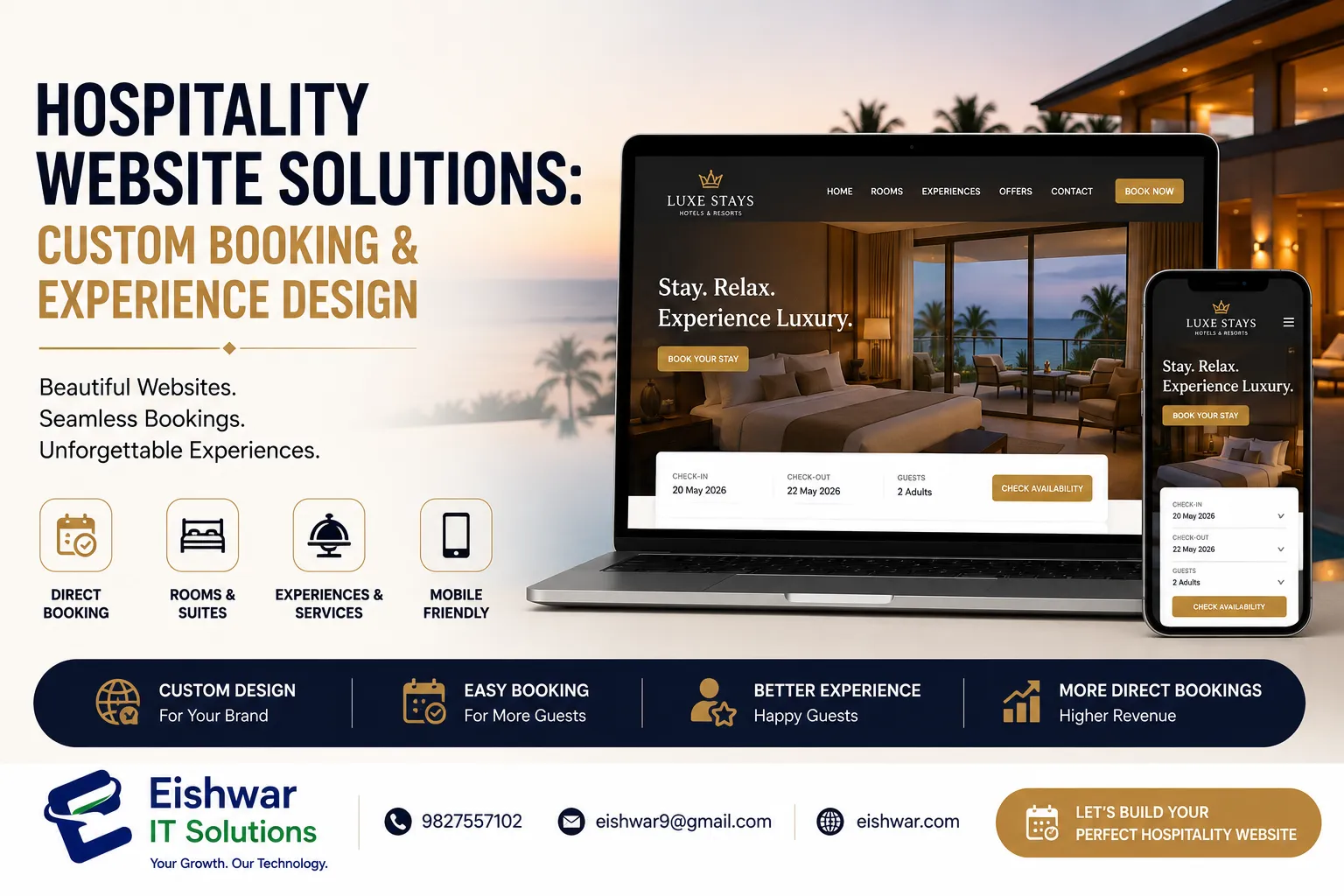
Hospitality Website Solutions: Custom Booking & Experience Design for Indian Hotels & Resorts
Introduction
India's hospitality industry is booming. From heritage havelis in Jaipur to beach resorts in Goa, business hotels in Mumbai to boutique stays in Coorg, every property competes for the same traveler's attention. Yet, many hotel websites still look like digital brochures from 2010. A static site with a contact form is no longer enough.
Today's guests expect seamless online experiences. They want to check availability, compare room types, view virtual tours, and book directly—all within seconds. If your website cannot deliver that, you lose potential guests to OTAs (Online Travel Agencies) like Booking.com or Agoda, which charge commissions of 15-25% per booking. For a mid-sized hotel in India earning ₹50 lakhs annually from bookings, that translates to a loss of ₹7.5–12.5 lakhs in commissions each year—money that could be reinvested into guest experiences or marketing.
This is where industry-specific hospitality website solutions come into play. A custom-built website with a smart booking engine and immersive experience design can transform your property's online presence. It helps you capture direct bookings, build guest loyalty, and tell your brand story effectively. For instance, a heritage property in Rajasthan that switched from a generic template to a custom solution saw a 40% increase in direct bookings within six months, simply by offering a seamless booking flow and showcasing its unique architecture through virtual tours.
In this guide, we will explore why generic websites fail for hospitality businesses, how custom solutions drive real results, and actionable steps to build a high-converting hotel or resort website that stands out in the Indian market.
Main Section 1: Why Generic Websites Fail for Hospitality Businesses
A generic website builder or a template-based design may work for a small cafe, but a hotel or resort has unique needs that standard solutions rarely address. Let's break down the key pain points with practical examples.
Lack of Real-Time Inventory Management
Hotels deal with dynamic inventory: room types, seasonal pricing, minimum stays, and special packages. A standard contact form cannot handle this complexity. Guests end up calling or emailing, which frustrates them and increases your operational load. For example, a resort in Goa with 20 rooms might receive 50 inquiries per day during peak season. Without real-time inventory, staff spend hours manually checking availability and responding to emails—time that could be spent on guest services. A custom booking engine automates this, showing guests exactly what's available and when.
Poor Mobile Experience
Over 70% of hotel searches in India happen on mobile devices. If your website is not optimized for mobile, you lose bookings. Many generic themes are not truly responsive, leading to slow load times and broken layouts on smartphones. Consider a traveler in Mumbai searching for a last-minute hotel on their phone during a commute. If your site takes more than 3 seconds to load or has tiny buttons, they'll bounce to a competitor. A custom mobile-first design ensures thumb-friendly navigation, fast loading, and a smooth booking experience on any device.
No Integration with Channel Managers
A custom hospitality website can integrate directly with your channel manager, ensuring that availability and rates are synced across your website, OTAs, and GDS. This prevents double bookings and saves hours of manual updates. For instance, a hotel in Udaipur using a channel manager like SiteMinder can automatically update room availability on its own website when a booking comes through Booking.com. Without this integration, staff must manually update each platform, risking errors and overbookings that lead to guest dissatisfaction.
Weak Storytelling & Visual Appeal
Hospitality is about emotion. A generic website cannot showcase your property's unique ambiance through high-quality visuals, virtual tours, or localized content. Travelers want to imagine themselves relaxing by your pool or enjoying a meal at your restaurant before they book. A boutique hotel in Coorg, for example, could use a 360-degree virtual tour of its coffee plantation to immerse potential guests. Generic templates often limit image sizes and layouts, making it hard to tell a compelling story that differentiates your property from hundreds of others.
Main Section 2: Key Features of a Custom Hospitality Website Solution
When you invest in a tailored solution from a partner like EishwarITSolution, you get features designed specifically for the hospitality industry. Here's how each feature adds value in practice.
Smart Booking Engine
A custom booking engine allows guests to check real-time availability, select room types, add extras (like airport transfers or spa packages), and pay securely. It should support multiple payment gateways popular in India, such as Razorpay, Paytm, and UPI. For example, a resort in Kerala can offer a "Monsoon Special" package that includes a room, a guided tour, and a complimentary dinner—all selectable in the booking flow. The engine should also handle complex rules like minimum stays (e.g., 2 nights during peak season) and dynamic pricing (e.g., higher rates for weekends).
Immersive Visual Experience
Use high-resolution images, 360-degree virtual tours, and video walkthroughs. For example, a resort in Kerala can embed a video of a houseboat cruise right on the homepage. This builds trust and reduces hesitation. A practical tip: optimize images for web (use WebP format) to keep load times under 2 seconds. Also, consider adding a gallery page with filters (e.g., "Rooms," "Dining," "Activities") so guests can explore specific areas of interest.
Localized Content & Multilingual Support
India is a multilingual country. Offering your website in Hindi, English, and regional languages like Marathi or Tamil can significantly increase engagement. Also, incorporate local keywords: instead of just "luxury hotel," use "luxury hotel near Gateway of India Mumbai." For instance, a hotel in Pune targeting local business travelers might use keywords like "business hotel near Hinjewadi IT park" in both English and Marathi. This improves SEO and resonates with regional audiences.
SEO & Performance Optimization
Your website must load in under 2 seconds. Google prioritizes fast sites. Use CDN, image compression, and clean code. Also, implement structured data (schema markup) for hotels to appear in rich snippets with star ratings, prices, and availability. A practical example: a hotel in Jaipur that adds schema markup for "Hotel" and "Offer" can show its best available rate directly in Google search results, increasing click-through rates by up to 30%.
Integration with Property Management Systems (PMS)
A custom solution can connect with your PMS to sync reservations, guest profiles, and billing. This reduces manual data entry and errors. For example, when a guest books through your website, the reservation automatically appears in your PMS (like IDS or Hotelogix), and the billing details are pre-filled for check-out. This integration also enables personalized pre-arrival emails, such as sending a welcome message with local tips based on the guest's profile.
Main Section 3: How Custom Hospitality Websites Drive Direct Bookings & Loyalty
Direct bookings are the lifeblood of hotel profitability. Every direct booking saves you 15-25% in commission. Here is how a custom website helps you win those bookings, with real-world strategies.
Best Rate Guarantee & Exclusive Offers
Display a clear best rate guarantee on your website. Offer exclusive perks for direct bookings—like free breakfast, late checkout, or a complimentary upgrade. Promote these offers prominently on your homepage and booking flow. For instance, a hotel in Shimla could run a "Direct Booking Special" that includes a free guided trek, visible only on its own website. This incentivizes guests to skip OTAs and book directly, saving the hotel commission costs.
Guest Portal & Loyalty Program
Create a login area where returning guests can view their booking history, manage preferences, and earn loyalty points. This encourages repeat visits and word-of-mouth referrals. For example, a chain of boutique hotels in India could offer a "Stay 5 Nights, Get 1 Free" program tracked through the portal. Guests can also store preferences like room type or dietary restrictions, making future bookings faster and more personalized.
Personalized Recommendations
Use guest data (with consent) to suggest packages based on past stays. For example, if a guest previously booked a family room, show them family holiday packages during their next visit. A resort in Goa could use browsing behavior to recommend a "Beachside Villa" to a user who viewed ocean-view rooms multiple times. This level of personalization increases conversion rates by up to 20%.
Seamless Check-in & Contactless Services
Post-pandemic, contactless check-in is a major selling point. Integrate your website with a mobile check-in feature so guests can skip the front desk. For example, a business hotel in Bangalore can allow guests to upload ID proofs and complete payment online before arrival, then receive a digital room key via the website or a linked app. This reduces wait times and enhances safety, a key differentiator in today's market.
Expert Tips
- Focus on mobile-first design: More than 70% of bookings in India start on mobile. Ensure your booking engine is thumb-friendly and loads fast on 4G/5G. Test on multiple devices, including older Android phones common in tier-2 cities.
- Use high-quality visuals: Invest in professional photography and videography. A picture of a well-lit room can increase conversion by 30%. Consider hiring a local photographer who understands your property's unique angles.
- Simplify the booking flow: Minimize the number of steps to book. Ask for essential details only—name, email, phone, dates. Avoid asking for unnecessary info upfront, like passport numbers or meal preferences, which can be collected later.
- Add social proof: Display real-time reviews from Google or TripAdvisor on your site. Use widgets that show recent bookings (e.g., "5 people booked this hotel in the last hour"). This builds trust and urgency.
- Enable multiple payment options: Indian travelers prefer UPI, credit/debit cards, and net banking. Ensure your gateway supports all popular methods, including Paytm and Google Pay for mobile users.
- Implement a clear cancellation policy: Display it near the booking button to reduce friction. Flexible cancellation policies increase booking confidence. For example, offer free cancellation up to 48 hours before check-in for direct bookings.
- Leverage local SEO: Create location-specific pages (e.g., "Best Hotel in Jaipur for Heritage Tours") to capture long-tail search queries. Include local landmarks and events in your content.
Common Mistakes
- Ignoring mobile optimization: A desktop-only design leads to high bounce rates and lost bookings. Always test your site on mobile first.
- Overcomplicating navigation: Too many menu items confuse visitors. Keep it simple: Rooms, Offers, Gallery, Contact, Book Now. Use a sticky "Book Now" button for easy access.
- Not integrating with OTAs: You need a channel manager to sync rates. Otherwise, you risk overbooking. Choose a channel manager that integrates with your PMS and website.
- Slow loading speed: Heavy images and unoptimized code make guests leave before seeing your property. Use tools like GTmetrix to audit speed and compress images.
- Generic content: Copy-pasting descriptions from other hotels hurts your SEO and brand identity. Write unique, compelling copy that highlights your property's story, like the history of a heritage haveli or the local cuisine at your restaurant.
- Neglecting security: Without SSL and PCI compliance, guests will not trust your payment page. Invest in an SSL certificate and ensure your payment gateway is PCI DSS compliant.
- Ignoring analytics: Without tracking, you can't improve. Set up Google Analytics and heatmaps to understand user behavior and optimize your site continuously.
Future Trends
- AI-powered chatbots: Provide instant answers to common queries (check-in time, pool hours, local attractions). For example, a chatbot on a hotel website can handle 80% of guest inquiries, freeing up staff for complex requests. Tools like Tidio or ManyChat can be integrated easily.
- Voice search optimization: More travelers use voice assistants like Google Assistant or Alexa to find hotels. Optimize for long-tail conversational keywords, such as "find a budget hotel near Mumbai airport with free breakfast."
- Augmented reality (AR) tours: Allow guests to "walk through" a room using their phone camera before booking. For instance, a resort in Goa could let users point their phone at a brochure to see a 3D model of the suite. This is still emerging but can be a differentiator for luxury properties.
- Sustainable tourism badges: Display eco-friendly practices (solar panels, local sourcing) to attract conscious travelers. For example, a hotel in Himachal that uses rainwater harvesting can highlight this with a badge, appealing to environmentally aware guests.
- Hyper-personalization: Use AI to recommend stays based on browsing behavior, past bookings, and even weather forecasts. For instance, if a guest frequently books beach resorts, show them a monsoon package for a Goa property with indoor activities.
- Blockchain for secure payments: While still niche, blockchain can offer transparent, low-fee transactions for international bookings, reducing chargeback risks.
FAQs
- What is a hospitality website solution? A tailored website built specifically for hotels, resorts, and other accommodation providers, featuring a booking engine, room management, and guest engagement tools. Unlike generic sites, it handles dynamic inventory, multi-language support, and integration with PMS and channel managers.
- How does a custom booking engine help reduce OTA dependency? It allows guests to book directly on your site, saving you commission fees (15-25%) and giving you control over the guest relationship. For example, you can capture guest emails for marketing and offer exclusive perks that OTAs cannot match.
- Can I integrate my existing PMS with a new website? Yes, most custom solutions can integrate with popular PMS like IDS, Hotelogix, or Frontdesk. This ensures real-time sync of reservations, guest profiles, and billing, reducing manual errors.
- What is the average cost of a hospitality website in India? Costs vary based on features, but a quality custom site typically ranges from ₹50,000 to ₹2,00,000+. For a basic site with a booking engine, expect ₹50,000–₹1,00,000; for a premium site with virtual tours and PMS integration, ₹1,50,000–₹2,00,000+.
- How long does it take to build a custom hotel website? Typically 4-8 weeks, depending on complexity and content readiness. A simple site with 10 pages and a booking engine can be done in 4 weeks, while a complex site with multilingual support and AR tours may take 8 weeks.
- Do I need a separate mobile app? Not necessarily. A mobile-optimized website with a PWA (Progressive Web App) can offer app-like functionality without the cost. PWAs can send push notifications, work offline, and load quickly on mobile, making them a cost-effective alternative.
- How do I rank my hotel website on Google? Focus on local SEO (e.g., "hotel in Jaipur near Hawa Mahal"), schema markup for hotels, quality backlinks from travel blogs, and regular blog content about your destination. For example, write posts like "Top 10 Things to Do in Coorg" to attract organic traffic.
- What payment gateways should I use for Indian guests? Razorpay, Paytm, Instamojo, and CCAvenue are popular and support UPI, cards, and net banking. For international guests, consider adding PayPal or Stripe. Ensure the gateway is PCI compliant and offers a seamless mobile experience.
- How can I measure the ROI of a custom website? Track metrics like direct booking conversion rate, average order value, and cost per acquisition. For instance, if your custom site generates 50 direct bookings per month at an average value of ₹10,000, that's ₹5 lakhs in revenue, saving ₹75,000–₹1.25 lakhs in OTA commissions.
- What if I have a small homestay with limited budget? Even a basic custom site with a simple booking engine can be cost-effective. Start with a single-page design, use free stock photos, and integrate a low-cost payment gateway. As you grow, you can add more features.
Conclusion
The Indian hospitality market is fiercely competitive. A generic website will not cut it anymore. To attract modern travelers, you need a solution that combines a seamless booking experience, stunning design, and smart integrations. Custom hospitality website solutions from EishwarITSolution empower you to take control of your online presence, reduce costs, and build lasting guest relationships. Whether you run a luxury hotel in Udaipur or a budget homestay in Himachal, investing in a tailored website is the smartest move you can make today. With the right features—from smart booking engines to personalized guest portals—you can turn your website into a 24/7 revenue generator that delights guests and boosts your bottom line.
CTA
Ready to transform your hospitality business online? Contact EishwarITSolution today for a free consultation. Let us build a custom website that drives direct bookings and delights your guests. Our team specializes in Indian hospitality, so we understand your unique challenges and opportunities. Don't let another booking slip away to OTAs—take control now.