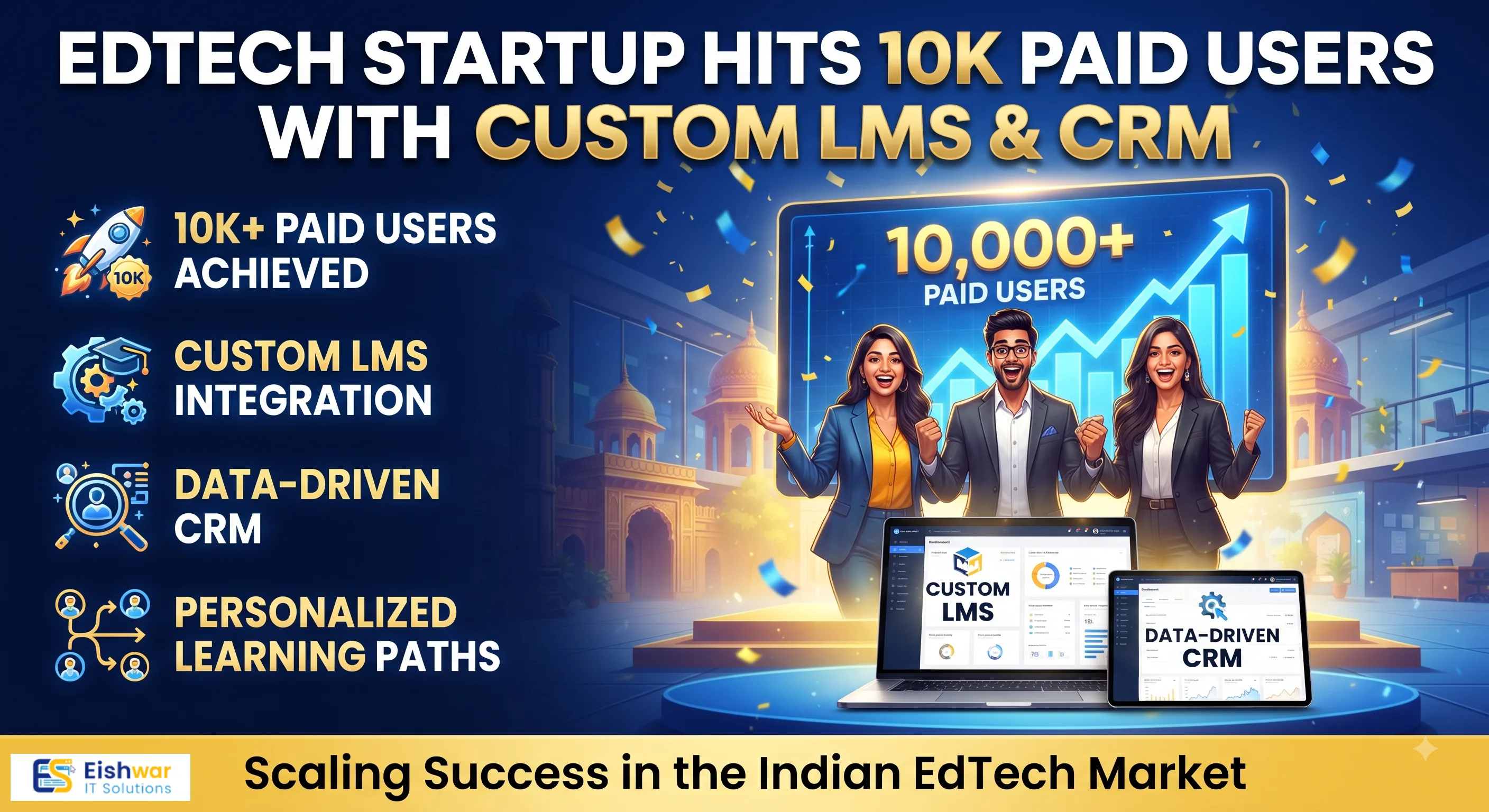
How a Tier-2 Indian EdTech Startup Scaled to 10,000 Paid Users with Custom LMS & CRM Integration
Introduction
In the bustling landscape of Indian education technology, stories of explosive growth often come from metro cities with deep pockets. But what about startups in Tier-2 cities? This is the story of LearnLocal (name changed for confidentiality), an EdTech startup based in Indore, Madhya Pradesh. With a modest beginning in 2023, they aimed to provide affordable, high-quality test preparation for competitive exams like NEET and JEE to students in smaller towns. By mid-2026, they crossed 10,000 paid users, a milestone many thought impossible without a massive marketing budget. The secret? A seamless integration of a custom Learning Management System (LMS) with a robust Customer Relationship Management (CRM) platform, developed in partnership with EishwarITSolution.
LearnLocal's target audience was students from towns like Ujjain, Gwalior, and Jabalpur—places where access to quality coaching is limited. The founders, Priya Sharma and Ravi Verma, bootstrapped the company with ₹50 lakhs from personal savings. They initially relied on word-of-mouth and local partnerships with small coaching centers. However, as user numbers grew, the cracks in their infrastructure became glaring. This case study delves into how they turned a fragmented system into a growth engine, achieving 10,000 paid users and a 3X revenue increase within 12 months of the new platform launch.
Main Section 1: The Challenge – Fragmented Systems and User Churn
Before the integration, LearnLocal operated like many early-stage startups: using a patchwork of tools. Google Classroom for content delivery, WhatsApp for communication, and a spreadsheet for tracking payments. This led to three major problems:
- Poor User Experience: Students had to juggle multiple apps, leading to confusion and drop-offs. For instance, a student might receive a quiz link via WhatsApp, but the results were posted on Google Classroom, requiring them to switch platforms repeatedly. This friction caused a 30% drop in quiz completion rates.
- No Data Centralization: The team couldn't track user progress or identify at-risk students. Priya recalls, "We had a student who was acing all tests but suddenly stopped logging in. We only found out two weeks later when his mother called to complain about lack of support. By then, he had already joined a competitor." Without a unified view, the team missed critical intervention opportunities.
- High Churn Rate: Nearly 40% of free trial users never converted to paid, and 25% of paid users left within the first two months. The main reasons were lack of personalized follow-up and inconsistent communication. For example, a student who signed up for a free trial would receive a generic welcome email but no subsequent nudges to complete the first module. Many felt abandoned.
Founder Priya Sharma recalls, "We had great content, but our delivery and follow-up were broken. We needed a single platform that could handle learning, communication, and retention." The team realized that scaling beyond 2,500 users would be impossible without a unified system. They estimated that manual processes were costing them ₹2 lakhs per month in lost revenue due to churn and inefficiencies.
Main Section 2: The Solution – Custom LMS + CRM Integration by EishwarITSolution
EishwarITSolution proposed a unified platform built from scratch. The custom LMS offered features like interactive video lessons, quizzes, and progress tracking, while the CRM handled lead capture, automated email/SMS sequences, and payment reminders. The integration meant that when a student completed a module, the CRM automatically triggered a personalized follow-up. If a student missed two quizzes in a row, the system flagged them for a counselor's call.
Key technical highlights:
- Single Sign-On (SSO): Users logged in once to access both learning and account management. This reduced login-related support tickets by 70%.
- Automated Workflows: Welcome emails, course recommendations, and re-engagement campaigns ran without manual intervention. For example, if a student scored below 60% on a quiz, the system would automatically send a link to a remedial video and schedule a one-on-one session with a tutor.
- Real-Time Analytics Dashboard: The team could see conversion funnels, drop-off points, and revenue projections in one view. This allowed them to identify that students who completed the first three modules within a week had a 90% conversion rate to paid plans. They then optimized the onboarding flow to encourage this behavior.
The development took 4 months, with iterative testing involving 200 beta users from the existing community. EishwarITSolution used an agile methodology, delivering core features in 2-week sprints. The beta testers provided crucial feedback, such as the need for a mobile-first design (70% of users accessed the platform via smartphones) and a simplified payment interface (many students in Tier-2 cities prefer UPI over credit cards). The final platform was built on a scalable cloud infrastructure (AWS) to handle 10x growth, with a cost of ₹12 lakhs, which included 6 months of post-launch support.
Main Section 3: Results – 10,000 Paid Users and 3X Revenue
Within 12 months of launch, LearnLocal achieved:
- 10,000 Paid Users: Up from 2,500 before the integration. The growth was driven by improved user experience and automated referrals. For instance, the CRM triggered a "refer a friend" campaign after a student completed their first paid month, offering a 10% discount for both parties. This alone generated 1,200 new paid users.
- 300% Increase in Revenue: Average revenue per user (ARPU) grew from ₹1,500 to ₹4,500 as students upgraded to premium plans. The platform's personalized course recommendations (e.g., "Based on your quiz performance, we recommend the Advanced Physics Pack") led to a 40% upsell rate.
- 60% Reduction in Churn: The automated retention flows brought the churn rate down to 10%. For example, if a user hadn't logged in for 5 days, they received a WhatsApp message with a motivational quote and a link to their next lesson. If they missed a payment, the system sent three reminders over a week, followed by a counselor call.
- 45% Higher Engagement: Students spent an average of 2 hours per day on the platform, compared to 45 minutes earlier. The gamification features (badges, leaderboards) and interactive content (e.g., virtual lab simulations) kept learners hooked.
One testimonial from a student in Ujjain: "The app reminded me to study and even suggested which topics I needed to focus on. I felt like I had a personal tutor." Another parent shared, "My son's grades improved from 60% to 85% in three months. The regular progress reports helped us track his improvement." Financially, LearnLocal broke even in month 8 and achieved a profit margin of 25% by month 12. The team grew from 5 to 20 employees, including content creators, counselors, and tech support.
Expert Tips
Based on this case, here are actionable tips for EdTech founders:
- Start with the user journey: Map every touchpoint from discovery to renewal. Identify friction points. For example, LearnLocal found that the payment page had a 50% drop-off rate. They simplified it to a single UPI QR code, reducing drop-offs to 10%.
- Invest in integration early: Don't wait until you have 5,000 users. Even with 500, a unified system saves time and money. LearnLocal's manual processes were costing ₹2 lakhs per month in lost productivity. A custom integration paid for itself within 6 months.
- Use data for personalization: Simple triggers like "student hasn't logged in for 3 days" can save a subscription. LearnLocal's automated re-engagement campaigns recovered 15% of at-risk users.
- Test with real users: Beta test with your most engaged users. Their feedback is gold. LearnLocal's beta testers suggested adding a dark mode, which increased evening usage by 20%.
- Plan for scale: Choose a tech stack that can handle 10x your current user base without breaking. LearnLocal's cloud infrastructure automatically scaled during peak exam seasons, handling 5,000 concurrent users without downtime.
Common Mistakes
Avoid these pitfalls that LearnLocal encountered:
- Over-engineering the MVP: They spent too much time on features nobody used, like a virtual classroom with whiteboarding. Focus on core functionality first—video lessons, quizzes, and progress tracking. Add advanced features based on user demand.
- Ignoring mobile users: 70% of their traffic came from mobile. Ensure the LMS is mobile-responsive. LearnLocal initially built a desktop-first version, which led to a 40% bounce rate on mobile. A mobile-first redesign fixed this.
- Neglecting data privacy: Indian regulations like DPDP Act 2023 are tightening. Use secure servers and get consent for data collection. LearnLocal faced a minor backlash when users discovered their data was stored on a non-compliant server. They migrated to AWS with encryption, which cost ₹50,000 but restored trust.
- Underestimating content migration: Moving existing courses to the new LMS took weeks. Plan ahead. LearnLocal's team had to manually reformat 200 video lessons and 500 quizzes. They now recommend using automated migration tools and allocating at least 2 weeks for testing.
Future Trends
The EdTech space in India is evolving rapidly. Expect to see:
- AI-driven personalization: Adaptive learning paths based on student performance. For example, an AI could analyze a student's quiz errors and generate custom practice sets. LearnLocal is piloting this with a chatbot that answers doubts in real-time.
- Blockchain for credentials: Tamper-proof certificates and micro-credentials. This is especially relevant for vocational courses. LearnLocal plans to issue blockchain-based certificates for their coding bootcamps by 2027.
- Voice-enabled interfaces: Especially for regional language learners. LearnLocal is testing a Hindi voice assistant that reads out questions and accepts voice answers, targeting students in rural areas.
- Integration with government schemes: Platforms that align with NEP 2020 will have an edge. LearnLocal is partnering with the Madhya Pradesh government to offer subsidized courses to 10,000 underprivileged students, funded by the state's education budget.
FAQs
What is the cost of developing a custom LMS and CRM integration?
Costs vary based on features and complexity. For a mid-range solution like LearnLocal's, expect between ₹8-15 lakhs. EishwarITSolution offers flexible payment plans for startups, including a 50% upfront and 50% on completion model. Additional costs may include cloud hosting (₹10,000-20,000 per month) and third-party API integrations (₹50,000-1 lakh).
How long does it take to build a custom LMS?
Typically 3-6 months for a robust platform. Timeline depends on features, team size, and testing requirements. For example, a basic LMS with video hosting and quizzes can be built in 3 months, while adding AI features or gamification may extend to 6 months. LearnLocal's project took 4 months due to iterative beta testing.
Can I integrate my existing CRM with a new LMS?
Yes, most modern CRMs (like HubSpot, Salesforce, Zoho) offer APIs. EishwarITSolution specializes in seamless integrations. For instance, they integrated LearnLocal's custom LMS with Zoho CRM, syncing user data in real-time. The integration cost ₹2 lakhs and took 3 weeks. Ensure your CRM supports webhooks and custom fields for a smooth integration.
What are the key features of a successful EdTech platform?
User-friendly interface, mobile compatibility, automated communication, progress tracking, and secure payment gateway. LearnLocal's platform also included gamification (badges, leaderboards) which increased engagement by 45%. Additionally, features like offline access for low-connectivity areas and multilingual support are becoming essential for Tier-2 and Tier-3 cities.
How do I measure ROI on a custom LMS?
Track metrics like user acquisition cost, churn rate, engagement time, and revenue per user. A good LMS should reduce churn by at least 20%. LearnLocal saw a 60% reduction in churn, translating to ₹3 lakhs in retained revenue per month. Also, measure time saved on manual tasks—LearnLocal's team saved 15 hours per week on follow-ups, which they redirected to content creation.
Is a custom solution better than off-the-shelf platforms like Teachable or Moodle?
Custom solutions offer flexibility and scalability. Off-the-shelf platforms are cheaper upfront but may limit growth. For long-term plans, custom is recommended. For example, LearnLocal needed a unique feature—automated counselor alerts based on quiz performance—which off-the-shelf platforms couldn't provide. However, if you have a tight budget and simple needs, Moodle (free) or Teachable (₹2,000/month) can be starting points.
What are the common challenges in migrating from off-the-shelf to custom LMS?
Common challenges include data migration (course content, user profiles), user training, and downtime. LearnLocal faced a 2-day downtime during migration, which they mitigated by running both systems in parallel for a week. They also created video tutorials for students and held live Q&A sessions. Plan for at least 2 weeks of transition period to avoid user frustration.
Conclusion
LearnLocal's journey from fragmented tools to a unified platform is a testament to the power of strategic technology investment. By integrating a custom LMS with CRM, they not only scaled to 10,000 paid users but also built a loyal community. For any Tier-2 Indian EdTech startup, this case proves that with the right partner and a focus on user experience, exponential growth is within reach. The key takeaways are clear: invest in integration early, prioritize mobile-first design, and use data to drive personalization. LearnLocal's success is not an anomaly—it's a blueprint for others to follow.
CTA
Ready to transform your EdTech startup? Contact EishwarITSolution today for a free consultation. Let's build a platform that scales with your vision. Our team of experts will analyze your current setup, identify pain points, and propose a custom solution tailored to your budget and goals. Don't let fragmented systems hold you back—join the ranks of successful EdTech startups like LearnLocal.