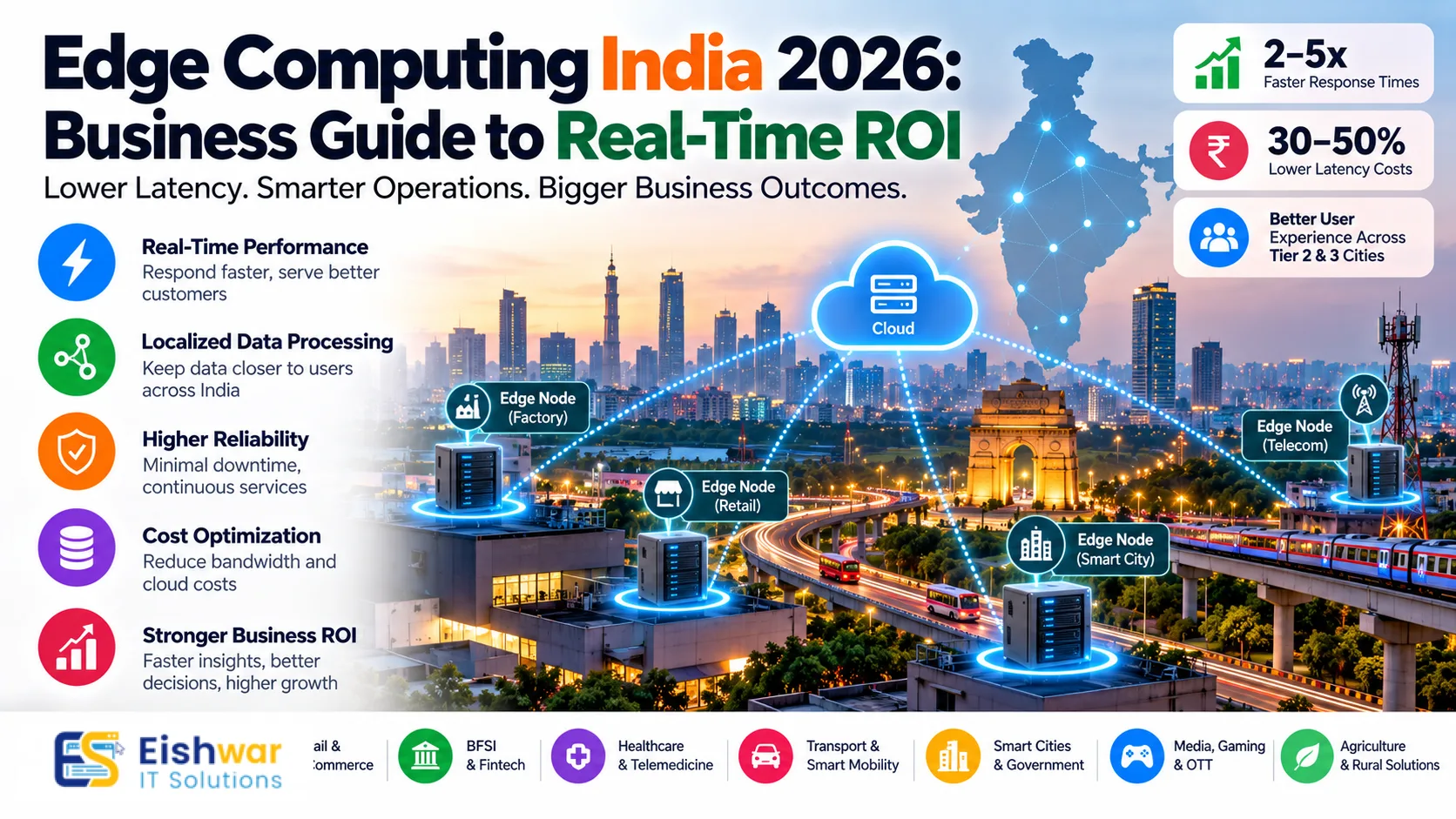
Edge Computing India 2026: Business Guide to Real-Time ROI
Introduction
Indian businesses are drowning in data, but many still send every byte to a distant cloud region before they can act on it. That model worked when dashboards updated hourly. It struggles when a factory sensor needs to stop a machine in milliseconds, a retailer wants to personalize an offer at the aisle, or a logistics fleet must reroute around a sudden traffic block.
Edge computing changes the equation. Instead of processing everything in a central cloud, edge computing processes data near where it is created: on the factory floor, inside a retail store, at a telecom tower, in a hospital, or on a delivery vehicle. In 2026, edge computing in India is moving from experimental pilots to mainstream business infrastructure. The reasons are practical: 5G coverage, cheaper IoT sensors, AI models that run on small devices, and rising customer expectations for instant digital experiences.
This guide is for business owners, marketers, and professionals who want a clear, practical view of edge computing in India 2026. You will learn why it matters, where it delivers ROI, how to implement it without betting the company, and what mistakes to avoid.
Main Section 1: Why Edge Computing Matters for Indian Businesses in 2026
Edge computing is not a replacement for cloud. It is a companion. Cloud remains the best place for long-term storage, heavy analytics, collaboration, and large-scale AI training. Edge handles what must happen now, locally, and reliably. For Indian businesses, three forces make this shift urgent.
The Latency Imperative
Latency is the delay between a request and a response. For a video call, 100 milliseconds is tolerable. For an autonomous forklift, a robotic surgery assistant, or a fraud detection system, it can be the difference between safety and disaster. Sending data from a Mumbai factory to a cloud server in another region and back can take 50 to 200 milliseconds. Edge computing can reduce that to under 10 milliseconds in many scenarios. That speed unlocks real-time control, real-time personalization, and real-time safety.
In India, 5G rollout is accelerating the edge opportunity. 5G promises high bandwidth and low latency, but those benefits are only fully realized when compute sits close to the user or device. Telecom operators, system integrators, and cloud providers are building edge zones in major cities and industrial corridors. Businesses that understand this shift can design applications that feel instantaneous.
Data Sovereignty and Compliance
India's data protection and localization expectations continue to evolve. Many organizations want sensitive data, such as customer records, health data, or operational technology logs, to stay within a controlled environment. Edge computing allows local processing and filtering. You can keep raw data on-premises or in a local edge data center, then send only anonymized or aggregated insights to the cloud. This supports compliance while still enabling analytics.
For BFSI, healthcare, and government-linked projects, this local-first approach can simplify audits and reduce legal risk. It also gives businesses more control over where data lives and who can access it.
Cost Efficiency Beyond Cloud
Cloud costs scale with data transfer, storage, and compute. When thousands of devices stream high-definition video or sensor data continuously, cloud bills can grow faster than revenue. Edge computing reduces backhaul bandwidth by processing and summarizing data locally. Instead of sending every frame, you send exceptions, alerts, and daily summaries. This can cut networking and cloud processing costs significantly.
There is also a resilience benefit. If the internet link goes down, an edge node can keep critical operations running. A retail store can continue billing, a factory can continue safe production, and a hospital can continue monitoring patients. For Indian businesses dealing with unpredictable connectivity, this local autonomy is valuable.
Main Section 2: High-Impact Edge Computing Use Cases in India
Edge computing creates value when speed, bandwidth, privacy, or reliability matter. Here are the use cases gaining traction across Indian industries in 2026.
Smart Manufacturing and Industry 4.0
Indian manufacturers are adopting IoT sensors, computer vision, and predictive maintenance. Edge computing enables real-time quality inspection on production lines. Cameras can detect defects instantly without sending video to the cloud. Vibration sensors can predict machine failure and trigger maintenance before a breakdown. In auto components, textiles, pharmaceuticals, and electronics assembly, edge-based quality control can reduce waste and downtime.
Example: A Pune-based auto parts manufacturer uses edge devices to analyze welding quality. If a weld is weak, the system alerts the operator immediately and stops the line. Only summary data goes to the cloud for trend analysis. The result is fewer defective parts and lower bandwidth costs.
Retail and Customer Experience
Retailers use edge computing for frictionless checkout, shelf monitoring, and personalized promotions. Smart cameras can track inventory on shelves and alert staff when stock is low. In-store edge servers can deliver personalized offers to a customer's phone without sending personal data to a remote cloud. This improves speed and privacy.
For Indian retail chains with hundreds of stores, edge computing also helps with offline resilience. If the central network fails, stores can continue billing, loyalty redemption, and local inventory updates.
Healthcare and Diagnostics
Hospitals generate sensitive data from imaging machines, wearables, and patient monitors. Edge computing can process X-rays or ECG data locally, helping doctors get faster preliminary insights. It also keeps patient data within the hospital network, which supports privacy and compliance. In remote clinics, edge devices can run AI models for initial screening and only send urgent cases to specialists.
Logistics and Fleet Management
Logistics companies use edge computing in vehicles and warehouses. On-board edge devices can process GPS, fuel, temperature, and driver behavior data in real time. They can alert drivers about route deviations or cold-chain breaches without waiting for a cloud round trip. In warehouses, edge-powered robots and scanners can coordinate picking and packing with minimal latency.
Financial Services and Fraud Detection
Banks and fintechs need to detect fraud as transactions happen. Edge computing at branch or point-of-sale level can run risk models locally, flagging suspicious transactions in milliseconds. This reduces dependence on central systems and improves customer experience. It also helps with offline verification in areas with poor connectivity.
Smart Cities and Utilities
Smart city projects use edge computing for traffic management, street lighting, water monitoring, and public safety. Cameras and sensors can analyze conditions locally and send only alerts to central command. This reduces network load and improves response times. For utilities, edge computing supports smart metering, grid monitoring, and predictive maintenance of equipment.
Main Section 3: How to Implement Edge Computing: A Practical Roadmap for Indian Businesses
Edge computing can seem complex, but a phased approach keeps risk manageable. Use this five-step roadmap.
Step 1: Assess Workloads and Business Priorities
Start by identifying processes where latency, bandwidth, privacy, or uptime directly affect revenue or risk. Not every application needs edge. Ask: What happens if this decision is delayed by 200 milliseconds? What happens if the internet goes down? How much data are we sending to the cloud, and what does it cost? Prioritize one or two high-impact use cases, such as real-time quality inspection or in-store personalization.
Step 2: Choose the Right Edge Architecture
Edge architecture can range from small devices to micro data centers. Options include:
- Device edge: AI runs directly on cameras, sensors, or gateways. Best for low-cost, simple inference.
- Local edge: A server or appliance sits in a store, factory, or branch. Good for multiple cameras, local databases, and offline operation.
- Network edge: Compute at a telecom tower or edge data center. Useful for low-latency services across a city.
- Regional edge: A larger facility serving a cluster of locations. Balances cost and performance.
Most Indian businesses start with local edge appliances and connect to cloud for management and analytics. This hybrid model is practical and scalable.
Step 3: Build Security and Governance from Day One
Edge devices are distributed, which expands the attack surface. You need device identity, encryption, secure boot, regular patching, and network segmentation. Define who can access edge data and how it is retained. For regulated industries, map data flows to compliance requirements. A zero-trust approach is useful: never trust a device or user by default, verify every access request.
Step 4: Partner and Scale
Few businesses have all the skills needed for hardware, connectivity, AI models, and security. Partner with cloud providers, telecom operators, system integrators, and managed service providers. Start with a pilot in one location. Measure results. Then create a standard edge blueprint that can be replicated across sites. This reduces deployment time and cost.
Step 5: Measure ROI and Iterate
Track metrics that matter: latency reduction, bandwidth savings, cloud cost avoidance, downtime reduction, defect rates, conversion lift, and compliance cost. Compare the edge solution against the previous cloud-only approach. Use the results to justify expansion. Remember that edge computing ROI often comes from avoided losses, not just new revenue.
Expert Tips
- Start with a business problem, not technology. Edge computing is a means to an end. Choose a use case with clear financial impact.
- Design for offline-first. Assume connectivity will fail. Critical operations should continue locally.
- Keep data minimal. Send only what the cloud needs. This cuts costs and improves privacy.
- Use open standards. Avoid vendor lock-in by supporting containers, Kubernetes, and standard APIs.
- Invest in device management. You need a way to monitor, update, and secure thousands of edge nodes.
- Train local teams. Store managers, factory supervisors, and IT staff need to understand edge basics.
- Plan for power and cooling. Edge sites may not have robust infrastructure. Use industrial-grade hardware.
- Integrate with existing cloud. Edge should feed the cloud, not create a separate data silo.
- Test with real conditions. Dust, heat, humidity, and power fluctuations affect edge devices in India.
- Review compliance early. Involve legal and security teams before deployment, not after.
Common Mistakes
- Treating edge as a mini cloud. Edge is not for everything. Use it for latency-sensitive or local workloads.
- Ignoring security. Unsecured edge devices are an easy entry point for attackers.
- Overbuilding in phase one. Buying too much hardware before proving value wastes budget.
- Forgetting data governance. Without clear rules, edge data can become a compliance risk.
- Underestimating connectivity. Some locations have unreliable networks. Design accordingly.
- Measuring only technical metrics. ROI should include business outcomes like revenue, cost, and risk.
- No central visibility. If you cannot monitor edge nodes, you cannot manage them.
- Skipping change management. Employees need training and incentives to use new edge workflows.
Future Trends
- Edge AI everywhere: Smaller, efficient AI models will run on cameras, sensors, and mobile devices.
- 5G and 6G integration: Telecom edge zones will make low-latency services more accessible across India.
- Sovereign edge clouds: Local cloud regions and edge data centers will support data sovereignty requirements.
- Edge Kubernetes: Container orchestration will become standard for managing edge applications at scale.
- IT-OT convergence: Factory IT and operational technology teams will collaborate more closely on edge projects.
- Sustainable edge: Energy-efficient edge hardware will reduce power consumption and carbon footprint.
- Edge marketplaces: Businesses will buy pre-built edge applications for retail, manufacturing, and healthcare.
- Autonomous operations: Edge computing will enable self-driving vehicles, drones, and robots in controlled environments.
FAQs
What is edge computing in simple terms?
Edge computing processes data near where it is created instead of sending everything to a central cloud. This reduces delay, saves bandwidth, and keeps sensitive data local.
Is edge computing replacing cloud computing?
No. Edge and cloud work together. Edge handles real-time, local processing. Cloud handles storage, big analytics, AI training, and company-wide applications.
Which Indian industries benefit most from edge computing?
Manufacturing, retail, healthcare, logistics, BFSI, telecom, and smart city projects see the fastest impact because they rely on real-time decisions and local data processing.
How much does edge computing cost in India?
Costs vary by scale. A small retail or branch edge setup may start with a few devices and a local appliance. Factory or city-scale deployments need more hardware, software, and integration. A pilot can start small and scale as ROI is proven.
Do I need 5G for edge computing?
No. Edge computing works with 4G, Wi-Fi, fiber, or wired networks. 5G improves speed and latency, but many use cases deliver value on existing connectivity.
How do I measure edge computing ROI?
Track latency reduction, bandwidth savings, cloud cost avoidance, downtime reduction, defect rates, customer conversion, and compliance cost. Compare against your previous cloud-only setup.
What are the biggest security risks at the edge?
Distributed devices can be physically tampered with, poorly patched, or used as entry points. Use device identity, encryption, secure boot, network segmentation, and zero-trust access.
Conclusion
Edge computing in India 2026 is no longer a niche experiment. It is a practical response to real-time customer expectations, data sovereignty, bandwidth costs, and operational resilience. Indian businesses across manufacturing, retail, healthcare, logistics, and finance are finding that processing data closer to the source improves speed, reduces costs, and unlocks new experiences.
The smartest approach is not to replace your cloud. It is to design a hybrid model where edge and cloud each do what they do best. Start with a focused use case, measure ROI, secure every device, and scale what works. That is how you turn edge computing from a technical buzzword into a business advantage.
CTA
Ready to explore edge computing for your business? Contact EishwarITSolution for a practical edge readiness assessment. We help Indian businesses identify high-ROI use cases, design secure edge architecture, and implement pilots that deliver measurable results. Visit http://eishwar.com or reach out to our team today.