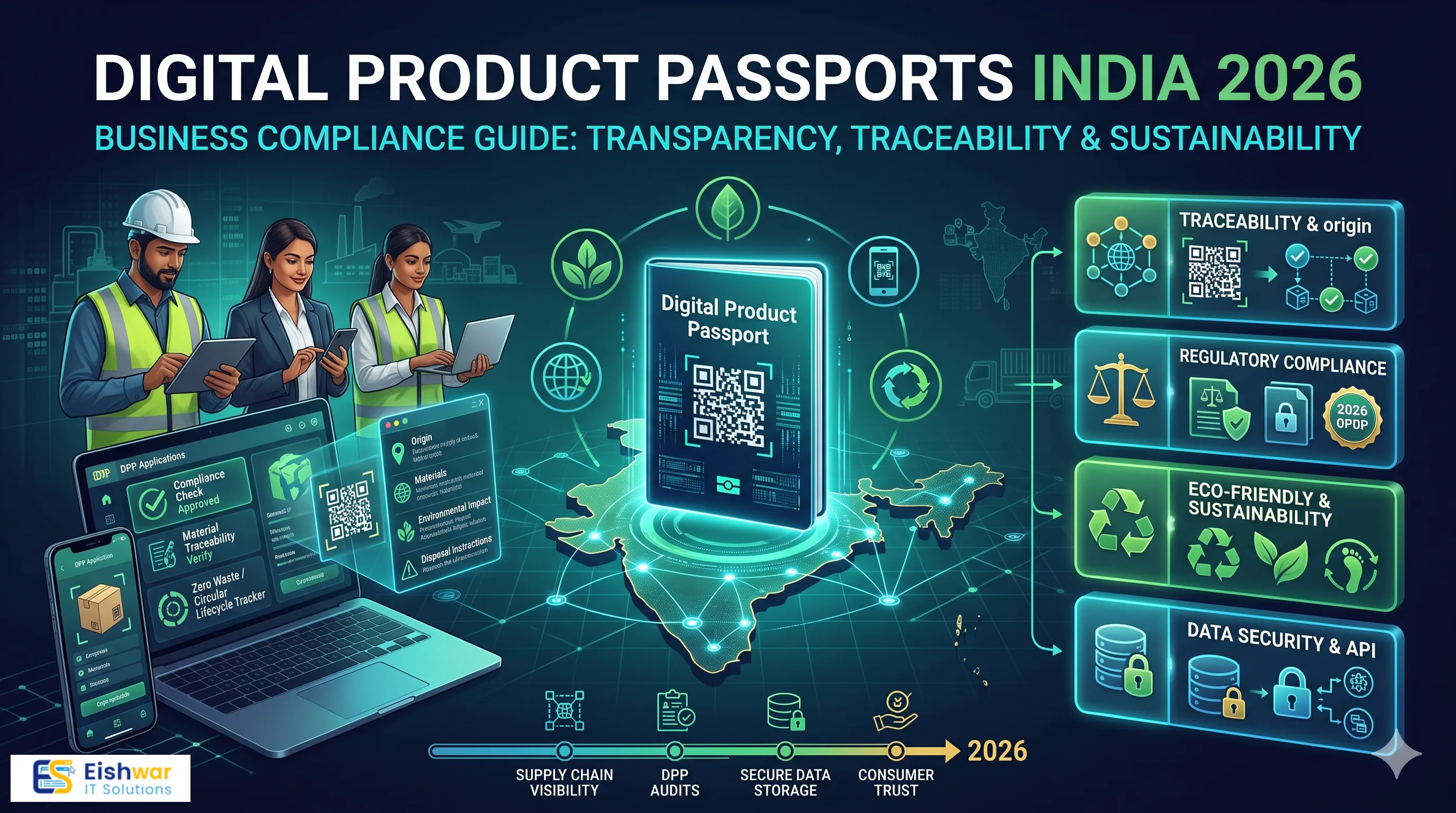
Digital Product Passports India 2026: Business Compliance Guide
Published on 5 October 2026 | Category: Industry Insights | By EishwarITSolution
Introduction
If your business exports to Europe, supplies global brands, or sells products that carry a battery, textile, or electronic component, a new compliance wave is heading your way. It is called the Digital Product Passport, or DPP. By 2026, the European Union's Ecodesign for Sustainable Products Regulation is moving from policy papers to practical pilots, and Indian exporters are already receiving data requests from buyers.
A Digital Product Passport is not another PDF certificate. It is a structured digital record that travels with a product across its lifecycle. A shopper, regulator, repair shop, or recycler can scan a QR code or NFC tag and see where the product came from, what it is made of, how it can be repaired, and how it should be recycled.
For Indian business owners, marketers, and professionals, this is both a compliance deadline and a market opportunity. Companies that prepare early will protect export revenue, win premium buyers, and build trust. Companies that wait will face urgent data requests, shipment delays, and lost contracts.
This guide explains what DPP means for India in 2026, which sectors are affected first, how to prepare without overspending, and where new business opportunities are emerging.
Main Section 1: What Is a Digital Product Passport and Why It Matters for India
The simple definition
A Digital Product Passport is a digital identity for a product. It links a physical item to a secure online record using a data carrier such as a QR code, NFC chip, or RFID tag. The record contains verified data about materials, origin, manufacturing, carbon footprint, durability, repairability, and end-of-life instructions.
The passport is not meant to be a marketing brochure. It is designed to be interoperable, machine-readable, and trustworthy. Different users see different levels of data. A consumer might see care and recycling instructions. A customs officer might verify compliance. A recycler might access material composition.
Why Europe matters to Indian businesses
The European Union is a major destination for Indian textiles, electronics, batteries, footwear, leather goods, and auto components. Under the EU's Ecodesign for Sustainable Products Regulation, DPP requirements are being rolled out product group by product group. Batteries are an early priority, followed by textiles, electronics, tyres, detergents, and iron and steel. Even if your product is not directly named yet, your buyer may ask for DPP-ready data because their own compliance depends on your inputs.
India is not a passive observer. Indian suppliers to global brands are being asked to share material composition, country of origin, recycled content, and chain-of-custody documents. In 2026, these requests are moving from spreadsheets to structured data feeds. That shift is the real story.
What a DPP record typically includes
- Unique product identifier: A GTIN, serial number, or batch ID linked to a digital carrier.
- Material and substance data: Recycled content, hazardous substances, and critical raw materials.
- Origin and supply chain: Manufacturing locations, supplier tiers, and chain of custody.
- Environmental footprint: Carbon emissions, water use, energy source, and transport impact.
- Circularity data: Repairability score, spare parts availability, disassembly instructions, and recycling guidance.
- Compliance evidence: Certifications, test reports, and due diligence records.
India-specific context
Indian MSMEs often operate in clusters: Tiruppur for knitwear, Surat for textiles, Noida for electronics, Pune and Chennai for auto components, and Morbi for ceramics. In these clusters, data is frequently held in paper files, WhatsApp messages, and separate accounting systems. DPP requires a more connected approach. The businesses that digitise supplier data now will find compliance easier and cheaper.
There is also a domestic angle. India is strengthening its own ESG, e-waste, battery waste, and extended producer responsibility rules. A DPP-ready data foundation helps with Indian compliance too, not just EU exports.
Practical example: A Tiruppur knitwear exporter supplying a German retailer was asked in early 2026 to provide fibre origin, recycled polyester percentage, dye chemistry, and repair instructions for 40 SKUs. The company created a simple product data sheet with QR codes and a supplier portal. Instead of losing the account, it negotiated a higher price because the buyer valued traceability.
Main Section 2: Business Benefits and New Revenue Opportunities
Compliance becomes market access
The first benefit is defensive: you keep selling into regulated markets. But DPP is not only a cost. It can become a competitive advantage. When buyers compare suppliers, the one with clean, verified product data is easier to trust and easier to onboard.
For Indian exporters, DPP can reduce audit fatigue. Instead of answering the same questionnaire from five buyers, you maintain one data backbone and share controlled access. That saves time for sales, quality, and compliance teams.
Stronger brand trust and premium positioning
Modern consumers, especially in Europe and urban India, want proof, not promises. A scannable passport that shows recycled content, repair options, and responsible sourcing can support premium pricing. Marketers can use DPP data in campaigns: 'Scan to see the journey of this shirt' or 'This battery is 72% recyclable.'
But be careful. If the data is vague or unverified, it becomes a reputational risk. DPP works best when marketing and compliance teams collaborate.
Circular economy and after-sales revenue
DPP enables circular business models. A furniture brand can offer repair services. An electronics company can run a take-back programme. A fashion brand can launch resale with verified authenticity. Each of these models creates new revenue and deepens customer relationships.
For Indian businesses, this opens opportunities in reverse logistics, refurbishment, spare parts, and recycling. If you already manufacture components, you can move into repair and remanufacturing with data-backed quality checks.
New B2B services and software opportunities
DPP is creating a services market. Indian IT companies, SaaS startups, and consultancies can build:
- DPP data platforms and APIs.
- QR and NFC labelling solutions.
- Supplier data collection and verification tools.
- Carbon footprint calculators for specific product categories.
- Compliance dashboards for EU regulations.
- Blockchain or distributed ledger pilots for chain of custody.
- Training and managed services for MSME clusters.
This is not limited to large enterprises. A small team that understands both Indian supply chains and EU data requirements can build a profitable niche.
Operational efficiency
Once product data is structured, it can be reused for customs, quality control, inventory, ESG reporting, and customer support. That reduces duplicate work. A battery maker in Pune, for example, used DPP preparation to consolidate material declarations from 60 suppliers. The company discovered two suppliers were using a restricted substance, fixed it before a recall, and avoided a potential penalty.
How to measure DPP ROI
Track these metrics:
- Percentage of SKUs with complete product data.
- Time saved per buyer audit or compliance request.
- Number of supplier data gaps closed.
- Export orders retained or won due to traceability.
- After-sales revenue from repair, resale, or take-back.
- Cost per product passport created and maintained.
When you present DPP to leadership, speak in terms of risk reduction, market access, and operational efficiency. Compliance alone rarely wins budget. Business value does.
Main Section 3: How to Prepare Your Business for DPP Compliance in 2026
Step 1: Map your product portfolio and regulatory exposure
List every product you export or supply to exporters. Mark which ones fall under EU priority groups: batteries, textiles, electronics, tyres, detergents, iron and steel, furniture, and footwear. Also mark products used in those categories. A small electronic sensor inside a washing machine may need data because the washing machine needs a passport.
Talk to your buyers. Ask what DPP data they will require, in what format, and by when. Get it in writing if possible.
Step 2: Conduct a data gap assessment
For each product, check what data you already have and what is missing. Typical gaps include supplier names beyond tier one, recycled content evidence, chemical composition, carbon emissions, and repairability information.
Use a simple red-amber-green rating. Red means no data. Amber means partial or unverified. Green means verified and digitised. Focus first on red items that affect your biggest export SKUs.
Step 3: Choose standards and technology wisely
Do not invent a proprietary system unless you must. Align with recognised standards such as GS1 identifiers, ISO data models, and emerging EU DPP schemas. Use QR codes for cost-effective consumer access and NFC or RFID for industrial or high-value use cases.
Your technology stack should include a product information management system, a supplier data portal, and an API layer for buyers and regulators. Blockchain is optional. Use it only if you need multi-party trust and your partners agree. Otherwise, a well-governed central database is faster and cheaper.
Step 4: Build data governance and supplier collaboration
DPP is a supply chain project, not just an IT project. Assign a data owner for each product category. Create a supplier code of conduct that requires timely data sharing. Offer suppliers a simple upload template and training. In Indian clusters, language and digital literacy can be barriers, so provide support in Hindi, Tamil, Gujarati, or other local languages where needed.
Also define access rules. Who can see what? How long is data stored? How do you correct errors? These questions matter for privacy, competition, and cybersecurity.
Step 5: Pilot with one product line
Choose one export product with a cooperative buyer. Build passports for 10 to 50 SKUs. Test QR scanning, data accuracy, supplier response time, and buyer feedback. Document the cost and effort. Use the pilot to create a repeatable playbook before scaling.
Example pilot plan: Month 1: map data and suppliers. Month 2: configure platform and QR labels. Month 3: collect and verify data. Month 4: launch with buyer and measure results. Month 5: fix gaps and expand to next product line.
Step 6: Integrate with ERP, PLM, and PIM
Manual spreadsheets will not scale. Integrate DPP data with your ERP for batch numbers, PLM for product design, and PIM for marketing content. This avoids duplicate entry and ensures that when a product changes, its passport updates automatically.
If you use a third-party manufacturer, require them to send structured data through an API or standard template. Make data quality part of your vendor scorecard.
Step 7: Budget, train, and monitor
Costs vary by size and sector. A small MSME pilot may cost Rs 50,000 to Rs 2,00,000 for software, labels, and consulting. A mid-sized exporter may invest Rs 5,00,000 to Rs 20,00,000 or more for integration and data cleanup. The larger cost is usually internal time, not software.
Train sales, procurement, quality, and IT teams. Appoint a DPP coordinator. Monitor EU delegated acts and Indian regulations every quarter. DPP rules will evolve, so build flexibility into your systems.
Step 8: Address cybersecurity and privacy
A digital passport is an internet-facing asset. Protect it with role-based access, encryption, audit logs, and vendor security reviews. Do not expose confidential supplier pricing or personal data. Use authentication for sensitive layers and keep public data separate.
Expert Tips
- Start with data, not technology. A cheap platform with clean data beats an expensive platform with messy data.
- Design for reuse. The same data should serve compliance, marketing, customer service, and ESG reporting.
- Involve suppliers early. Send a clear one-page data request. Explain why it helps them win more business.
- Use GS1 standards. Global buyers recognise them, and they reduce integration friction.
- Keep consumer-facing passports simple. Show clear benefits: care, repair, recycling, and authenticity. Hide technical data behind layers.
- Verify before you publish. A wrong recycled-content claim can trigger greenwashing penalties.
- Pilot with a friendly buyer. Use their feedback to refine your data model before a mandatory deadline.
- Document everything. Regulators and buyers may ask how data was collected, verified, and updated.
Common Mistakes
- Treating DPP as a one-time project. It is an ongoing data operation, not a certificate.
- Waiting for the final EU rule. By the time rules are final, timelines are tight. Pilots should start now.
- Ignoring tier-two and tier-three suppliers. Most material risk sits deeper in the supply chain.
- Building a closed system. Buyers and regulators need interoperability. Proprietary formats create rework.
- Overloading the consumer view. Too much data confuses users. Layer information by audience.
- Using DPP only for marketing. If compliance data is weak, marketing claims become a liability.
- Forgetting cybersecurity. Public QR codes can be spoofed or scraped. Plan for authentication and monitoring.
- Not measuring ROI. Without metrics, DPP feels like a cost centre and loses leadership support.
Future Trends
1. From pilots to mandates. Between 2027 and 2030, more product groups will require DPP in Europe. Other markets, including the UK, Japan, and Canada, are watching closely. India may develop its own framework for domestic traceability and EPR.
2. AI-assisted data verification. AI will help classify materials, detect anomalies in supplier declarations, and auto-generate passport content. Human review will remain important for legal and safety data.
3. Digital twins and lifecycle intelligence. DPP data will feed digital twins that simulate repair, recycling, and carbon impact. This will help manufacturers design products for circularity from day one.
4. Blockchain where trust is missing. Distributed ledgers will be used in complex, multi-party supply chains, especially for critical minerals and luxury goods. Most companies will use conventional databases with strong governance.
5. New Indian service exports. India's IT and BPO strengths can position the country as a DPP data operations hub for global brands. This means jobs in data engineering, compliance, and sustainability analytics.
6. Consumer expectations rise. Shoppers will expect a scan-to-verify experience. Brands that offer it will earn trust; those that do not may look outdated.
FAQs
1. What is a Digital Product Passport in simple terms?
A Digital Product Passport is a digital record linked to a product through a QR code, NFC tag, or RFID. It shows verified information about materials, origin, repair, and recycling so buyers, regulators, and recyclers can make better decisions.
2. Is DPP mandatory for Indian companies in 2026?
DPP is primarily driven by EU regulations, so Indian companies exporting to Europe or supplying EU-regulated brands will face requirements through contracts and supply chain rules. Domestic Indian mandates may also emerge for batteries, e-waste, and textiles.
3. Which industries are affected first?
Batteries, textiles, electronics, tyres, detergents, iron and steel, furniture, and footwear are early priorities. Even if your product is not directly covered, you may need to provide data if you supply a covered product.
4. How much does DPP implementation cost?
A small pilot can cost Rs 50,000 to Rs 2,00,000. Larger exporters may spend Rs 5,00,000 to Rs 20,00,000 or more on software, integration, data cleanup, and training. Internal staff time is often the biggest cost.
5. Do I need blockchain for DPP?
No. Most businesses can use a secure central database with APIs, role-based access, and audit logs. Blockchain is useful only when multiple parties need shared, tamper-resistant records and agree on governance.
6. How long does it take to prepare?
A focused pilot can be ready in three to five months. Full portfolio readiness may take 12 to 24 months depending on product complexity, supplier depth, and data quality.
7. What is the biggest risk if we delay?
Lost export orders, shipment delays, buyer penalties, and reputational damage. Buyers may shift to suppliers who can provide verified product data on time.
Conclusion
Digital Product Passports are moving from concept to commercial requirement. For Indian businesses in 2026, the smart move is not to wait for a final deadline. Start mapping your products, clean up supplier data, and pilot one product line with a friendly buyer.
DPP is more than compliance. It is a chance to build trust, reduce risk, improve operations, and create new revenue from repair, resale, and recycling. The companies that treat product data as a strategic asset will lead in the next era of global trade.
At EishwarITSolution, we help Indian businesses plan digital compliance, build data systems, and prepare for DPP without unnecessary complexity. Whether you are an MSME exporter or a large manufacturer, the right time to act is now.
CTA
Ready to make your products DPP-ready? Contact EishwarITSolution for a practical DPP readiness assessment. We will help you identify data gaps, choose the right technology, and build a cost-effective roadmap for 2026 and beyond.
Book a free consultation today or explore our Industry Insights blog for more guides on AI, cybersecurity, and digital growth for Indian businesses.