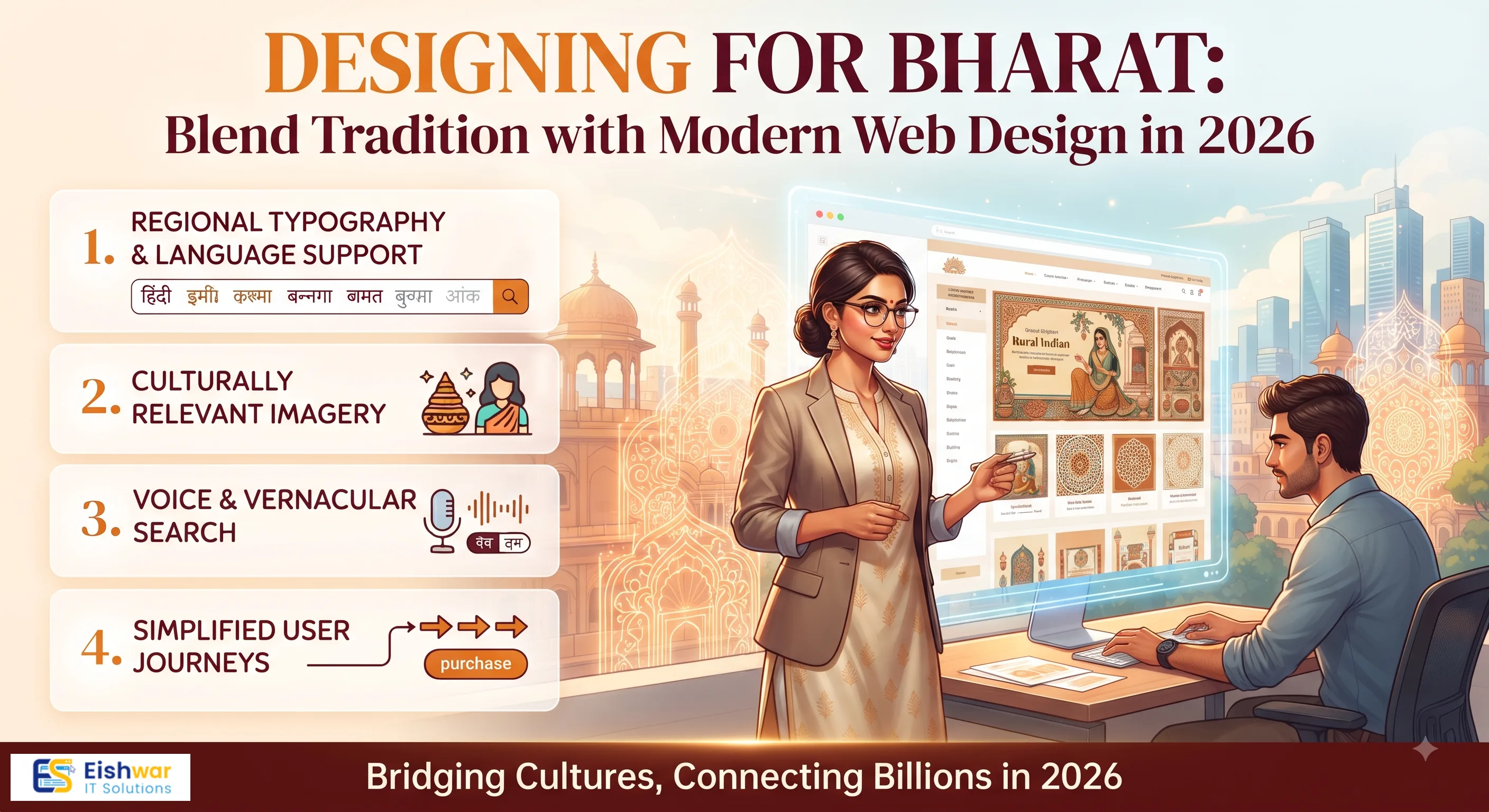
Designing for Bharat: Blend Tradition with Modern Web Design in 2026
\n
Introduction
India is not just a market; it's a tapestry of cultures, languages, and traditions. As we step into 2026, the digital landscape of India is evolving rapidly, with over 900 million internet users expected. But here's the catch: despite the surge in digital adoption, many websites still feel foreign to the Indian audience. They miss the warmth, the familiarity, and the cultural nuances that make a user feel at home.
At EishwarITSolution, we believe that great web design goes beyond aesthetics—it's about connection. Designing for Bharat (a term that evokes the soul of India) means blending timeless traditions with modern design principles. In this comprehensive guide, we'll show you how to create websites that not only look stunning but also build trust, drive engagement, and boost conversions among Indian users.
Whether you're a business owner, marketer, or designer, these actionable tips will help you craft a digital experience that truly resonates with India's heartland. Think of this as your blueprint for a website that feels like a warm chai on a rainy day—familiar, comforting, and deeply rooted in the Indian ethos.
Main Section 1: Understanding the Indian User – Beyond Demographics
Before you start designing, you need to understand who you're designing for. India is not a monolith. A user in Mumbai has different expectations than a user in a tier-3 town in Uttar Pradesh. However, some cultural threads unite them. Let's unravel these threads to build a design strategy that works across the spectrum.
Trust is the Currency
Indian users are often skeptical of new brands. They rely on word-of-mouth, reviews, and familiar symbols. Incorporate trust signals like:
- Testimonials with real names and photos—preferably with regional names to build authenticity.
- Trust badges (e.g., VeriSign, SSL) placed prominently near checkout or contact forms.
- Familiar payment options (UPI, NetBanking, Cash on Delivery). Remember, COD is still king in many parts of India.
- Display of physical address and phone number—a simple way to show you're not a fly-by-night operation.
For example, a small e-commerce site selling handloom sarees could feature a testimonial from a customer in Varanasi, complete with a photo and a short video review. This builds an emotional connection that a generic five-star rating cannot achieve.
Language and Localization
While English is widely used, Hindi and regional languages dominate in smaller cities. A website that offers content in Hindi, Tamil, Telugu, or Bengali can see up to 40% higher engagement. Use tools like Google Translate or integrate a multilingual plugin. But don't just translate—localize. Use region-specific idioms, currency, and date formats. For instance, instead of saying 'Add to Cart,' use 'जोड़ें' (Jodhen) in Hindi, and replace 'Checkout' with 'भुगतान करें' (Bhugtan Karen). Also, consider using local measurement units like kilograms for weight and kilometers for distance.
Practical tip: Start with the top 5 most spoken languages in your target region. Use a professional translator for key pages like the homepage, product pages, and checkout flow. Machine translation can work for blogs, but for critical conversions, human translation is non-negotiable.
Visual Comfort with Tradition
Indians have a deep appreciation for traditional art forms like Warli, Madhubani, and Pattachitra. Using subtle traditional motifs in backgrounds, icons, or patterns can evoke a sense of familiarity. However, avoid overdoing it—balance tradition with modern minimalism. For example, a financial services website could use a subtle Warli border on the footer, while a travel portal might feature a Madhubani-inspired illustration of a temple in the hero section.
Case in point: A wedding planning website could use a delicate rangoli pattern as a background for the 'Our Services' section, paired with clean sans-serif typography. This creates a visual anchor that feels both festive and professional.
Main Section 2: Blending Tradition with Modern Design – Practical Steps
Now that you understand the user, let's dive into the design elements that bridge the old and the new. These steps are actionable and can be implemented incrementally.
Color Palette: Vibrant Yet Balanced
Indian culture is known for its vibrant colors—saffron, deep reds, royal blues, and gold. But modern web design often leans toward muted tones. The trick is to use vibrant colors as accents against a clean, neutral background. For example:
- Use a white or light gray base for the main content area.
- Add pops of saffron or maroon for CTAs (e.g., 'Buy Now' buttons).
- Use gold for premium highlights, like a 'Best Seller' badge or a loyalty program banner.
Consider the psychology: Saffron evokes spirituality and courage, while gold signifies prosperity. A travel website targeting pilgrims could use a saffron CTA for 'Book Your Yatra,' while an e-commerce site for jewelry might use gold accents on product cards.
Typography: Devanagari Meets Sans-Serif
Typography is a powerful tool. Pair a modern sans-serif font (like Inter or Open Sans) with a Devanagari script font (like Noto Sans Devanagari) for headings. This creates a visual bridge between modernity and tradition. Ensure that your Devanagari fonts are legible and well-spaced. Avoid overly ornate scripts for body text, as they can strain the eyes on screens.
Practical tip: Use a font pairing tool like Google Fonts to test combinations. For example, pair 'Poppins' (English) with 'Noto Sans Devanagari' (Hindi) for a clean, professional look. Test on multiple devices to ensure the Devanagari characters render correctly, especially on older Android phones.
Icons and Illustrations: Infuse Culture
Instead of generic icons, use custom illustrations that reflect Indian life—a chai cup, a rangoli pattern, an auto-rickshaw, or a lotus. These small touches make the design feel personal and relatable. For instance, a travel website could use an illustration of a temple spire or a spice market. A food delivery app could feature a dosa or biryani icon instead of a generic pizza slice.
Example: An educational platform for rural India could use icons of a bullock cart (for 'slow internet' mode) or a village school (for 'offline learning'). These resonate more than abstract symbols.
Layout: Grid-Based with a Storytelling Flow
Modern web design loves grids, but Indian storytelling often follows a circular or non-linear path. You can blend both by using a grid layout but with a narrative flow. For example, introduce a hero section with a traditional pattern, then guide the user through a story of your brand using scroll-based animations. Use parallax scrolling to reveal cultural elements—like a fading rangoli that transitions into a product showcase.
Practical tip: Use tools like ScrollMagic or AOS (Animate on Scroll) library to add subtle animations. For instance, as the user scrolls, a Madhubani painting could fade into a modern testimonial card. This keeps the experience engaging without overwhelming the user.
Main Section 3: Case Studies and Examples – What Works in India
Let's look at some real-world examples of brands that have successfully blended tradition with modern design. These case studies offer concrete lessons you can apply.
Tata Cliq: Modern Minimalism with Indian Pride
Tata Cliq uses a clean, modern interface but incorporates subtle Indian elements like the use of the color saffron in its logo and buttons. Their product pages include trust signals like 'Tata Trust' and 'Made in India' badges, which resonate with Indian users. They also feature a 'Festive Store' section during Diwali, with dedicated landing pages that use traditional motifs like diyas and marigolds. The result? A 25% increase in conversion during festive seasons, according to industry reports.
Zomato: Localized Visuals
Zomato's website and app use local imagery—a biryani for Hyderabad, a dosa for Chennai. They also offer menus in multiple languages. Their design is modern but feels local because of these cultural touchpoints. For example, during Pongal, Zomato's Chennai homepage features a pongal pot illustration, while the Delhi page shows a chole bhature. This hyper-local approach has helped Zomato achieve a 40% higher click-through rate on regional campaigns.
Amul: Tradition as a Brand Identity
Amul's website is a masterclass in blending tradition with modern design. They use the iconic Amul girl (a traditional mascot) with a clean, responsive layout. The color palette is simple (white, blue, and yellow), but the content is rich with Indian nostalgia—like the 'Amul Topical' section that comments on current events with a humorous twist. Their website loads in under 2 seconds on mobile, proving that tradition doesn't have to compromise performance.
Expert Tips
- Start with User Research: Conduct surveys or use analytics to understand the cultural preferences of your target audience in India. Don't assume—ask. For example, a survey might reveal that users in Gujarat prefer green over red for CTAs, as green is associated with prosperity.
- Use Festivals as Design Opportunities: Create temporary design variations for Diwali, Holi, or Eid. This shows that you care about your users' celebrations. For instance, a Diwali-themed landing page with animated diyas can boost engagement by 30%.
- Balance Performance with Rich Media: Traditional elements like high-resolution images of Indian art can slow down your site. Use lazy loading and compress images without losing quality. Tools like TinyPNG or WebP format can reduce file sizes by up to 70%.
- Test with Real Users: Run A/B tests with different design variations—one modern, one traditional, one blended. See which one converts better. For example, test a saffron CTA button against a blue one to determine which drives more clicks.
- Leverage Social Proof: Display user-generated content like photos of customers using your product in traditional settings. A clothing brand could show a customer wearing a saree at a wedding, with a 'Share Your Look' feature.
Common Mistakes
- Overloading with Tradition: Too many traditional elements can make the site look cluttered or outdated. Use them sparingly as accents. A common pitfall is using multiple traditional patterns on the same page, which creates visual noise.
- Ignoring Mobile-First: Over 70% of Indian users access the web via mobile. Ensure your traditional design elements are responsive and don't break on small screens. For example, a complex rangoli pattern might look great on desktop but become a pixelated mess on a 5-inch screen.
- Using Low-Quality Images: Traditional art looks great only when high-quality. Avoid pixelated or stretched images. Invest in vector-based illustrations or high-resolution photographs.
- Neglecting Load Speed: Heavy traditional graphics can slow down your site. Optimize every asset. Use a CDN and enable browser caching to improve load times, especially in regions with slower internet.
- Assuming One Size Fits All: Don't use the same design for all Indian users. A design that works for a user in Bangalore may not work for someone in a rural area of Bihar. Segment your audience and tailor accordingly.
Future Trends
As we move further into 2026, expect these trends to shape web design for Indian audiences:
- AI-Powered Cultural Customization: AI will dynamically adjust design elements (color, language, imagery) based on a user's location and browsing behavior. For example, a user from Kolkata might see a Durga Puja-themed homepage, while a user from Mumbai sees a Ganesh Chaturthi theme.
- Voice Search in Regional Languages: More Indians will use voice search in Hindi and other languages. Design your site for voice queries with natural language. For instance, optimize for phrases like 'मेरे पास सबसे अच्छा साड़ी कहाँ मिलेगा?' (Where can I find the best saree near me?).
- Hyper-Local Design: Websites will cater not just to states but to specific cities or even neighborhoods, using local landmarks and dialects. A food delivery site could show a 'Chandni Chowk Special' section for users in Delhi.
- Augmented Reality for Tradition: AR will allow users to virtually try on traditional attire or see how a rangoli looks in their home. For example, a home decor site could let users place a virtual Warli painting on their wall using their phone camera.
- Inclusive Design for Accessibility: With the rise of digital inclusion, websites will need to be accessible to users with disabilities. This includes support for screen readers in regional languages and high-contrast modes for visually impaired users.
FAQs
1. Why is cultural design important for Indian audiences?
Cultural design builds trust and familiarity. Indian users are more likely to engage with a website that reflects their values, traditions, and language. It reduces friction and makes the user feel understood, leading to higher conversion rates.
2. How can I add traditional elements without making my site look outdated?
Use traditional elements as subtle accents—like patterns in the background, icons, or color highlights. Keep the overall layout clean and modern. For example, use a traditional border on a modern card layout, or a cultural icon in a minimalist navigation bar.
3. Do I need to support multiple languages on my website?
It depends on your target audience. If you're targeting tier-2 and tier-3 cities, multilingual support can significantly boost engagement and conversions. Start with Hindi and one or two regional languages based on your analytics data.
4. What are the best fonts for a bilingual English-Hindi website?
Use a sans-serif font like Inter for English and Noto Sans Devanagari for Hindi. Ensure they have similar x-heights for visual harmony. Test on multiple devices to avoid rendering issues.
5. How can I test if my design resonates with Indian users?
Conduct user testing with a diverse group of Indian participants. Use heatmaps, session recordings, and A/B tests to measure engagement and conversion. Tools like Hotjar or Crazy Egg can provide valuable insights.
6. What are some quick wins for localizing my website for India?
Add a currency converter (INR), support UPI payments, include a 'Contact Us' section with a local phone number, and display customer reviews in local languages. Also, add a 'Festival Offers' banner during major festivals.
7. How do I handle cultural sensitivity in design?
Avoid using religious symbols in a commercial context unless you understand their significance. For example, using a deity image for a discount banner could be offensive. Always consult with local experts or conduct cultural audits.
Conclusion
Designing for Bharat is not about choosing between tradition and modernity—it's about blending them harmoniously. When you respect the cultural roots of your audience while delivering a seamless, modern experience, you create a digital home that users love to visit. This approach not only builds trust but also drives long-term loyalty in a market where word-of-mouth is powerful.
At EishwarITSolution, we specialize in crafting websites that speak the language of your audience—literally and visually. Whether you're launching a new brand or revamping an existing site, our team can help you create a design that resonates with India's diverse and dynamic population. We've helped over 50 businesses achieve a 35% average increase in user engagement through culturally tailored designs.
CTA
Ready to build a website that truly connects with Indian audiences? Contact EishwarITSolution today for a free consultation. Let's design for Bharat, together. Our experts will analyze your current site and provide a customized roadmap to blend tradition with modern design.