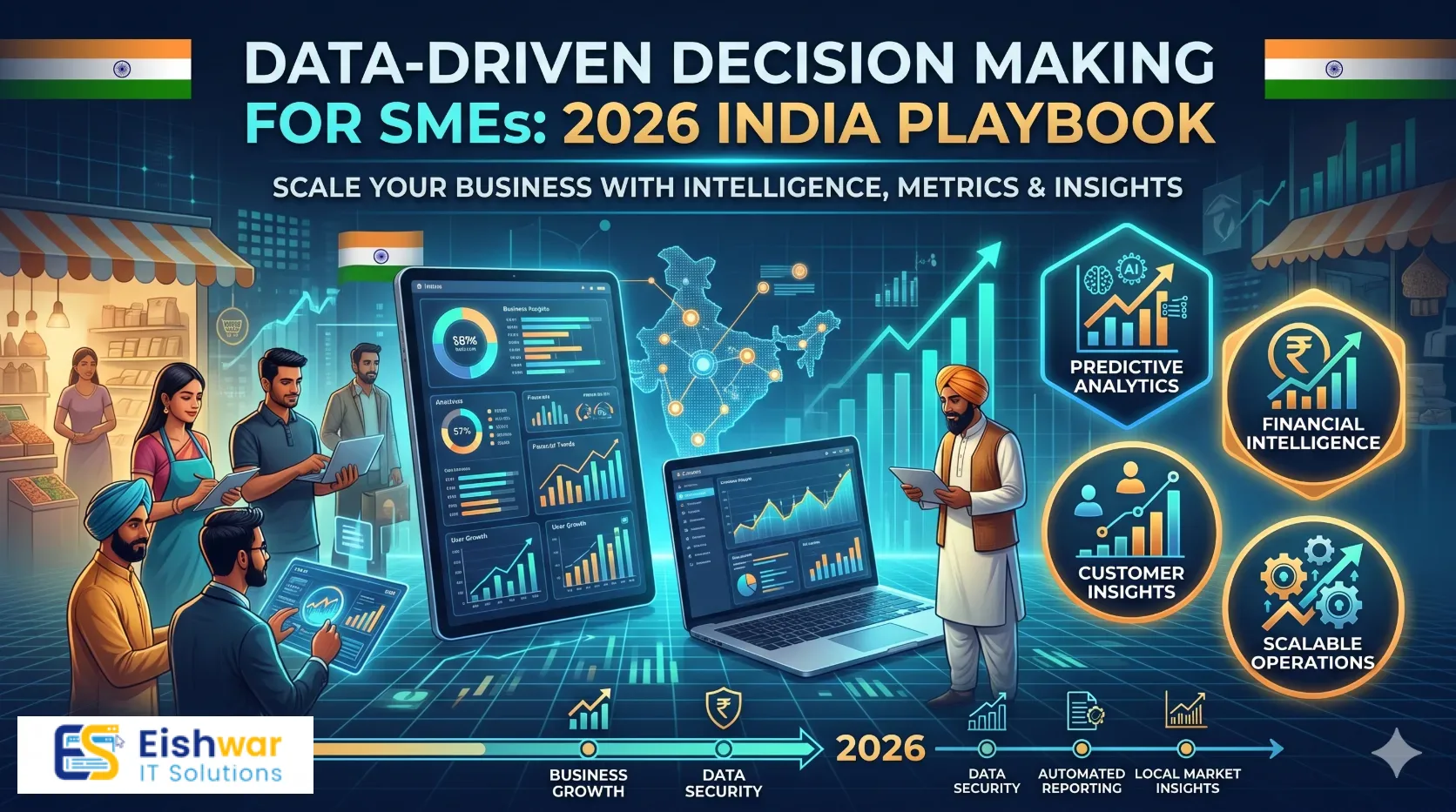
Data-Driven Decision Making for SMEs: 2026 India Playbook
Introduction
Indian SMEs are sitting on more data than ever. Every GST invoice, UPI payment, website visit, WhatsApp enquiry, and inventory movement creates a digital trail. The problem is not a lack of data. The problem is knowing what to do with it.
Many business owners still make decisions based on gut feel. That worked when markets were local and competition was slow. In 2026, it is risky. Customer expectations change fast. Ad costs rise. Margins get squeezed. One wrong decision on pricing, stock, or hiring can cost lakhs.
Data-driven decision making for SMEs is a practical way to reduce that risk. It does not require a data science team or a huge software budget. It requires a simple system: collect clean data, track a few key metrics, review them regularly, and act.
This guide is written for Indian business owners, marketers, and professionals who want to use data to grow. You will learn why it matters, how to build a data foundation, and a step-by-step framework you can start this month.
Main Section 1: Why Data-Driven Decision Making Matters for Indian SMEs
The hidden cost of guessing
When decisions are based only on intuition, small inefficiencies compound. You might overstock a slow-moving product because it sold well last festive season. You might keep spending on an ad set that looks busy but brings low-quality leads. You might offer discounts to customers who would have paid full price.
These mistakes rarely appear as one big loss. They show up as lower gross margin, blocked working capital, and missed growth. Over a year, they can quietly drain profit.
Benefits that show up on the P and L
- Better cash flow: Track receivables, payables, and inventory turnover to free up working capital.
- Smarter marketing: Know which channels bring profitable customers, not just clicks.
- Leaner operations: Spot bottlenecks in production, delivery, or support before they become expensive.
- Faster decisions: Weekly dashboards replace month-end guesswork.
- Team accountability: When numbers are visible, owners and managers align on priorities.
- Customer retention: Identify repeat buyers, at-risk accounts, and upsell opportunities.
Why 2026 is a turning point
India's digital public infrastructure has made data more accessible. UPI, GST e-invoicing, ONDC, and affordable SaaS tools mean even a 10-person business can see real-time sales, payments, and customer behaviour. AI copilots can summarise reports and flag anomalies. Cloud dashboards can be viewed on a mobile phone.
The SMEs that win in 2026 will not be the ones with the biggest data teams. They will be the ones that build a habit of using data in everyday decisions.
Main Section 2: Building Your Data Foundation Without a Data Team
You do not need a perfect data warehouse. You need a reliable minimum. Start with three questions before you touch any tool.
Start with three questions
- What decision are we trying to improve? For example, which product to promote next month.
- What data would change that decision? For example, product margin, repeat purchase rate, and stock cover.
- Who will act on it, and when? For example, the sales head every Monday morning.
If you cannot answer these, more dashboards will not help. Data only creates value when it leads to a decision.
Pick your core data sources
Most Indian SMEs already have data scattered across a few places. Common sources include:
- Accounting software such as Tally, Zoho Books, or QuickBooks for sales, expenses, and receivables.
- POS or billing software for daily transactions and product mix.
- CRM or lead sheets for enquiries, follow-ups, and conversion rates.
- Google Analytics and Search Console for website traffic and intent.
- Meta Ads, Google Ads, and WhatsApp Business for campaign performance.
- Inventory or ERP systems for stock levels, reorder points, and dead stock.
- Support tools or WhatsApp chats for complaints and service delays.
- HR and payroll systems for productivity and attrition signals.
You do not need to connect everything on day one. Pick the two or three sources that answer your most important decision.
Clean data basics
Dirty data creates false confidence. Before building reports, fix these basics:
- Use one customer name format. Avoid duplicates like Pvt Ltd, Private Limited, and Pvt. Ltd.
- Standardise dates to DD-MM-YYYY or YYYY-MM-DD. Do not mix formats.
- Tag expenses with consistent categories. Do not create new categories for every bill.
- Record lead sources in CRM. If source is blank, you cannot calculate marketing ROI.
- Separate personal and business transactions. This improves cash flow accuracy.
- Review data hygiene monthly. Assign one person to fix errors.
Affordable tools for Indian SMEs
You can start with tools you already pay for or free versions:
- Google Sheets and Looker Studio: Free, flexible, and good for one-page dashboards.
- Microsoft Power BI: Strong for teams already using Excel and Microsoft 365.
- Zoho Analytics: Connects well with Zoho CRM, Books, and Inventory.
- Metabase: Open-source option for companies with a technical resource.
- Tally integrations and connectors: Useful for accounting-led reporting.
- Excel: Still powerful for forecasting and ad-hoc analysis.
Start with a spreadsheet. Move to a dashboard tool when manual updates take more than two hours a week.
KPIs every Indian SME should track
Do not track 50 metrics. Track a balanced set of five to seven. A good starter set includes:
- Revenue growth: Month-on-month and year-on-year sales.
- Gross margin: Revenue minus direct costs. This shows true profitability.
- Customer acquisition cost: Marketing spend divided by new customers.
- Customer lifetime value: Average order value multiplied by repeat purchases.
- Cash conversion cycle: Days to collect from customers minus days to pay suppliers.
- Inventory turnover: How quickly stock sells. Low turnover ties up cash.
- Lead conversion rate: Enquiries to paying customers. A key sales health metric.
- Repeat purchase rate: Percentage of customers who buy again.
- Receivables days: How long customers take to pay. Critical for cash flow.
- Marketing ROI: Revenue generated per rupee spent on each channel.
Choose the metrics that match your current stage. A growing D2C brand may focus on acquisition cost and repeat rate. A manufacturing SME may focus on inventory turnover, order fulfilment time, and receivables.
Main Section 3: A 7-Step Implementation Framework
Use this framework to move from scattered data to confident decisions.
Step 1: Define business goals and decisions
Write down three goals for the next quarter. Examples: increase gross margin by 3 percent, reduce receivables by 10 days, or grow repeat sales by 15 percent. For each goal, list the decisions that will drive it.
Step 2: Choose five to seven KPIs
Select KPIs that directly influence your goals. Keep definitions simple and consistent. Share them with your team so everyone uses the same formula.
Step 3: Connect data sources
Export data from accounting, CRM, ads, and website analytics. If possible, automate refreshes using built-in connectors or scheduled sheet imports. Manual exports are fine for the first month, but automate what you can.
Step 4: Build a one-page dashboard
Create a single screen that shows your KPIs, trends, and targets. Use simple charts: line for trends, bar for comparison, and number cards for current values. Avoid clutter. If a metric does not drive action, remove it.
Step 5: Set a weekly data review ritual
Block 30 minutes every Monday. Review the dashboard with department heads. Ask three questions: What changed? Why did it change? What will we do this week? Document decisions and owners.
Step 6: Run small experiments
Use data to test one change at a time. For example, test a new WhatsApp follow-up message for 50 leads. Compare conversion against a control group. Small experiments reduce risk and build confidence.
Step 7: Scale what works
When an experiment improves a KPI, standardise it. Update processes, train staff, and track the impact. Then move to the next bottleneck. This creates a continuous improvement loop.
Expert Tips
- Start with one decision, not one tool. Tools are useful only when tied to a decision that matters.
- Assign a data owner. One person should be responsible for accuracy, updates, and access.
- Use mobile dashboards. Owners and sales teams can review numbers between meetings or on the road.
- Combine numbers with customer conversations. Data shows what is happening. Customers explain why.
- Train your team on data literacy. Teach basic Excel, chart reading, and KPI definitions. This reduces dependence on one analyst.
- Automate data refresh where possible. Manual reporting causes delays and errors.
- Review cash flow weekly, not monthly. Cash problems grow fast. Early warning saves businesses.
- Use AI for summaries, not blind decisions. AI can highlight trends, but a human should verify context and exceptions.
- Keep a decision log. Record what you decided, why, and the outcome. This improves judgement over time.
- Protect sensitive data. Use role-based access, strong passwords, and backups. Follow India's DPDP Act principles for customer data.
Common Mistakes
- Tracking too many metrics. A crowded dashboard hides the signal. Focus on a few KPIs.
- Ignoring data quality. Wrong data leads to wrong decisions. Clean data is a business asset.
- No action owner. Insights without accountability become interesting but useless reports.
- Buying tools before strategy. A fancy BI tool cannot fix unclear goals.
- Leaving out offline data. Walk-in sales, phone orders, and field activity still matter for many SMEs.
- Creating data silos. When sales, finance, and operations use different numbers, trust breaks down.
- Waiting for perfect data. Start with good-enough data and improve as you go.
- Not involving frontline staff. The people closest to customers often know why a metric moved.
- Confusing correlation with causation. Two metrics moving together does not mean one caused the other. Test before scaling.
- Neglecting privacy and security. Customer data is sensitive. Unauthorised sharing can damage trust and invite penalties.
Future Trends
Data-driven decision making for SMEs will become faster, cheaper, and more intuitive. Here are trends to watch in 2026 and beyond.
- AI copilots for owners: Ask questions in plain English or Hindi and get instant summaries of sales, stock, and cash flow.
- Real-time dashboards: Daily or hourly updates replace month-end reports for fast-moving businesses.
- Predictive cash flow: Tools will forecast shortfalls by combining invoices, payment history, and seasonality.
- Composable analytics: SMEs will mix and match best-of-breed tools instead of one large suite.
- Privacy by design: DPDP Act compliance will become a standard part of data projects.
- Embedded finance and analytics: Lending, payments, and insights will appear inside the tools SMEs already use.
- ONDC and DPI-driven insights: Open networks will create new benchmarks for pricing, demand, and supply.
- Industry-specific benchmarks: SMEs will compare performance against anonymised peer groups.
- Voice and local language queries: Business owners will ask questions in regional languages and receive audio summaries.
- Sustainability metrics: Energy, waste, and supply chain data will become part of mainstream SME reporting.
FAQs
What is data-driven decision making for SMEs?
It is the practice of using accurate business data to guide choices about sales, marketing, operations, hiring, and cash flow. Instead of relying only on intuition, you track key metrics, review them regularly, and act on evidence.
Do I need a data scientist or analyst?
No. Most Indian SMEs can start with a spreadsheet, a dashboard tool, and one trained team member. A part-time analyst or consultant can help later when data volume and complexity grow.
Which tools are best for Indian SMEs?
Google Sheets and Looker Studio are great free options. Zoho Analytics works well for Zoho users. Power BI is popular with Microsoft 365 teams. Tally, Zoho Books, and QuickBooks can feed accounting data into these tools.
How much does it cost to start?
You can start for free using Google Sheets and Looker Studio. Paid tools typically range from a few hundred to a few thousand rupees per month. The bigger investment is time: cleaning data and building a weekly review habit.
What KPIs should I track first?
Start with sales growth, gross margin, cash flow or receivables days, customer acquisition cost, and lead conversion rate. Add repeat purchase rate and inventory turnover if they match your business model.
How often should we review data?
Review operational KPIs weekly. Review strategic KPIs monthly or quarterly. Daily reviews are useful for cash flow, stock, and campaign performance in fast-moving businesses.
Is my business data safe?
Use strong passwords, role-based access, regular backups, and encrypted tools. Follow India's DPDP Act principles: collect only what you need, use it responsibly, and allow customers to access or delete their data where required.
Can data-driven decisions help small businesses with limited digital maturity?
Yes. Start with one decision and one data source. For example, track lead sources in a sheet and calculate conversion by channel. That single insight can improve marketing spend immediately.
Conclusion
Data-driven decision making for SMEs is not a luxury project. It is a survival and growth habit. Indian businesses already generate enough data through billing, payments, CRM, and digital marketing. The gap is in using it consistently.
Start small. Pick one business decision, choose a few KPIs, clean the data, and review it every week. Build a one-page dashboard that your team actually uses. Run experiments. Scale what works. Over time, this habit compounds into better margins, stronger cash flow, and faster growth.
The SMEs that thrive in 2026 will be the ones that combine human judgement with reliable data. You do not need perfect systems. You need a practical system that improves every month.
CTA
Ready to turn your business data into better decisions? EishwarITSolution helps Indian SMEs set up practical dashboards, integrate data sources, and train teams on data-driven decision making. Visit EishwarITSolution or contact us today to request a free consultation. Let us build your 2026 growth dashboard together.