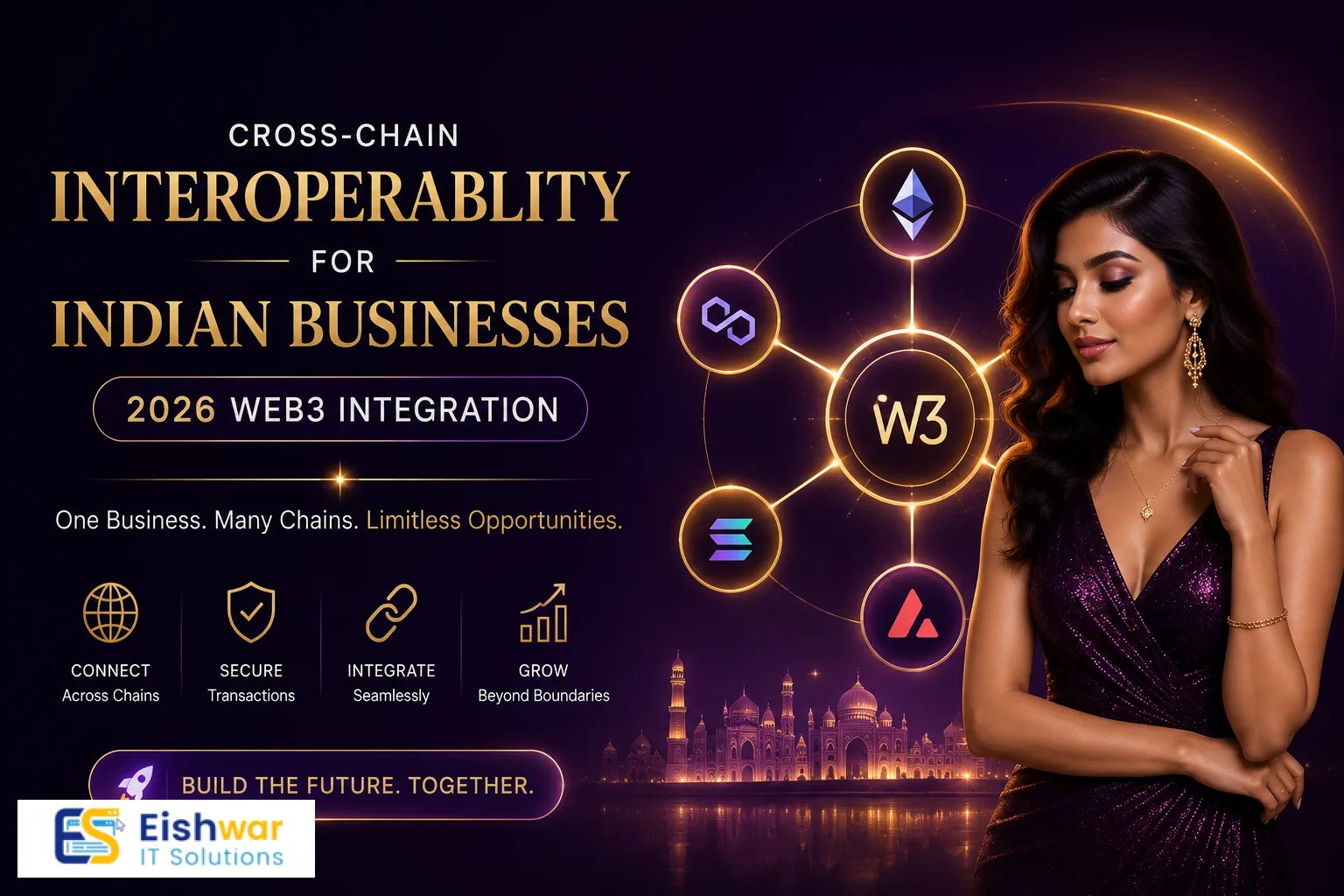
Cross-Chain Interoperability for Indian Businesses: 2026 Web3 Integration Guide
Introduction
Imagine a world where your business can move assets, data, and smart contracts across different blockchain networks as easily as sending an email. That's the promise of cross-chain interoperability. For Indian businesses eyeing Web3 in 2026, this isn't just a technical buzzword—it's a strategic advantage that can redefine how you operate, scale, and compete in a rapidly digitizing economy.
Interoperability solves one of blockchain's biggest hurdles: silos. Ethereum, Polygon, Solana, and other chains each have unique strengths—Ethereum offers robust security and a vast developer ecosystem, Polygon provides low transaction fees ideal for microtransactions, and Solana delivers high throughput for real-time applications. But without interoperability, your business is locked into one ecosystem, limiting your reach and flexibility. Cross-chain technology bridges these networks, enabling seamless value transfer and data exchange, much like how the internet connects disparate computer networks into a unified global system.
In this guide, we'll explore what cross-chain interoperability means for Indian businesses, how to implement it practically, and what the future holds. Whether you're a startup founder, a CTO, or a marketing lead, you'll walk away with actionable insights to stay ahead in 2026. We'll cover real-world examples, step-by-step strategies, and pitfalls to avoid, all tailored to the unique opportunities and challenges of the Indian market.
Main Section 1: Understanding Cross-Chain Interoperability
Cross-chain interoperability refers to the ability of different blockchain networks to communicate, share data, and transfer value without intermediaries. Think of it as the internet of blockchains—each chain remains independent but connected, allowing for a seamless flow of assets and information. This is achieved through a combination of protocols, bridges, and oracles that standardize communication across heterogeneous networks.
For Indian businesses, this means you can leverage the speed of Solana for payments, the security of Ethereum for smart contracts, and the low fees of Polygon for microtransactions—all within one workflow. For example, a fintech startup could use Solana for instant cross-border remittances, settle smart contracts on Ethereum for regulatory compliance, and issue loyalty points on Polygon to minimize costs for users. This flexibility is a game-changer in a country where digital payments are exploding, with UPI transactions surpassing 10 billion monthly in 2024.
Key components of cross-chain interoperability include:
- Cross-chain bridges: Protocols that lock assets on one chain and mint equivalent tokens on another. Example: Using a bridge to move USDT from Ethereum to Polygon. Bridges like Wormhole or Multichain handle billions in value daily, but they require careful security assessment.
- Interoperability protocols: Standards like Polkadot's XCMP (Cross-Chain Message Passing) or Cosmos IBC (Inter-Blockchain Communication) that enable native communication between chains. These protocols are built into the blockchain's architecture, reducing reliance on third-party bridges.
- Oracles: Services like Chainlink that feed off-chain data into multiple chains, enabling cross-chain data sharing. For instance, an oracle can provide price feeds for a DeFi protocol operating across Ethereum and Avalanche.
For a deeper dive into blockchain basics, check our guide on Blockchain Technology: The Future of Digital Security.
Main Section 2: Why Indian Businesses Need Cross-Chain Interoperability in 2026
The Indian Web3 ecosystem is booming. From DeFi startups in Bangalore to NFT marketplaces in Mumbai, businesses are adopting blockchain at an unprecedented rate. According to a 2025 NASSCOM report, India has over 1,000 Web3 startups, with funding exceeding $3 billion. But fragmentation remains a challenge—users and assets are scattered across multiple chains, creating friction and inefficiency.
Here's why cross-chain interoperability is a game-changer for Indian businesses:
- Cost efficiency: Move transactions to lower-cost chains without losing access to high-value assets. For example, a supply chain company can settle payments on Polygon (where fees are fractions of a cent) while recording provenance on Ethereum for immutability. This can reduce operational costs by up to 90% compared to using Ethereum alone.
- User experience: Your customers don't care about blockchain silos. Interoperability allows them to interact with your dApp using any token from any chain, reducing friction. Imagine a DeFi lending platform where a user can deposit USDC from Ethereum, borrow against it on Solana, and repay with MATIC from Polygon—all in one interface.
- Liquidity aggregation: Access deeper liquidity pools across multiple chains, enabling better rates for trading, lending, or staking. For Indian crypto exchanges, this means offering competitive spreads by tapping into liquidity from Uniswap (Ethereum), QuickSwap (Polygon), and Serum (Solana) simultaneously.
- Regulatory flexibility: As Indian regulations evolve, interoperability lets you adapt by moving operations to compliant chains without rebuilding your entire infrastructure. For instance, if a particular chain becomes regulated under Indian law, you can migrate assets to a more compliant chain seamlessly.
Consider the example of an Indian e-commerce platform accepting crypto payments. With cross-chain interoperability, customers can pay with ETH, MATIC, or SOL directly, and the platform can auto-convert to stablecoins on a preferred chain (e.g., USDC on Polygon) to avoid volatility. This reduces checkout abandonment and expands the customer base to include crypto-savvy users.
Practical tip: Start by identifying your most common user transactions and map them to the cheapest chain. For Indian users, Polygon is often the best choice due to its low fees and strong local developer community.
Main Section 3: Practical Implementation Strategies for Indian Businesses
Implementing cross-chain interoperability doesn't require a PhD in blockchain. Here are actionable steps for Indian businesses, complete with examples and tools:
1. Choose the Right Interoperability Protocol
Evaluate protocols based on security, speed, and ecosystem support. Polkadot offers shared security through parachains, making it ideal for high-value applications. Cosmos focuses on sovereign chains with IBC, perfect for businesses that want full control over their chain. For Indian businesses, consider protocols with strong Asian developer communities—Polkadot has a growing presence in India, with events like Polkadot India Meetups.
Example: A real estate tokenization platform could use Polkadot to create a parachain for property titles, ensuring interoperability with Ethereum for liquidity and Solana for fast transactions.
2. Leverage Cross-Chain Bridges Securely
Bridges are frequent targets for hacks—over $2 billion was lost in bridge exploits in 2022 alone. Use audited bridges like Wormhole (audited by Trail of Bits) or Multichain (audited by SlowMist), and implement multi-sig wallets for large transfers. Always test with small amounts first. For Indian businesses, consider using Axelar, which offers a decentralized bridge with strong security guarantees.
Practical tip: Use tools like DefiLlama to track bridge TVL and audit history. Avoid bridges with low liquidity (<$10 million) or unverified audits. For daily operations, set up alerts for unusual bridge activity.
3. Build Multi-Chain dApps
Instead of deploying on a single chain, build dApps that operate across multiple chains using interoperability layers. For example, a DeFi lending platform can accept deposits on Ethereum and offer loans on Avalanche, using Chainlink CCIP (Cross-Chain Interoperability Protocol) for secure messaging.
Case study: Aave, a leading DeFi protocol, uses cross-chain bridges to allow users to deposit assets on one chain and borrow on another, aggregating liquidity across Ethereum, Polygon, and Avalanche. Indian startups can replicate this model for localized use cases like micro-lending or invoice financing.
4. Partner with Interoperability Experts
Collaborate with blockchain consultancies that specialize in cross-chain solutions. EishwarITSolution can help you design and deploy multi-chain architecture tailored to your business needs, from initial assessment to ongoing maintenance. Our team has experience with over 50 cross-chain projects, including supply chain tracking and NFT marketplaces.
For more on building secure Web3 apps, read our guide on Zero-Knowledge Proofs in Web Authentication: 2026 Guide.
Expert Tips
- Start with a single bridge: Don't try to connect to all chains at once. Pick one or two chains that align with your target audience (e.g., Polygon for Indian users due to low fees and strong local community). Gradually expand as you gain confidence.
- Monitor bridge security: Use tools like DefiLlama to track bridge TVL and audit history. Avoid bridges with low liquidity or unverified audits. Set up automated alerts for any bridge downtime or anomalies.
- Think about user onboarding: Simplify the cross-chain experience for non-technical users. Provide clear instructions or one-click bridging widgets like those from Socket or LI.FI. For example, integrate a widget that automatically detects the user's wallet and suggests the cheapest bridge.
- Stay updated on regulation: Indian crypto regulations are evolving, with the 2025 Crypto Bill proposing a licensing framework. Cross-chain solutions should be flexible to adapt to new compliance requirements, such as KYC/AML on specific chains.
- Optimize for gas costs: Different chains have different fee structures. Use gas estimation tools like GasNow or Etherscan to choose the most cost-effective chain for each transaction. For high-volume operations, consider batch processing on Layer-2 solutions.
Common Mistakes
- Ignoring security: Using unaudited bridges can lead to loss of funds. Always prioritize security over speed. Example: The 2022 Wormhole hack ($325 million) was due to a signature verification bug. Use only bridges with multiple audits and bug bounty programs.
- Overcomplicating architecture: Building multi-chain solutions that are too complex can confuse users and increase development time. Keep it simple. Start with a single cross-chain use case (e.g., token transfer) before adding more.
- Neglecting gas costs: Different chains have different fee structures. Factor in gas costs when designing cross-chain workflows. For example, moving assets from Ethereum to Polygon might save on transaction fees, but the bridge fee itself could be high during network congestion.
- Assuming all chains are equal: Each chain has unique features and limitations. Choose chains that complement your use case, not just popular ones. For instance, Solana is great for high-frequency trading but has experienced outages; Polygon is reliable but has lower security than Ethereum.
- Failing to test on testnets: Always test cross-chain transactions on testnets like Goerli or Mumbai before deploying to mainnet. This helps identify issues with bridge latency, token compatibility, and user experience.
Future Trends
By 2026, cross-chain interoperability will become the standard for Web3 applications. Here's what to expect:
- Native interoperability: Blockchains like Polkadot and Cosmos are building interoperability directly into their protocols, reducing reliance on third-party bridges. This will improve security and reduce the risk of hacks. Expect more chains to adopt IBC or XCMP as native features.
- Cross-chain DeFi: Expect more DeFi protocols that aggregate liquidity across chains, offering better rates and lower slippage. For example, a single platform could let you trade on Uniswap (Ethereum), QuickSwap (Polygon), and Raydium (Solana) with one click.
- Interoperable NFTs: NFTs that can move between chains will unlock new use cases for gaming, art, and loyalty programs in India. Imagine a cricket-themed NFT that can be used in a game on Polygon, traded on an Ethereum marketplace, and redeemed for merchandise on Solana.
- Regulatory sandboxes: Indian regulators may create frameworks that encourage interoperability while ensuring compliance, fostering innovation. The 2026 National Blockchain Framework is expected to include guidelines for cross-chain data sharing, particularly for supply chain and healthcare.
- AI-driven interoperability: Artificial intelligence will optimize cross-chain routing, automatically selecting the cheapest and fastest bridge for each transaction. This will reduce user friction and make multi-chain experiences seamless.
Stay ahead by exploring Layer-2 Scaling Solutions for Indian Web3 Apps.
FAQs
What is cross-chain interoperability?
Cross-chain interoperability is the ability of different blockchain networks to communicate and share data or assets without intermediaries. It enables seamless movement of tokens, NFTs, and data across chains, much like how email works across different providers. For example, you can send USDT from Ethereum to Polygon using a bridge, and the recipient receives it as a Polygon-based token.
Why is cross-chain interoperability important for Indian businesses?
It reduces costs, improves user experience, aggregates liquidity, and offers regulatory flexibility. Indian businesses can leverage multiple chains' strengths without being locked into one ecosystem. For instance, a fintech startup can use Solana for fast payments, Ethereum for smart contracts, and Polygon for low-cost microtransactions, all while maintaining a single user interface.
What are cross-chain bridges and are they safe?
Cross-chain bridges lock assets on one chain and mint equivalent tokens on another. While useful, they can be vulnerable to hacks—over $2 billion was lost in bridge exploits in 2022. Always use audited bridges with high liquidity and multi-sig security. Examples of secure bridges include Wormhole (audited by Trail of Bits) and Axelar (decentralized with multiple validators). Test with small amounts first.
How can I implement cross-chain interoperability in my business?
Start by selecting a protocol (e.g., Polkadot or Cosmos), use secure bridges, build multi-chain dApps, and partner with experts like EishwarITSolution for tailored solutions. Begin with a single use case, such as cross-chain token transfers, and gradually expand. Use tools like Chainlink CCIP for secure messaging and DefiLlama for bridge monitoring.
What chains should Indian businesses focus on for interoperability?
Polygon is popular for low fees and Indian developer community. Ethereum offers security, Solana for speed, and Polkadot for native interoperability. Choose based on your use case and audience. For example, if your target users are Indian retail customers, Polygon's low fees make it ideal. For enterprise-grade applications, consider Ethereum or Polkadot.
Will Indian regulations affect cross-chain interoperability?
Yes, evolving regulations may require compliance with specific chains. Interoperability allows you to adapt by moving operations to compliant chains without rebuilding your infrastructure. For instance, if the Indian government mandates that all crypto transactions must occur on a regulated chain, you can migrate assets via bridges while keeping your dApp logic intact.
What are the costs associated with cross-chain transactions?
Costs include bridge fees (typically 0.1% to 1% of the transaction value), gas fees on both source and destination chains, and potential slippage. For example, moving $1,000 USDT from Ethereum to Polygon might cost $5 in bridge fees plus $10 in Ethereum gas fees. Use tools like GasNow to estimate costs before transacting.
Conclusion
Cross-chain interoperability is not just a technical upgrade—it's a strategic necessity for Indian businesses embracing Web3 in 2026. By breaking down blockchain silos, you can unlock cost savings, better user experiences, and new revenue streams. The Indian market, with its growing crypto adoption and regulatory evolution, is uniquely positioned to benefit from multi-chain solutions.
Start small, prioritize security, and stay informed about regulatory changes. With the right approach, your business can thrive in a multi-chain world, offering seamless experiences that rival traditional web applications. Remember, the goal is not to use every chain, but to use the right chains for your specific needs.
CTA
Ready to take your business cross-chain? Contact EishwarITSolution today for a free consultation on integrating cross-chain interoperability into your Web3 strategy. Our experts will help you assess your needs, choose the right protocols, and build a secure, scalable multi-chain architecture. Let's build the future of Indian Web solutions together.