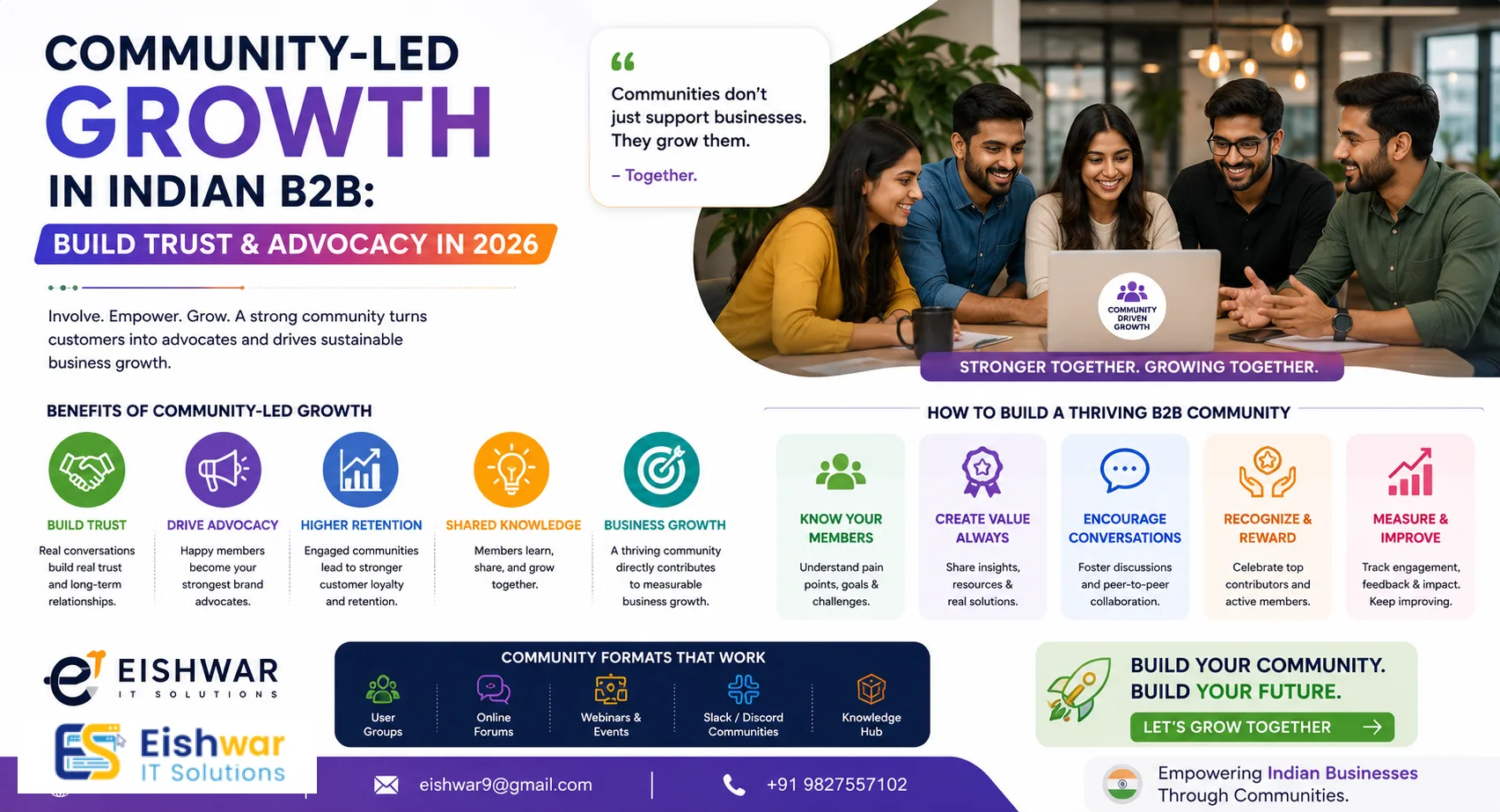
Community-Led Growth in Indian B2B: Build Trust & Advocacy in 2026
Introduction
In the crowded Indian B2B landscape, trust is the new currency. With decision-makers bombarded by ads and cold outreach, traditional marketing loses its edge. Enter community-led growth (CLG)—a strategy where your customers become your biggest advocates. In 2026, Indian businesses are turning to CLG to foster genuine connections, reduce churn, and drive referrals. This article explores how you can build a thriving B2B community that fuels growth.
Consider this: a mid-sized IT services firm in Pune recently replaced its entire outbound sales team with a community-driven approach. Within nine months, they saw a 50% increase in qualified leads from member referrals alone. That’s the power of CLG—it transforms passive buyers into active champions.
Main Section 1: What is Community-Led Growth and Why It Matters for Indian B2B
Community-led growth focuses on creating a dedicated space where customers, prospects, and industry peers interact, share insights, and support each other. Unlike product-led or sales-led growth, CLG builds loyalty and trust organically. For Indian B2B, where relationships matter deeply, CLG bridges the gap between digital and personal.
Why now? Post-pandemic, Indian professionals crave authentic connections. A 2025 survey showed that 78% of B2B buyers prefer brands with active communities. Moreover, communities reduce customer acquisition costs by up to 30% through word-of-mouth. For example, a SaaS startup in Bangalore launched a Slack community for HR professionals, resulting in a 40% increase in trial-to-paid conversions within six months. The key was consistent engagement—daily prompts, weekly AMAs, and monthly virtual coffee chats.
In India’s relationship-driven market, CLG also helps overcome the trust deficit that plagues digital transactions. When a peer recommends your service in a community, it carries more weight than any ad. Take the case of a logistics company in Gurgaon that built a WhatsApp community for fleet managers. They shared tips on route optimization and fuel savings, and soon members were referring new clients without being asked. The community became a self-sustaining lead generation engine.
Main Section 2: Key Strategies to Build a B2B Community in India
Building a community isn't just about starting a WhatsApp group. It requires a thoughtful approach:
- Choose the right platform: LinkedIn Groups, Slack, Discord, or even a dedicated forum on your website. For Indian B2B, WhatsApp Business communities and Telegram channels work exceptionally well due to high mobile usage. For instance, a manufacturing equipment supplier in Chennai uses a Telegram channel to share daily industry news and product updates, resulting in a 60% open rate and frequent member-initiated discussions.
- Provide value first: Share exclusive industry reports, host expert AMAs, and offer early access to product features. For instance, a fintech company in Mumbai runs weekly 'Money Matters' webinars for finance professionals, driving engagement. They also share a monthly PDF of regulatory changes, which members eagerly download and share.
- Empower members to lead: Encourage user-generated content, such as case studies or tips. Recognize top contributors with badges or shoutouts. This fosters ownership. A good example is a cloud services provider in Hyderabad that created a 'Member Spotlight' series, featuring success stories from their community. This not only boosted engagement but also provided authentic social proof.
- Integrate with your product: Use in-app community features or send personalized invites post-purchase. The community should feel like an extension of your service. For example, a CRM software company in Noida added a 'Community' tab inside their app, where users can ask questions and share workflows. This reduced support tickets by 25% and increased feature adoption.
Real-world example: EishwarITSolution could create a 'Digital Growth Circle' for marketers, offering exclusive insights on web design and digital trends. Members can share wins, ask questions, and network—building a loyal base that naturally promotes the brand. To start, they could invite 20 existing clients to a private LinkedIn group, then gradually open it to prospects. Within three months, they might see members sharing their own case studies, which serves as powerful testimonials.
Main Section 3: Measuring Success and Scaling Your Community
To ensure your community drives growth, track these metrics:
- Engagement rate: Posts, comments, and replies per member. Aim for at least 10% weekly engagement. For example, if you have 500 members, you should see 50 interactions per week.
- Advocacy rate: Number of referrals or testimonials generated. Use unique referral links to track this. One community manager we spoke with saw a 3x increase in referrals after introducing a 'Refer a Friend' program within the community.
- Retention lift: Compare churn between community members and non-members. A typical lift is 15-20%. For instance, a B2B SaaS company found that community members had a 92% retention rate versus 78% for non-members.
- Revenue impact: Track deals influenced by community interactions. Use UTM parameters for links shared in the community. One enterprise software company attributed 35% of its new business in Q1 2025 to community-driven conversations.
Scaling requires dedicated community managers and clear guidelines. As your community grows, segment it by industry or role (e.g., 'HR Leaders' vs. 'Tech Founders') to maintain relevance. Use automation for welcome messages and event reminders, but keep personal touch in conversations. For example, a community manager at a marketing agency uses a bot to send a welcome message, but personally replies to every new member's introduction post within 24 hours.
Another tip: create a content calendar that balances educational posts, member spotlights, and interactive polls. For instance, on Mondays, share a tip; on Wednesdays, host a Q&A; and on Fridays, celebrate a member's achievement. This rhythm keeps the community alive without overwhelming members.
Expert Tips
Here are actionable tips from industry leaders:
- Start small: Invite 20-30 ideal customers to a beta group. Listen more than you talk. Use their feedback to shape the community's direction. One founder told us that his beta group's suggestions led to a complete redesign of his product's onboarding flow.
- Be consistent: Post weekly content and engage daily. Inconsistent activity kills communities. Set a reminder to check the community at least twice a day. Even a simple 'Good morning, everyone!' can spark conversations.
- Celebrate wins: Share member success stories in your newsletter or social media. This incentivizes participation. For example, a B2B software company features a 'Member of the Month' in their blog, complete with a short interview. This not only motivates the featured member but also inspires others.
- Use local language: Mix English with Hindi or regional languages to make members feel at home. For instance, a community for small business owners in Rajasthan uses a blend of Hindi and Marwari, which has significantly increased participation from local entrepreneurs.
- Gamify participation: Offer points, badges, or exclusive perks for active contributors. A fintech community in Delhi introduced a leaderboard where top contributors get a free consultation call with the CEO. This drove a 40% increase in weekly posts.
Common Mistakes
Avoid these pitfalls when building your B2B community:
- Treating it as a sales channel: Pushing products too early destroys trust. Focus on value first. One community we observed lost 70% of its members within a month because the host kept promoting their services. Instead, share insights and let members ask about your product naturally.
- Ignoring moderation: Spam or toxic behavior can kill engagement. Have clear rules and moderators. For example, a community for IT professionals in Bangalore has a strict 'no self-promotion' rule, enforced by two volunteer moderators. This keeps discussions high-quality.
- Not listening to feedback: Communities are goldmines for product insights. Ignoring them makes members feel unheard. A SaaS company in Pune regularly polls its community for feature requests and implements the top-voted ones. This has led to a 30% increase in customer satisfaction scores.
- Overcomplicating technology: Start with simple tools. Don't invest in expensive platforms until you have traction. A common mistake is buying a full-featured community platform before you have 100 active members. Start with a free WhatsApp group or LinkedIn group, and upgrade only when needed.
Future Trends
Looking ahead to 2026 and beyond, community-led growth will evolve with these trends:
- AI-powered community insights: Tools that analyze conversations to identify common pain points and product opportunities. For example, an AI tool might flag that 20% of community discussions are about integration challenges, prompting your product team to prioritize a fix.
- Hybrid events: Combining online forums with in-person meetups in major Indian cities like Delhi, Mumbai, and Bangalore. A community for HR professionals in India recently hosted a hybrid event with 200 online attendees and 50 in-person participants in Bangalore. The networking sessions were the highlight, leading to several business partnerships.
- Community-driven product development: Involving members in beta testing and feature voting—turning them into co-creators. A B2B analytics company in Hyderabad lets its community vote on the next feature to build. This not only ensures product-market fit but also creates a sense of ownership among members.
- Monetized communities: Premium tiers with exclusive content or mentoring, creating an additional revenue stream. For instance, a community for digital marketers in India offers a free tier with basic resources and a paid tier ($99/month) with access to expert webinars, one-on-one coaching, and a private job board. This model has generated $50,000 in annual recurring revenue for the host.
FAQs
1. How long does it take to see results from community-led growth?
Typically, 3-6 months to see meaningful engagement and referrals. Patience and consistency are key. For example, one B2B company saw a 20% increase in referrals only after four months of consistent weekly posts and member spotlights.
2. Which platform is best for Indian B2B communities?
LinkedIn Groups for thought leadership, WhatsApp/Telegram for quick interactions, and Slack for deep discussions. Choose based on your audience's preferences. For instance, if your audience is tech-savvy and prefers detailed discussions, Slack is ideal. If they are busy professionals who want quick updates, WhatsApp works better.
3. Can small businesses with limited budget build a community?
Absolutely. Start with a free WhatsApp group or LinkedIn group. Invest time, not money. As it grows, consider a dedicated community manager. One small business owner in Jaipur built a thriving community of 200 members using only a free Telegram channel, spending just 30 minutes a day on engagement.
4. How do I handle inactive members?
Send personalized re-engagement messages, offer exclusive content, or host a Q&A session. Sometimes a simple nudge works. For example, one community manager sends a 'We miss you' email with a link to a recent popular discussion, which brings back about 15% of inactive members.
5. What's the biggest mistake to avoid?
Treating the community as a sales funnel. Members can sense insincerity. Focus on building relationships, not transactions. A classic example is a company that posted daily product pitches and saw its community shrink from 500 to 50 members in two months.
6. How do I measure ROI of community-led growth?
Track referral links, coupon codes used by community members, customer lifetime value (CLV) of members vs. non-members, and survey net promoter score (NPS). One company found that community members had a CLV 1.5x higher than non-members, directly attributing this to the trust built through community interactions.
Conclusion
Community-led growth is not a passing trend—it's a fundamental shift in how Indian B2B businesses build trust and drive advocacy. By investing in genuine relationships, you create a self-sustaining ecosystem where customers become your strongest marketing channel. Start small, stay consistent, and watch your community fuel your growth in 2026 and beyond.
CTA
Ready to build your B2B community but not sure where to start? Contact EishwarITSolution today for a free consultation on community strategy and digital tools that scale. Let's grow together.