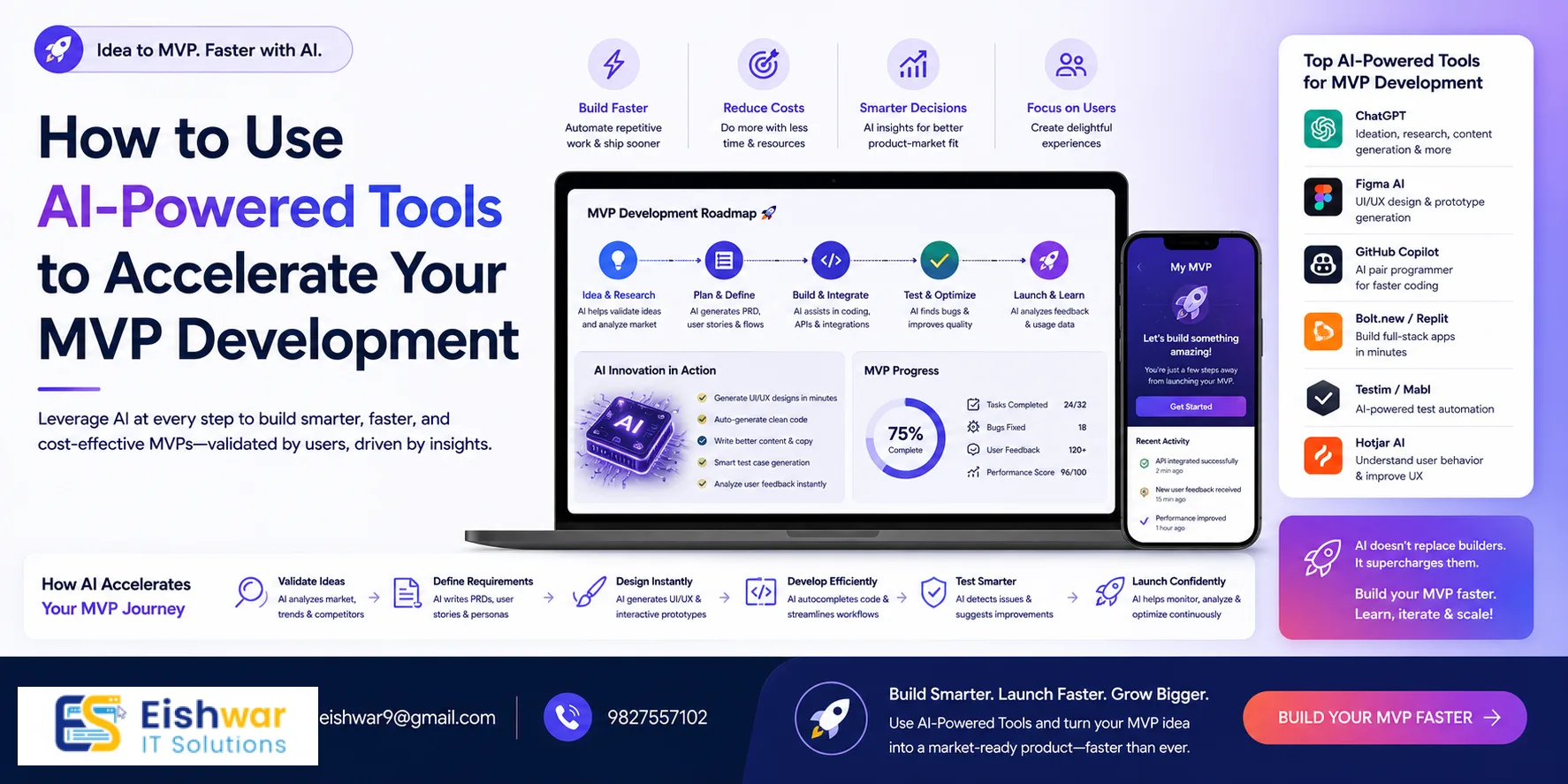
How to Use AI-Powered Tools to Accelerate Your MVP Development in India
Introduction
In the fast-paced world of Indian startups, speed is everything. The quicker you can validate your idea, the sooner you can pivot, scale, or secure funding. But building a Minimum Viable Product (MVP) from scratch is time-consuming and expensive. Enter AI-powered tools. In 2026, artificial intelligence is no longer a luxury—it's a necessity for lean startups. Whether you're a solo founder in Bangalore or a small team in Mumbai, AI can help you design, code, test, and launch your MVP in weeks instead of months. In this guide, we'll explore how to leverage AI to accelerate your MVP development, reduce costs, and outpace competitors. We'll cover practical examples, tool recommendations, and step-by-step workflows tailored to the Indian startup ecosystem, including considerations for regional languages, budget constraints, and device diversity.
Main Section 1: Why AI Is a Game-Changer for MVP Development
Building an MVP traditionally involves multiple iterations, manual coding, and extensive user testing. AI flips the script. It automates repetitive tasks, generates code snippets, and even predicts user behavior. For Indian startups operating on tight budgets, AI tools like GitHub Copilot, ChatGPT, and Figma AI can cut development time by up to 40%. They also reduce the need for large teams. With AI, a two-person team can achieve what a five-person team used to. Plus, AI-driven analytics help you understand user feedback faster, so you can iterate without wasting resources. For example, a fintech startup in Pune used ChatGPT to generate customer pain points for a budgeting app, reducing research time from two weeks to three days. Similarly, an edtech team in Hyderabad employed GitHub Copilot to auto-generate API endpoints, saving 30% of development time. The key advantage is that AI handles the grunt work, allowing founders to focus on strategy and user experience.
Main Section 2: Top AI Tools for Each Stage of MVP Development
2.1 Ideation and Validation
Before writing a single line of code, you need to validate your idea. AI tools like ChatGPT and Jasper can help you generate survey questions, analyze competitor data, and even simulate customer interviews. Use them to refine your value proposition. For example, prompt ChatGPT with: 'List top 5 pain points of small business owners in India regarding inventory management.' The insights can shape your MVP features. Additionally, tools like SurveyMonkey Genius use AI to suggest question types and predict response rates. For Indian startups targeting regional markets, you can ask ChatGPT to generate prompts in Hindi or Tamil, then cross-check with native speakers. A practical tip: create a 'validation checklist' with AI—list assumptions, ask AI to challenge them, and prioritize features based on frequency of pain points mentioned.
2.2 Design and Prototyping
Design tools like Figma now have AI plugins that generate UI components from text descriptions. Describe your landing page, and AI creates a wireframe. Tools like Uizard turn sketches into digital prototypes. This is a huge time-saver for non-designers. You can also use AI to generate color palettes and typography that resonate with Indian audiences. For instance, AI can suggest color schemes based on regional festivals (e.g., bright colors for Diwali-themed apps) or cultural preferences. A startup in Delhi used Figma AI to create a mobile app prototype for a local grocery delivery service in just two days, compared to the usual two weeks. They iterated on the design by feeding AI feedback from user testing, adjusting button sizes for low-end smartphones. Remember to test prototypes on devices with 4-inch screens, common in rural India, to ensure accessibility.
2.3 Development and Coding
GitHub Copilot, Amazon CodeWhisperer, and Tabnine are AI pair programmers. They suggest code as you type, reducing bugs and speeding up development. For Indian startups using Python, JavaScript, or React, these tools can handle boilerplate code. You can also use AI to generate API endpoints or database schemas. For example, prompt Copilot: 'Create a REST API for user authentication in Node.js.' Additionally, tools like Replit Ghostwriter can debug code in real time. A real-world example: a healthtech startup in Mumbai used CodeWhisperer to generate HIPAA-compliant code for patient data handling, reducing manual review time by 50%. However, always audit AI-generated code for security vulnerabilities, especially when handling sensitive data like Aadhaar numbers or payment information. Use static analysis tools like SonarQube to catch issues early.
2.4 Testing and Quality Assurance
AI testing tools like Testim and Applitools automate regression testing. They detect visual bugs and performance issues. For Indian startups targeting multiple devices, AI can simulate thousands of user scenarios in minutes. This ensures your MVP works smoothly on low-end smartphones common in India. For example, a logistics startup in Chennai used Testim to test their app on 200+ device configurations, including older Android versions, catching 15 critical bugs before launch. AI can also simulate network conditions like 3G or intermittent connectivity, which is crucial for rural users. Tools like BrowserStack integrate AI to prioritize test cases based on usage patterns. A practical tip: set up automated testing pipelines with AI tools to run after every code commit, reducing manual QA time by 70%.
2.5 User Feedback and Iteration
Tools like Hotjar and FullStory use AI to analyze user sessions. They highlight drop-off points and heatmaps. You can also use AI sentiment analysis on customer reviews or support tickets. This helps you prioritize features that matter most to your users. For instance, an e-commerce startup in Bengaluru used FullStory's AI to identify that users were abandoning the checkout page due to a confusing 'OTP verification' step. They simplified the flow, resulting in a 20% increase in conversions. Additionally, AI tools like Qualtrics can analyze open-ended survey responses in regional languages, extracting themes and emotions. Remember to set up feedback loops: collect data, analyze with AI, implement changes, and re-test within a week. This rapid iteration cycle is key to MVP success.
Main Section 3: Practical Steps to Integrate AI into Your MVP Workflow
Start small. Pick one stage—say, design or coding—and adopt one AI tool. Train your team on it. For example, use ChatGPT for brainstorming and GitHub Copilot for coding. Monitor time saved and quality improvements. Gradually expand to other stages. Remember, AI is a helper, not a replacement. Always review AI-generated code for security vulnerabilities. Also, consider data privacy laws in India. Use AI tools that comply with local regulations, such as those that store data within India or offer GDPR-like protections. A step-by-step approach: Week 1-2: Use AI for ideation and validation. Week 3-4: AI-assisted design and prototyping. Week 5-8: AI-powered coding and testing. Week 9-10: AI-driven user feedback analysis. This phased integration minimizes disruption and allows your team to adapt. For example, a SaaS startup in Gurgaon followed this plan and launched their MVP in 8 weeks, 40% faster than their previous project.
Expert Tips
- Start with a clear problem statement: AI works best when you have a defined goal. Don't ask vague questions. For instance, instead of 'How to improve my app?', ask 'What are the top 3 reasons users drop off after signup?'
- Combine multiple AI tools: Use ChatGPT for research, Copilot for coding, and Figma AI for design—they complement each other. Integration can be seamless with APIs or manual workflows.
- Iterate based on real data: AI analytics are only as good as the data you feed. Collect user feedback from day one. Use tools like Google Analytics with AI add-ons to track behavior.
- Keep costs low: Many AI tools have free tiers. Use them until you need advanced features. For example, GitHub Copilot is free for students and open-source projects.
- Focus on core functionality: AI can generate lots of features, but your MVP should solve one problem well. Use AI to identify the 'must-have' features via user surveys.
- Localize for Indian users: Train AI on Indian datasets or use region-specific models. For instance, use AI translation tools for Hindi, Tamil, or Telugu, but always have a native speaker review.
Common Mistakes
- Over-relying on AI: Don't let AI make all decisions. Human intuition is still crucial. For example, AI might suggest features that don't align with your brand voice.
- Ignoring security: AI-generated code can have vulnerabilities. Always audit. Use tools like Snyk to scan for open-source vulnerabilities.
- Skipping user testing: AI can't replace real user feedback. Test with actual users, especially from your target demographic in India.
- Using too many tools: Stick to 2-3 tools initially. Too many can overwhelm your team and increase costs.
- Neglecting localization: AI tools trained on global data may miss cultural nuances. Customize for Indian users, such as using local idioms or payment methods like UPI.
- Ignoring data privacy: Ensure AI tools comply with India's Digital Personal Data Protection Act. Avoid sharing sensitive user data with unverified platforms.
Future Trends
By 2027, AI will be embedded in every stage of MVP development. Expect AI to generate entire MVPs from a single prompt. No-code AI platforms will allow non-technical founders to build functional apps. Also, AI-driven market validation will become standard. Indian startups that adopt AI early will have a competitive edge in speed and cost. The future is lean, fast, and AI-powered. For example, platforms like Bubble are integrating AI to generate backend logic, while tools like Vercel's AI can deploy apps automatically. Additionally, AI will enable hyper-personalization for Indian users, such as dynamic pricing based on location or language preferences. Startups that leverage these trends will be able to launch MVPs in days, not weeks.
FAQs
- What is an MVP and why use AI for it? An MVP is a basic version of your product to test market demand. AI accelerates development by automating tasks, generating code, and analyzing feedback. For Indian startups, this means faster validation and lower costs.
- Can AI replace developers? No, AI assists developers by handling repetitive tasks. Human oversight is essential for complex logic and creative decisions. In India, where developer talent is scarce, AI helps small teams do more.
- Which AI tools are best for Indian startups on a budget? Start with free tools like ChatGPT (for ideation), GitHub Copilot (free for students and open-source), and Figma AI (free tier). Also consider open-source alternatives like Hugging Face for custom models.
- How do I ensure my MVP is secure when using AI? Regularly review AI-generated code, use static analysis tools like SonarQube, and follow secure coding practices. Consider hiring a security consultant for critical apps handling sensitive data like Aadhaar or payments.
- Can AI help with localization for Indian languages? Yes, tools like Google Cloud Translation AI and ChatGPT can generate content in Hindi, Tamil, and other regional languages. But always have a native speaker review for cultural accuracy and idiomatic expressions.
- How long does it take to build an MVP with AI? Depending on complexity, 2-6 weeks. AI can reduce traditional timelines by 30-50%. For example, a simple e-commerce MVP might take 3 weeks with AI, compared to 6 weeks manually.
- What if my AI tool generates incorrect code? Always test thoroughly. Use version control (e.g., Git) and rollback if needed. AI is a helper, not a final authority. Implement code reviews and automated tests to catch errors early.
- How do I choose the right AI tool for my startup? Evaluate based on your stage: ideation (ChatGPT), design (Figma AI), coding (Copilot), testing (Testim), or analytics (Hotjar). Start with free trials and measure time saved.
Conclusion
AI-powered tools are transforming MVP development for Indian startups. They reduce costs, speed up iterations, and help you launch faster. By integrating AI into your workflow, you can validate ideas with fewer resources and outpace competitors. Start small, experiment, and scale. The future of startup success in India belongs to those who embrace AI smartly. Remember to balance AI automation with human oversight, prioritize security and localization, and iterate based on real user feedback. With the right approach, your MVP can go from concept to launch in record time.
CTA
Ready to build your AI-accelerated MVP? Contact EishwarITSolution today for expert guidance on leveraging AI for your startup web solution. Let's turn your idea into reality—fast. Our team specializes in integrating AI tools into MVP workflows, ensuring cost-effective and secure development tailored to Indian markets.