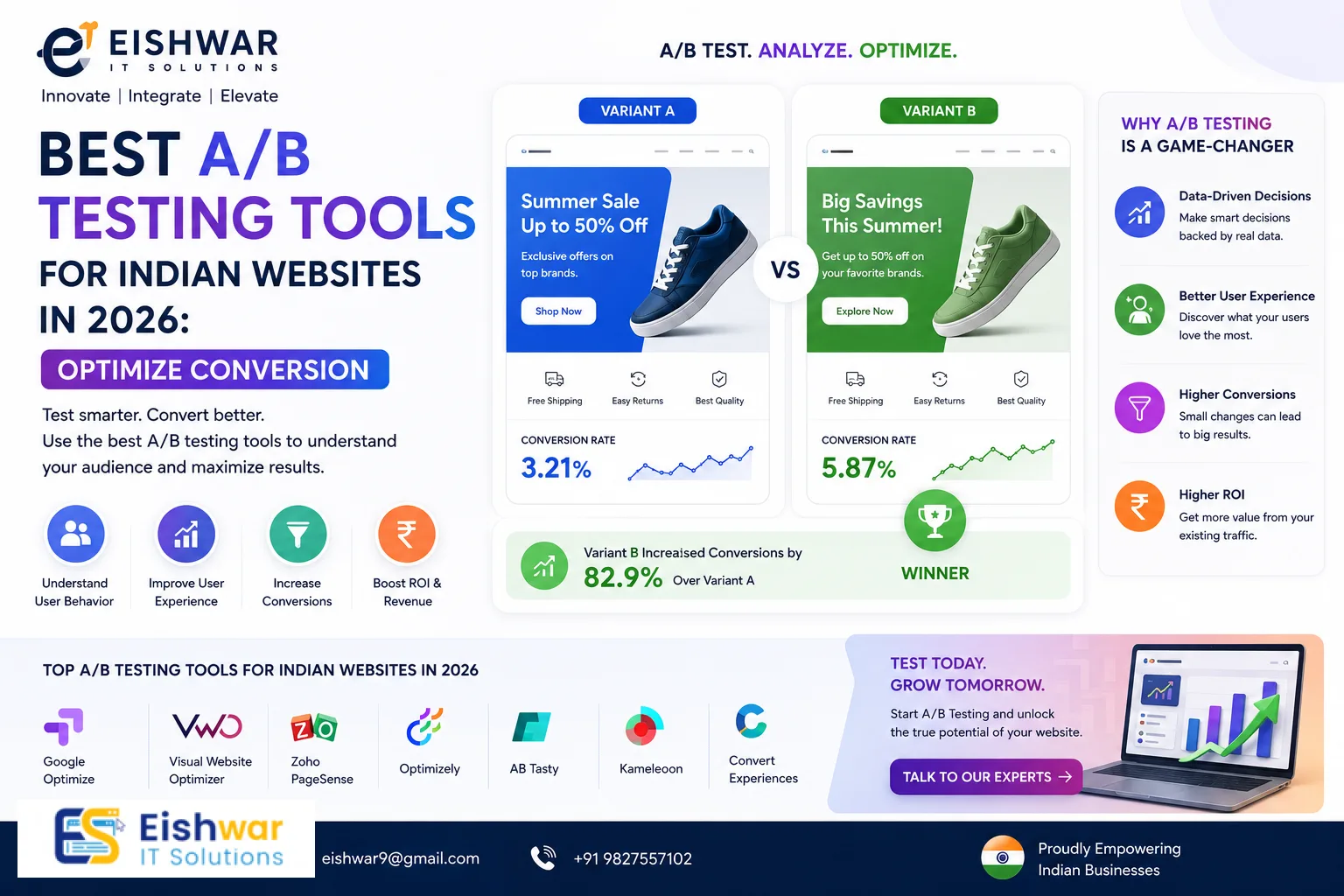
Best A/B Testing Tools for Indian Websites in 2026: Optimize Conversions with Data-Driven Design
Introduction
In the fast-paced digital landscape of India, your website is often the first impression potential customers have of your business. But how do you know if your site is truly optimized for conversions? The answer lies in A/B testing—a data-driven method to compare two versions of a webpage and determine which performs better. As we step into 2026, Indian businesses have access to a plethora of powerful A/B testing tools that are affordable, easy to use, and tailored for local needs. Whether you run a small e-commerce store in Bilaspur or a SaaS startup in Bengaluru, this guide will help you choose the right tool to turn visitors into loyal customers. With over 900 million internet users expected in India by 2026, the competition for attention is fierce. A/B testing isn't just a luxury; it's a necessity for any business looking to thrive in this dynamic market. By leveraging data, you can make informed decisions that reduce guesswork and maximize return on investment (ROI). Let's dive into the tools and strategies that will set you apart.
Main Section 1: Why A/B Testing is Crucial for Indian Businesses in 2026
India’s internet user base is expected to cross 900 million by 2026, with mobile-first users dominating traffic. Yet, many Indian websites suffer from high bounce rates and low conversions due to poor design, slow load times, or unclear calls-to-action. A/B testing allows you to make incremental improvements based on real user behavior, not guesswork. For example, a simple change like button color or headline text can boost conversions by 20-30%. With rising competition, data-driven design is no longer optional—it’s essential for survival. Consider a case study from a Delhi-based e-commerce store: by testing two versions of their product page—one with a red "Buy Now" button and another with a green one—they discovered a 25% increase in click-throughs with the green button. This kind of insight is invaluable. Moreover, A/B testing helps you understand cultural nuances. For instance, Indian users often prefer detailed product descriptions and trust signals like payment icons. Testing these elements can significantly improve user trust and conversion rates. In 2026, with the rise of regional languages, testing multilingual content can also unlock new audience segments. Ultimately, A/B testing empowers you to iterate quickly, reduce risk, and build a website that truly resonates with your target audience.
Main Section 2: Top A/B Testing Tools for Indian Websites in 2026
Here are the best tools that combine affordability, local features, and robust analytics. Each tool has unique strengths, so consider your business size, budget, and technical expertise when choosing.
1. Google Optimize (Free & Integrated)
Google Optimize is a free tool that seamlessly integrates with Google Analytics. It’s perfect for small businesses on a budget. You can run A/B, multivariate, and redirect tests. For Indian users, it supports Hindi and other regional languages in the interface. However, its advanced personalization features require a paid plan. Practical tip: Use Google Optimize to test simple changes like headline variations or CTA button colors. For example, a local restaurant in Pune tested two versions of their homepage—one emphasizing "Free Delivery" and another "Family Discounts"—and saw a 15% increase in orders. The tool's integration with Google Analytics means you can segment users by location, device, or traffic source for deeper insights.
2. VWO (Visual Website Optimizer)
VWO is a favorite among Indian marketers for its user-friendly visual editor and heatmaps. It offers A/B testing, split URL testing, and multivariate testing. VWO’s pricing is competitive for Indian SMEs, and it provides local support. Their recent AI-powered suggestions can recommend test variations based on user behavior. For instance, a Bengaluru SaaS startup used VWO to test different pricing page layouts. The AI suggested a variation with a "Most Popular" badge, which increased conversions by 18%. VWO also includes session recording and form analytics, helping you identify friction points. Pro tip: Start with VWO's heatmaps to see where users click most, then design your A/B tests around those areas.
3. Optimizely
Optimizely is an enterprise-grade platform used by global brands. For Indian businesses scaling up, it offers robust experimentation features, including server-side testing and feature flags. While pricier, its reliability and detailed reporting justify the cost for high-traffic sites. For example, a large Indian e-commerce platform used Optimizely to test a new checkout flow, reducing cart abandonment by 12%. The tool's statistical engine ensures accurate results even with complex tests. However, it requires some technical setup, so it's best for teams with developer resources. Consider Optimizely if you're handling millions of visitors and need advanced personalization.
4. Convert
Convert is a privacy-focused tool that complies with India’s upcoming data protection laws. It offers easy setup, statistical accuracy, and a visual editor. Their transparent pricing and free trial make it accessible for startups. Convert's emphasis on privacy is crucial as Indian regulations like the Digital Personal Data Protection Act take effect. For instance, a health tech startup in Mumbai used Convert to test sign-up form variations without compromising user data. The tool also supports Bayesian statistics, which is ideal for low-traffic sites. Practical tip: Use Convert's audience targeting to show different test variations to users from different cities, helping you tailor experiences for regional preferences.
5. AB Tasty
AB Tasty combines A/B testing with personalization and AI-driven recommendations. It’s ideal for e-commerce sites looking to tailor experiences for Indian shoppers. Features like session replay and funnel analysis give deep insights. For example, a fashion retailer in Jaipur used AB Tasty to test personalized product recommendations based on browsing history, leading to a 22% increase in average order value. The tool's AI can automatically generate test variations, saving time. Additionally, AB Tasty offers a visual editor that works well with mobile-first designs, which is critical since over 70% of Indian web traffic comes from mobile devices.
Main Section 3: How to Choose the Right Tool for Your Business
Consider these factors: budget, technical expertise, traffic volume, and specific goals. For a local restaurant website with low traffic, Google Optimize is sufficient. For a growing online store, VWO or Convert offer better features. Always check for Indian server locations to ensure fast load times. Also, look for tools that support mobile-first testing since over 70% of Indian web traffic comes from mobile devices. For example, if your audience is primarily in Tier 2 and Tier 3 cities, prioritize tools that offer reliable performance on slower networks. Additionally, evaluate the learning curve: tools like VWO have intuitive interfaces, while Optimizely may require training. Consider your team's size—small teams benefit from all-in-one solutions like VWO, while larger teams can leverage Optimizely's advanced features. Finally, test the tool's customer support: Indian businesses often need local support for quick issue resolution. Many tools now offer live chat in Hindi or English, which can be a game-changer.
Expert Tips
- Start with small, high-impact changes: Test headlines, CTA buttons, or form fields first. For instance, changing a CTA from "Submit" to "Get Your Free Quote" can increase clicks by 30%.
- Run tests for at least 1-2 weeks to collect statistically significant data. Avoid the temptation to peek early—use a tool's built-in confidence calculator to stay disciplined.
- Segment your audience by location, device, or traffic source for deeper insights. For example, test different hero images for users in Mumbai vs. Delhi to see which resonates more.
- Use heatmaps and session recordings alongside A/B tests to understand why users behave a certain way. If a test variation wins, heatmaps can show you exactly where users clicked.
- Always have a clear hypothesis before starting a test. For example, "Changing the button color to green will increase click-throughs because it contrasts better with the background." This keeps your tests focused and actionable.
- Document your results in a shared spreadsheet. Over time, you'll build a library of insights that inform future tests, saving time and resources.
Common Mistakes
- Testing too many variables at once—stick to one change per test. Otherwise, you won't know which element caused the improvement.
- Ending tests early due to excitement—wait for statistical significance (95% confidence). Early results can be misleading due to small sample sizes.
- Ignoring mobile users—ensure your variations look great on all devices. Test on actual mobile devices, not just emulators.
- Not documenting learnings—keep a log of what worked and what didn’t for future reference. This helps avoid repeating failed tests.
- Copying competitors’ tests without understanding your own audience. What works for a global brand may not work for a local Indian business. Always base tests on your user data.
- Forgetting about page load times—A/B test variations that are heavy on images or scripts can slow down your site, hurting conversions. Use tools like Google PageSpeed Insights to monitor performance.
Future Trends
In 2026, AI-powered A/B testing will become mainstream, with tools automatically generating and prioritizing test variations. Personalization at scale will merge with experimentation, allowing dynamic content for different user segments. Voice search and conversational UI testing will also emerge as new frontiers. Indian businesses should prepare for cookieless tracking and privacy-first testing methods. For example, tools like Convert are already leading the way with privacy-compliant solutions. Additionally, the rise of progressive web apps (PWAs) will require testing for offline functionality and app-like experiences. As 5G expands in India, testing for faster load times and richer media will become crucial. Stay ahead by experimenting with AI-driven recommendations and automated test generation. The future of A/B testing is about speed and intelligence—tools that can learn from each test and adapt in real-time will dominate.
FAQs
1. What is A/B testing and why do I need it?
A/B testing compares two versions of a webpage to see which performs better. It helps you make data-driven decisions to improve conversions, user experience, and revenue. For Indian businesses, it's crucial for understanding local user behavior and optimizing for mobile-first audiences.
2. Which A/B testing tool is best for a small Indian business?
Google Optimize is free and great for beginners with low traffic. VWO offers more features at an affordable price for growing businesses, including heatmaps and AI suggestions. Convert is also a strong choice for privacy-conscious startups.
3. How long should I run an A/B test?
Run tests for at least 1-2 weeks or until you reach 95% statistical confidence. Avoid ending tests early based on initial results, as they can be misleading. For low-traffic sites, consider using Bayesian statistics for faster insights.
4. Can A/B testing work for low-traffic websites?
Yes, but you may need to test high-impact changes or use Bayesian statistics. Tools like Google Optimize can still provide insights with smaller sample sizes. Focus on testing elements that have the biggest potential impact, like headlines or CTAs.
5. Do I need technical skills to use A/B testing tools?
Most modern tools like VWO and Convert have visual editors that require no coding. Basic HTML knowledge helps for advanced customizations, but you can start without it. Many tools also offer tutorials and support in regional languages.
6. How does A/B testing impact SEO?
Properly implemented A/B tests do not harm SEO. Use canonical URLs and avoid cloaking. Google’s guidelines allow experimentation as long as you don’t deceive users. Always use rel="canonical" to point to the original page, and avoid serving different content to search bots.
7. What are the costs of A/B testing tools for Indian businesses?
Costs vary widely. Google Optimize is free. VWO starts at around ₹5,000 per month for basic plans, while Optimizely can cost ₹50,000+ per month for enterprise features. Convert offers transparent pricing starting at ₹10,000 per month. Many tools offer free trials, so test before committing.
Conclusion
A/B testing is your secret weapon to create a website that truly resonates with your Indian audience. By leveraging the right tools and following best practices, you can continuously improve your site’s performance and stay ahead of competitors. Remember, every test is a learning opportunity. Start small, iterate fast, and let data guide your design decisions. With the right approach, you can turn your website into a conversion powerhouse that drives growth for your business in 2026 and beyond.
CTA
Ready to transform your website with data-driven design? Contact EishwarITSolution today for a free consultation. Let our experts help you set up A/B tests that drive real results. Whether you're a startup or an established enterprise, we'll guide you through the process of optimizing your site for maximum conversions. Don't leave your success to chance—let data lead the way.