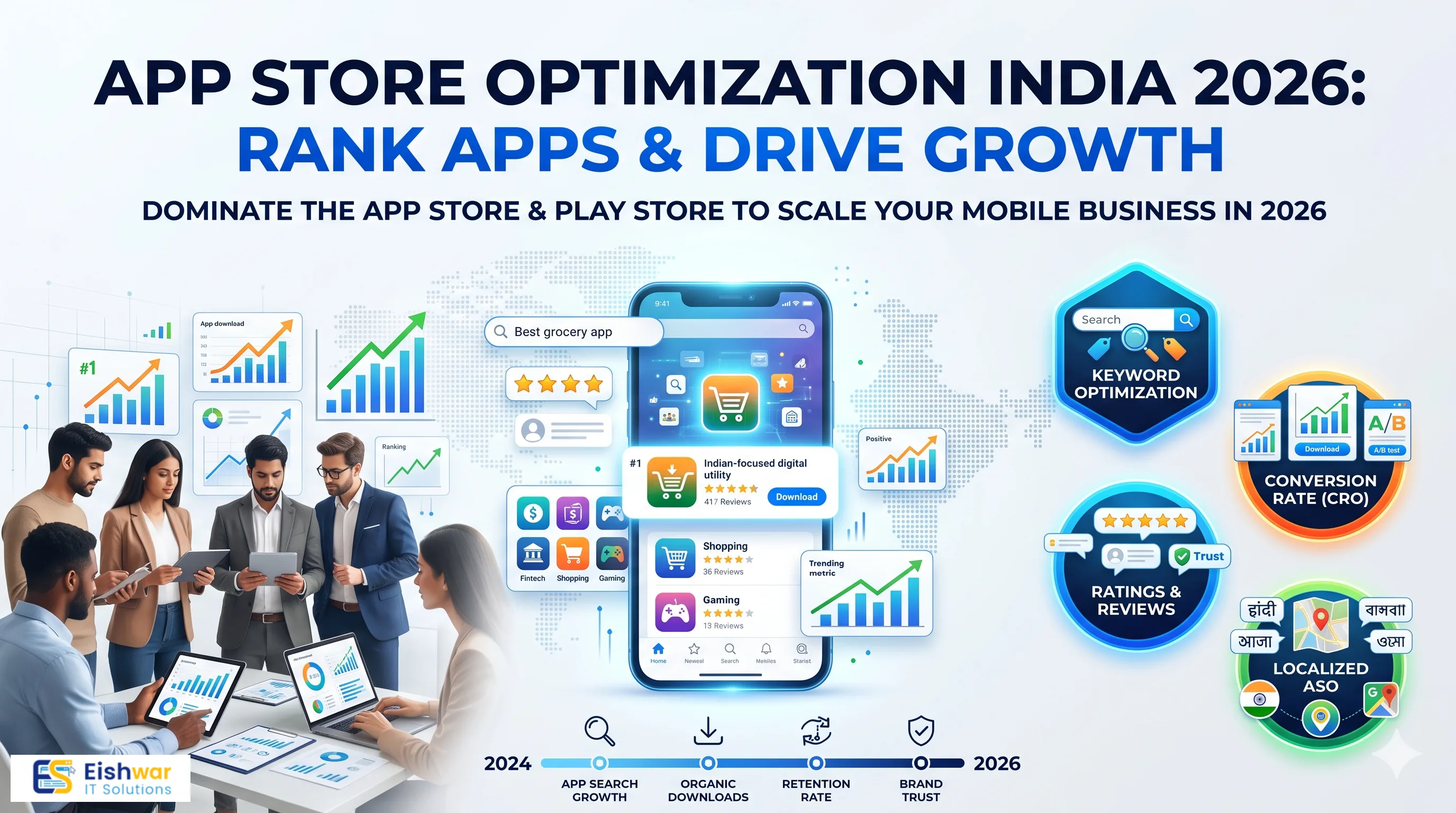
App Store Optimization India 2026: Rank Apps & Drive Growth
Introduction
India is one of the most exciting mobile app markets in the world. With over 750 million smartphone users, cheap data, and a rapidly growing digital payment ecosystem, Indian consumers now use apps for everything from grocery shopping and UPI payments to learning, health, travel, and entertainment. For business owners, marketers, and professionals, this creates a huge opportunity. It also creates a serious challenge: getting your app discovered.
App Store Optimization, or ASO, is the process of improving your app store listing so more relevant users find, install, and keep using your app. In 2026, ASO in India is no longer just about adding keywords. It is about understanding local languages, regional buying behavior, festive demand, privacy expectations, and the way Indian users search on Google Play and the Apple App Store.
This guide from EishwarITSolution gives you a practical, India-focused ASO playbook for 2026. You will learn how to research keywords, optimize your listing, build reviews, connect ASO with SEO, and measure what actually drives growth.
Main Section 1: Why ASO Is Different in India in 2026
If you copy an ASO strategy from the US or Europe, it may not work in India. Indian app discovery has its own rules. Here are the factors that matter most.
1. Google Play dominates, but Apple users are valuable
Google Play has the largest share of Indian smartphone users. That means Android-first ASO is usually the priority. However, Apple App Store users often have higher spending power and stronger retention in categories like finance, productivity, health, and premium education. Smart Indian businesses optimize for both, but they do not treat them as identical.
2. Language and regional diversity
India is not a single-language market. Users search in English, Hindi, Tamil, Telugu, Bengali, Marathi, Gujarati, Kannada, Malayalam, and many other languages. They also use Hinglish, such as grocery delivery app near me or best UPI app for students. Your app store listing should be localized for the languages your target users actually speak. A Tamil user in Coimbatore may ignore an English-only listing even if the app is perfect for them.
3. Low data cost, high competition, short attention spans
Cheap mobile data means users are willing to try new apps. But it also means they switch quickly. Your icon, first two screenshots, app name, and short description must communicate value in seconds. If your listing looks generic, users will move to the next option.
4. Trust signals matter more than ever
Indian users check ratings, reviews, permissions, privacy policies, and brand credibility. Negative reviews about payments, refunds, or poor support can damage installs fast. ASO and reputation management are now part of the same job.
5. Festive and seasonal search spikes
Demand in India changes with festivals, cricket seasons, exam periods, and wedding months. A shopping app may see a spike before Diwali. An edtech app may see demand before board exams. A travel app may peak during summer holidays. Your ASO calendar should reflect these moments.
Main Section 2: Step-by-Step ASO Playbook for Indian Businesses
Use this playbook as a practical checklist. You do not need to do everything at once, but you should build a consistent process.
Step 1: Keyword research for Indian app stores
Start with seed keywords that describe what your app does and who it helps. Then expand with location, language, and use-case modifiers. For example, a grocery app in Pune might target keywords like kirana delivery app, daily grocery app Pune, online sabzi mandi, 15 minute grocery delivery, and fresh vegetables home delivery.
Use Google Play Console, Apple App Store Connect, and ASO tools like AppTweak, Sensor Tower, AppFollow, and MobileAction. Also mine your own reviews, competitor reviews, and Google search suggestions. Look for Hinglish phrases and regional terms. Do not just translate keywords. Adapt them to how people actually speak.
Step 2: Optimize title, subtitle, and short description
Your title is the most important real estate. In Google Play, the title has a 30-character limit. In the Apple App Store, the title has a 30-character limit and the subtitle has a 30-character limit. Use your brand name plus your primary keyword. For example, instead of FreshCart, use FreshCart: Grocery Delivery. It is clear, keyword-rich, and still branded.
The short description on Google Play gives you 80 characters. Use it to highlight your strongest benefit and primary keyword. Example: Order fresh vegetables, fruits and daily essentials in 15 minutes. On Apple, use the subtitle for a secondary keyword and clear value proposition.
Step 3: Create high-converting visuals for Indian users
Your icon, screenshots, feature graphic, and preview video do the selling. Show Indian context: local city landmarks, UPI payment screens, Hindi or regional language text, festive offers, and real user scenarios. Do not use stock photos that look foreign.
Test different creatives using Google Play experiments and Apple Product Page Optimization. A simple change, like showing a Rs. 100 cashback offer or a 15-minute delivery promise, can improve conversion significantly.
Step 4: Build a ratings and reviews engine
Ratings and reviews influence both ranking and conversion. Ask for reviews after a positive moment, such as a successful payment, completed order, or finished lesson. Use in-app prompts, but do not interrupt users during critical tasks. Respond to negative reviews politely and quickly. Show that you are solving problems.
Never buy fake reviews. Indian users and app store algorithms are better at detecting them, and the long-term damage is not worth it.
Step 5: Localize and culturally adapt
Localization is more than translation. It includes screenshots, support language, currency, payment methods, and cultural references. If you target Tamil Nadu, show Tamil text and local offers. If you target West Bengal, mention Durga Puja campaigns. If you target Bharat users, keep language simple and avoid heavy English jargon.
Step 6: Improve technical and engagement signals
App store algorithms look at download velocity, retention, crash rate, app size, permissions, and update frequency. A smaller, faster, stable app often ranks better because users keep using it. Improve onboarding, reduce signup friction, and fix bugs quickly. Encourage users to enable notifications only when you have something valuable to share.
Step 7: Track ASO metrics that matter
Do not celebrate downloads alone. Track store listing visitors, install conversion rate, keyword rankings, impressions, retention at day 1, day 7, and day 30, average revenue per user, cost per install, and organic versus paid installs. Use Google Play Console, App Store Connect, AppsFlyer, Adjust, and Firebase. Review these metrics every month and adjust your ASO plan.
Main Section 3: Connecting ASO With SEO and Digital Marketing
ASO should not live in a silo. Indian users discover apps through Google Search, YouTube, Instagram, WhatsApp, Telegram, and influencers. Your app store listing must work together with your website and marketing channels.
Create app landing pages that rank
Build web pages for high-intent searches like best grocery delivery app in Pune, UPI expense tracker app India, or online yoga app for beginners. Include app screenshots, features, FAQs, schema markup, and clear download buttons. These pages can rank on Google and send qualified users to your app store listing.
Use YouTube and short video SEO
YouTube is one of the largest search engines in India. Create app demos, how-to videos, customer testimonials, and comparison videos. Optimize video titles, descriptions, and thumbnails with keywords. Link to your app store listing in the description. Short videos on Instagram Reels and YouTube Shorts can also drive app installs when they show real value quickly.
Leverage social search and community proof
Indian users search on Instagram and WhatsApp for recommendations. Encourage user-generated content, run referral campaigns, and share customer stories. Use local hashtags and community groups carefully. Social proof can improve both app store conversion and web search visibility.
Use email, SMS, and push notifications wisely
Re-engage existing users with personalized messages. Segment by language, city, and behavior. Ask for reviews after a positive experience. Promote new features that give users a reason to return. This improves retention, which indirectly supports ASO ranking.
Run paid campaigns for velocity, but optimize for retention
Google App campaigns, Meta ads, and influencer marketing can create early download velocity. That can help your app store ranking. But if users install and uninstall quickly, the algorithm learns the wrong lesson. Target users who are likely to stay, and measure lifetime value, not just cost per install.
Expert Tips
- Treat your app store listing like a high-converting landing page. Every element should answer one question: why should I install this app now?
- Use Hinglish and regional keywords naturally. Do not force them into the title if they sound unnatural.
- Update screenshots every quarter. Festive offers, new features, and social proof can improve conversion.
- Ask for reviews after a positive action, not immediately after install.
- Build a review response SOP. Reply to negative reviews within 24 to 48 hours.
- Monitor top competitors every month. Track their keywords, creatives, ratings, and update notes.
- Keep your app size low. Users on mid-range Android phones may skip large apps.
- Run A/B tests on icon, screenshots, and short description. Small changes can produce big gains.
- Align ASO with SEO. Use the same keyword themes on your website, YouTube, and app store listing.
- Track retention and revenue, not just downloads. Downloads are the start, not the goal.
Common Mistakes
- Keyword stuffing your app title and short description. It looks spammy and can hurt conversion.
- Using the same creatives for every region and language.
- Ignoring negative reviews or replying defensively.
- Buying fake reviews or incentivizing positive reviews in a way that violates store policies.
- Focusing only on installs and not on activation, retention, or revenue.
- Not localizing the listing for major Indian languages.
- Neglecting app performance, crashes, and load times.
- Missing the web-to-app funnel. Many users prefer to check a website before installing.
- Changing too many elements at once, making it impossible to know what worked.
- Ignoring competitor updates and seasonal trends.
Future Trends
- AI-generated store creatives and dynamic listings that adapt to user segments.
- Voice and vernacular search inside app stores and on Google.
- App store algorithms putting more weight on engagement, retention, and privacy signals.
- Privacy-first measurement as third-party cookies and device identifiers decline.
- Super apps and mini apps changing how Indian users discover services.
- Short video previews becoming a standard part of app store listings.
- Generative search and AI assistants recommending apps through conversational queries.
- Regional language ASO becoming a major competitive advantage.
FAQs
What is App Store Optimization (ASO)?
App Store Optimization is the process of improving your app store listing so more relevant users find and install your app. It includes keyword research, title and description optimization, visuals, ratings, reviews, localization, and conversion rate improvements.
How is ASO different from SEO?
SEO focuses on ranking web pages in search engines like Google. ASO focuses on ranking apps in app stores like Google Play and the Apple App Store. Both use keyword research and conversion optimization, but ASO also depends heavily on app ratings, reviews, install velocity, and retention.
Which keywords should Indian apps target?
Target keywords based on user intent, location, language, and category. For example, a fintech app might target UPI payment app India, expense tracker app for students, or best app for bill payments. Use Hinglish and regional terms where relevant, and validate search volume with ASO tools and store data.
How long does ASO take to show results?
Some changes, such as icon and screenshot tests, can improve conversion within a few weeks. Keyword ranking improvements may take one to three months depending on competition, install velocity, and app performance. ASO is an ongoing process, not a one-time task.
Do I need ASO for both Google Play and Apple App Store?
Yes, if your target users use both platforms. Google Play requires an Android-first approach because of its larger user base in India. Apple App Store requires a more premium, design-focused approach. Optimize each store separately instead of copying the same listing.
Can ASO help reduce user acquisition costs?
Yes. Strong ASO increases organic installs, which reduces your dependence on paid campaigns. It also improves conversion from paid traffic because users who visit your store listing are more likely to install. Combine ASO with paid ads for the best results.
How often should I update my app store listing?
Review your listing every month and make meaningful updates every quarter. Update screenshots for festivals, new features, and major milestones. Always test one major change at a time so you can measure impact.
Conclusion
App Store Optimization in India is a powerful growth channel for businesses that treat it seriously. In 2026, success will come from a combination of localized keywords, high-converting creatives, strong ratings, fast app performance, and smart integration with SEO, social media, and paid campaigns.
Start with a clear keyword strategy. Improve your visuals. Build a review engine. Track retention and revenue. Then connect your app store listing to your website, YouTube channel, and social presence. When you do this consistently, your app becomes easier to discover, easier to trust, and easier to choose.
CTA
Ready to make your app more visible on Google Play and the Apple App Store? EishwarITSolution helps Indian businesses plan, optimize, and scale their digital marketing and SEO efforts. Contact us today for a custom ASO and app growth strategy for 2026.