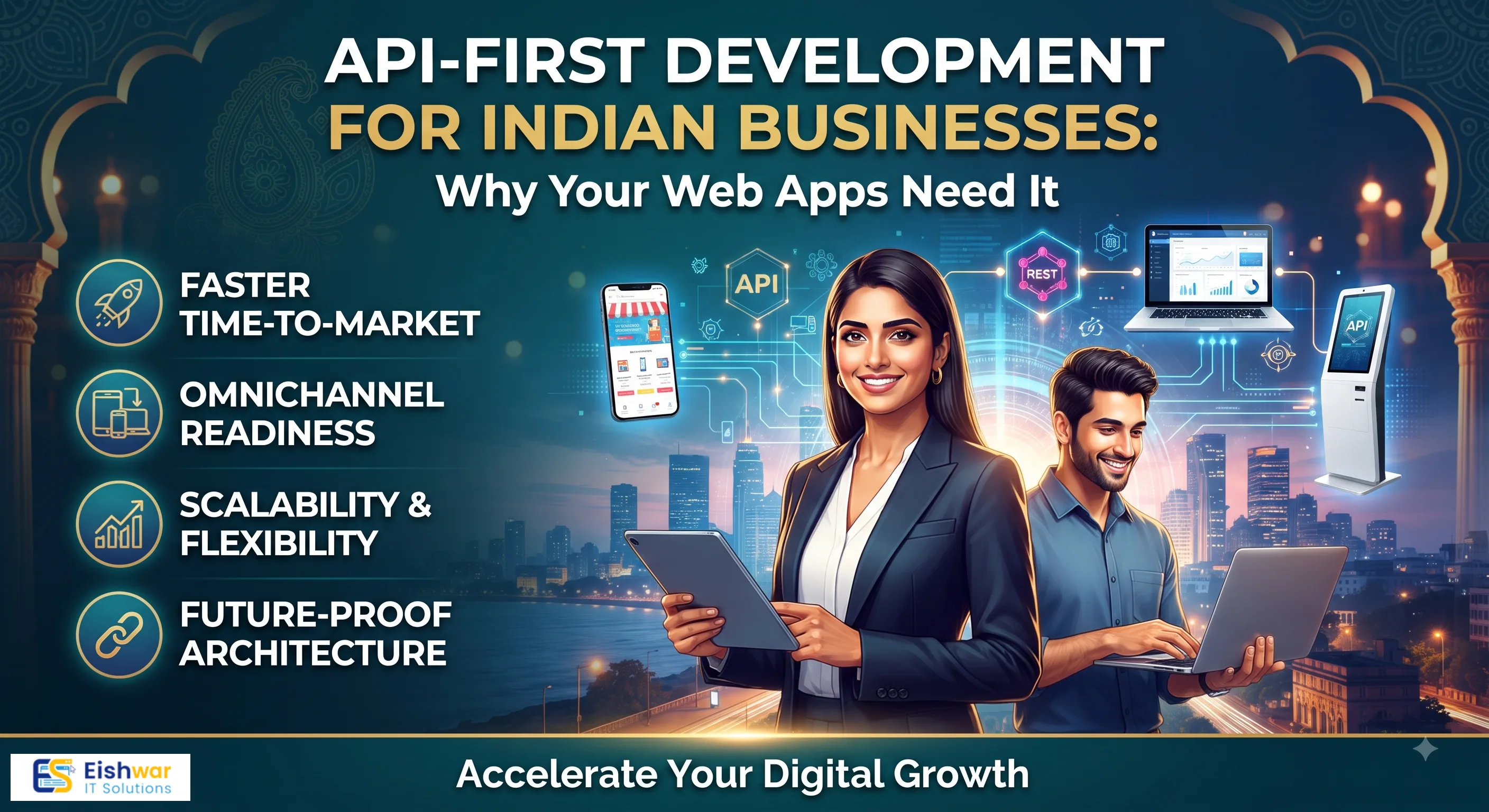
API-First Development for Indian Businesses: Why Your Web Apps Need to Be API-Ready in 2026
Introduction
Imagine your business website as a digital storefront. In 2026, that storefront won't just be visited by humans—it will be accessed by apps, chatbots, payment gateways, and third-party services. Without an API-first approach, your web app becomes a walled garden, limiting growth and integration. For Indian businesses, where digital transformation is accelerating, being API-ready is no longer optional—it's a competitive necessity.
API-first development means designing your application's core functionality as APIs from the start, rather than bolting them on later. This approach ensures your web app can seamlessly connect with other systems, scale with demand, and adapt to new technologies. In this guide, we'll explore why API-first matters for Indian businesses, how to implement it, and what trends to watch in 2026. We'll also dive into practical examples, common pitfalls, and expert insights to help you make informed decisions.
Main Section 1: Why API-First Development Matters for Indian Businesses
Scalability Without Limits
Indian businesses are growing rapidly. Whether you're an e-commerce startup in Bengaluru or a manufacturing firm in Pune, your web app needs to handle spikes in traffic, orders, and data. API-first architecture allows you to decouple frontend and backend, meaning you can scale each independently. For example, if your payment API needs to handle 10,000 transactions per minute during a sale, you can scale that component without affecting the product catalog. This modularity is crucial during high-traffic events like Diwali sales or festive seasons, where demand can surge unpredictably.
Practical Example: Consider a Mumbai-based online grocery store that experiences a 500% traffic spike during the month of Ganesh Chaturthi. With an API-first approach, they can spin up additional instances of their order processing API without touching the product listing or user authentication services. This ensures smooth operations and prevents downtime, which could otherwise lead to lost revenue and customer trust.
Seamless Integration with Indian Ecosystem
India's digital ecosystem is diverse—UPI payments (like PhonePe, Google Pay, Paytm), GST invoicing, logistics APIs from Delhivery or Shiprocket, and social login via Google or Facebook. An API-first approach makes integration straightforward. Instead of writing custom code for each service, you use standardized endpoints. This reduces development time and errors. For instance, integrating UPI payments becomes a matter of calling a well-documented API, rather than building a custom payment module from scratch.
Tip: Use API gateways like Kong or AWS API Gateway to manage multiple integrations. These tools handle authentication, rate limiting, and monitoring, simplifying your architecture.
Future-Proofing Your Business
Technology evolves fast. In 2026, we'll see more AI, IoT, and voice interfaces. API-first design ensures your web app can easily connect to these new channels. For instance, you could add a voice-based ordering system by simply integrating with a speech-to-text API. Similarly, IoT devices in warehouses can send inventory updates via APIs, automating stock management.
Actionable Tip: Start by identifying the core functions of your web app—user management, payments, inventory—and design them as APIs. Use tools like Swagger or Postman to document and test them. This upfront investment pays off when you need to pivot or expand.
Main Section 2: How to Implement API-First Development for Your Indian Business Web App
Step 1: Define Your API Strategy
Before coding, plan. What data and services will your APIs expose? Who will use them—internal developers, third-party partners, or public consumers? For Indian businesses, consider compliance with local regulations like India's Data Protection Bill (Digital Personal Data Protection Act, 2023). Use RESTful or GraphQL standards for flexibility. REST is simpler and widely adopted, while GraphQL offers more efficient data fetching for complex queries.
Example: A fintech startup in Gurgaon decided to expose APIs for account balance checks, transaction history, and fund transfers. They chose REST for simplicity but used GraphQL for their mobile app to reduce data payload, improving performance on slower networks.
Step 2: Choose the Right Tech Stack
Popular API-first frameworks include Node.js with Express, Django REST Framework, or Laravel for PHP. For Indian businesses, cost and performance matter. Node.js is great for real-time apps, while Django offers robust security—important for handling sensitive customer data. Laravel is a solid choice for PHP shops with existing infrastructure.
Practical Tip: Consider using serverless architectures (e.g., AWS Lambda, Azure Functions) for APIs that have unpredictable traffic. This reduces costs during low-usage periods and scales automatically during spikes.
Step 3: Build and Document APIs
Create clear, consistent endpoints. Use versioning (e.g., /v1/users) to avoid breaking changes. Document everything with OpenAPI/Swagger. This helps your team and external developers integrate quickly. Good documentation includes request/response examples, error codes, and authentication methods.
Example: A Jaipur-based travel booking platform documented their flight search API with sample requests for different cities (e.g., Delhi to Mumbai). This reduced integration time for their partner agencies by 50%.
Step 4: Test and Monitor
Use automated testing tools like Jest or Mocha for unit tests, and Postman or Insomnia for integration tests. Monitor API performance with tools like New Relic or Datadog. In India, where internet speeds can vary, optimize for low latency by using CDNs and caching strategies.
Case Study: A Delhi-based food delivery startup used API-first to integrate with Zomato, Swiggy, and their own app simultaneously. They built a unified order API that handled all channels, reducing development time by 40%. They also implemented rate limiting to prevent abuse during peak hours.
Main Section 3: Real-World Benefits for Indian Business Owners
Cost Efficiency
API-first development reduces rework. When you need to add a new feature or integrate a new service, you just call an existing API instead of rewriting code. This saves money and speeds up time-to-market. For example, adding a new payment gateway like Razorpay or Instamojo becomes a matter of integrating with their API, rather than building a custom solution.
Tip: Use API marketplaces like RapidAPI to discover pre-built APIs for common tasks (e.g., SMS notifications, email services). This further reduces development costs.
Enhanced Customer Experience
With APIs, you can offer personalized experiences. For example, use a recommendation API to suggest products based on browsing history. Or integrate with a chatbot API to provide 24/7 customer support in Hindi or English. APIs also enable omnichannel experiences—customers can start an order on mobile and complete it on desktop.
Practical Example: A Chennai-based fashion retailer used a recommendation API to show personalized outfit suggestions. This increased average order value by 15% and reduced cart abandonment by 10%.
Competitive Advantage
Indian businesses that adopt API-first are better positioned to partner with larger platforms. For instance, if you want to list your products on Amazon or Flipkart, an API-first architecture makes integration seamless. You can also create your own API marketplace, selling access to your data or services to other businesses.
Case Study: A Jaipur-based textile exporter used API-first to connect their inventory system with global B2B marketplaces like Alibaba and IndiaMART. They reduced manual data entry by 80% and increased sales by 25% in six months. Their APIs also allowed real-time inventory updates, preventing overselling.
Expert Tips
- Start Small: Don't try to API-fy everything at once. Pick one core business function, like product catalog or user authentication, and build an API for it. Iterate based on feedback.
- Prioritize Security: Use OAuth 2.0 for authentication, encrypt data in transit (HTTPS), and implement rate limiting to prevent abuse. Also, validate all inputs to avoid injection attacks.
- Embrace Versioning: Always version your APIs to avoid breaking existing integrations when you make changes. Use semantic versioning (e.g., v1.2.3) for clarity.
- Think Mobile-First: Many Indian users access the web via mobile. Design your APIs to serve lightweight responses suitable for mobile apps. Use pagination for large datasets.
- Leverage Indian Cloud Providers: Use services like AWS Mumbai region or Azure India for low-latency API hosting. This ensures faster response times for users across India.
- Implement Caching: Use Redis or Memcached to cache frequently accessed data, reducing database load and improving response times.
Common Mistakes
- Over-Engineering: Don't build complex APIs for simple needs. Keep it simple and iterate. Start with a minimal viable API and add features as needed.
- Ignoring Documentation: Poor documentation leads to integration delays. Invest in clear, updated docs. Use tools like Swagger UI for interactive documentation.
- Neglecting Error Handling: Always return meaningful error messages (e.g., 404 with a message like 'User not found'). Include error codes and suggestions for resolution.
- Not Planning for Scale: Use caching (Redis) and load balancers to handle traffic spikes during Indian festivals like Diwali. Also, consider auto-scaling in cloud environments.
- Forgetting Compliance: Ensure your APIs comply with Indian data laws, especially for customer data. Implement data anonymization and consent management.
- Ignoring Monitoring: Without monitoring, you won't know if your APIs are failing. Set up alerts for error rates, latency, and throughput.
Future Trends
In 2026, API-first development will evolve with:
- AI-Powered APIs: APIs that integrate machine learning models for predictions, recommendations, and automation. For example, a fraud detection API that analyzes transaction patterns in real-time.
- Event-Driven APIs: Using webhooks and real-time events for instant updates (e.g., order status changes, inventory alerts). This enables reactive systems that respond to events as they happen.
- API Marketplaces: Indian businesses will buy and sell APIs on platforms like RapidAPI, creating new revenue streams. For instance, a logistics company could sell a real-time tracking API to e-commerce platforms.
- GraphQL Adoption: More Indian developers will use GraphQL for flexible, efficient data fetching. This reduces over-fetching and under-fetching, improving mobile app performance.
- API Security as a Service: Specialized tools to protect against DDoS, injection attacks, and data breaches. Services like Cloudflare API Shield will become standard.
- Low-Code/No-Code Integration: Platforms like Zapier and Make (formerly Integromat) will allow non-technical users to connect APIs, democratizing integration.
FAQs
1. What is API-first development?
API-first development is a software design approach where you build the API (Application Programming Interface) before the user interface. This ensures that all core functionality is accessible via APIs, making integration and scaling easier. It prioritizes the API as a first-class citizen, not an afterthought.
2. Why is API-first important for Indian small businesses?
It allows small businesses to integrate with payment gateways, logistics providers, and e-commerce platforms quickly and cost-effectively, leveling the playing field with larger competitors. It also enables them to reach customers through multiple channels (web, mobile, chatbots) without rebuilding their backend.
3. How long does it take to implement API-first for an existing web app?
It depends on the complexity. For a simple app, it might take a few weeks. For complex systems, plan for 2-3 months. Start with a pilot project to minimize disruption. Use a phased approach—first, identify the most critical APIs (e.g., user management, payments), then gradually expose other functions.
4. What are the cost implications?
Initial development costs may be higher due to planning and documentation, but long-term savings from reduced rework and faster integrations outweigh the upfront investment. For example, a well-designed API can reduce integration time for new partners from weeks to days, saving significant engineering hours.
5. Can API-first work with legacy systems?
Yes, you can build an API layer on top of legacy systems using adapters or microservices. This allows you to modernize gradually without a complete rewrite. For instance, you can create a RESTful API that wraps your legacy database, enabling new frontends to access data without touching the old code.
6. What are the best practices for API security in India?
Use OAuth 2.0 for authentication, encrypt data with HTTPS, implement rate limiting, and validate all inputs. Also, comply with India's Data Protection Act by anonymizing personal data and obtaining user consent. Regularly audit your APIs for vulnerabilities.
7. How do I choose between REST and GraphQL for my API?
REST is simpler and works well for most use cases, especially when you have well-defined resources. GraphQL is better for complex queries where clients need flexible data fetching, such as mobile apps with varying screen sizes. For Indian businesses, start with REST if you're new to APIs, then consider GraphQL as your needs grow.
Conclusion
API-first development is not just a trend—it's a strategic move for Indian businesses aiming to thrive in 2026 and beyond. By designing your web apps with APIs at the core, you unlock scalability, seamless integration, and future-readiness. Whether you're a startup or an established enterprise, adopting this approach will help you stay ahead in India's competitive digital landscape. The key is to start small, prioritize security, and continuously iterate based on feedback. With the right strategy, your web app can become a hub for innovation, connecting with partners, customers, and emerging technologies effortlessly.
CTA
Ready to make your web app API-ready? Contact EishwarITSolution today for a free consultation. Our experts will help you design and implement an API-first strategy tailored to your business needs. We specialize in helping Indian businesses modernize their web apps, integrate with local ecosystems, and scale for the future. Get in touch now and future-proof your digital presence. Don't wait until 2026—start your API journey today!