Introduction
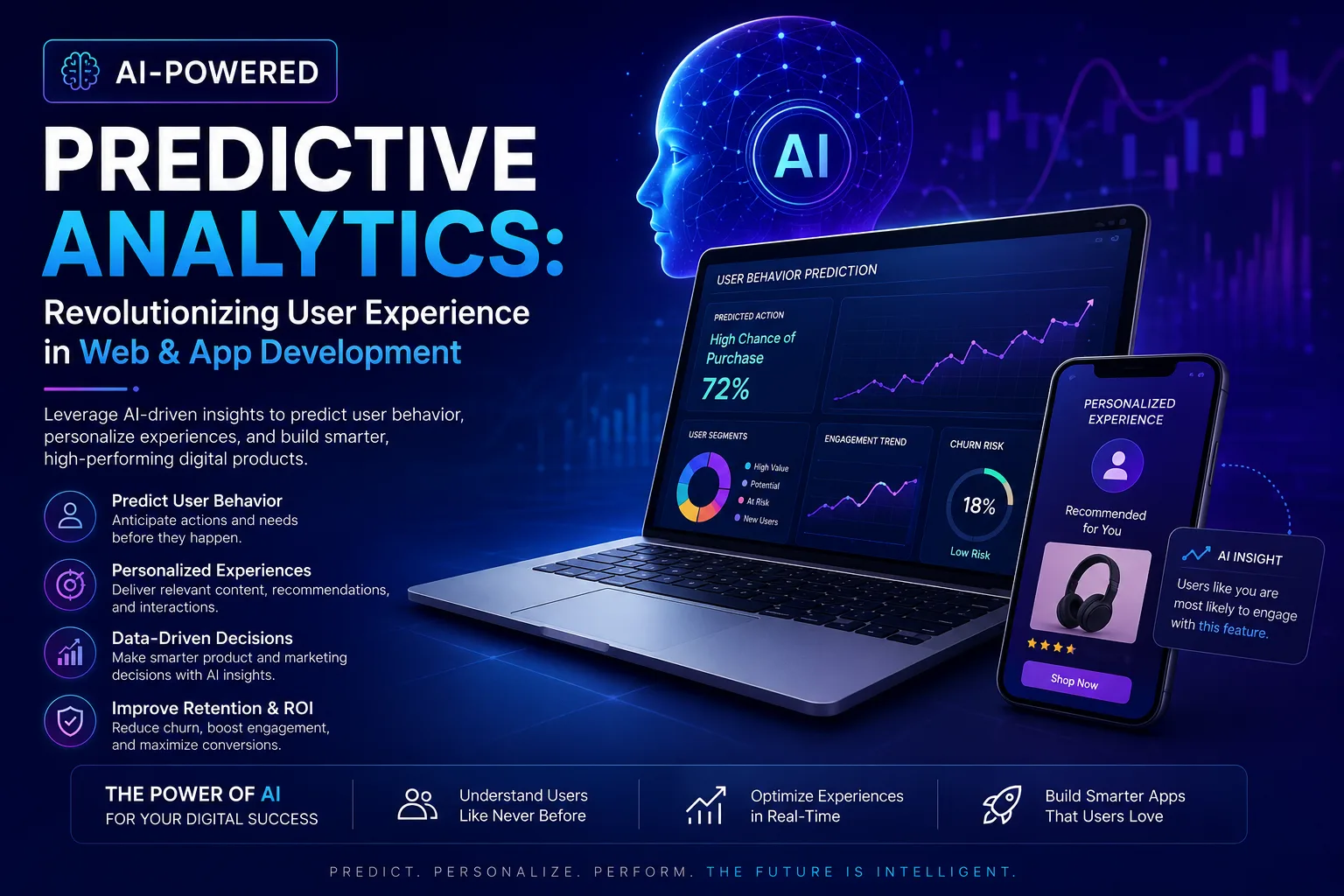
Imagine knowing exactly what your users want before they even click a button. That’s not magic—it’s AI-powered predictive analytics. In today’s hyper-competitive digital landscape, businesses in India and beyond are racing to deliver personalized, seamless experiences. Predictive analytics uses machine learning and historical data to forecast user behavior, enabling you to tailor your web or app in real-time. At EishwarITSolution, we’ve seen how this technology turns casual visitors into loyal customers. In this guide, we’ll explore how you can harness predictive analytics to transform your user experience (UX), boost conversions, and stay ahead of the curve.
The digital ecosystem is evolving at an unprecedented pace. With users expecting instant gratification and hyper-relevant interactions, traditional one-size-fits-all approaches no longer suffice. Predictive analytics bridges the gap between user expectations and business capabilities by leveraging data to anticipate needs. For instance, an Indian e-commerce platform can predict festival-season buying patterns and adjust inventory or promotions accordingly. This isn’t just about improving metrics—it’s about building lasting relationships with your audience.
In this comprehensive guide, we’ll dive deep into the mechanics of predictive analytics, its practical applications, and a step-by-step implementation framework. Whether you’re a startup founder, a marketing manager, or a developer, you’ll find actionable insights to elevate your web or app project. Let’s begin by understanding the core concept and why it matters for UX.
Main Section 1: What is AI-Powered Predictive Analytics and Why Does It Matter for UX?
Predictive analytics isn’t new, but AI has supercharged it. Instead of just reporting what happened, it predicts what will happen. For web and app development, this means anticipating user actions—like which product they’ll buy, when they’ll churn, or what content they’ll engage with. At its core, predictive analytics involves training machine learning models on historical data to identify patterns and make forecasts. These models can be as simple as linear regression or as complex as deep neural networks, depending on the use case.
Why it matters:
- Personalization at scale: Deliver tailored recommendations, offers, and interfaces without manual effort. For example, a news app can surface articles based on a user’s reading history, increasing time spent on site by up to 30%.
- Reduced friction: Predict and resolve user pain points before they cause drop-offs. Imagine a travel booking site that anticipates when a user is likely to abandon a multi-step form and offers a simplified version or live chat support.
- Higher ROI: Optimize marketing spend and feature development based on data-driven forecasts. By focusing resources on high-impact areas, businesses can see a 15-20% improvement in conversion rates within months.
For example, an e-commerce app using AI can predict that a user is likely to abandon their cart and trigger a personalized discount or reminder. This isn’t guesswork—it’s science. And it’s accessible to businesses of all sizes through platforms like Google Analytics 4, Salesforce Einstein, or custom models built with TensorFlow. The key is to start with a clear understanding of your users’ journey and identify where predictions can add the most value.
Consider a practical scenario: A food delivery app in Mumbai uses predictive analytics to forecast peak order times based on weather, local events, and historical data. By pre-positioning delivery partners and optimizing kitchen workflows, they reduce delivery times by 25% during rush hours. This not only improves customer satisfaction but also increases order frequency. Such applications demonstrate that predictive analytics is not a luxury but a necessity for modern UX.
Main Section 2: Practical Applications of Predictive Analytics in Web & App Development
Let’s get specific. Here are three high-impact areas where predictive analytics is reshaping user experience, along with detailed examples and implementation tips:
1. Intelligent Content & Product Recommendations
Netflix and Amazon set the standard, but you don’t need their budget. Tools like Recombee or Algolia let you embed AI-driven recommendations into your site or app. By analyzing past behavior, time of day, and even device type, these systems surface the most relevant content or products, increasing average session duration and conversion rates. For instance, a streaming service can recommend a movie based on a user’s viewing history and current mood (e.g., “Since you watched a thriller last night, here’s a similar option for tonight”).
To implement this effectively, start by segmenting your users into cohorts based on behavior patterns. Use collaborative filtering or content-based filtering algorithms to generate recommendations. A/B test different recommendation strategies—such as “most popular” vs. “personalized”—to measure impact. For a small business, even a simple rule-based system (e.g., “users who bought X also bought Y”) can yield significant results.
2. Predictive Search & Navigation
Ever noticed how Google predicts your search query? You can do the same on your website. AI-powered search engines learn from user queries and clicks to autocomplete and rank results intelligently. This reduces bounce rates and helps users find what they need in seconds. For example, an e-commerce site can use predictive search to suggest products as a user types, incorporating synonyms and misspellings to improve accuracy.
To build this, integrate a search-as-you-service like Elasticsearch with machine learning plugins or use platforms like Algolia. Train the model on historical search logs to understand user intent. For instance, if many users search for “wireless headphones” and then click on noise-cancelling models, the system should prioritize those results. Additionally, consider adding filters based on predicted preferences (e.g., price range, brand) to streamline navigation.
3. Churn Prediction & Proactive Retention
Identify users at risk of leaving before they do. By tracking engagement metrics like login frequency, feature usage, or support tickets, AI models flag high-risk users. You can then trigger automated emails, in-app messages, or special offers to re-engage them. For SaaS businesses, this alone can reduce churn by 20-30%. For example, a project management app might notice a user hasn’t logged in for 10 days and send a personalized email with tips on using a new feature.
To build a churn prediction model, start by defining what “churn” means for your business (e.g., no activity for 30 days). Collect data on user behavior, demographics, and support interactions. Use a classification algorithm like logistic regression or random forest to predict churn probability. Then, set up automated workflows using tools like Intercom or HubSpot to deliver targeted interventions. Remember to monitor the effectiveness of these interventions and iterate based on results.
Main Section 3: How to Implement Predictive Analytics in Your Web or App Project
Ready to get started? Here’s a step-by-step framework tailored for business owners and marketers, with practical considerations for each stage:
Step 1: Define Your Goals
What do you want to predict? Common goals include: increase conversion rate, reduce churn, improve content engagement, or optimize pricing. Be specific—vague objectives lead to vague results. For instance, instead of “improve user experience,” set a goal like “increase product recommendation click-through rate by 15% in three months.” Align your goals with business KPIs and ensure they are measurable.
Step 2: Collect Quality Data
Predictive models are only as good as the data they’re trained on. Ensure you’re capturing key events: page views, clicks, form submissions, purchase history, session duration, and user demographics. Use tools like Mixpanel, Amplitude, or custom event tracking. Pay attention to data cleanliness—remove duplicates, handle missing values, and standardize formats. For example, if you’re tracking “purchase amount,” ensure it’s consistently recorded in the same currency.
Also, consider data privacy. Under India’s Digital Personal Data Protection Act (DPDPA), you must obtain user consent and anonymize sensitive information. Use techniques like differential privacy to protect individual identities while still gaining insights.
Step 3: Choose the Right Tools
For small to mid-sized businesses, start with no-code or low-code platforms:
- Google Analytics 4: Built-in predictive metrics like purchase probability and churn probability. It’s free and integrates easily with your website or app.
- Salesforce Einstein: Predictive lead scoring and recommendations. Ideal for CRM-heavy businesses.
- Custom ML models: If you have a data science team, frameworks like Scikit-learn or PyTorch offer flexibility. For example, you can build a custom recommendation engine using collaborative filtering.
Evaluate tools based on your budget, technical expertise, and scalability needs. Start with a free tier and upgrade as you see results.
Step 4: Integrate and Test
Work with developers to embed predictions into your UX. For example, display a “Recommended for You” section on your homepage. A/B test the feature to measure impact on KPIs. Iterate based on results. For instance, test two versions of a recommendation widget—one with AI-driven suggestions and one with static bestsellers—to see which drives more conversions.
Also, monitor model performance over time. User behavior changes, so retrain your models every 3-6 months. Use metrics like precision, recall, and F1-score to evaluate accuracy. If a model’s predictions become less reliable, investigate data drift or changes in user behavior.
Expert Tips
Here are insider tips from our team at EishwarITSolution:
- Start small: Pick one use case (e.g., product recommendations) and scale up. Don’t try to predict everything at once. A focused approach reduces complexity and allows for quicker wins.
- Focus on interpretability: Use models that explain why a prediction was made (e.g., SHAP values). This builds trust with stakeholders and helps you debug issues. For example, if a model predicts a user will churn, knowing the top contributing factors (e.g., low login frequency) allows you to take targeted action.
- Respect privacy: Comply with India’s Digital Personal Data Protection Act (DPDPA) and be transparent with users about data usage. Provide clear opt-in/opt-out options and avoid collecting unnecessary data.
- Update models regularly: User behavior changes. Retrain your models every 3-6 months to maintain accuracy. For seasonal businesses, consider retraining more frequently during peak periods.
- Involve cross-functional teams: Collaborate with marketing, product, and engineering teams to ensure predictions are actionable. For example, if the model predicts a user is interested in a specific product category, the marketing team can create targeted campaigns.
Common Mistakes
Avoid these pitfalls that can derail your predictive analytics efforts:
- Ignoring data quality: Garbage in, garbage out. Clean your data and remove outliers before training. For instance, if you have missing values in your dataset, use imputation techniques like mean or median substitution.
- Over-relying on automation: Predictive analytics is a tool, not a replacement for human intuition. Always validate insights with real users. For example, if a model recommends a product that seems irrelevant, test it with a focus group before deploying.
- Neglecting mobile users: Ensure your models account for mobile-specific behaviors like app opens and touch interactions. Mobile users often have different patterns (e.g., shorter sessions, higher bounce rates) that should be factored in.
- Not testing predictions: Deploying a model without A/B testing can lead to unintended negative UX changes. For instance, a recommendation system that shows too many irrelevant products might frustrate users and increase bounce rates.
- Ignoring ethical considerations: Avoid using predictive analytics to manipulate users or reinforce biases. For example, don’t use demographic data to exclude certain groups from offers. Instead, focus on behavior-based predictions that are fair and transparent.
Future Trends
The field is evolving fast. Here’s what’s coming next:
- Real-time hyper-personalization: AI will adjust interfaces on the fly based on live user actions—imagine a website that changes layout as you scroll. For example, a news site might rearrange articles based on your reading speed and interests.
- Predictive UX design: Tools like Adobe Sensei will help designers create interfaces that automatically adapt to predicted user needs. This could include dynamic forms that show only relevant fields or navigation menus that prioritize frequently used features.
- Edge AI: Processing predictions on the user’s device (e.g., via WebAssembly) for instant, privacy-friendly personalization. This reduces latency and ensures data stays local, addressing privacy concerns.
- Voice & multimodal predictions: Combining voice, text, and visual data for richer user profiles and forecasts. For instance, a smart assistant could predict your next action based on your tone of voice and previous commands.
- Generative AI integration: Using large language models (LLMs) to generate personalized content in real-time. For example, an e-commerce site could create unique product descriptions for each user based on their preferences.
FAQs
1. What is AI-powered predictive analytics in web development?
It’s the use of machine learning algorithms to analyze historical user data and forecast future actions, such as clicks, purchases, or churn. This helps developers and marketers create more personalized and efficient web experiences.
2. How can small businesses afford predictive analytics tools?
Many tools offer free tiers or affordable plans. Google Analytics 4 provides predictive metrics at no extra cost. Open-source libraries like Scikit-learn are free if you have in-house data skills. Start with one use case to keep costs low.
3. Do I need a data science team to implement predictive analytics?
Not necessarily. No-code platforms like Google Analytics 4 and Salesforce Einstein require minimal technical expertise. For custom models, you may need a data scientist or partner with an agency like EishwarITSolution.
4. How does predictive analytics improve conversion rates?
By predicting user intent, you can show the right offer at the right time—like a discount to a hesitant buyer or a product recommendation based on browsing history. This reduces friction and encourages action.
5. Is user privacy a concern with predictive analytics?
Yes, but you can mitigate risks by anonymizing data, obtaining consent, and complying with regulations like DPDPA and GDPR. Focus on aggregated predictions rather than individual profiling when possible.
6. What are the best tools for predictive analytics in 2026?
Top tools include Google Analytics 4, Salesforce Einstein, Adobe Sensei, Mixpanel, and custom solutions using TensorFlow or PyTorch. The best choice depends on your budget, scale, and technical resources.
7. How often should I retrain my predictive models?
It depends on your data velocity. For most businesses, retraining every 3-6 months is sufficient. However, if your user behavior changes rapidly (e.g., due to seasonality), consider monthly retraining. Monitor model performance metrics to determine the optimal frequency.
Conclusion
AI-powered predictive analytics isn’t just a buzzword—it’s a practical tool that can dramatically improve your web and app user experience. By anticipating user needs, you can deliver personalized, frictionless interactions that drive loyalty and revenue. Whether you’re a startup or an established enterprise, the time to start is now. Begin with a clear goal, collect quality data, and choose the right tools for your business. Remember, the journey is iterative—start small, learn from your data, and scale up as you see results. With the right approach, predictive analytics can become a cornerstone of your digital strategy, helping you stay ahead in a competitive landscape.
CTA
Ready to integrate predictive analytics into your web or app? Contact EishwarITSolution today for a free consultation. Our experts will help you design a data-driven UX strategy that boosts engagement and conversions. Let’s predict your success together.