AI-Powered Low-Code Platforms: Accelerating Web & App Delivery for Indian Businesses in 2026
Introduction
In the fast-paced digital economy of India, speed is everything. Businesses need to launch web apps and mobile applications quickly to capture market share, respond to customer needs, and outpace competitors. Traditional development, while powerful, often takes months and requires large teams of specialized developers. Enter AI-powered low-code platforms—a game-changer that combines visual development with intelligent automation. In 2026, these platforms are not just a trend; they are a strategic necessity for Indian businesses aiming to innovate without breaking the bank. At EishwarITSolution, we have seen firsthand how AI-driven low-code tools empower entrepreneurs and enterprises to build robust applications with minimal coding, freeing up resources for growth. This article explores how you can harness this revolution to accelerate your digital journey.
Main Section 1: What Are AI-Powered Low-Code Platforms?
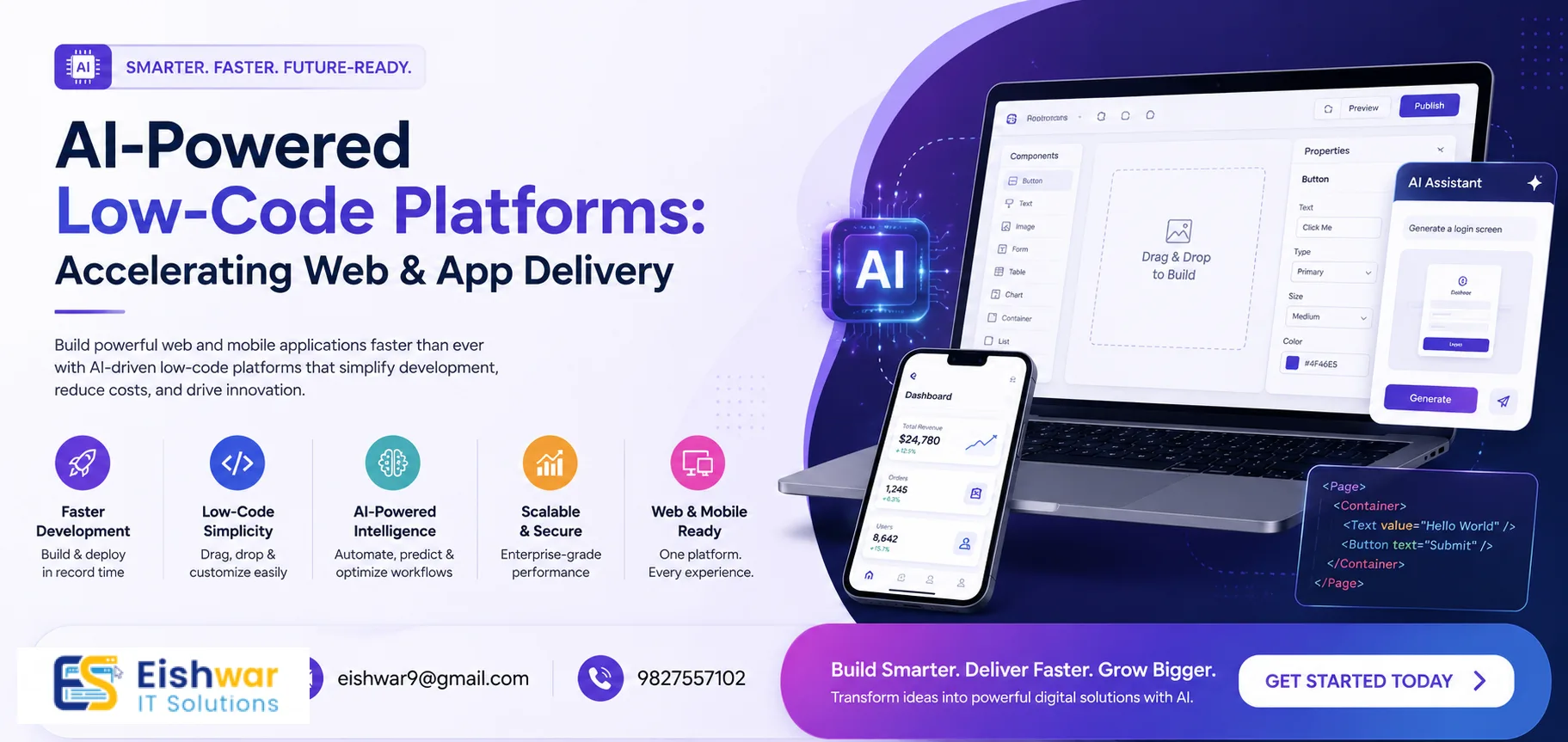
Low-code platforms have been around for a while, but the integration of artificial intelligence takes them to a new level. AI-powered low-code platforms use machine learning, natural language processing, and predictive analytics to automate repetitive tasks, suggest code snippets, and even generate entire modules based on user requirements. Think of it as having an intelligent assistant that understands your business logic and helps you build faster.
For example, instead of manually configuring a user authentication system, an AI low-code platform can analyze your app's requirements and auto-generate secure login flows. This reduces development time by up to 70%. Popular platforms like OutSystems, Mendix, and Microsoft Power Apps now offer AI copilots that guide developers through complex workflows. In India, where skilled developer talent is both scarce and expensive, these platforms democratize app creation. Business owners, marketers, and operations teams can now participate directly in building tools, rather than waiting weeks for IT.
Key features include drag-and-drop interfaces, pre-built templates, AI-driven testing, and automated deployment. The result? Faster time-to-market, lower costs, and higher quality. For instance, a retail business in Mumbai used an AI low-code platform to build a customer loyalty app in just three weeks—a project that would have taken three months traditionally. This is the power of combining low-code with AI.
Main Section 2: Why Indian Businesses Should Embrace AI Low-Code in 2026
India's digital transformation is accelerating, with projections showing that by 2026, over 60% of Indian enterprises will have adopted some form of low-code development. The reasons are compelling. First, cost efficiency. Hiring a full-stack developer in India can cost upwards of ₹12 lakh per annum. With AI low-code platforms, you need fewer developers, and those you have can focus on high-value tasks instead of boilerplate code. Second, speed. In a market where first-mover advantage is critical, being able to launch an MVP in days rather than months can be the difference between success and obscurity.
Third, agility. Indian businesses face rapidly changing regulations, customer preferences, and competitive landscapes. AI-powered low-code platforms allow you to iterate quickly—update your app's features, fix bugs, and add new functionalities without rewriting entire codebases. For example, a fintech startup in Bengaluru used an AI low-code platform to comply with new RBI guidelines in just two days, while competitors took weeks. Fourth, AI enhances the platform's intelligence. It can automatically detect performance bottlenecks, suggest optimizations, and even predict user behavior to improve UX. This is not just about building apps; it's about building smarter apps.
Finally, the ecosystem in India is maturing. Local cloud providers like Jio and AWS India regions offer seamless integration with low-code platforms, reducing latency and ensuring data sovereignty. EishwarITSolution recommends that businesses start with a pilot project—perhaps an internal tool or a customer-facing feature—to test the waters before scaling.
Main Section 3: Practical Steps to Get Started with AI Low-Code
Ready to dive in? Here's a step-by-step guide to adopting AI-powered low-code platforms for your next web or app project.
Step 1: Define Your Use Case. Start small. Identify a specific business problem that can be solved with a simple app or workflow. For example, automating lead capture from your website or building a customer support ticketing system. Avoid trying to build a complex ERP from day one.
Step 2: Choose the Right Platform. Evaluate platforms based on your team's technical skills, budget, and integration needs. For Indian businesses, consider platforms like OutSystems (enterprise-grade), Mendix (great for collaboration), or Zoho Creator (affordable and India-friendly). Look for AI features such as intelligent form generation, automated testing, and predictive analytics.
Step 3: Assemble a Hybrid Team. You don't need a large team. Pair a business analyst (who understands the process) with a citizen developer (who can use the low-code tool) and a senior developer (for complex integrations). This trio can often deliver faster than a traditional team of five.
Step 4: Leverage AI Assistance. Use the platform's AI copilot to generate initial app structures, suggest data models, and automate testing. For instance, if you're building an inventory management app, the AI can automatically create tables for products, suppliers, and orders based on your description.
Step 5: Iterate and Scale. Launch your MVP quickly, gather user feedback, and use the platform's agility to make improvements. As you gain confidence, expand to more critical applications. Remember, AI low-code platforms are not just for simple apps; they can handle complex workflows with proper architecture.
Expert Tips
- Start with a clear governance model. Even with low-code, you need standards for data security, API usage, and user access. This prevents chaos as you scale. For example, define who can publish apps and what data they can access.
- Invest in training. Your team needs to understand both the platform and AI capabilities. Many platforms offer free certification courses. Encourage your staff to get certified, and consider hands-on workshops to build confidence.
- Use AI for testing. One of the biggest time-savers is AI-driven test automation. Let the platform generate test cases and run regression tests automatically. This ensures quality without manual effort. For instance, AI can simulate thousands of user interactions in minutes.
- Monitor performance. Use built-in analytics to track app usage, identify bottlenecks, and optimize continuously. AI can even suggest code improvements based on real usage data, such as optimizing database queries or caching frequently accessed data.
- Partner with experts. If you're unsure, work with a consultancy like EishwarITSolution that has experience in AI low-code implementations. We can help you avoid common pitfalls and accelerate your learning curve, especially with complex integrations.
Common Mistakes
- Overcomplicating the first project. Many businesses try to build too much too soon. Keep your first low-code project simple—a single workflow or a departmental tool. Success breeds confidence. For example, start with an expense tracking app before tackling a full CRM.
- Ignoring security. Low-code platforms handle many security aspects, but you must still configure authentication, encryption, and compliance (e.g., India's DPDP Act). Never skip security reviews. Use role-based access control and encrypt sensitive data at rest and in transit.
- Neglecting user training. An app is only as good as its adoption. Provide training and documentation for end-users. AI features like in-app guidance can help, but human support is still key. Consider creating short video tutorials for common tasks.
- Choosing the wrong platform. Not all low-code platforms are created equal. Some are better for internal tools, others for customer-facing apps. Evaluate based on your specific needs, not just hype. For instance, Zoho Creator is great for small businesses, while OutSystems suits large enterprises.
- Thinking low-code means no-code. While low-code reduces coding, you still need some technical skills for integrations and custom logic. Be realistic about your team's capabilities. Plan for a learning curve of a few weeks to become proficient.
Future Trends
Looking ahead to 2026 and beyond, AI-powered low-code platforms will become even more intelligent. Expect to see AI that can understand natural language requirements and automatically generate complete applications—imagine describing your app idea in plain English and having it built in minutes. This is already emerging with platforms like Microsoft Power Apps' Copilot. Additionally, AI will enable hyper-personalization, where apps dynamically adapt to individual user preferences without manual configuration.
Another trend is the convergence of low-code with edge computing and IoT. Indian businesses in manufacturing, logistics, and agriculture will be able to build apps that process data from IoT sensors in real-time, all using low-code interfaces. AI will also enhance collaboration between human developers and AI agents, creating a symbiotic workflow where AI handles routine tasks and humans focus on strategy and creativity.
Finally, regulatory compliance will become easier. AI low-code platforms will incorporate compliance checks for Indian laws like GST, DPDP, and RBI guidelines, automatically generating required reports and audit trails. This will be a major boon for startups and SMEs that lack dedicated legal teams. For example, a platform could automatically flag non-compliant data handling practices during development.
FAQs
- What is an AI-powered low-code platform? It's a development environment that combines visual drag-and-drop tools with artificial intelligence to automate coding, testing, and deployment, enabling faster app creation with less manual coding.
- How does AI enhance low-code development? AI automates repetitive tasks like generating code snippets, suggesting data models, running tests, and predicting performance issues. It also provides intelligent recommendations based on best practices.
- Can non-technical business owners use these platforms? Yes, many AI low-code platforms are designed for citizen developers. However, some technical understanding is helpful for complex integrations. With training, marketers and operations professionals can build functional apps.
- What are the cost benefits for Indian businesses? AI low-code platforms reduce development costs by up to 70% by cutting developer hours, minimizing errors, and speeding up time-to-market. This is especially valuable for SMEs with tight budgets.
- Is AI low-code secure for business-critical applications? Yes, when properly configured. Leading platforms offer enterprise-grade security features like role-based access, encryption, and compliance certifications. Always follow security best practices and conduct regular audits.
- How do I choose the right platform for my business? Consider your team's skills, project complexity, budget, and integration needs. Evaluate platforms like OutSystems, Mendix, Zoho Creator, or Microsoft Power Apps. Start with a free trial or pilot project.
- Can AI low-code platforms handle complex enterprise applications? Absolutely. Modern platforms can handle complex workflows, integrations with ERP/CRM systems, and high-traffic applications. They are used by Fortune 500 companies for mission-critical apps.
- What is the role of EishwarITSolution in AI low-code adoption? We provide consulting, platform selection, implementation, training, and ongoing support. Our team helps Indian businesses maximize the ROI of AI low-code platforms while avoiding common pitfalls.
Conclusion
AI-powered low-code platforms are not just a technological advancement; they are a strategic enabler for Indian businesses in 2026. By combining the ease of visual development with the intelligence of AI, these platforms allow you to build web and mobile applications faster, cheaper, and smarter. Whether you are a startup looking to launch an MVP or an established enterprise seeking to digitize operations, now is the time to embrace this trend. The future of development is collaborative—humans and AI working together to create exceptional digital experiences. At EishwarITSolution, we are committed to helping you navigate this exciting landscape. Start your low-code journey today and unlock new levels of productivity and innovation.
CTA
Ready to accelerate your web and app development with AI-powered low-code? Contact EishwarITSolution today for a free consultation. Our experts will help you choose the right platform, design your first project, and train your team. Don't let complexity slow you down—embrace the future of development now.