
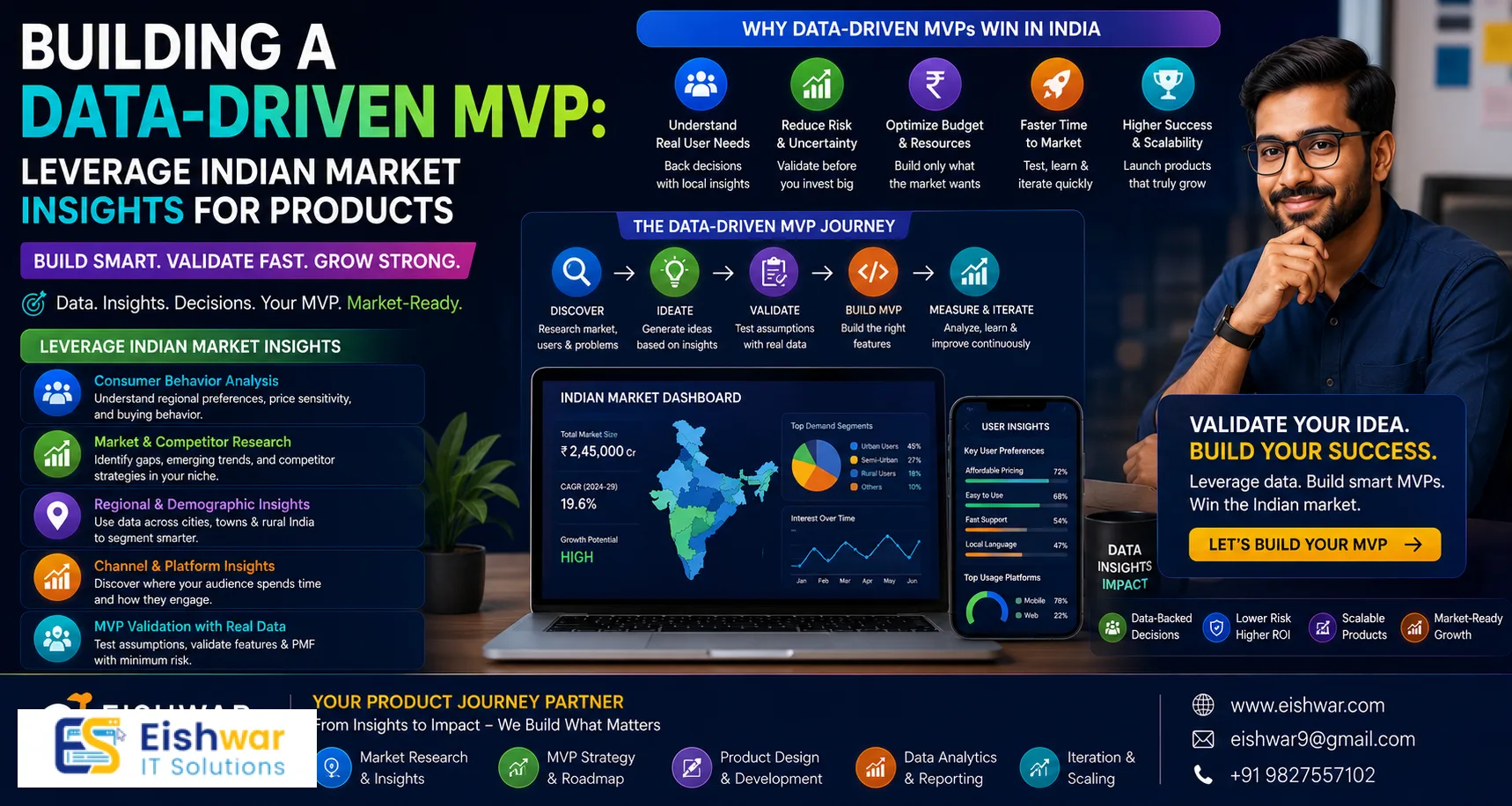
Building a Data-Driven MVP: Leverage Indian Market Insights for Produc
Published on: 06 Jul 2026
Building a Data-Driven MVP: Leverage Indian Market Insights for Product Validation
Introduction
In the fast-paced world of Indian startups, building a Minimum Viable Product (MVP) is no longer just about speed—it's about precision. A data-driven MVP uses real market insights to validate your idea before you invest heavily. For Indian entrepreneurs, tapping into local data—from regional consumer behavior to digital payment trends—can make or break your product. This guide will show you how to harness Indian market insights to build an MVP that truly resonates, with practical steps and real-world examples tailored to the unique dynamics of the Indian market.
Learn more about our Website services
Main Section 1: Why Indian Market Data Matters for Your MVP
India is not a single market; it's a mosaic of languages, cultures, and economic levels. A generic MVP built on global assumptions often fails here. For example, a food delivery app that works in the US might flop in tier-2 Indian cities if it ignores cash-on-delivery preferences. According to a 2025 report by NASSCOM, 72% of Indian startups fail due to lack of market fit. Using Indian-specific data—like GST registrations, UPI transaction volumes, or regional internet penetration—helps you identify real pain points. EishwarITSolution recommends starting with government datasets, such as the Ministry of Statistics, to understand your target audience's digital behavior. For instance, if you're targeting rural areas, data from the Telecom Regulatory Authority of India (TRAI) can reveal that internet penetration is only 30% in some states, suggesting a need for offline-first features. Similarly, the Reserve Bank of India's (RBI) data on UPI transactions shows that states like Maharashtra and Karnataka have over 80% adoption, while Bihar lags at 40%, influencing your payment strategy. By leveraging such granular insights, you can tailor your MVP to specific user segments, avoiding the one-size-fits-all trap that leads to failure.
Main Section 2: Step-by-Step Process to Build a Data-Driven MVP
Step 1: Define Your Hypothesis with Local Data
Start by analyzing secondary data from sources like the India Brand Equity Foundation (IBEF) or Statista India. For instance, if you're building a fintech MVP, look at RBI's digital payment statistics to see which states have high UPI adoption. Also, explore the National Sample Survey Office (NSSO) reports for consumption patterns. For example, a startup aiming to create a budgeting app for salaried professionals in Delhi could use data from the Ministry of Labour & Employment to understand average income brackets and spending habits. This helps you form a hypothesis like, 'Professionals in Delhi spend 40% of their income on rent and groceries, so an MVP focusing on automated savings for these categories will gain traction.'
Step 2: Conduct Primary Research Using Indian Tools
Use platforms like SurveyMonkey India or Google Forms with local language options. Run polls on WhatsApp Business to get quick feedback from your network. EishwarITSolution suggests interviewing at least 30 potential users from your target city. For example, if your MVP is for small business owners in Jaipur, use WhatsApp groups of local trade associations to distribute a survey in Hindi. Ask about their biggest pain points—like inventory management or payment delays—and use the responses to prioritize features. Additionally, leverage tools like Typeform for engaging surveys and set up a simple chatbot on Telegram to collect feedback. Remember to offer small incentives, like a ₹100 Amazon voucher, to boost participation rates.
👉 Don't wait for the perfect moment; turn your vision into reality today.
Free ConsultationStep 3: Build a Lean MVP with Data-Driven Features
Prioritize features based on frequency of user pain points. For example, if your data shows that small business owners struggle with inventory tracking, make that your core feature. Use no-code tools like Bubble or FlutterFlow to iterate fast. For instance, a startup building a logistics MVP for local kirana stores in Mumbai discovered from data that 70% of owners used WhatsApp for orders. So, they built an MVP that integrated with WhatsApp Business API to automate order management, rather than building a separate app. This reduced development time to 3 weeks and cost under ₹50,000. Also, consider using platforms like Adalo for mobile apps or Glide for spreadsheet-based apps to test your concept without heavy investment.
Step 4: Launch and Measure with Indian Metrics
Track metrics like Daily Active Users (DAU), retention rate, and Net Promoter Score (NPS) among Indian users. Tools like Mixpanel and Google Analytics can segment by location. Adjust based on regional feedback. For example, if you launch in Bangalore and find that users churn after 7 days, analyze the data to see if it's due to slow load times on 4G networks or a confusing interface. Use A/B testing with tools like VWO to test different onboarding flows. Also, measure customer acquisition cost (CAC) using Indian ad platforms like Google Ads India or Facebook Ads, which offer granular targeting by city and language. Set up a simple dashboard in Google Data Studio to visualize these metrics weekly, and pivot if needed.
Main Section 3: Real-World Example: A Data-Driven MVP for Indian EdTech
Consider a startup that wanted to build an online tutoring platform for rural students. Instead of copying Western models, they analyzed data from the Unified District Information System for Education (UDISE+). They discovered that most rural students accessed the internet via shared smartphones and preferred video content in Hindi. Their MVP focused on short, downloadable video lessons with offline access. Within six months, they had 10,000 active users and a 40% retention rate. This data-first approach saved them from building expensive live-streaming features that wouldn't have worked. They also used data from the National Family Health Survey (NFHS) to understand that many students in rural areas had limited electricity, so they optimized videos to be under 10 MB for easy download. Additionally, they partnered with local NGOs to distribute the app via SD cards in areas with no internet, resulting in a 25% increase in user base within three months. This example underscores how deep local insights can transform an MVP from a generic product to a tailored solution that solves real problems.
Expert Tips
- Use Google Trends India to check real-time search interest for your problem. For instance, if you're building a health app, search for 'home remedies for cold' to see seasonal spikes in demand.
- Leverage free tools like the Indian Census data to validate demographic assumptions. For example, check the age distribution in your target city to ensure your product appeals to the right age group.
- Partner with local colleges or co-working spaces to get beta testers. Offer free access to your MVP in exchange for detailed feedback, and use platforms like Internshala to recruit interns for user testing.
- Run A/B tests on pricing models using Indian payment gateways like Razorpay. Test different price points, such as ₹99 vs. ₹149 per month, and analyze conversion rates across states.
- Monitor social media chatter on platforms like ShareChat or Koo for unfiltered feedback. For example, search for keywords related to your problem in Hindi or Tamil to understand user sentiment.
- Use tools like SurveySparrow to create interactive surveys that work well on low-bandwidth connections, ensuring you capture feedback from users in remote areas.
Common Mistakes
- Relying solely on global data without local context. For example, assuming that all Indian users prefer credit cards because US data shows high adoption, while in India, UPI and cash on delivery dominate.
- Overcomplicating the MVP with too many features. A common error is adding a recommendation engine when users just want a simple search function. Stick to the core value proposition.
- Ignoring non-urban user behavior and preferences. For instance, designing an app that requires high-speed internet for video calls, when many users in tier-3 cities rely on 2G networks.
- Not validating with real Indian currency (e.g., asking for payment upfront). Many users are hesitant to pay without first experiencing value, so consider a freemium model or a low-cost trial.
- Failing to iterate based on data—sticking to initial assumptions. For example, if data shows that users drop off at the signup page, but you ignore it and continue with the same flow, you'll lose potential customers.
Future Trends
By 2027, AI-driven analytics will make it easier to predict Indian market trends. Tools like ChatGPT integrated with Indian datasets will help startups generate hyper-local insights. For example, an AI model trained on state-wise agricultural data could predict demand for farming tools in Punjab vs. Tamil Nadu. The rise of voice-based interfaces in Hindi and regional languages will also shape MVP design, as seen with the success of voice assistants like Alexa in Indian households. EishwarITSolution predicts that data privacy regulations (like India's Digital Personal Data Protection Act) will require MVPs to be transparent from day one, meaning startups must build in consent mechanisms and data encryption from the start. Additionally, the growth of 5G in urban areas will enable more data-intensive features, but startups must still cater to users in areas with limited connectivity. Finally, the increasing use of blockchain for supply chain transparency could inspire MVPs that track product origins, especially for sectors like organic food or pharmaceuticals.
👉 Free Website Audit
Get Free AuditFAQs
1. What is a data-driven MVP?
A data-driven MVP is a minimum viable product built using real market data to validate assumptions, reducing the risk of failure. It involves collecting and analyzing data on user behavior, preferences, and pain points before and during development, ensuring that every feature is backed by evidence rather than guesswork.
👉 Free Homepage Demo
Book Demo2. How can I get Indian market data for free?
Use government sources like the Ministry of Statistics, RBI reports, and open data portals like data.gov.in. Also, tools like Google Trends India and Statista offer free tiers. For example, the Ministry of Electronics and Information Technology (MeitY) provides reports on digital adoption, and the National Sample Survey Office (NSSO) offers household consumption data. Additionally, platforms like IndiaSpend and FactChecker provide curated datasets for social issues.
3. What metrics should I track for an Indian MVP?
Focus on user acquisition cost, retention rate, time spent on app, and NPS. Segment by city and language to understand regional differences. For instance, track how users in Mumbai vs. Lucknow engage with your app, and adjust features accordingly. Also, monitor churn rate and customer lifetime value (CLV) to assess long-term viability.
4. Can I build an MVP without coding?
Yes, no-code platforms like Bubble, Adalo, and Glide allow you to create functional MVPs without technical skills, perfect for testing ideas quickly. For example, you can build a simple marketplace app in Bubble within a week, using drag-and-drop features. These platforms also integrate with Indian payment gateways like Razorpay and social logins like Google and Facebook.
5. How long does it take to build a data-driven MVP?
Typically 4-8 weeks, depending on complexity and data availability. The research phase might take 1-2 weeks, followed by 2-4 weeks for development using no-code tools, and 1-2 weeks for testing and iteration. For a more complex MVP with custom features, it could take up to 12 weeks.
6. What if my MVP fails?
Failure is part of the process. Use the data to pivot or refine your idea. Many successful Indian startups like Ola and Zomato pivoted after initial MVPs. For example, Ola started as a cab aggregator but later expanded to auto-rickshaws and bike taxis based on user demand. Analyze the data to understand why it failed—was it the wrong target audience, poor user experience, or lack of demand? Then, iterate or pivot to a new hypothesis.
7. How do I choose the right features for my MVP?
Prioritize features based on frequency of user pain points from your research. Use a framework like the MoSCoW method (Must-have, Should-have, Could-have, Won't-have) to categorize. For example, if your data shows that 80% of users struggle with payment delays, make a fast payment feature a 'Must-have,' while a referral program can be a 'Could-have.'
8. What are the best tools for Indian market research?
Besides government sources, use SurveyMonkey India, Google Forms, and Typeform for surveys. For social listening, use Brandwatch or Talkwalker with filters for Indian languages. For competitor analysis, use SimilarWeb to see traffic sources of Indian competitors. Also, tools like LocalCircles can help you run polls on hyper-local issues.
Conclusion
Building a data-driven MVP is the smartest way to launch in India's diverse market. By leveraging local insights, you validate your idea faster, save money, and create a product that users actually need. Start with small data, iterate relentlessly, and let the market guide you. EishwarITSolution is here to help you every step of the way, from data collection to MVP launch and beyond.
CTA
Ready to build your data-driven MVP? Contact EishwarITSolution today for a free consultation. Our experts will help you turn market insights into a winning product, with tailored strategies for the Indian market.