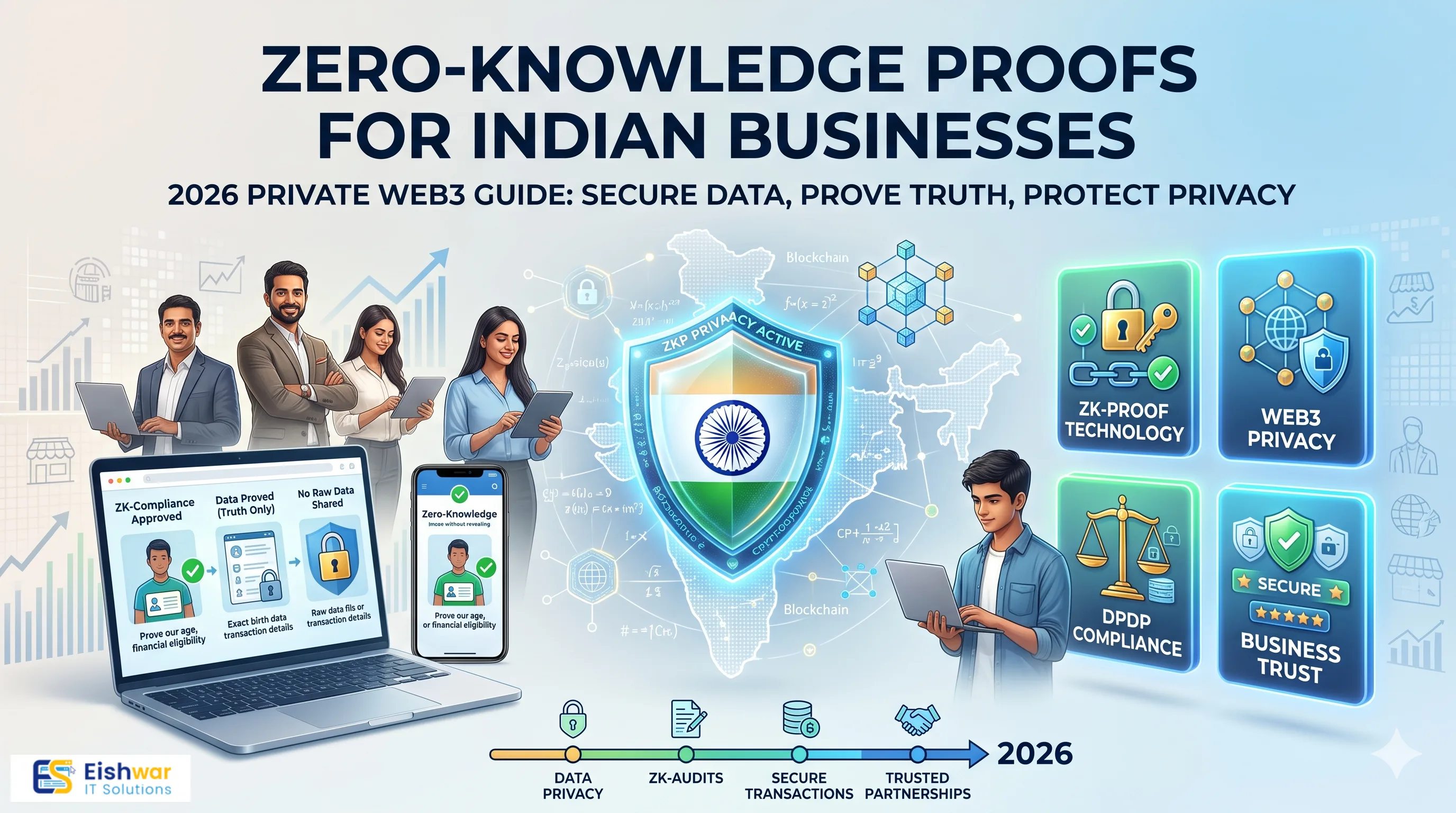
Zero-Knowledge Proofs for Indian Businesses: 2026 Private Web3 Guide
Introduction
Indian businesses are no longer asking whether blockchain is useful. They are asking a sharper question: how do we use it without exposing sensitive customer, supplier, and financial data? That is where zero-knowledge proofs, or ZKPs, are becoming a practical Web3 solution in 2026.
A zero-knowledge proof lets one party prove that a statement is true without revealing the underlying data. For example, a customer can prove they are above 18 without showing a birth certificate. A supplier can prove a product is organic without publishing its entire audit trail. An MSME can prove turnover eligibility for a tender without handing over confidential bank statements.
For Indian businesses, this matters because privacy is now a boardroom issue. The Digital Personal Data Protection Act, RBI digital lending norms, CERT-In directions, and global client requirements are pushing companies to collect less data, store it carefully, and prove compliance. ZKPs offer a way to do that while keeping trust on-chain or in a verifiable system.
This guide explains zero-knowledge proofs in plain English, shows practical use cases for Indian companies, covers compliance and architecture, and gives you a roadmap to run a pilot without wasting time or money.
Main Section 1: What Are Zero-Knowledge Proofs and Why Indian Businesses Need Them in 2026
A zero-knowledge proof is a cryptographic method that allows a prover to convince a verifier that a fact is true. The verifier learns nothing else. In a business context, this means you can verify eligibility, identity, ownership, or compliance without moving raw data between parties.
Think of it like proving you have enough balance in your bank account to buy a car. You do not need to show the dealer your full bank statement. You only need a trusted proof that says your balance is above the required amount. ZKPs make that proof mathematically verifiable.
The three core properties
- Completeness: If the statement is true, an honest prover can convince the verifier.
- Soundness: If the statement is false, a dishonest prover cannot fake a valid proof.
- Zero-knowledge: The verifier learns nothing beyond the truth of the statement.
Popular types of ZKPs
In 2026, Indian teams mostly work with four families. zk-SNARKs produce small, fast-to-verify proofs but often need a trusted setup. zk-STARKs are transparent and scalable but create larger proofs. Bulletproofs are useful for range proofs, such as proving a salary is within a band. Recursive proofs allow one proof to verify many other proofs, which is powerful for scaling and compliance audits.
You will also hear about PLONK, Halo2, Groth16, and newer systems. The right choice depends on your use case, team skills, verification cost, and whether you can manage a trusted setup ceremony.
How ZKPs differ from encryption and public blockchain transparency
Encryption hides data in transit and at rest, but it does not let someone verify a fact without decrypting it. Public blockchains are transparent by default, which is great for auditability but terrible for privacy. ZKPs sit between these two worlds. They preserve verification while minimizing data exposure.
This is especially important in India, where businesses often need to prove compliance to regulators, partners, and customers without sharing personal data across every layer of the web solution.
Why Indian businesses need ZKPs now
- DPDP Act compliance: Data minimization and purpose limitation are easier to demonstrate when you never collect raw data.
- Customer trust: After repeated data breaches, users prefer services that ask for less.
- Fintech and banking: KYC, lending, and account aggregation can use proofs instead of document sharing.
- Global exports: European and US clients increasingly ask for privacy-by-design evidence.
- Cost control: Fewer data stores mean lower breach risk, lower compliance overhead, and simpler audits.
In short, ZKPs are not just a crypto trend. They are becoming a privacy and verification layer for modern web solutions.
Main Section 2: Practical Ways Indian Businesses Can Use Zero-Knowledge Proofs
The best way to understand ZKPs is through business scenarios. Here are practical ways Indian companies can use them in 2026.
1. Private KYC and reusable customer credentials
Banks, NBFCs, fintech apps, and gaming platforms spend heavily on KYC. With ZKPs, a customer can complete KYC once with a trusted issuer and later prove they are verified without sharing PAN, Aadhaar, or address documents again. A lending app can check that an applicant meets income and age criteria without storing the underlying documents.
This reduces onboarding friction and limits the blast radius of a breach. If the verifier only receives a proof, there is no sensitive document to leak.
2. Supply chain provenance without exposing supplier economics
Indian exporters, agri-businesses, and manufacturers need to prove origin, quality, and compliance. But they do not want to reveal supplier pricing, routes, or contract terms. ZKPs allow a business to prove that a product meets a standard, such as organic certification or fair-labour compliance, without publishing the full supply chain data.
Buyers get confidence. Suppliers keep confidentiality. Auditors can verify proofs when needed.
3. Loyalty, rewards, and tier eligibility
Loyalty programs often require customers to share purchase history. A ZKP can prove that a customer qualifies for a premium tier, a discount, or a cashback without exposing every transaction. This is useful for airlines, retail chains, fintech rewards, and D2C brands that want personalization without surveillance.
4. B2B tenders and credential verification
Government and enterprise tenders require proof of turnover, certifications, tax compliance, and past performance. Today, vendors submit large document packs. With ZKPs, a vendor can prove they meet the criteria while keeping financial statements private. The buyer verifies the proof and shortlists faster.
5. Verifiable AI and private data collaboration
AI models often need sensitive data from multiple parties. ZKPs can prove that a model ran correctly on private inputs without revealing the data itself. In healthcare, a diagnostic AI can prove it followed an approved model without exposing patient records. In finance, a fraud model can prove a transaction was scored correctly without revealing customer details.
6. Employee and shareholder voting
Companies can run internal votes where eligibility and results are verifiable, but individual choices remain private. This is useful for ESOP decisions, shareholder resolutions, and community governance in Web3 projects.
Implementation roadmap for Indian businesses
- Identify a high-friction privacy process: onboarding, KYC, vendor verification, or loyalty.
- Define the exact statement to prove: “user is over 18,” “vendor turnover is above 5 crore,” “product is organic.”
- Choose the proof system: zk-SNARKs for small proofs, zk-STARKs for transparency, or recursive proofs for scale.
- Start off-chain, verify on-chain: keep sensitive data off-chain and only put proofs or verification results on-chain.
- Build a small pilot: one circuit, one user group, one verifier.
- Audit the circuit and smart contract: a bug in the circuit can break the entire privacy promise.
- Measure and scale: track onboarding time, fraud rate, cost per verification, and user trust.
Useful tools include Circom, SnarkJS, Noir, Halo2, and platforms such as Polygon zkEVM, zkSync, StarkNet, Aleo, Mina, and Aztec. Indian developers are increasingly familiar with these stacks, but deep ZK talent is still scarce. A focused pilot can range from a few lakh rupees to a larger enterprise budget depending on complexity, audits, and integrations.
Main Section 3: Compliance, Architecture, and ROI for ZKPs in India
Zero-knowledge proofs are powerful, but they are not a compliance shortcut. Indian businesses must map ZKPs to legal and operational requirements.
Compliance mapping for India
- DPDP Act: ZKPs support data minimization, purpose limitation, and consent. But you still need lawful basis, notices, and grievance redressal.
- RBI KYC and digital lending: Proofs can reduce document collection, but regulated entities must confirm that the method meets KYC and audit expectations.
- CERT-In directions: Logs, incident reporting, and security practices still apply. A proof does not replace basic cyber hygiene.
- SEBI, IRDAI, and sector rules: Financial and insurance workflows may need additional controls before using ZKPs in production.
- Global privacy laws: If you serve EU or US customers, GDPR and state privacy laws add another layer of documentation.
Always involve legal and compliance teams early. The goal is not to hide data from regulators. The goal is to share only what is necessary.
Architecture patterns that work
Most Indian businesses should use a hybrid architecture. Raw data stays in a secure off-chain database or user wallet. A ZK circuit generates a proof. A smart contract or verification service checks the proof. The result is recorded on-chain or in an audit log.
For scale, use zk rollups or proof aggregators so you are not verifying every proof on the main chain. For privacy, use nullifiers to prevent double-spending or repeated claims. For operations, build a fallback manual review process in case a proof fails.
Security checklist
- Run a trusted setup ceremony if your proof system requires it.
- Audit circuits for logic errors, overflow, and missing constraints.
- Protect proving keys and verifier keys with strong key management.
- Test for side-channel leaks and metadata exposure.
- Monitor for replay attacks and proof reuse.
- Keep an upgrade path for post-quantum cryptography.
Calculating ROI
ZKPs can improve return on investment in several ways. They reduce the amount of sensitive data you store, which lowers breach and compliance costs. They speed up onboarding, which improves conversion. They enable premium privacy features that customers may pay for. They also strengthen your position with global clients who demand privacy-by-design.
Track metrics such as onboarding completion rate, time to verify, fraud attempts blocked, cost per KYC, audit preparation time, and customer trust scores. A pilot should prove one clear business metric before you scale.
Build versus partner? Most Indian businesses should partner for the first pilot. ZK development is specialized, and a wrong circuit design can be expensive to fix. Once the model works, train internal teams to maintain and extend it.
Expert Tips
- Start with one narrow circuit. Do not try to prove your entire business logic in the first version.
- Keep raw data off-chain. The blockchain should verify proofs, not store personal data.
- Design for auditability. Regulators and partners need to understand what a proof means.
- Use zk rollups for scale. If you expect high volume, plan for cheaper verification.
- Involve legal early. Privacy law and cryptography must be designed together.
- Test with real Indian users. UX matters. If users do not understand the privacy benefit, adoption will suffer.
- Budget for audits. Circuit audits are not optional for production financial or identity use cases.
- Plan key management. Lost proving keys can break operations; leaked keys can break trust.
Common Mistakes
- Treating ZKPs as magic privacy. Metadata, timing, and wallet patterns can still leak information.
- Ignoring compliance. A proof does not remove your obligations under DPDP, RBI, or sector rules.
- Overengineering the first version. Complex circuits take longer and cost more to audit.
- Weak trusted setup. If the setup is compromised, fake proofs may become possible.
- No fallback process. Proofs can fail for legitimate reasons; users need a support path.
- Poor user experience. If proving takes too long or feels confusing, users drop off.
- Assuming regulators will understand immediately. Prepare clear documentation and sandbox discussions.
- Not measuring ROI. Without metrics, ZKPs become an expensive experiment instead of a business win.
Future Trends
Zero-knowledge proofs are moving from crypto-native projects into mainstream Indian web solutions. Here are the trends to watch.
- ZK and AI agents: Agents will need to prove they followed rules without exposing user data.
- ZK identity wallets: Reusable credentials for KYC, age, and eligibility will reduce repeated document sharing.
- India Stack integration: Expect more experiments that connect verifiable credentials with digital public infrastructure.
- zkEVM maturity: Easier developer tools will lower the barrier for Indian startups and enterprises.
- Post-quantum ZK: Quantum-resistant proof systems will become a board-level discussion.
- ZK-as-a-service: Cloud and platform providers will offer managed proving and verification.
- Interoperable proofs: Proofs will move across chains and platforms, making privacy portable.
- Regulatory sandboxes: More Indian regulators may test privacy-preserving compliance with selected businesses.
FAQs
What is a zero-knowledge proof in simple terms?
It is a way to prove that something is true without revealing the information behind it. For example, you can prove you are eligible for a loan without sharing your full bank statement.
Are zero-knowledge proofs legal in India?
There is no blanket ban on ZKPs. They are a cryptographic method. However, their use must comply with applicable laws such as the DPDP Act, RBI rules, and sector-specific regulations. Legal review is essential.
How much does ZKP implementation cost for Indian businesses?
Costs vary widely. A small pilot may cost a few lakh rupees. Production systems with audits, integrations, and high-volume verification can cost significantly more. Start with a narrow use case to control budget.
Can ZKPs work with existing Indian apps and databases?
Yes. Most implementations keep existing databases and add a proof generation layer plus a verifier. You do not need to rebuild your entire stack.
Do ZKPs replace blockchain?
No. ZKPs can work with or without a blockchain. Blockchain provides a shared verification and audit layer, while ZKPs provide privacy and proof efficiency. They complement each other.
Which Indian industries benefit most from ZKPs?
Fintech, banking, insurance, healthcare, supply chain, e-commerce, gaming, and any business that handles sensitive customer or vendor data can benefit.
Are ZKPs quantum-safe?
Some proof systems are more quantum-resistant than others, especially zk-STARKs. Quantum-resistant cryptography is evolving, so plan for future upgrades.
How should an Indian business start with ZKPs?
Pick one high-friction privacy process, define a simple statement to prove, build a pilot with off-chain data and on-chain verification, audit the circuit, and measure business impact before scaling.
Conclusion
Zero-knowledge proofs are no longer a niche cryptographic idea. In 2026, they are a practical way for Indian businesses to add privacy, compliance, and trust to Web3 solutions. Whether you are in fintech, supply chain, healthcare, or e-commerce, ZKPs can help you verify what matters without exposing what does not.
The winners will not be the companies that collect the most data. They will be the ones that can prove trust with the least data. Start small, involve legal and security teams, and measure results. A well-designed ZK pilot can become a competitive advantage in India and global markets.
CTA
Ready to explore zero-knowledge proofs for your business? EishwarITSolution helps Indian companies design privacy-first Web3 solutions, from pilot strategy to secure implementation. Visit eishwar.com or contact our team to discuss a ZKP pilot for your use case.