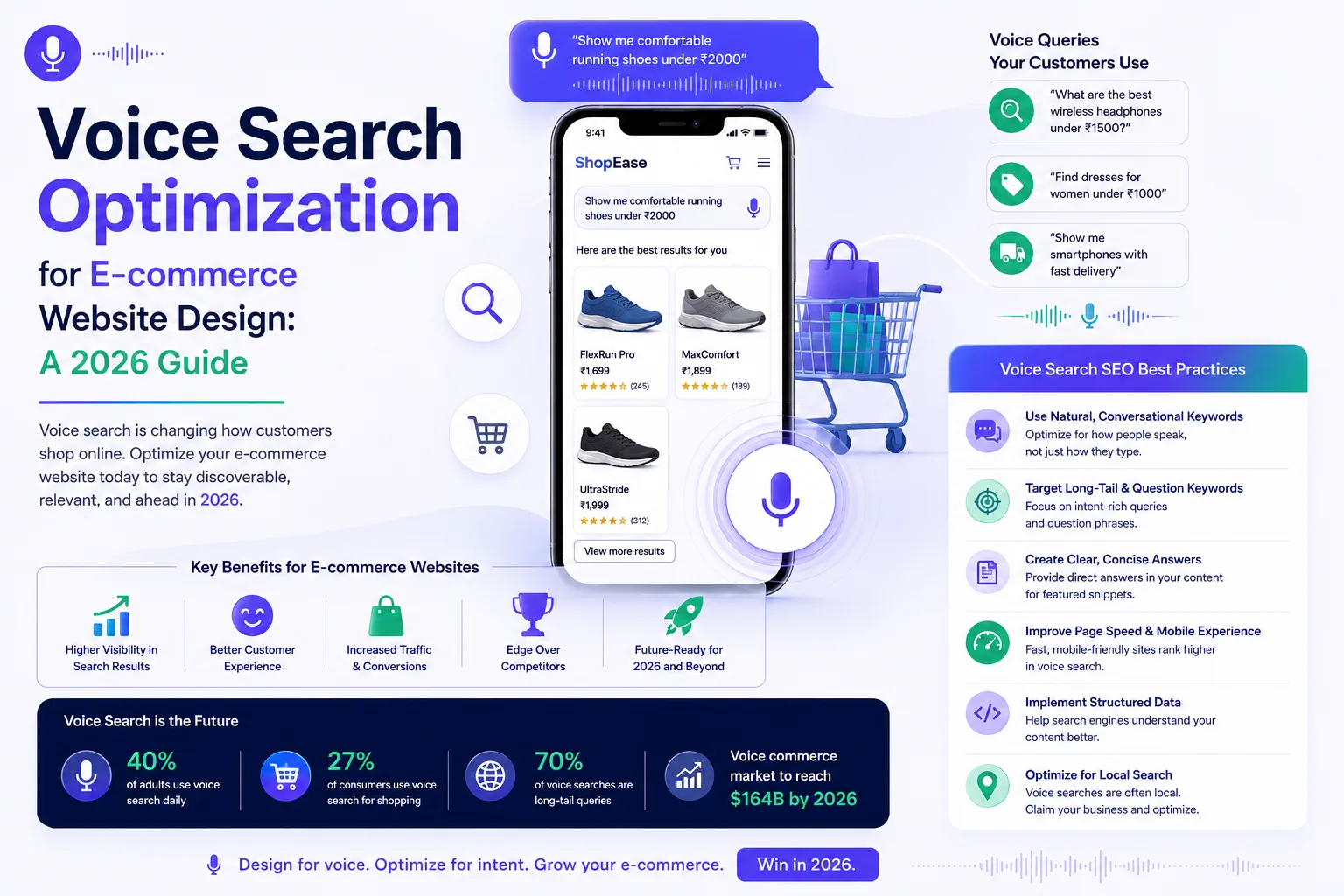
Voice Search Optimization for E-commerce Website Design: A 2026 Guide for Indian Businesses
Introduction
Imagine a customer in Mumbai asking their phone, “Where can I buy organic cotton kurtis near me?” Within seconds, they get a result—and if your e-commerce store isn’t optimized for that voice query, you just lost a sale. Welcome to 2026, where voice search isn’t a futuristic gimmick; it’s a daily habit for millions of Indian shoppers. From bustling metros like Delhi and Bengaluru to tier-2 cities like Lucknow and Coimbatore, voice assistants are becoming the go-to tool for product discovery.
India’s voice search usage has exploded, thanks to affordable smartphones, cheap data, and the rise of regional language assistants like Google Assistant in Hindi, Tamil, and Bengali. By 2026, over 50% of all online searches are expected to be voice-based. For e-commerce businesses, this means your website design must adapt—or risk being invisible. Consider this: a recent study found that 40% of Indian smartphone users perform at least one voice search daily, and that number is climbing. If your site isn’t ready, you’re missing out on a massive, engaged audience.
In this guide, we’ll show you exactly how to optimize your e-commerce website design for voice search. You’ll get practical, actionable tips tailored for the Indian market. Whether you’re a business owner, marketer, or web designer, this is your roadmap to voice-ready success. We’ll cover everything from keyword strategy to technical tweaks, with real-world examples from Indian brands that have already seen results.
Why Voice Search Matters for E-commerce in India
Voice search changes how people find products. Instead of typing “best wireless earphones under 2000,” they ask, “What are the best wireless earphones under 2000 rupees?” This shift from keyword-focused to question-based queries demands a new approach to e-commerce website design. It’s not just about being found; it’s about being the answer.
Here’s why it’s critical for Indian businesses:
- Convenience: Voice is faster than typing, especially on mobile—where most Indians shop. In a country where data is cheap but time is precious, voice search offers instant gratification.
- Local language dominance: Over 70% of Indian voice users prefer their native language. Your site must support Hinglish or regional scripts like Devanagari, Tamil, or Telugu. For example, a user in Chennai might ask, “Enaku virumbi cotton sarees enga kedaikum?” (Where can I find good cotton sarees?)—if your site doesn’t understand that, you lose.
- Local intent: “Near me” queries are huge. Voice search often includes location, making local SEO vital. A customer in Pune might say, “Find me a store that sells organic spices in Kothrud.” Without local optimization, you’re invisible.
- Competitive edge: Most e-commerce sites still ignore voice optimization. Early adopters win big. For instance, a small Jaipur-based handicraft store optimized for voice and saw a 50% increase in inquiries from tourists searching for “traditional blue pottery near Hawa Mahal.”
At EishwarITSolution, we’ve seen clients double their organic traffic by redesigning for voice. Let’s dive into the how.
How to Design Your E-commerce Website for Voice Search
1. Focus on Natural Language and Long-Tail Keywords
Voice queries are conversational. Instead of “men sneakers,” users say, “Where can I buy comfortable men’s sneakers for running?” Your product descriptions, category pages, and blog content must mirror this natural speech. Think of it as writing for a friend, not a search engine.
Actionable Tip: Use tools like AnswerThePublic or Google’s “People also ask” to find common questions. Then, create FAQ sections and product pages that answer those questions directly. For example, if you sell fitness gear, include a question like “What is the best yoga mat for beginners in India?” and answer it naturally. Also, consider using Google’s Keyword Planner with a conversational filter to identify long-tail phrases.
Example: An Indian shoe store optimized its product page for “comfortable walking shoes for flat feet in Mumbai.” They saw a 40% increase in voice-driven traffic within three months. The key was rewriting the product description to include phrases like “These shoes are perfect for long walks on Mumbai’s Marine Drive” and “Ideal for flat feet, with extra arch support.”
2. Optimize for Featured Snippets and Position Zero
Voice assistants often read from featured snippets—the boxed answer at the top of Google search results. To win this spot, structure your content for quick answers. This is crucial because voice assistants typically read only one result, so being in position zero is like winning the lottery.
How to do it:
- Use bullet points, numbered lists, and short paragraphs. For example, a “Top 5 Benefits of Using Organic Skincare” list is more likely to be picked up than a long paragraph.
- Answer questions concisely in 40–50 words. Voice assistants prefer direct, clear answers.
- Include schema markup (FAQ schema, Product schema) to help Google understand your content and increase your chances of being featured.
Example: A kitchen appliance store added a “How to clean a mixer grinder” guide with a step-by-step list. Google picked it as a snippet, and voice searches for that query tripled. The store also saw a 20% increase in sales of cleaning brushes and spare parts.
3. Improve Page Speed and Mobile Experience
Voice searches are mostly mobile. If your site takes more than 3 seconds to load, users bounce—and voice assistants won’t recommend you. In fact, Google’s research shows that 53% of mobile users abandon a site if it takes longer than 3 seconds to load. For voice search, this is even more critical because users expect instant answers.
Checklist:
- Compress images (use WebP format) to reduce file size without losing quality.
- Minify CSS, JavaScript, and HTML to streamline code.
- Use a content delivery network (CDN) for faster delivery, especially for users in remote areas.
- Enable Accelerated Mobile Pages (AMP) for key pages like product listings and blog posts.
- Optimize server response time by using a reliable hosting provider.
Remember: Google’s Core Web Vitals are ranking factors. A fast, smooth mobile experience directly boosts your voice search visibility. Tools like Google PageSpeed Insights can help you identify bottlenecks.
4. Embrace Structured Data (Schema Markup)
Schema helps search engines understand your content. For e-commerce, use these types:
- Product schema: Price, availability, reviews, brand. This helps voice assistants provide accurate product details.
- Organization schema: Business name, logo, contact info. Essential for building trust.
- FAQ schema: For question-and-answer content. This directly targets voice queries.
- LocalBusiness schema: If you have a physical store, include address, phone number, and hours.
Actionable Tip: Use Google’s Structured Data Markup Helper or plugins like Yoast SEO (WordPress) to add schema without coding. For custom sites, consider using JSON-LD format, which is Google’s preferred method.
5. Target Local Voice Queries
Indian users often search for “near me” or “in [city].” Optimize your site for local SEO:
- Create city-specific landing pages (e.g., “Buy Handloom Sarees in Jaipur” or “Organic Groceries in Bangalore”).
- Add your business to Google Business Profile with accurate address, hours, and photos. Encourage customers to leave reviews.
- Encourage customer reviews on Google and other platforms. Positive reviews boost local rankings.
- Use local keywords in your content, such as “best chai in Chandni Chowk” or “affordable furniture in Andheri.”
Example: A Delhi-based organic store created pages for “organic vegetables in Dwarka” and “chemical-free grains in Delhi.” Their voice traffic from local queries jumped by 60%, and they saw a 30% increase in in-store visits from nearby customers.
Expert Tips for Voice-Ready E-commerce Design
We spoke with leading e-commerce designers and SEO experts to bring you these pro insights:
- Simplify navigation: Voice users expect easy, logical menus. Use clear categories and a robust search bar with autocomplete. For example, instead of “Apparel > Men > Casual,” use “Men’s Casual Wear.”
- Use conversational tone: Write product descriptions as if you’re talking to a friend. Avoid jargon. Instead of “This garment is crafted from premium cotton,” say “This shirt is made from soft, breathable cotton—perfect for hot Indian summers.”
- Add voice search functionality: Let users search your site by speaking. Tools like Google’s Speech-to-Text API can integrate this. For example, a user could say “Show me red kurtis under 1000 rupees” and get instant results.
- Test with real users: Ask people to perform voice searches on your site and note friction points. Use tools like UserTesting or conduct in-person sessions.
- Optimize for zero-click searches: Many voice searches don’t result in a click. Ensure your site provides enough information in the snippet to drive users to your store.
One designer shared: “We redesigned a fashion store’s category pages to answer questions like ‘What to wear for a wedding in summer?’ The result? A 25% increase in time spent on site and higher conversions. Users loved the personalized feel.”
Common Mistakes to Avoid
Many businesses rush into voice optimization and make these errors:
- Ignoring regional languages: India is multilingual. Use Hinglish or local scripts where relevant. For example, a product page for “masala chai” should include phrases like “Achhi quality ki chai” (good quality tea).
- Keyword stuffing: Voice search rewards natural language, not repetitive keywords. Instead of “buy shoes online, cheap shoes online, best shoes online,” write “Looking for affordable, comfortable shoes? Check our collection.”
- Slow mobile pages: Even a 1-second delay can hurt rankings. Use tools like GTmetrix to monitor speed.
- No schema markup: Without it, Google can’t easily extract your content for voice answers. This is a common oversight.
- Forgetting about privacy: Voice data raises concerns. Be transparent about how you handle user data. Add a clear privacy policy and opt-in options.
- Not optimizing for multiple devices: Voice searches happen on phones, smart speakers, and even cars. Ensure your site is responsive across all platforms.
Avoid these pitfalls, and you’ll stay ahead of competitors who are still optimizing for typed searches only.
Future Trends in Voice Commerce (2026 and Beyond)
Voice search is evolving fast. Here’s what to watch:
- Voice shopping: Users will buy directly via voice assistants. Ensure your product catalog is voice-purchase ready with clear pricing, availability, and easy checkout. For example, a user might say “Alexa, order my usual coffee beans.”
- AI-driven personalization: Voice assistants will remember user preferences. Tailor your site to returning voice users with personalized recommendations. For instance, if a user frequently buys organic snacks, show them new arrivals first.
- Visual voice search: Combining voice with image recognition. For example, “Find me a dress like this one in blue.” This will require high-quality images and descriptive alt text.
- Regional language dominance: Expect more support for languages like Marathi, Telugu, and Tamil. Start creating content in these languages now.
- Integration with IoT: Smart speakers and home devices will drive more voice orders. For example, a smart fridge could order groceries automatically.
- Voice-based customer service: Chatbots and voice assistants will handle queries like “Where is my order?” or “What’s your return policy?”
Start preparing now. The businesses that adapt early will dominate voice commerce in India.
Frequently Asked Questions
What is voice search optimization for e-commerce?
It’s the process of designing your online store to appear in voice search results. This includes using natural language, schema markup, fast mobile design, and local SEO to answer user questions spoken into devices. The goal is to make your site the top result when someone asks a voice assistant a question related to your products.
How does voice search affect e-commerce website design?
Voice search prioritizes conversational queries, mobile speed, and structured data. Your design must be mobile-first, with clear navigation, FAQ sections, and fast loading times to rank for voice queries. It also requires a focus on local SEO and regional language support to capture Indian users.
Why is voice search important for Indian e-commerce in 2026?
India has one of the fastest-growing voice search user bases, driven by affordable smartphones and regional language support. Optimizing for voice helps businesses capture local, mobile-first shoppers who prefer speaking over typing. With over 50% of searches expected to be voice-based, ignoring it means losing a significant market share.
What schema types are best for voice search?
Product schema, FAQ schema, Organization schema, and LocalBusiness schema are most effective. They help search engines understand your content and display it as rich snippets in voice answers. For e-commerce, Product schema is particularly important for showing price and availability.
Can voice search work for regional languages in India?
Absolutely. Google Assistant supports Hindi, Tamil, Telugu, Bengali, Marathi, and more. Create content in Hinglish or use Unicode for native scripts to reach regional voice users effectively. For example, a product page for “pongal” in Tamil could include the query “Pongal seivathu eppadi?” (How to make pongal?).
How long does it take to see results from voice search optimization?
Results can vary, but many businesses see improvements within 3–6 months. Factors include your site’s current SEO, competition, and the quality of your optimization. Consistent effort in updating content and monitoring performance is key.
Do I need a separate website for voice search?
No, you don’t need a separate site. Voice search optimization is about enhancing your existing website with natural language, schema, and mobile improvements. A single, well-optimized site can serve both typed and voice searches effectively.
Conclusion
Voice search is not a passing trend—it’s a fundamental shift in how people discover and buy products online. For Indian e-commerce businesses, optimizing your website design for voice queries is no longer optional. It’s a competitive necessity. The data is clear: voice search is growing rapidly, and early adopters are reaping the rewards.
By focusing on natural language, mobile speed, schema markup, and local intent, you can capture the growing wave of voice shoppers. Start with the actionable tips in this guide, and you’ll see real results in traffic, engagement, and sales. Remember, every voice query is an opportunity to connect with a customer who is ready to buy.
Remember: The voice revolution is happening now. Don’t let your e-commerce store be silent.
Ready to Make Your E-commerce Store Voice-Ready?
At EishwarITSolution, we specialize in designing e-commerce websites that dominate voice search. Our team combines technical SEO, user experience, and cutting-edge design to help Indian businesses thrive. Contact us today for a free consultation and voice audit. Let’s turn every voice query into a loyal customer.
CTA
Ready to Make Your E-commerce Store Voice-Ready? At EishwarITSolution, we specialize in designing e-commerce websites that dominate voice search. Our team combines technical SEO, user experience, and cutting-edge design to help Indian businesses thrive. Contact us today for a free consultation and voice audit. Let’s turn every voice query into a loyal customer.