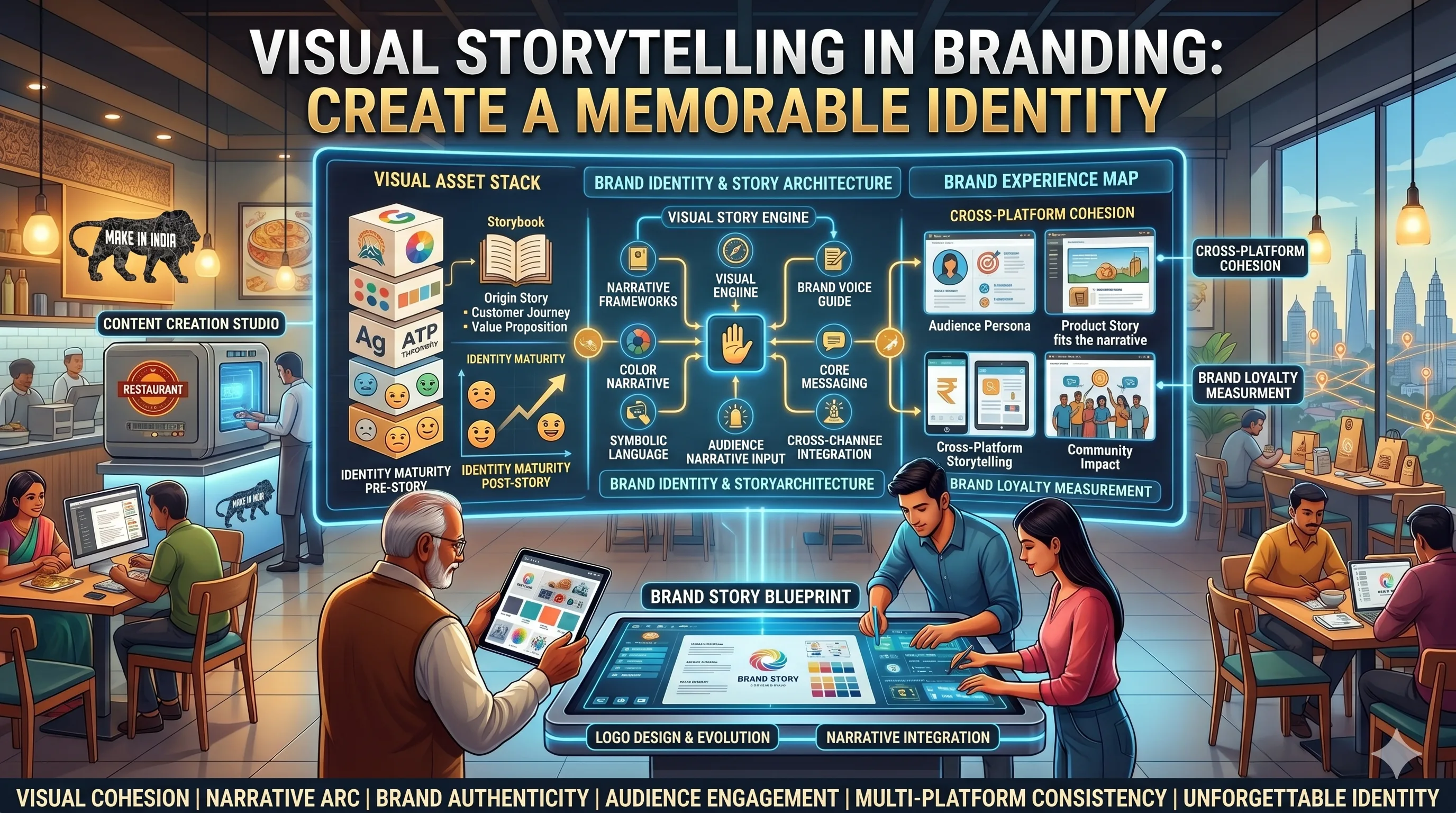
Visual Storytelling in Branding: Create a Memorable Identity for Your Indian Business
Introduction
In today's crowded digital marketplace, your brand's visual identity is the first impression you make. For Indian businesses, where competition is fierce and consumer attention spans are short, visual storytelling is no longer optional—it's essential. Whether you're a startup in Bangalore or a family-run business in Jaipur, the way you tell your story through images, colors, and design can make or break your connection with customers. This guide will walk you through the art of visual storytelling and how to leverage it to build a memorable brand identity that resonates with your audience in 2026. With over 800 million internet users in India and a rapidly growing e-commerce sector, standing out visually is your ticket to capturing attention and fostering loyalty. Let's dive into the strategies that will transform your brand from forgettable to unforgettable.
Main Section 1: The Power of Visual Storytelling in Branding
Visual storytelling combines narrative and design to evoke emotions and communicate your brand's values. Humans are wired to process visuals faster than text—90% of information transmitted to the brain is visual, and studies show that people remember 80% of what they see compared to just 20% of what they read. For Indian businesses, this means using imagery that reflects local culture, aspirations, and authenticity. A well-crafted visual story can increase brand recall, build trust, and differentiate you from competitors. Think of brands like Amul or Tata—their visual narratives are deeply rooted in Indian ethos yet globally appealing. Amul's iconic girl in a polka-dot dress has been telling stories for decades, adapting to current events while maintaining a consistent, lovable identity. Similarly, Tata's use of the color blue and its timeless logo conveys trust and reliability across its diverse portfolio. For your business, the goal is to create a visual language that speaks directly to your audience's heart, making them feel understood and valued.
Why Visual Storytelling Matters for Indian Businesses
India's diverse market demands a nuanced approach. A visual story that works in Mumbai may not resonate in Chennai. However, universal principles apply: consistency, emotion, and clarity. When you tell a story through your logo, website design, social media graphics, and packaging, you create a cohesive identity that customers recognize instantly. In 2026, with AI-generated content on the rise, authentic human-centric visuals will stand out even more. For example, a local spice brand in Kerala could use images of lush green farms and traditional grinding stones to evoke freshness and heritage, while a tech startup in Hyderabad might use sleek, futuristic graphics to convey innovation. The key is to align your visuals with your brand's core narrative—whether it's about empowering small businesses, celebrating Indian craftsmanship, or simplifying complex problems. Consider the case of Paper Boat, a beverage brand that uses nostalgic illustrations and vintage typography to tell stories of Indian childhood memories. Their visual identity is so strong that customers often buy the product for the packaging alone. This is the power of visual storytelling: it transforms a commodity into an experience.
Main Section 2: Key Elements of a Visual Storytelling Strategy
To craft a compelling visual narrative, focus on these core elements:
- Color Palette: Colors evoke emotions. Blue conveys trust (ideal for IT companies like EishwarITSolution), green suggests growth, and red evokes passion. Choose a palette that aligns with your brand personality. For Indian audiences, consider cultural associations: saffron for courage and sacrifice, green for prosperity and nature, and gold for luxury and celebration. A palette of 3-5 colors is ideal—use one dominant color, one secondary, and one accent. For instance, a sustainable fashion brand might use earthy greens and browns with a pop of mustard yellow to reflect eco-friendliness and Indian tradition.
- Typography: Fonts speak volumes. A modern sans-serif font feels tech-forward, while a serif font suggests tradition. Use no more than two fonts for consistency—one for headings and one for body text. For Indian brands, consider using Devanagari or regional scripts in your logo or taglines to connect with local audiences. For example, a brand targeting millennials in Mumbai might use a clean, geometric sans-serif like Montserrat, while a heritage jewelry brand in Jaipur could opt for a decorative serif like Playfair Display paired with a handwritten script for elegance.
- Imagery: Use authentic photos of your team, customers, or products. Avoid generic stock photos. Show real Indian settings—a bustling office, a local festival, or a rural workshop. Authenticity builds trust; a 2023 survey found that 86% of consumers value authenticity in brand visuals. For example, a food delivery service could share photos of their delivery partners in action during monsoon rains, highlighting their reliability and human touch. If you can't afford a professional shoot, use your smartphone with natural lighting and edit with free tools like Snapseed or Lightroom Mobile.
- Logo Design: Your logo is the face of your brand. It should be simple, scalable, and meaningful. Incorporate elements that hint at your story (e.g., a tree for sustainability, a gear for technology, or a lotus for purity). A great example is the logo of MakeMyTrip, which uses a stylized 'M' that resembles a road, subtly conveying travel. For EishwarITSolution, a logo could integrate a circuit pattern with the letter 'E' to symbolize tech expertise. Ensure your logo works in black and white, on a favicon, and on a billboard—test its scalability.
- Video Content: Short-form videos (Reels, YouTube Shorts) are powerful. Show behind-the-scenes, customer testimonials, or your brand's journey. Videos increase engagement by 1200% on social media. For Indian businesses, consider using regional languages in videos to reach Tier 2 and Tier 3 cities. A practical tip: create a 15-second 'day in the life' video of your founder or a quick tutorial on using your product. For example, a skincare brand could show a step-by-step routine using their products, set to upbeat Indian music.
Main Section 3: Practical Steps to Implement Visual Storytelling
Ready to apply visual storytelling? Follow these actionable steps:
- Define Your Brand Story: What is your mission? What problem do you solve? Write a one-paragraph narrative that captures your essence. For example, EishwarITSolution's story could be: 'We empower Indian businesses with cutting-edge tech solutions that simplify operations, so you can focus on growth. Our journey began in a small garage in Bangalore, driven by a passion to make technology accessible to every entrepreneur.' This narrative will guide all your visual choices.
- Create a Visual Style Guide: Document your color codes (HEX, RGB, CMYK), font choices (with fallbacks), logo usage (clear space, minimum size, do's and don'ts), and image styles (e.g., warm tones, candid shots, or flat lays). Share it with your team and designers. Tools like Canva's Brand Kit or Figma can help you maintain consistency. For instance, specify that all social media images should have a 10px white border and use the accent color for call-to-action buttons.
- Audit Current Visuals: Review your website, social media, and marketing materials. Remove anything inconsistent. For example, if your brand is modern, avoid outdated clip art or mismatched fonts. Use a checklist: Are all logos the same version? Are colors consistent? Are images high-resolution? A practical tip: create a folder on your computer with approved assets and delete old ones to avoid confusion.
- Leverage User-Generated Content: Encourage customers to share photos using your product. Repost them with credit—this builds community and authenticity. Run a contest like 'Share your best moment with [Product]' and feature winners on your website. For example, a clothing brand could ask customers to post outfit-of-the-day photos with a specific hashtag. This not only provides free content but also acts as social proof.
- Use Data to Refine: Track which visuals get the most engagement on your website and social media. A/B test different images and colors. Tools like Google Analytics, Hotjar (for heatmaps), and Instagram Insights can show you what resonates. For instance, if you notice that carousel posts with step-by-step guides perform better than single images, create more of those. Set a monthly review to analyze metrics and adjust your strategy.
For instance, EishwarITSolution could create a visual story around how their tech solutions simplify business operations—showing before-and-after scenarios through infographics and client success stories. Imagine a series of Instagram posts: 'Before: 10 hours spent on manual data entry. After: 2 hours automated with our software.' Use a split-screen image with a chaotic desk on one side and a clean, organized setup on the other.
Expert Tips
- Consistency is key: Use the same filter or tone across all images to create a recognizable brand look. For example, if you use a warm, vintage filter on Instagram, apply it to your website images too. Consistency builds recognition—think of how you instantly recognize a Coca-Cola ad by its red color and script font.
- Embrace local flavors: Incorporate Indian motifs, patterns, or languages (e.g., Hindi or regional scripts) to connect deeply with your audience. For a brand targeting South India, use elements like kolam designs or temple architecture in your graphics. A food brand could use images of traditional utensils like a brass thali or a clay pot to evoke nostalgia.
- Invest in professional photography: High-quality visuals reflect professionalism. Even smartphone photos can work if well-lit and composed. Use natural light, avoid cluttered backgrounds, and focus on the subject. For product shots, consider a lightbox (available for under ₹2,000 on Amazon) for consistent lighting. If budget allows, hire a local photographer for a half-day shoot—it can yield dozens of usable images.
- Tell micro-stories: Use carousel posts on Instagram or LinkedIn to tell a step-by-step story. Each slide should add a new layer. For example, a bakery could create a carousel: Slide 1: 'Our secret ingredient' (close-up of flour), Slide 2: 'Mixed with love' (hands kneading dough), Slide 3: 'Baked to perfection' (oven shot), Slide 4: 'Ready for you' (final product). This keeps viewers engaged and encourages swiping.
- Stay updated: Follow design trends like 3D elements, minimalist layouts, or retro aesthetics—but only if they fit your brand. For 2026, expect trends like glassmorphism (frosted glass effects), bold typography, and animated gradients. However, don't chase trends blindly; your visual identity should be timeless. A good rule: 80% of your visuals should be classic, 20% can be trendy.
Common Mistakes
- Overcomplicating: Too many colors or fonts confuse your audience. Stick to a simple palette. A common mistake is using every color of the rainbow in a single graphic—this looks amateurish. Instead, use a color wheel to choose complementary or analogous colors.
- Ignoring mobile optimization: Most Indians browse on phones. Ensure your visuals look great on small screens. Test your website on a mobile device: are images loading quickly? Are buttons easy to tap? Use responsive design and compress images to under 100KB for faster loading.
- Copying competitors: Your visual story should be unique. Don't imitate—innovate. If your competitor uses blue and white, consider a different color scheme. Conduct a competitive audit to identify gaps—for example, if all competitors use stock photos, you can stand out with authentic, behind-the-scenes shots.
- Neglecting accessibility: Use alt text for images and ensure high contrast for readability. This also helps SEO. For example, avoid light gray text on a white background—use dark text on light backgrounds. Add captions to videos for hearing-impaired users. Accessibility not only broadens your audience but also improves user experience.
Future Trends
Looking ahead to 2026, visual storytelling will evolve with technology. Expect AI-generated personalized visuals, interactive content (like 360-degree videos), and augmented reality try-ons for products. Indian brands will increasingly use hyperlocal stories—showcasing regional diversity—to build emotional bonds. Sustainability visuals (eco-friendly packaging, green initiatives) will also gain prominence. EishwarITSolution can stay ahead by adopting these trends early, like creating AR demos of their software solutions. For instance, a potential client could point their phone at a brochure to see a 3D model of the software interface. Additionally, voice-activated visual searches will become common—optimize your images with descriptive file names and structured data. The brands that embrace these technologies while staying true to their core narrative will lead the market.
FAQs
What is visual storytelling in branding?
Visual storytelling is the use of images, videos, colors, and design elements to convey a brand's narrative and values. It helps create an emotional connection with the audience and makes the brand more memorable. For example, a brand like Amul uses a cartoon mascot and topical illustrations to tell stories that resonate with Indians across generations.
How can small Indian businesses afford professional visual storytelling?
Start small. Use free tools like Canva for graphics, shoot videos with your smartphone, and leverage user-generated content. As you grow, invest in a professional designer or photographer. Consistency matters more than cost. For instance, a local chai vendor could use Canva templates to create consistent social media posts with a warm color palette, costing only time. Many Indian freelancers on platforms like Fiverr or Upwork offer affordable services starting at ₹500 per design.
What role does color play in branding for Indian audiences?
Colors have cultural significance in India. For example, saffron represents courage, green symbolizes prosperity, and blue is associated with divinity. Choose colors that align with your brand's values and resonate with your target region. A brand targeting a pan-India audience might use a neutral palette with accents of regional colors. For instance, a financial services brand could use blue for trust and green for growth, appealing to both urban and rural customers.
How often should I update my brand's visual identity?
A major rebrand every 5-7 years is typical, but minor updates (like refreshing your website or social media templates) can happen annually. Monitor market trends and customer feedback to decide when to evolve. For example, if your audience starts shifting to younger demographics, you might update your logo to a more modern font or introduce new accent colors. Always test changes with a focus group before full rollout.
Can visual storytelling improve my website's SEO?
Yes. Optimized images with alt text, descriptive file names, and proper compression improve page load speed and search visibility. Engaging visuals also reduce bounce rates, which is a positive SEO signal. For example, an e-commerce site with high-quality product images and videos can see a 30% increase in time spent on page, signaling to Google that the content is valuable. Use tools like TinyPNG for compression and include keywords in alt text naturally.
What are some low-cost tools for creating visual content?
Free tools like Canva, Adobe Express, and Piktochart offer templates for social media, presentations, and infographics. For video, use InShot or CapCut. For stock photos, try Unsplash or Pexels, which offer high-quality, royalty-free images. For Indian-specific visuals, platforms like Indian Stock Photos provide authentic local imagery. These tools can help you create professional-looking content without a big budget.
How do I measure the success of my visual storytelling efforts?
Track metrics like engagement rate (likes, shares, comments), website bounce rate, conversion rate, and brand recall surveys. Use tools like Google Analytics, social media insights, and heatmaps. For example, if you post a visual story on Instagram and see a 20% increase in profile visits, that's a positive sign. Conduct quarterly surveys asking customers to describe your brand's visual identity to gauge recall.
Conclusion
Visual storytelling is a powerful tool to build a brand identity that resonates with Indian audiences. By combining authentic imagery, consistent design, and a compelling narrative, you can create a lasting impression. Start small, stay consistent, and always keep your customer at the heart of your story. In 2026, brands that tell visual stories will lead the market. Remember, every image, color, and font choice is an opportunity to connect with your audience on a deeper level. Whether you're a solopreneur or a growing enterprise, the principles outlined here will help you craft a visual identity that not only stands out but also builds lasting relationships. Take the first step today—audit your current visuals, define your story, and start creating. The market is waiting for your unique voice.
CTA
Ready to transform your brand's visual story? Contact EishwarITSolution today for a free consultation on branding and web design. Let's create a visual identity that sets you apart. Our team of experts will work with you to develop a custom visual storytelling strategy that aligns with your business goals and resonates with your target audience. Don't let your brand blend in—make it unforgettable. Reach out now and take the first step toward a memorable brand identity.