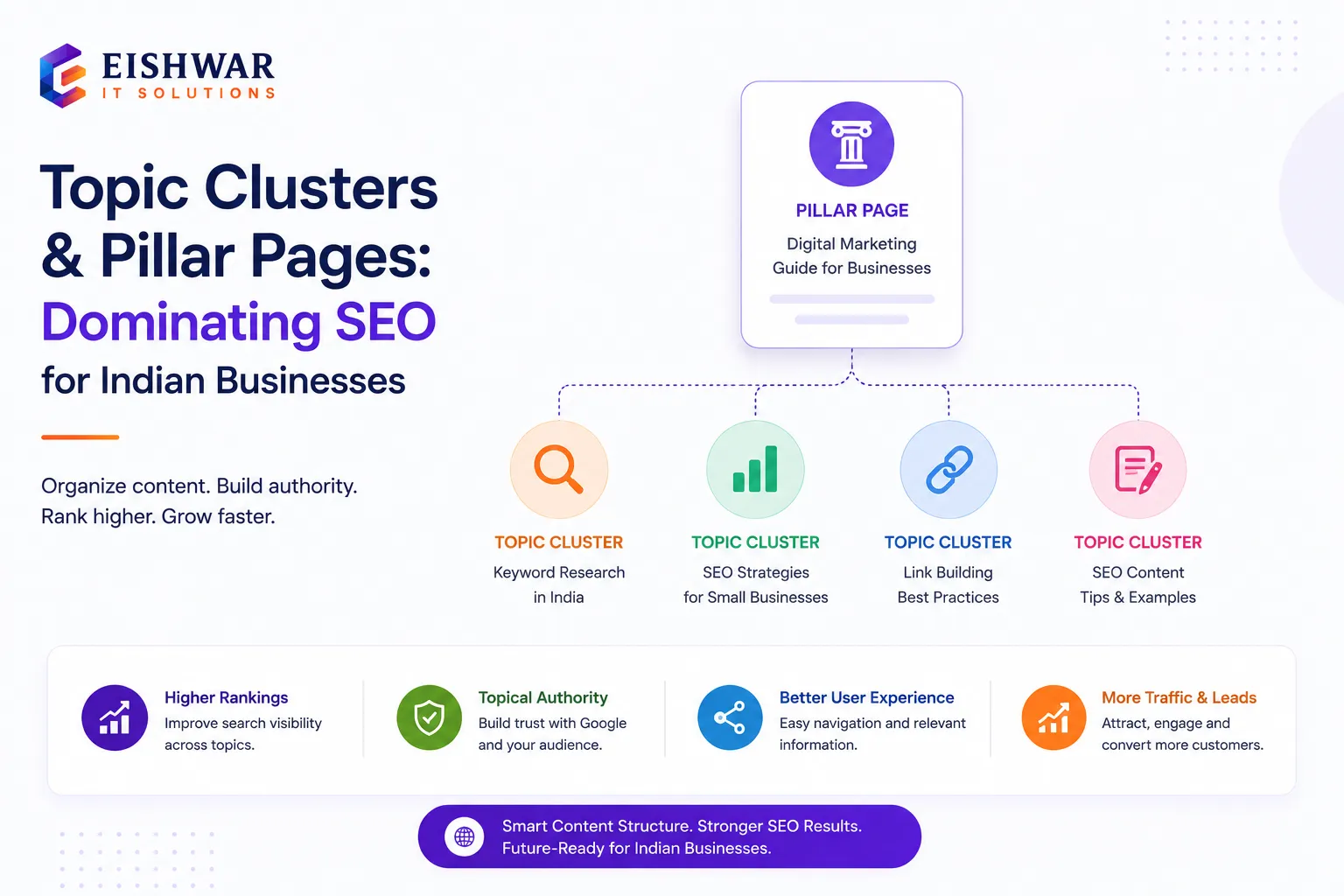
Topic Clusters & Pillar Pages: Dominating SEO for Indian Businesses in 2026
Introduction
In the fast-evolving world of SEO, traditional keyword stuffing and scattered blog posts no longer cut it. Google's algorithms now prioritize comprehensive topic authority over isolated keywords. For Indian businesses aiming to capture local and global audiences, the topic cluster model—centered around pillar pages—has emerged as the most powerful content strategy. In 2026, this approach is not just a trend; it's a necessity for staying competitive.
At EishwarITSolution, we've seen first-hand how Indian SMEs and enterprises transform their organic traffic by implementing structured content silos. This guide will walk you through the entire process, from planning to execution, with practical examples tailored to the Indian market.
Consider this: a small business in Jaipur selling handmade textiles used to publish random blog posts about 'Indian fashion trends.' After adopting a topic cluster model with a pillar page on 'Handmade Textiles in India' and clusters covering 'Block Printing Techniques,' 'Sustainable Fabrics for Summer,' and 'How to Care for Handloom Sarees,' their organic traffic grew by 200% in four months. This is the power of structured content.
Main Section 1: What Are Topic Clusters and Pillar Pages?
A pillar page is a comprehensive, long-form piece of content that covers a broad topic in depth. It serves as the central hub. Topic clusters are a group of interlinked articles (cluster content) that explore specific subtopics related to the pillar. Each cluster article links back to the pillar page, and the pillar links out to them, creating a robust internal linking structure that signals topical authority to search engines.
For example, if your pillar page is 'Complete Guide to Digital Marketing for Indian Businesses,' your cluster articles could cover 'SEO for Local Businesses in Mumbai,' 'Social Media Marketing for Indian Startups,' and 'Email Marketing for E-commerce in India.' Each cluster article dives deep into a niche aspect, answering specific user queries like 'How to optimize Google My Business for Mumbai?' or 'What are the best email marketing tools for Indian e-commerce stores?'
This model mimics how users naturally search—starting broad and diving deeper. Google rewards this structure with higher rankings for both the pillar and cluster pages. In practice, a well-optimized pillar page can rank for dozens of related keywords, while cluster pages capture long-tail traffic. For instance, a pillar on 'Digital Marketing' might rank for 'digital marketing strategies 2026,' while a cluster on 'SEO for Indian Startups' captures 'how to do SEO for a startup in Bangalore.'
Main Section 2: Why Topic Clusters Are Crucial for Indian Businesses in 2026
India's digital landscape is booming. With over 900 million internet users, competition for visibility is fierce. Here's why topic clusters give Indian businesses an edge:
- Enhanced Authority: Google's E-E-A-T (Experience, Expertise, Authoritativeness, Trustworthiness) framework values depth. A well-linked cluster proves your expertise on a subject. For example, a financial advisory firm in Delhi with a pillar on 'Personal Finance for Indians' and clusters on 'Tax Saving Tips for Salaried Employees,' 'Mutual Fund Investments for Beginners,' and 'Insurance Planning for Families' demonstrates comprehensive knowledge, boosting trust.
- Better User Experience: Users can navigate from a broad overview to specific answers without leaving your site, reducing bounce rates. A user searching 'best SEO tools for Indian bloggers' can land on a cluster article and easily find links to the pillar page for a broader context, keeping them engaged longer.
- Higher Click-Through Rates: Pillar pages often appear in featured snippets and 'People Also Ask' boxes due to their comprehensive nature. For instance, a pillar on 'E-commerce SEO in India' might get a featured snippet for 'how to optimize product pages for SEO in India,' driving more clicks.
- Cost-Effective Scaling: Instead of creating random blog posts, you build a cohesive library that attracts long-tail traffic over time. A startup with limited resources can start with one pillar and five clusters, then expand as they see ROI.
- Local SEO Boost: For Indian businesses targeting cities like Delhi, Bangalore, or Mumbai, clusters can cover location-specific subtopics, improving local rankings. A real estate agency in Hyderabad could have a pillar 'Buying Property in Hyderabad' and clusters like 'Best Areas for Apartments in Gachibowli,' 'Home Loan Tips for Hyderabad Buyers,' and 'Rental Market in Hitech City.'
Example: A Pune-based digital marketing agency creates a pillar page 'Digital Marketing Services for Pune Businesses.' Cluster articles include 'SEO for Pune Startups,' 'PPC Advertising in Pune,' and 'Content Marketing for Pune Real Estate.' Within six months, the agency saw a 150% increase in organic leads from Pune, with the pillar page ranking #1 for 'digital marketing services Pune' and cluster articles capturing long-tail queries like 'best PPC agency in Pune.'
Main Section 3: How to Build a Topic Cluster Strategy (Step-by-Step)
Step 1: Identify Your Core Topics
Choose 5–10 broad topics relevant to your business. Use tools like Google Keyword Planner, Ahrefs, or SEMrush to find topics with high search volume and commercial intent. For an Indian audience, consider topics like 'Digital Marketing for Small Business India' or 'E-commerce SEO India.' Look for topics that have a search volume of at least 1,000 monthly searches and low-to-medium competition. For example, 'health insurance for senior citizens in India' might be a good core topic for an insurance company.
Step 2: Create Your Pillar Page
Write a comprehensive guide (2,000–5,000 words) covering the core topic. Include a table of contents, internal links to cluster articles, and multimedia like images, videos, or infographics. Optimize for the main keyword and related semantic terms. For instance, if your pillar is 'Complete Guide to Digital Marketing for Indian Businesses,' include sections on SEO, social media, email marketing, and PPC, each with links to corresponding cluster articles. Use headings like 'What is Digital Marketing?' and 'Why Digital Marketing Matters for Indian Businesses' to structure content.
Step 3: Develop Cluster Content
For each pillar, create 5–15 cluster articles (1,000–2,000 words each) that answer specific questions or subtopics. Each article should link back to the pillar using the exact keyword anchor text. For example, a cluster article on 'SEO for Indian Startups' should link to the pillar with anchor text like 'digital marketing strategies for Indian businesses.' Ensure each cluster article provides unique value, such as step-by-step guides, case studies, or expert interviews.
Step 4: Interlink Strategically
Use contextual links within the pillar to each cluster article. Also, link cluster articles to each other where relevant, forming a web of related content. For example, a cluster on 'Social Media Marketing for Indian Startups' could link to a cluster on 'Content Marketing for Indian Startups' if they share common themes. This creates a silo structure that search engines love.
Step 5: Promote and Update
Share your pillar page on social media, email newsletters, and as a lead magnet. For instance, offer the pillar page as a free downloadable PDF in exchange for email sign-ups. Regularly update both pillar and cluster content to keep it fresh, especially for fast-changing topics like digital marketing. Set a quarterly review schedule to add new statistics, tools, or trends.
Expert Tips
- Use Schema Markup: Add FAQ schema to your pillar page to increase chances of appearing in rich snippets. For example, if your pillar covers 'Digital Marketing for Indian Businesses,' add FAQ schema for common questions like 'What is the cost of digital marketing in India?'
- Leverage User Intent: Match cluster content to different stages of the buyer's journey—awareness, consideration, decision. For a pillar on 'E-commerce SEO,' create awareness clusters like 'Why SEO Matters for Online Stores,' consideration clusters like 'How to Choose an SEO Agency for E-commerce,' and decision clusters like 'Top SEO Tools for E-commerce Sites.'
- Analyze Competitor Clusters: Identify gaps in your competitors' topic clusters and fill them with unique content. Use tools like Ahrefs' Content Gap analysis to find keywords your competitors rank for but you don't. For instance, if a competitor's pillar on 'Real Estate in Mumbai' lacks clusters on 'Rental Properties,' create one.
- Repurpose Content: Turn cluster articles into videos, infographics, or podcasts to reach wider audiences. A cluster on 'How to Optimize Google My Business for Local SEO' can become a YouTube tutorial or an Instagram carousel.
- Track Performance: Use Google Search Console and analytics to monitor which clusters drive the most traffic and conversions. Set up goals in Google Analytics to track leads from pillar and cluster pages. Adjust your strategy based on data—if a cluster on 'PPC for Indian Startups' gets high traffic but low conversions, consider adding a stronger call-to-action.
Common Mistakes
- Thin Cluster Content: Don't create short, low-value articles just for the sake of linking. Each piece should provide genuine value. For example, a 300-word article on 'SEO Tips for Indian Bloggers' won't rank well; instead, write a 1,500-word guide with actionable steps.
- Over-Optimizing Anchor Text: Vary anchor text between exact match, partial match, and branded links to avoid penalties. For instance, use 'digital marketing strategies' (exact), 'effective marketing approaches' (partial), and 'our guide on marketing' (branded).
- Ignoring Mobile Users: Over 70% of Indian internet users access via mobile. Ensure pillar pages and clusters are mobile-friendly with responsive design, fast loading times, and easy navigation. Test on multiple devices.
- Neglecting Updates: SEO landscapes change. Review your clusters quarterly and update outdated information. For example, if a cluster on 'Social Media Trends in India' references 2023 data, update it with 2025 statistics.
- Poor Internal Linking Structure: Don't just link from cluster to pillar; also link between related clusters to create a silo. For instance, link a cluster on 'Email Marketing for Indian E-commerce' to a cluster on 'Customer Retention Strategies for Indian Brands' if they share themes.
Future Trends
Looking ahead to 2026 and beyond, topic clusters will evolve with AI and voice search. Google's AI models (like MUM and BERT) will better understand content relationships, making clusters even more critical. Voice search queries are longer and more conversational; clusters that answer specific questions will dominate voice results. For example, a cluster on 'How to Start a Blog in India' should include voice-friendly answers like 'To start a blog in India, first choose a niche, then select a hosting provider like HostGator India.' Additionally, video clusters—where a pillar video links to shorter video subtopics—will become popular for visual industries like real estate and travel. A real estate company could have a pillar video 'Complete Guide to Buying a Home in India' with cluster videos on 'Home Loan Process,' 'Property Inspection Tips,' and 'Legal Documents Required.'
Another trend is the use of AI tools like ChatGPT to generate cluster content ideas and outlines. However, human oversight is crucial to ensure accuracy and authenticity. Indian businesses should also focus on hyperlocal clusters, targeting specific neighborhoods or dialects, such as 'Best Restaurants in Koramangala, Bangalore' or 'Digital Marketing Services in Hindi.'
FAQs
1. What is the difference between a pillar page and a blog post?
A pillar page is a comprehensive, evergreen resource covering a broad topic, while a blog post is typically shorter and focuses on a specific subtopic. Pillar pages serve as the central hub for a topic cluster. For example, a pillar page on 'Digital Marketing for Indian Businesses' might be 4,000 words, while a blog post on 'SEO Tips for Indian Startups' is 1,500 words and links back to the pillar.
2. How many cluster articles should I create per pillar?
Start with 5–10 high-quality cluster articles. As your site grows, you can expand to 15–20 per pillar. Quality always trumps quantity. For a local business like a restaurant, 5 clusters might be enough, while an e-commerce site might need 15 to cover all product categories.
3. Can small businesses with limited budgets use topic clusters?
Absolutely. Start with one pillar page and 3–5 cluster articles. Use free tools like Google Keyword Planner and AnswerThePublic to find subtopics. Focus on high-intent keywords. For example, a small bakery in Delhi could create a pillar 'Ultimate Guide to Custom Cakes in Delhi' with clusters on 'Birthday Cakes in Delhi,' 'Wedding Cakes in Delhi,' and 'Eggless Cakes in Delhi.'
4. How long does it take to see results from topic clusters?
Typically 3–6 months for noticeable ranking improvements, depending on competition and content quality. Consistency is key. For a new website, it might take 6 months, while an established site could see results in 3 months. Monitor progress with Google Search Console.
5. Do I need to update pillar pages regularly?
Yes. Update your pillar page every 6–12 months to keep information current. Add new cluster articles as new subtopics emerge. For example, if a new social media platform like Threads gains popularity in India, add a cluster article on 'Marketing on Threads for Indian Brands.'
6. Can I use topic clusters for a local business like a restaurant?
Definitely. Pillar: 'Ultimate Guide to Dining in Bangalore.' Clusters: 'Best Vegetarian Restaurants in Bangalore,' 'Romantic Dinner Spots in Bangalore,' 'Budget-Friendly Eateries in Bangalore,' 'Late-Night Food Options in Bangalore,' and 'Family-Friendly Restaurants in Bangalore.' Each cluster can include local SEO elements like Google My Business optimization and customer reviews.
7. What tools help with topic cluster planning?
Tools like Ahrefs, SEMrush, Surfer SEO, and HubSpot's content strategy tool can help identify topics and analyze clusters. For free options, use Google Keyword Planner, AnswerThePublic, and Google Trends. For example, use AnswerThePublic to find questions like 'How to do SEO for a small business in India?' and create cluster articles around those queries.
Conclusion
Topic clusters and pillar pages are not just a passing trend—they are the backbone of modern SEO. For Indian businesses aiming to build authority, attract qualified traffic, and stay ahead of competitors in 2026, this strategy is indispensable. By organizing your content into logical, interconnected hubs, you signal to Google that you are the go-to resource in your niche.
Start small, measure results, and scale. The time to invest in a structured content strategy is now. Whether you're a startup in Bengaluru or a family-run business in Jaipur, topic clusters can transform your online presence. Remember, the key is consistency and quality—focus on providing value to your audience, and the rankings will follow.
CTA
Ready to transform your SEO with topic clusters? Contact EishwarITSolution today for a free content audit and personalized strategy. Let's build your digital authority together. Our team of experts will analyze your current content, identify opportunities for clusters, and create a roadmap to dominate search results in 2026. Don't wait—your competitors are already implementing this strategy. Reach out now!