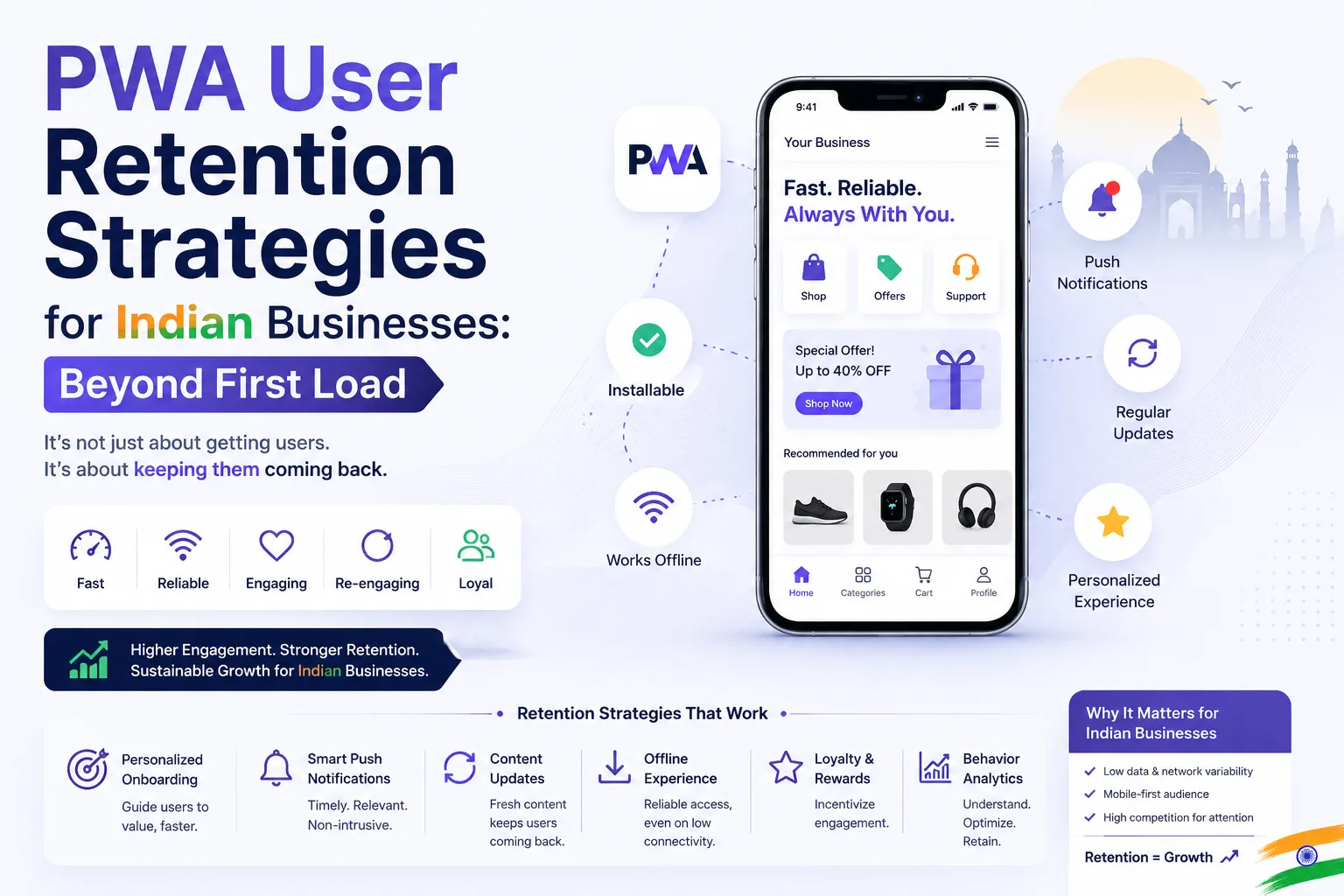
PWA User Retention Strategies for Indian Businesses: Beyond First Load Speed
Introduction
In the fast-paced digital landscape of India, first impressions matter. Your Progressive Web App (PWA) loads in under a second—great! But what happens after that initial visit? User retention is the real game-changer. Many businesses focus solely on speed, forgetting that engagement, loyalty, and repeat visits drive long-term success. This article dives into proven PWA user retention strategies tailored for Indian businesses, covering everything from push notifications to offline experiences. Whether you run an e-commerce store, a SaaS platform, or a local service, these insights will help you turn one-time visitors into loyal customers.
Main Section 1: Why User Retention Matters More Than Speed for Indian Businesses
Speed is a threshold, not a differentiator. In India, where mobile data costs are dropping and smartphone penetration is soaring, users expect fast experiences. But retention is where the real value lies. A retained user is worth 5–10 times more than a new one. For Indian SMEs, acquiring a customer can cost ₹500–₹1000, while retaining one costs only a fraction. PWAs offer unique tools—like install prompts, offline caching, and push notifications—that directly boost retention. Yet, many businesses underutilize them. Let’s explore how to change that.
Main Section 2: Core PWA Retention Strategies for Indian Audiences
1. Optimize the Install Experience
Your PWA’s install prompt is the first step to retention. Make it contextual. For example, show the prompt after a user has added an item to the cart or read two blog posts. Use a custom banner with a clear value proposition: “Install our app for faster checkout & offline access.” A/B test the timing and design. For instance, an Indian e-commerce site like Flipkart could show the prompt after a user browses three products, reducing friction and increasing install rates by up to 30%. Also, consider using a mini-info bar instead of a full-screen prompt to avoid annoyance.
2. Leverage Push Notifications Wisely
Push notifications are powerful, but misuse leads to uninstalls. Segment your users—new vs. returning, location-based, or behavior-triggered. For instance, send a discount code to users who abandoned their cart within 24 hours. Use personalization: “Hi Priya, your favorite saree is back in stock!” Keep frequency low—max 2–3 per week. A practical tip: Use time-based triggers, like sending a lunch offer at 11 AM for a food delivery PWA. Also, respect user preferences by allowing them to choose notification types (e.g., deals only, order updates).
3. Build an Offline-First Experience
Indian users often face connectivity issues, especially in tier-2 and tier-3 cities. A PWA that works offline can be a retention magnet. Cache key pages—home, product catalog, account dashboard. Allow users to browse previously viewed items without internet. For example, a food delivery PWA can show saved addresses and past orders offline. This builds trust and reduces bounce. Implement a custom offline page with a fun message like “You’re offline, but your favorites are still here!” and include a retry button. Use the Cache API to store dynamic content, such as user profiles, for offline access.
4. Gamify Engagement
Add loyalty points, badges, or progress bars. For example, “You’ve saved ₹500 this month—keep going!” Use subtle gamification to encourage repeat visits. An educational PWA could award “streak badges” for daily learning. For a travel booking PWA, offer “explorer points” for checking in at new destinations. Keep it simple—avoid complex mechanics that confuse users. Integrate with local rewards like Paytm cash or Amazon vouchers to increase appeal.
5. Use Service Workers for Background Sync
Allow users to complete actions offline and sync later. For instance, a user can fill a contact form or update a task list without internet. The PWA syncs automatically when online. This reduces friction and increases completion rates. For a job portal PWA, users can apply for jobs offline, and the application syncs when connectivity returns. Ensure you handle conflicts gracefully—show a confirmation message after sync. This is especially useful for rural areas with intermittent connectivity.
Main Section 3: Measuring and Improving Retention with Analytics
Track key metrics: daily active users (DAU), monthly active users (MAU), session duration, and repeat visit rate. Use tools like Google Analytics 4 with PWA tracking enabled. Set up events for install, push notification click, and offline usage. Analyze drop-off points using funnel reports. For example, if many users uninstall after 7 days, review your push notification strategy. Regularly survey users to understand why they return or leave. A practical example: Create a cohort analysis to see if users who installed via the prompt have higher retention than those who didn’t. Use heatmaps to identify where users spend most time offline.
Expert Tips
- Tip 1: Integrate WhatsApp sharing for viral loops. A user can share a product link that opens your PWA directly. This leverages India’s high WhatsApp usage.
- Tip 2: Use a splash screen with your brand logo to make the PWA feel native. Keep it under 2 seconds to avoid delays.
- Tip 3: Optimize for low-end devices—compress images, lazy load, and use lightweight frameworks like Preact or Svelte. Test on devices with 2GB RAM.
- Tip 4: Offer a “save for later” feature that syncs across devices via cloud. Use IndexedDB for local storage and sync with a backend API.
- Tip 5: Run re-engagement campaigns via email or SMS linking to your PWA with deep links. Use UTM parameters to track campaign performance.
- Tip 6: Support regional languages like Hindi, Tamil, or Bengali in your PWA interface. This increases comfort and trust among non-English users.
Common Mistakes
- Mistake 1: Overusing push notifications—users will block or uninstall. Stick to a maximum of 2–3 per week and always provide an opt-out option.
- Mistake 2: Ignoring offline experience—users on 2G/3G networks will leave. Test your PWA on slow networks using Chrome DevTools throttling.
- Mistake 3: Not optimizing the install prompt—showing it too early or too late. Delay until the user has shown engagement, like viewing multiple pages.
- Mistake 4: Failing to track retention metrics—you can’t improve what you don’t measure. Set up dashboards for real-time monitoring.
- Mistake 5: Treating PWA as a one-time project—continuous improvement is key. Regularly update content, fix bugs, and add features based on user feedback.
- Mistake 6: Ignoring accessibility—ensure your PWA works with screen readers and supports keyboard navigation for inclusive design.
Future Trends
By 2027, PWAs will integrate with AI for personalized experiences—like dynamic offline content based on user behavior. Web push notifications will become smarter with machine learning to predict optimal send times. India’s BharatNet initiative will bring high-speed internet to rural areas, expanding PWA reach. Also, expect deeper integration with UPI payments for seamless checkouts. For example, a PWA could automatically suggest UPI payment options based on user history. Businesses that invest in retention now will lead the market. Additionally, PWAs will leverage WebAssembly for near-native performance, enabling complex tasks like image editing offline.
FAQs
What is the best way to increase PWA user retention in India?
Focus on offline capabilities, contextual push notifications, and a seamless install experience. Personalization based on user behavior also significantly boosts retention. For example, use service workers to cache frequently accessed pages and send notifications only when relevant.
How often should I send push notifications from my PWA?
Limit to 2–3 times per week. Segment your audience and send relevant, personalized messages. Avoid generic blasts to prevent uninstalls. Use A/B testing to find the optimal frequency for your audience.
Can a PWA work offline on all devices?
Yes, if you implement service workers and cache essential resources. However, functionality depends on the browser and device. Modern browsers like Chrome and Edge support offline mode. Test on older devices to ensure compatibility.
What metrics should I track for PWA retention?
Track DAU, MAU, session duration, repeat visit rate, install-to-registration ratio, and push notification click-through rate. Use Google Analytics 4 for detailed insights. Also monitor offline usage metrics to understand user behavior.
How do I make my PWA feel like a native app for Indian users?
Use a splash screen, set a theme color, add app shortcuts, and enable offline access. Also, support local languages and UPI payments for a familiar experience. Include haptic feedback on supported devices for a tactile feel.
Is gamification effective for PWA retention in India?
Yes, especially for younger audiences. Points, badges, and leaderboards encourage repeat visits. Tailor rewards to local preferences, like discount coupons or free shipping. Keep the gamification simple and avoid overcomplicating it.
How can I reduce uninstall rates for my PWA?
Focus on value delivery: ensure fast load times, relevant notifications, and a smooth offline experience. Ask for feedback before users uninstall, and offer incentives like a discount code to stay. Monitor uninstall triggers through analytics.
Conclusion
User retention is the heartbeat of a successful PWA. For Indian businesses, the opportunity is immense—by focusing on offline experiences, smart notifications, and personalized engagement, you can build a loyal user base that returns again and again. Remember, speed gets you in the door, but retention keeps you in the game. Start implementing these strategies today and watch your metrics soar.
CTA
Ready to transform your PWA into a retention powerhouse? Contact EishwarITSolution for a free consultation. Let’s build an app your users will love to come back to.