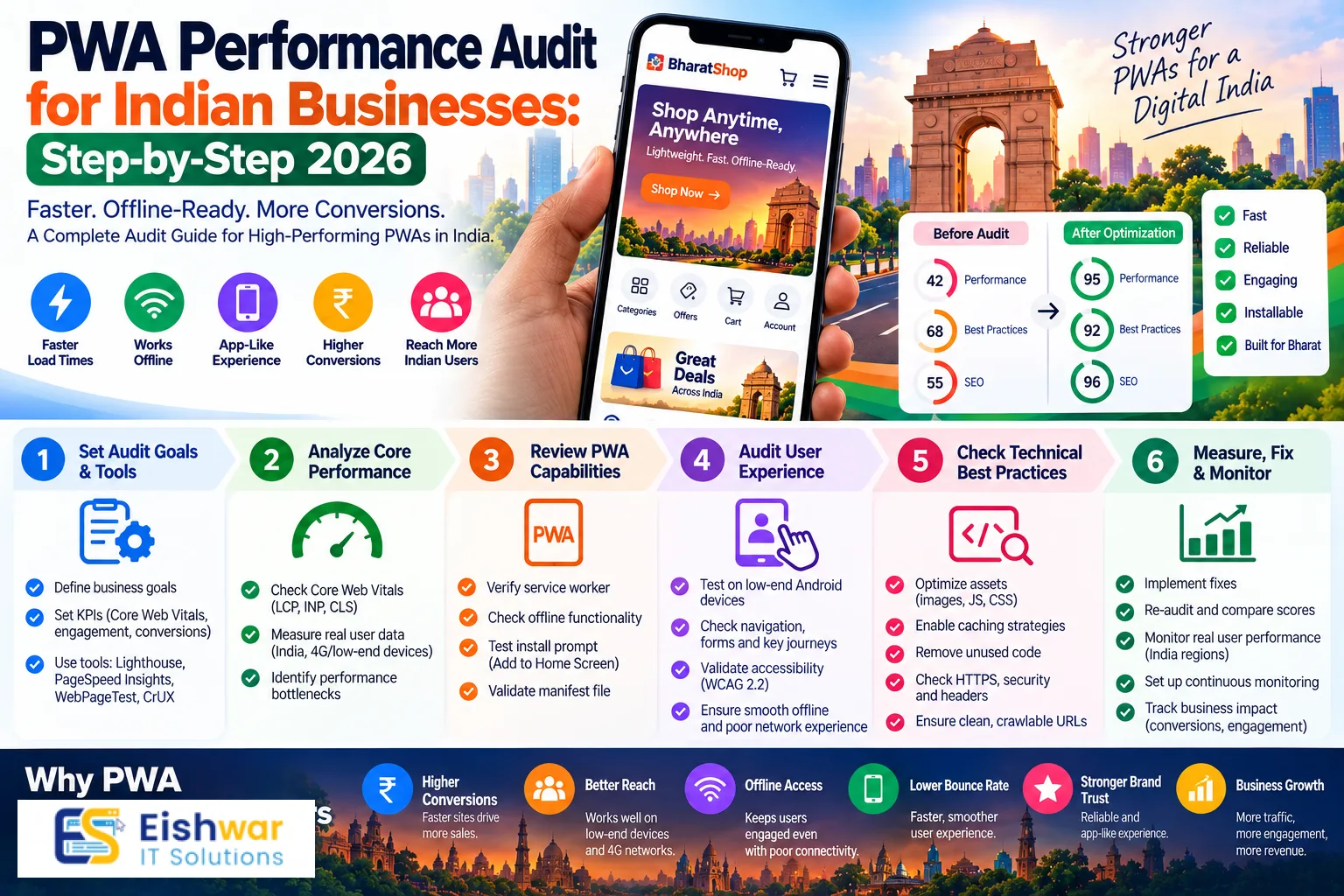
PWA Performance Audit for Indian Businesses: Step-by-Step 2026
Introduction
Indian users are mobile-first, data-conscious, and impatient. If your Progressive Web App takes more than three seconds to load on a mid-range Android phone over 4G, many visitors will leave before they see your offer. Speed is not a technical vanity metric. It directly affects leads, sales, and brand trust.
A PWA performance audit helps you find out why your app feels slow, which fixes will move the needle, and how to measure progress. It connects technical speed with business outcomes: more form submissions, lower bounce rates, higher checkout completion, and better Core Web Vitals.
This guide is for business owners, marketers, and professionals in India who want a practical, step-by-step PWA performance audit. You will learn how to set benchmarks, use the right tools, prioritise fixes, and avoid common mistakes.
Main Section 1: What Is a PWA Performance Audit and Why Indian Businesses Need It
A PWA performance audit is a structured review of how your Progressive Web App loads, responds, and behaves across real devices and networks. It looks at page speed, interactivity, visual stability, service worker behaviour, caching, and third-party scripts. The goal is not a perfect score. The goal is to remove friction from the user journey.
In India, the context makes audits essential. Many users are on mid-range Android devices with limited RAM. Network quality varies by city, tower, and time of day. Data packs are affordable but still precious. A PWA that performs well on office Wi-Fi in Bengaluru may fail in a Tier-2 town during peak hours.
Speed affects revenue
Imagine an Indian D2C brand selling apparel. Its PWA loads in 2.1 seconds on 5G but 6.8 seconds on 4G. The marketing team spends on Instagram ads, yet the landing page bounce rate is high. After an audit, the team compresses hero images, defers third-party pixels, and caches product listings. Load time drops to 3.2 seconds on 4G. Add-to-cart rate improves, and cost per acquisition falls.
Or think about a B2B services company that receives enquiries through a PWA form. If the form page takes long to become interactive, users tap submit before scripts load and nothing happens. An audit reveals long tasks blocking the main thread. Fixing them increases qualified leads without increasing ad spend.
Key metrics to track
- Largest Contentful Paint (LCP): How quickly the main content appears. Aim for under 2.5 seconds on mobile.
- Interaction to Next Paint (INP): How quickly the app responds to taps and clicks. Aim for under 200 milliseconds.
- Cumulative Layout Shift (CLS): How much the page jumps while loading. Aim for under 0.1.
- Time to First Byte (TTFB): How fast your server responds. Aim for under 800 milliseconds for most Indian audiences.
- Bounce rate and conversion rate: The business metrics that speed improvements should influence.
Google uses Core Web Vitals as part of page experience signals. But even without SEO pressure, speed builds trust. Indian users often judge a business by its mobile experience. A fast PWA feels professional and reliable.
Audit vs monitoring
Monitoring tells you what is happening continuously. An audit tells you why it is happening and what to fix first. Start with an audit to establish a baseline and prioritise improvements. Then set up monitoring to catch regressions after deployments, campaigns, or festive traffic spikes.
Main Section 2: Step-by-Step PWA Performance Audit Framework
Use this framework to run a PWA performance audit that produces actionable results, not just a report.
Step 1: Define business goals and critical user journeys
Before opening any tool, write down what success looks like. Is it more checkout completions, more demo bookings, more app installs, or lower support calls? Map the journeys that matter: home page to product page, product page to cart, cart to payment, landing page to lead form.
Audit the pages in those journeys first. A fast blog page is nice, but a slow checkout page costs money. For Indian businesses, pay special attention to UPI payment redirects, OTP screens, address forms, and order confirmation pages.
Step 2: Collect real-user data before lab tests
Lab tools simulate conditions. Real-user monitoring (RUM) shows what actual visitors experience. Use Google Analytics 4, Chrome User Experience Report, or a RUM tool to see Core Web Vitals by device, browser, network, and geography.
Segment your Indian audience by city tier, mobile brand, and connection type. You may discover that users on Jio, Airtel, and Vi have different experiences. Android users on older versions may face larger delays than iPhone users.
Step 3: Run lab audits with trusted tools
Use a combination of tools:
- Google PageSpeed Insights: Quick view of lab and field data for a single URL.
- Lighthouse in Chrome DevTools: Detailed diagnostics on performance, accessibility, SEO, and PWA checks.
- WebPageTest: Advanced testing from Indian locations, custom throttling, and filmstrips.
- Chrome DevTools Performance panel: Find long tasks, layout shifts, and render-blocking resources.
- Lighthouse CI: Automate audits in your deployment pipeline.
Test at least three key pages on a simulated mid-range Android device with 4G throttling. Do not rely on desktop results.
Step 4: Audit PWA-specific layers
PWAs have unique moving parts. Check these carefully:
- Service worker: Is it caching too much, too little, or serving stale content? Does it update correctly?
- Web app manifest: Are icons, splash screens, and theme colours optimised for mobile?
- Offline fallback: Does the app show a useful offline page instead of a browser error?
- Cache strategy: Are you using cache-first, network-first, or stale-while-revalidate where appropriate?
- Background sync: For forms or carts, does data sync when the connection returns?
A common issue in Indian PWAs is over-caching product prices or stock levels. Users see old information, lose trust, and abandon the purchase. Balance speed with freshness.
Step 5: Test across Indian network conditions and devices
Do not test only on a flagship phone. Borrow or buy a popular budget Android device. Use Chrome DevTools network throttling to simulate slow 4G, regular 4G, and 3G. Test during peak hours if possible.
Check how your PWA behaves when the network drops mid-session. Does the cart survive? Does form data persist? These details matter in India, where mobile connectivity can change quickly.
Step 6: Review third-party scripts and analytics
Third-party scripts are often the biggest performance killers. Marketing tags, chat widgets, heatmaps, A/B testing tools, and social pixels can block rendering and slow interactions. Audit each script. Remove what you do not use. Load the rest asynchronously or after user interaction.
For Indian businesses running festive campaigns, this step is critical. A single unoptimised ad pixel can add hundreds of milliseconds to every page.
Step 7: Prioritise fixes by impact and effort
Create a simple table with columns for issue, impact, effort, owner, and deadline. Focus first on fixes that affect revenue pages and require low effort:
- Compress and convert hero images to WebP or AVIF.
- Preload the LCP image and critical fonts.
- Defer non-critical JavaScript.
- Set explicit width and height for images and ads.
- Enable text compression and browser caching.
- Move to an Indian CDN or edge provider.
Assign an owner for every fix. Performance work often stalls because everyone assumes someone else is handling it.
Main Section 3: High-Impact PWA Performance Enhancements for India
Once your audit identifies the gaps, apply these enhancements.
Optimise LCP with smarter media delivery
LCP is usually an image or a large text block. For Indian PWAs, product images and banners are common culprits. Use responsive images with srcset and sizes. Serve AVIF or WebP with fallbacks. Compress images without visible quality loss. Use a CDN with edge locations in Mumbai, Delhi, Chennai, Hyderabad, and Bengaluru. Preload the LCP image and avoid lazy-loading it.
Also check server response times. If your hosting is overseas, TTFB will be high for Indian users. Move to an Indian data centre or use edge caching.
Improve INP by reducing JavaScript work
INP measures how quickly your PWA responds to taps. Long JavaScript tasks block the main thread. Split large bundles, remove unused code, and defer non-critical scripts. Use web workers for heavy calculations. Avoid large third-party libraries if a lightweight alternative exists.
For e-commerce, ensure add-to-cart and buy-now buttons respond instantly. For lead forms, validate fields without waiting for a server round trip.
Stabilise CLS with reserved space
Layout shifts annoy users and cause accidental clicks. Always set width and height attributes on images and videos. Reserve space for ads, banners, and dynamic content. Use font-display: swap and preload fonts to avoid text reflow. Avoid injecting content above existing content unless necessary.
Make your service worker smarter
Use stale-while-revalidate for product listings and blog pages. Use network-first for prices, stock, and account data. Version your caches and clean up old entries. Provide a clear offline fallback page with contact details and a retry button.
Test service worker updates carefully. A broken service worker can serve old JavaScript and CSS for days, confusing users and your team.
Use CDN and edge caching
A CDN reduces latency by serving content from locations closer to users. Choose a provider with strong Indian coverage. Cache static assets aggressively. Use edge functions for personalisation when possible, so you do not have to round-trip to a central server.
Reduce data and battery consumption
Indian users appreciate apps that respect data and battery. Compress images, minify code, and avoid autoplay videos. Lazy-load below-the-fold content. Use system fonts where brand guidelines allow. Batch network requests. These changes improve speed and reduce power consumption.
Monitor after deployment
Performance is not a one-time project. Set up alerts for Core Web Vitals regressions. Review dashboards weekly. Run Lighthouse CI on every pull request. Track business metrics alongside technical metrics so you can prove ROI.
Expert Tips
- Audit before and after festive campaigns. Diwali, Holi, and end-of-season sales bring traffic spikes. Test under load before the campaign.
- Test on a ₹8,000 to ₹12,000 Android phone. This represents a large share of Indian users.
- Set a performance budget. Keep JavaScript under 200 KB compressed and LCP under 2.5 seconds on 4G.
- Involve business stakeholders. Explain performance in terms of revenue, leads, and support tickets.
- Focus on the funnel, not just the home page. Checkout, payment, and form pages often have the worst performance and the highest business impact.
- Do not chase a perfect 100 Lighthouse score. Real-user metrics and conversions matter more.
- Document your caching strategy. Future developers will thank you, and you will avoid stale content bugs.
Common Mistakes
- Testing only on fast Wi-Fi and desktop. This hides real issues.
- Ignoring real-user data. Lab tests are useful, but field data shows what customers actually experience.
- Over-caching dynamic content. Serving stale prices, stock, or offers damages trust.
- Adding too many third-party scripts. Every marketing tool has a cost.
- No ownership after the audit. A report without assigned tasks changes nothing.
- Optimising only the home page. Users convert on product, cart, checkout, and form pages.
- Forgetting service worker updates. Users may see old versions for days.
- Using large uncompressed images. This is still a common cause of slow PWAs in India.
Future Trends
PWA performance will keep evolving. Here are trends Indian businesses should watch.
- AI-assisted performance optimisation: Tools will automatically detect bottlenecks and suggest fixes. Human judgement will still matter.
- Edge computing and 5G: Faster networks and edge servers will reduce latency, but poor front-end code can still slow things down.
- Core Web Vitals updates: Google continues to refine metrics. INP is now central to interactivity.
- Privacy-first analytics: First-party and privacy-friendly analytics will shape performance audits.
- PWA plus AI assistants: Voice and AI interfaces will demand faster, more accessible PWAs.
- Sustainable web performance: Reducing data transfer and energy use will become a brand value.
- India-specific commerce integrations: ONDC, UPI, and vernacular interfaces will require performance work for local payment flows and languages.
FAQs
What is a PWA performance audit?
A PWA performance audit is a structured review of your Progressive Web App's speed, responsiveness, stability, caching, and third-party scripts. It identifies what is slowing down real users and prioritises fixes that improve business results.
How often should Indian businesses audit PWA performance?
Run a full audit every quarter, and a lighter check after major deployments or before festive campaigns. Monitor Core Web Vitals continuously to catch regressions early.
Which tools are best for PWA performance audit in India?
Use Google PageSpeed Insights, Lighthouse, WebPageTest, Chrome DevTools, and real-user monitoring. WebPageTest is especially useful because it lets you test from Indian locations with custom throttling.
Can a PWA performance audit improve SEO?
Yes. Core Web Vitals are part of Google's page experience signals. Faster pages often rank better and get more engagement. But SEO also depends on content, links, and technical health.
How much does a PWA performance audit cost in India?
Costs vary. A DIY audit using free tools can be done in-house. A professional audit may range from ₹25,000 to ₹1,50,000 or more, depending on app complexity and the number of pages. The ROI usually comes from higher conversions and lower ad waste.
What metrics matter most for Indian mobile users?
LCP, INP, and CLS are the core metrics. Also track TTFB, page weight, data consumption, and conversion rate on mobile. Test on 4G and budget Android devices to reflect real conditions.
Will performance fixes break my PWA?
They can if you do not test properly. Use staging environments, automated tests, and gradual rollouts. Monitor error rates and Core Web Vitals after each change.
Conclusion
A PWA performance audit is one of the smartest investments for Indian businesses in 2026. It turns vague complaints about speed into a clear plan. It helps you prioritise fixes that reduce bounce rates, improve Core Web Vitals, and increase conversions.
Start with real-user data. Test on the devices and networks your customers actually use. Fix the biggest issues on your revenue pages first. Then monitor continuously and make performance part of your regular development process.
Speed is not just a developer metric. It is a customer experience metric. In a competitive Indian market, a fast PWA can be the difference between a missed opportunity and a loyal customer.
CTA
Ready to find out what is slowing down your PWA? EishwarITSolution can run a practical PWA performance audit for your business, prioritise high-impact fixes, and help you implement them without disrupting your operations. Visit eishwar.com or contact our team to book your audit before your next campaign.