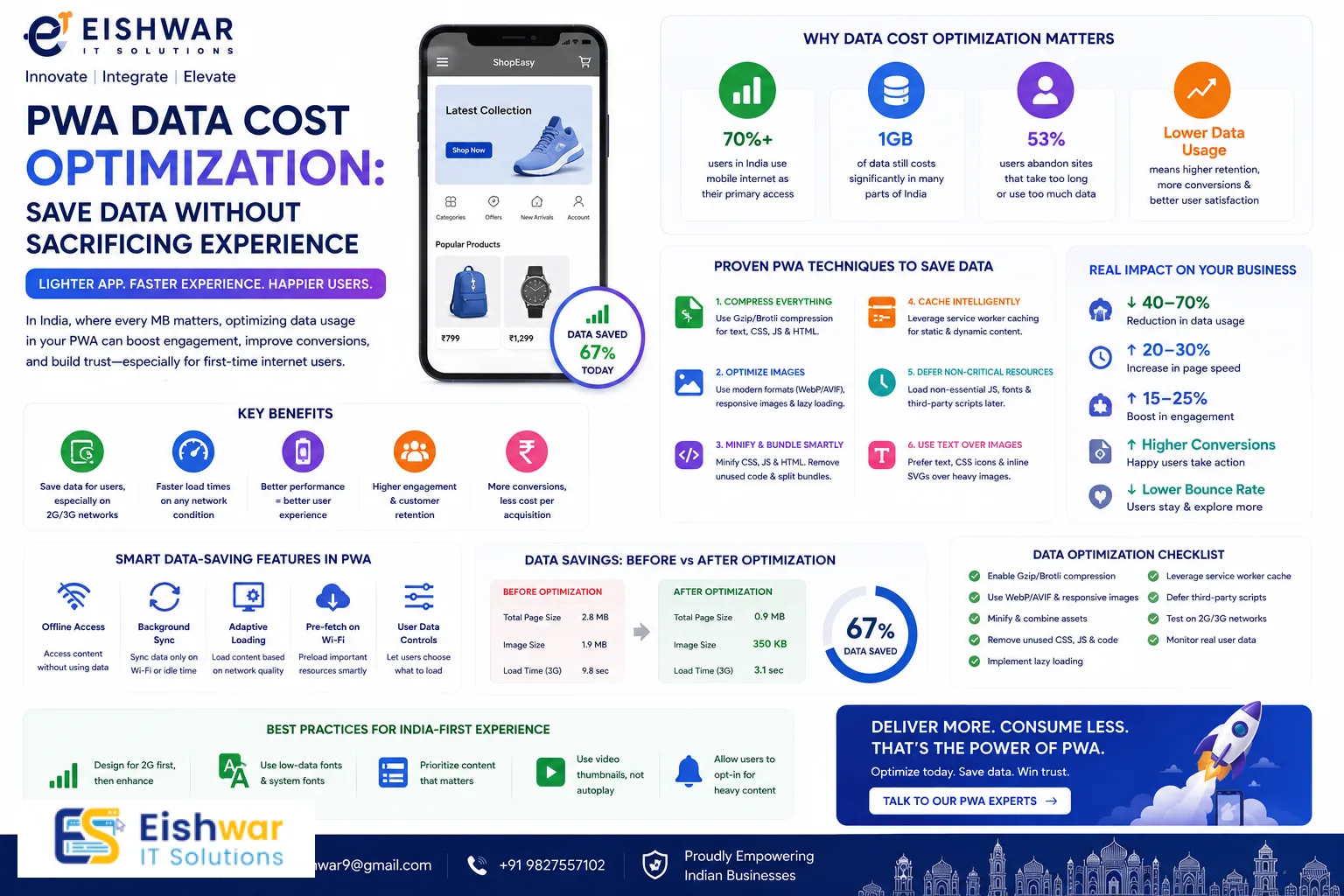
PWA Data Cost Optimization: Save Data Without Sacrificing Experience
\n
Introduction
India is a mobile-first nation where data costs, though dropping, still matter deeply to millions of users. For businesses relying on Progressive Web Apps (PWAs), data consumption directly impacts user retention, bounce rates, and overall conversion. A bloated PWA that eats up data can drive away cost-conscious users, especially those on prepaid plans or limited data packs. This guide dives into practical strategies to optimize your PWA's data usage without sacrificing the rich, fast experience users expect.
Consider this: a typical Indian user on a ₹299 plan gets only 1.5GB of data per month. If your PWA consumes 5MB per session, that's over 100 sessions before the pack runs out. Every kilobyte saved extends their usage and builds trust. We'll explore actionable techniques that balance performance with frugality, ensuring your PWA remains competitive in a data-sensitive market.
Main Section 1: Understanding Data Consumption in PWAs
PWAs are inherently lighter than native apps, but they still consume data through caching, service workers, and dynamic content. Common culprits include large images, unoptimized JavaScript bundles, excessive API calls, and redundant caching strategies. For Indian users, where 2G/3G networks are still prevalent in rural areas, every kilobyte counts. Reducing data usage also improves load times, which is a known ranking factor for Google and directly affects user satisfaction.
Let's break down the typical data footprint of a PWA. A study by Google found that the median PWA page weight is around 400KB, but top-performing PWAs often stay under 150KB. The main contributors are: images (60-70% of total weight), JavaScript (20-30%), CSS (5-10%), and fonts (2-5%). Each of these areas offers opportunities for optimization.
Actionable insight: Audit your PWA with tools like Lighthouse or WebPageTest to identify data-heavy resources. Focus on the initial load—the first 14KB can make or break user trust. Use the 'Network' panel in Chrome DevTools to simulate slow connections and see exactly what's being downloaded. For example, a common mistake is loading a 2MB hero image on the homepage, which can be compressed to 200KB with modern formats.
Another key factor is the service worker cache. While caching improves repeat visit speed, an overly aggressive cache strategy can store outdated or large resources, consuming both data and storage. Implement cache versioning and set maximum cache sizes (e.g., 50MB for static assets) to prevent bloat.
Main Section 2: Practical Data Saving Techniques for Your PWA
Here are proven methods to trim data consumption, with real-world examples:
- Image Optimization: Use modern formats like WebP or AVIF. Implement lazy loading for images below the fold. Serve responsive images based on device screen size. For instance, an e-commerce site can serve a 400px-wide image on mobile instead of the default 1200px. Tools like ImageMagick or Cloudinary can automate this.
- Code Splitting: Break JavaScript into smaller chunks. Load only what's needed for the initial view and defer the rest. Use dynamic imports for route-based splitting. Example: A news PWA can load the article content first, then lazy-load the comment section and related stories.
- Cache Smartly: Use service workers to cache static assets, but set appropriate expiration times. Avoid caching large dynamic responses unless necessary. Implement a 'stale-while-revalidate' strategy for API calls: serve cached data instantly, then update in the background. This reduces perceived data usage by up to 50%.
- Minify and Compress: Enable Gzip or Brotli compression on your server. Minify CSS, JS, and HTML files. Brotli can reduce text file sizes by 20-30% compared to Gzip. Most CDNs like Cloudflare or Akamai support Brotli out of the box.
- Reduce API Payloads: Return only required data from APIs. Use pagination, field selection, and compression for responses. For example, instead of returning full user profiles, return only IDs and names for a list view. Implement GraphQL to let clients request exactly what they need.
- Offline-First Architecture: Cache critical pages for offline access, reducing repeated network requests. But keep cache size in check. Use the Cache API to store only essential resources. For a blog PWA, cache the last 10 articles and the homepage, but not every image.
- Font Optimization: Use system fonts or subset custom fonts to reduce size. Avoid loading multiple weights. For example, instead of loading all 400+ glyphs in a font, subset to only Latin characters used on your site. Tools like Font Squirrel can generate subsets.
Example: An Indian e-commerce PWA reduced data usage by 40% by switching to WebP images and implementing code splitting. Their bounce rate dropped by 15% among users on 3G. Another example: a news PWA used lazy loading and API pagination to cut data consumption by 60%, resulting in a 20% increase in pages per session.
Main Section 3: Measuring and Monitoring Data Savings
Use the Network panel in Chrome DevTools to measure total bytes transferred. Set up real user monitoring (RUM) with tools like Google Analytics or custom service worker logs to track data usage across segments. Create a data budget—a limit on how much data your PWA can consume per page load. Regularly test on slow network emulation (e.g., 3G or 2G) to ensure changes are effective.
Key metric: Aim for under 100KB total page weight for initial load on 3G. Monitor the Largest Contentful Paint (LCP) alongside data usage—optimizations should not degrade LCP beyond 2.5 seconds. Use the Performance API to measure resource sizes in real time. For example, you can log the total bytes transferred per page view and alert if it exceeds your budget.
Practical tip: Set up a data budget in your CI/CD pipeline. Use tools like Lighthouse CI to fail builds if page weight exceeds a threshold (e.g., 150KB for mobile). This prevents regressions. Also, segment your users by connection type (4G, 3G, 2G) and track data usage per segment. You might find that 2G users consume 30% more data due to retries, which can be mitigated by reducing timeouts.
Another approach: Use the Network Information API to get real-time connection speed and adjust resource loading accordingly. For example, on a 2G connection, you can skip loading high-resolution images and serve only text. This can reduce data usage by 70% for those users.
Expert Tips
- Prioritize Critical CSS: Inline only the CSS needed for above-the-fold content. Load the rest asynchronously. This can reduce initial CSS payload by 50-80%. Tools like Critical or PurgeCSS can automate this.
- Use Service Workers for Stale-While-Revalidate: Serve cached content instantly, then update in background. Reduces perceived data usage. For dynamic content like news feeds, this can cut data consumption by 40% on repeat visits.
- Leverage Preload and Preconnect: Hint the browser to fetch critical resources early. But use sparingly to avoid extra data. For example, preload the hero image but not every image on the page.
- Consider Data Saver Mode: Detect if the user's device has data saver enabled (via navigator.connection.saveData). Serve lighter assets accordingly. For example, serve lower-quality images or skip autoplay videos. This can reduce data usage by 30-50% for users with data saver enabled.
- Optimize Fonts: Use system fonts or subset custom fonts to reduce size. Avoid loading multiple weights. For example, use 'font-display: swap' to ensure text is visible immediately, even if the font hasn't loaded.
- Use HTTP/2 or HTTP/3: These protocols multiplex requests, reducing overhead. Combined with server push, you can send critical resources without waiting for the client to request them. This can cut initial load data by 10-15%.
Common Mistakes
- Over-caching large media files: Can bloat storage and cause unnecessary data usage on updates. Set cache limits and use cache-first only for small, static assets.
- Ignoring mobile-first design: Desktop-sized assets served to mobile waste data. Always design for mobile first and use responsive images.
- Not compressing API responses: JSON without compression can be large. Always enable Gzip or Brotli on your API server.
- Using too many third-party scripts: Analytics, ads, and chat widgets add significant data weight. Audit third-party scripts and remove unused ones. Consider using lightweight alternatives like Plausible for analytics.
- Failing to test on real Indian networks: Emulation is good, but real-world 3G/2G reveals surprises. Use tools like WebPageTest with location set to Mumbai or Delhi to get realistic results.
- Not setting a data budget: Without a budget, data usage can creep up over time. Set a hard limit and enforce it in your build process.
Future Trends
As 5G expands in India, data costs may drop further, but the need for efficient PWAs remains. Edge computing and CDN-based caching will reduce data travel. AI-driven optimization can automatically adjust asset quality based on network conditions. Web Bundles and streaming responses (e.g., using HTTP/3) will further trim overhead. PWAs will increasingly integrate with device APIs to detect data saver preferences and adjust behavior in real time.
Another emerging trend is the use of WebAssembly for compute-intensive tasks, which can reduce the need for large JavaScript bundles. For example, image processing can be done client-side with WebAssembly, reducing server round trips. Also, the rise of 'isomorphic' JavaScript frameworks like Next.js allows server-side rendering, which can reduce client-side data processing.
Finally, the concept of 'progressive enhancement' will become more data-aware. PWAs will serve a basic HTML version on slow connections, then progressively enhance with JavaScript and images as bandwidth improves. This ensures that even users on 2G get a usable experience without waiting for heavy resources.
FAQs
- What is the average data consumption of a typical PWA? A well-optimized PWA can load under 100KB. Unoptimized ones may exceed 1MB. The median is around 400KB, but top performers aim for 150KB or less.
- How can I check my PWA data usage? Use Chrome DevTools Network tab or set up service worker logging to measure bytes transferred. You can also use the Performance API to log resource sizes in real time.
- Does reducing data usage affect user experience? No, if done correctly. It improves load speed and reduces frustration, especially on slow networks. In fact, users on 3G often prefer a lighter experience over a visually rich but slow one.
- Are there tools to automate data optimization? Yes, tools like Lighthouse, PageSpeed Insights, and Webpack plugins help automate minification, compression, and code splitting. Also, image optimization tools like ImageOptim or Cloudinary can automate format conversion.
- Can I serve different content based on data saver mode? Yes, use the Network Information API to detect saveData and serve lighter assets. For example, you can serve lower-quality images or skip autoplay videos when saveData is true.
- What is a data budget? A data budget is a limit on total bytes per page. You track it during development to prevent bloat. For example, set a budget of 150KB for initial load and enforce it in your CI/CD pipeline.
- How often should I audit data consumption? At least quarterly, or after major feature releases. Also, audit whenever you add new third-party scripts or change your caching strategy.
Conclusion
Optimizing your PWA's data consumption is not just a technical exercise—it's a business imperative for Indian audiences. By implementing the strategies above, you can deliver a fast, engaging experience that respects users' data budgets. Start small: audit your current data usage, set a budget, and iterate. Your users will thank you with longer sessions and higher conversions.
CTA
Ready to optimize your PWA for Indian users? Contact EishwarITSolution for a free data audit and performance consultation. Let's build a faster, lighter web experience together.