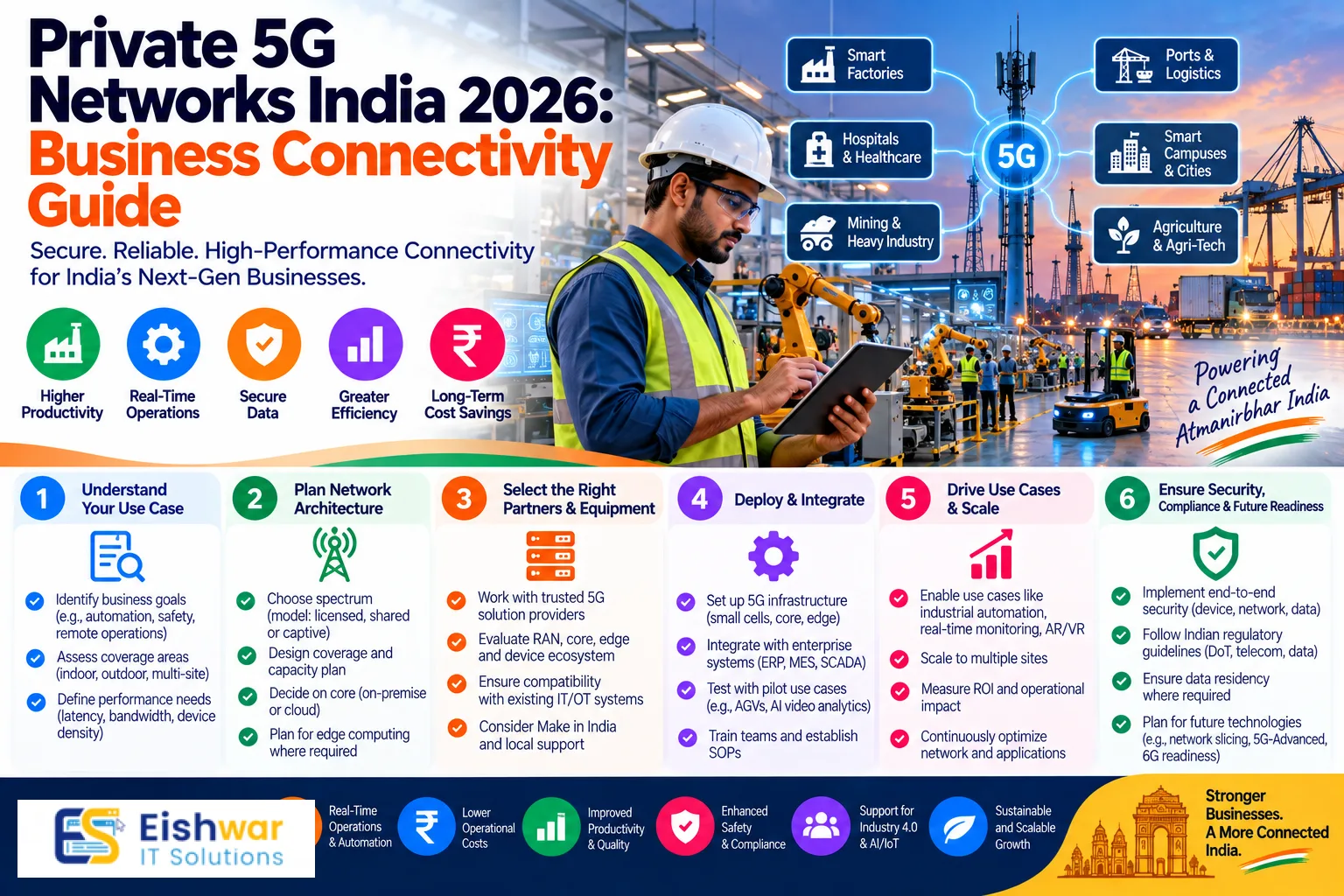
Private 5G Networks India 2026: Business Connectivity Guide
Introduction
India is on the cusp of a connectivity revolution. With 5G rollout accelerating across urban and industrial corridors, businesses are no longer limited to public networks. Private 5G networks are emerging as a game-changer for enterprises seeking ultra-reliable, low-latency, and secure connectivity. As we step into 2026, private 5G is set to redefine how Indian businesses operate, innovate, and compete globally.
But what exactly is a private 5G network? How can it benefit your business? And what does it take to implement one successfully? This guide answers these questions and more. Whether you are a business owner, marketer, operations leader, or technology professional, understanding private 5G is crucial for staying ahead in the digital-first economy. We will cover core concepts, industry use cases, deployment steps, expert tips, common mistakes, and future trends tailored to the Indian market. According to industry estimates, Indian enterprises are expected to invest significantly in private 5G by 2026, driven by Industry 4.0, smart ports, and digital healthcare.
What Are Private 5G Networks?
A private 5G network is a dedicated cellular network built for a specific organization or campus. Unlike public 5G, which is available to everyone, a private network is owned, managed, and used exclusively by a single entity. It offers dedicated bandwidth, guaranteed performance, and enhanced security. Think of it as a private highway for your data, while public networks are shared roads with unpredictable traffic.
Key characteristics include:
- Low latency: Sub-10ms latency enables real-time applications like robotics, autonomous vehicles, and AR/VR.
- High bandwidth: Supports massive data transfers, high-definition video, and dense sensor deployments.
- Security: Isolated from public networks, reducing cyber threats and enabling granular access control.
- Customization: Tailored to specific business needs, from coverage and capacity to device density and QoS.
- Reliability: Consistent performance even during peak usage, with dedicated resources and network slicing.
In India, private 5G is gaining traction across industries like manufacturing, logistics, healthcare, retail, mining, ports, and smart campuses. The government has allocated spectrum for private networks, and recent policy developments are paving the way for wider adoption. Enterprises can either partner with telecom operators or apply for captive spectrum directly, depending on their scale and strategic needs. For example, a large port can deploy private 5G across cranes, trucks, and sensors without competing with consumer traffic, while a hospital can keep patient data on campus.
Benefits of Private 5G for Indian Businesses
Adopting a private 5G network can deliver transformative benefits. Here is how Indian businesses can gain a competitive edge:
1. Enhanced Operational Efficiency
Private 5G enables automation and real-time monitoring. In manufacturing, machines can communicate instantly, reducing downtime and optimizing production lines. For logistics, real-time tracking of vehicles, pallets, and inventory becomes seamless. For example, a Pune-based auto component maker used private 5G to connect AGVs and reduce material movement time by 18 percent within six months. Key performance indicators often include OEE, mean time to repair, and throughput per shift.
2. Real-Time Data Processing
With edge computing integrated into private 5G, data can be processed locally, reducing latency and enabling instant decision-making. This is critical for applications like autonomous vehicles, remote surgery, and smart grid management. Instead of sending every byte to a distant cloud, edge nodes analyze data on-site, improving response times and reducing backhaul costs. For a steel plant, edge-based video analytics can detect safety violations in milliseconds.
3. IoT Enablement at Scale
Private 5G supports a massive number of IoT devices per square kilometer. This allows businesses to deploy sensors, wearables, and smart devices without network congestion. Agriculture, smart cities, and retail benefit immensely. A warehouse can track thousands of assets in real time, while a factory can monitor vibration, temperature, and pressure across hundreds of machines. This density is a major upgrade over Wi-Fi, which struggles when hundreds of devices connect at once.
4. Improved Customer Experience
In retail, private 5G can power augmented reality try-ons, personalized promotions, and frictionless checkout. In healthcare, telemedicine and remote patient monitoring become more reliable. For instance, a hospital campus can use private 5G to stream high-definition imaging to specialists without buffering or privacy risks. A mall can offer location-based offers while maintaining privacy and security.
5. Cost Savings and Scalability
While initial setup costs may seem high, private 5G reduces long-term expenses by eliminating dependence on public networks and enabling efficient operations. It is also scalable—start small with one production line or warehouse zone and expand as needed. Many Indian enterprises begin with a pilot and scale after proving ROI. Operators also offer managed private 5G services that convert capex into predictable opex.
6. Data Sovereignty and Compliance
With data processed on-premises, businesses can comply with India's data protection laws more easily, ensuring sensitive information never leaves the premises. This is especially important for BFSI, healthcare, and government contractors that handle regulated data. This reduces legal risk and builds customer trust.
Key Use Cases and Implementation Steps
Private 5G is not a one-size-fits-all solution. Let us explore leading use cases and a roadmap for implementation.
Use Cases Across Industries
- Manufacturing: Smart factories with connected robots, AR-guided assembly, predictive maintenance, and real-time quality control.
- Logistics and Warehousing: Autonomous guided vehicles, real-time inventory, drone-based delivery, and yard management.
- Healthcare: Remote diagnostics, connected ambulances, AR-assisted surgery, and secure patient data transfer.
- Retail: Smart shelves, footfall analytics, immersive shopping experiences, and queue-free checkout.
- Smart Offices: Seamless connectivity for IoT devices, video conferencing, access control, and energy management.
- Mining and Ports: Remote-controlled machinery, worker safety monitoring, and automated logistics in harsh environments.
Each use case should be mapped to measurable outcomes. For example, in logistics, a pilot may target 20 percent faster picking; in healthcare, 30 percent quicker image transfer.
Implementation Steps
- Assess Your Needs: Identify pain points and define clear objectives. Do you need low latency for robotics, high bandwidth for video, or massive IoT density for sensors? Map current network gaps and business KPIs. Involve finance, operations, and security from the start.
- Choose Spectrum: In India, you can use licensed spectrum from telecom operators or apply for captive spectrum from the government. Evaluate coverage, cost, and control trade-offs. Captive spectrum may suit large campuses, while operator-managed spectrum can speed up deployment.
- Select a Partner: Collaborate with a telecom operator, equipment vendor, or system integrator experienced in private 5G. Check local references and support capabilities. Ask about service-level agreements, upgrade paths, and local support.
- Design the Network: Plan coverage, capacity, and architecture. Consider edge computing, cloud integration, and redundancy. A good design balances performance with budget. Document network topology and integration points.
- Deploy and Test: Start with a pilot in one area, test performance, and iterate. Measure latency, throughput, device density, and application behavior. Define success metrics before the pilot begins.
- Ensure Security: Implement robust security protocols, including encryption, authentication, and access controls. Use zero-trust principles and monitor traffic continuously. Conduct penetration testing and incident response drills.
- Measure ROI: Track KPIs like productivity, cost reduction, downtime, and customer satisfaction to justify investment and guide expansion. Review results quarterly and adjust the roadmap.
Expert Tips
To maximize success with private 5G, follow these expert recommendations:
- Start Small, Think Big: Begin with a pilot project to prove value before scaling across the organization. Choose a high-impact, contained use case. A single factory floor or warehouse aisle is enough to validate performance.
- Focus on ROI: Align use cases with clear business outcomes, such as reduced downtime, faster cycle times, or increased sales. Calculate payback period and total cost of ownership.
- Invest in Cybersecurity: Private networks are secure, but not invincible. Deploy zero-trust architecture, regular audits, and employee training. Segment IT and OT traffic and monitor for unusual behavior.
- Train Your Workforce: Upskill IT teams and employees to manage and leverage the new network. Consider roles like network slicing manager and edge operations engineer. Run hands-on workshops with real devices and dashboards.
- Collaborate with Regulators: Stay updated on TRAI and DoT guidelines for private 5G spectrum and compliance. Engage early to avoid delays. Appoint a compliance owner for spectrum and data rules.
- Leverage Edge Computing: Combine private 5G with edge nodes to unlock real-time analytics and reduce cloud costs. Start with one high-value analytics use case.
Common Mistakes
Avoid these pitfalls when adopting private 5G:
- Lack of Clear Strategy: Deploying without defined goals leads to wasted resources. Start with a business problem, not technology. Write a one-page charter with goals, scope, and owners.
- Underestimating Costs: Consider spectrum, hardware, integration, maintenance, and skills. Total cost of ownership matters more than initial price. Budget for spectrum fees, SIMs, devices, and integration.
- Ignoring Security: Assuming private equals safe can be dangerous. Implement strong security from day one, including segmentation and monitoring. Use identity-based access and continuous monitoring.
- Not Involving IT Early: IT and OT convergence requires careful planning. Bring network, security, and operations teams together. Create a cross-functional steering committee.
- Overlooking Integration: Ensure compatibility with existing systems and legacy equipment. Test gateways, APIs, and protocols. Run lab tests with legacy PLCs and ERP systems.
- Skipping Pilot Testing: A pilot helps identify issues before full-scale rollout. Measure and document everything. Set go/no-go criteria and a rollback plan.
Future Trends
The private 5G landscape in India is evolving rapidly. Here is what to watch:
- 5G Advanced: Enhanced features like network slicing and ultra-reliable low-latency communication (URLLC) will become mainstream. Network slicing will let one physical network serve multiple virtual networks.
- Convergence with AI: AI will automate network management and enable predictive maintenance, anomaly detection, and dynamic resource allocation. Self-healing networks will reduce manual intervention.
- Edge Computing Integration: More businesses will deploy edge data centers to process data locally, reducing latency and bandwidth costs. Edge will become standard for latency-sensitive workloads.
- 6G Research: While 6G is years away, early research will shape the next decade of enterprise connectivity. India's 6G alliance and academic research will influence standards.
- Spectrum Policy Changes: The Indian government may refine policies to encourage private 5G adoption, including clearer captive spectrum rules. Expect more clarity on captive spectrum pricing and sharing.
- Industry 4.0 Acceleration: Private 5G will be the backbone of smart factories, smart ports, and smart cities across India. Private 5G will connect robots, AGVs, and digital twins.
FAQs
Here are answers to common questions about private 5G networks in India.
1. What is the difference between public 5G and private 5G?
Public 5G is available to all consumers and businesses, managed by telecom operators. Private 5G is a dedicated network for a single organization, offering greater control, security, and performance customization. Private 5G can be customized for latency, coverage, and device density.
2. Do I need a license to set up a private 5G network in India?
Yes, you need spectrum. You can either partner with a telecom operator that holds licensed spectrum or apply for captive spectrum from the Department of Telecommunications (DoT) under the new guidelines. Operators can also offer managed private 5G under their licenses.
3. How much does it cost to deploy a private 5G network?
Costs vary based on scale, spectrum, and equipment. A small pilot might cost a few lakhs, while a full campus deployment can run into crores. However, long-term ROI often justifies the investment. Managed services can reduce upfront costs.
4. Which industries benefit most from private 5G?
Manufacturing, logistics, healthcare, retail, mining, and smart campuses see the highest impact due to their need for real-time data, automation, and reliable connectivity. Ports, airports, and defense are also emerging adopters.
5. Is private 5G secure?
Yes, private 5G is inherently more secure than public networks because it is isolated. However, you must still implement security best practices like encryption, authentication, and monitoring. Regular audits and firmware updates are essential.
6. Can I integrate private 5G with my existing Wi-Fi and wired networks?
Absolutely. Private 5G is designed to complement existing networks. It can be integrated with Wi-Fi, Ethernet, and cloud systems through gateways and APIs. Policy-based routing can prioritize critical traffic.
7. What is the typical latency of a private 5G network?
Latency can be as low as 1-10 milliseconds, depending on configuration. This is significantly lower than 4G and public Wi-Fi, enabling real-time applications. URLLC can push latency below 5ms in ideal conditions.
Conclusion
Private 5G networks are no longer a futuristic concept—they are a present-day competitive advantage. For Indian businesses, 2026 presents a pivotal opportunity to leverage this technology for growth, efficiency, and innovation. By understanding the benefits, avoiding common mistakes, and following a strategic implementation roadmap, you can unlock the full potential of next-gen connectivity.
Whether you are streamlining manufacturing, enhancing customer experiences, or building smart infrastructure, private 5G provides the foundation. The time to act is now.
CTA
Ready to explore private 5G for your business? Contact EishwarITSolution today for a free consultation. Our experts can help you assess your needs, design a custom private 5G strategy, and guide you through implementation. Visit eishwar.com or call us to get started. Let us build your connected future together.