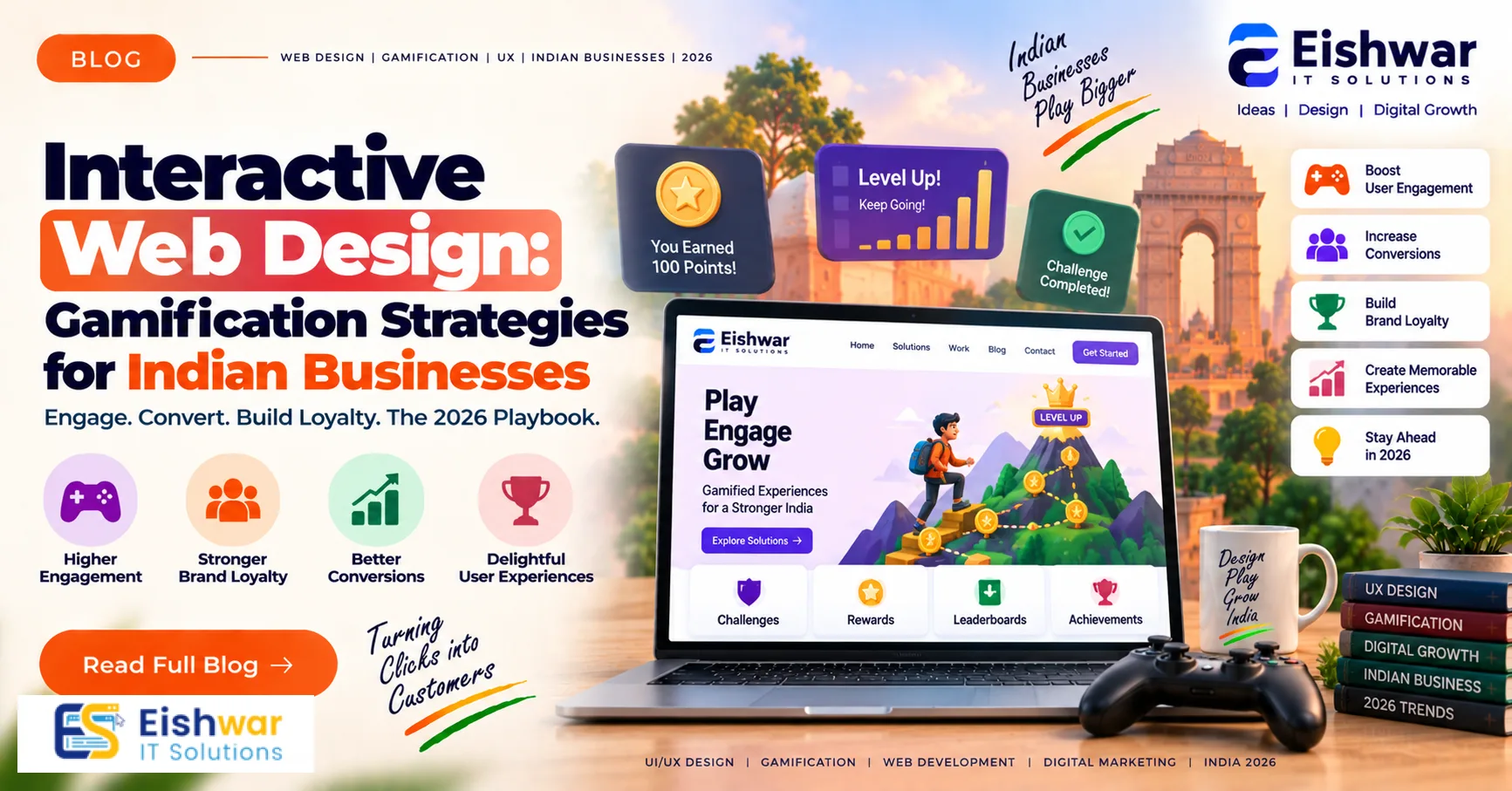
Interactive Web Design: Gamification Strategies for Indian Businesses in 2026
Introduction
In the crowded digital landscape of 2026, simply having a website is not enough. Indian consumers are bombarded with options, and their attention spans are shrinking. To stand out, businesses must create memorable, engaging experiences that not only attract visitors but also keep them coming back. This is where interactive web design and gamification come into play.
Gamification—the application of game-design elements in non-game contexts—has emerged as a powerful tool to boost user engagement, increase time on site, and drive conversions. For Indian businesses, from e-commerce to education, gamification can tap into the country's love for competition, rewards, and interactive experiences. In this guide, we'll explore how you can integrate gamification into your website design to achieve measurable results in 2026.
But what exactly does gamification look like in practice? It's not just about adding a few badges or a point system. It's about creating a psychological connection with your users, leveraging their innate desires for achievement, status, and reward. For Indian businesses, this is particularly potent because of the cultural emphasis on festivals, celebrations, and community. A well-designed gamification strategy can turn a mundane browsing session into an exciting journey, making your brand memorable and shareable.
Main Section 1: Understanding Gamification in Web Design
Gamification is more than just adding points and badges. It's about understanding what motivates your users and designing experiences that fulfill those motivations. In the context of web design, gamification involves incorporating game mechanics like points, levels, challenges, leaderboards, and rewards into your website’s interface and user journey. The goal is to tap into intrinsic and extrinsic motivators—such as the desire for mastery, competition, social recognition, and tangible rewards—to encourage specific user behaviors.
For Indian users, who are increasingly mobile-first and accustomed to engaging with apps like Paytm, Swiggy, and Myntra, gamified elements feel natural. These apps have successfully used gamification to drive daily active usage and loyalty. For example, Paytm offers cashback and scratch cards, while Swiggy has a reward points system. These strategies have set a precedent that Indian users respond positively to. The success of these platforms demonstrates that gamification is not a passing fad but a fundamental shift in how digital products engage users.
But gamification is not just for consumer apps. B2B websites can also benefit by using interactive quizzes, progress bars in forms, and interactive product demos to engage potential clients. For instance, a SaaS company could use a 'ROI Calculator' that allows prospects to input their metrics and see potential savings, turning a passive visit into an active exploration. The key is to align gamification with your business goals and user needs. A well-thought-out gamification strategy should be subtle, intuitive, and deeply integrated into the user journey, not just a superficial add-on.
Main Section 2: Top Gamification Strategies for Indian Businesses
Here are some effective gamification strategies that you can implement on your website, each with practical examples and actionable tips:
1. Reward Points and Loyalty Programs
Implement a points system where users earn points for actions like signing up, making purchases, sharing content, or leaving reviews. These points can be redeemed for discounts, freebies, or exclusive content. This not only encourages repeat visits but also fosters a sense of achievement.
Practical Example: An Indian online bookstore could offer 10 points for every ₹100 spent, 50 points for a first purchase, and 20 points for writing a review. Users can redeem 500 points for a ₹50 discount. To make it more engaging, introduce 'Double Points' days during festivals like Diwali or Republic Day, aligning with cultural moments.
Tip: Make the points visible and easily accessible. A 'My Rewards' dashboard that shows points balance, history, and redemption options can enhance transparency and encourage participation.
2. Quizzes and Interactive Assessments
Create quizzes that help users find the right product or service. For instance, a skincare brand can have a 'Skin Type Quiz' that recommends products. This interactive element engages users and provides personalized suggestions, increasing the likelihood of conversion.
Practical Example: A fashion e-commerce site could offer a 'Style Personality Quiz' that categorizes users into styles like 'Boho Chic' or 'Minimalist'. Based on the result, the site can showcase curated collections, making the shopping experience feel bespoke.
Tip: Keep quizzes short (5-7 questions) and visually appealing. Use images and GIFs to make the quiz fun. After the quiz, provide a shareable result card that users can post on social media, driving organic traffic.
3. Progress Bars and Milestones
When users are filling out forms or completing a multi-step process, show a progress bar. This gives them a sense of completion and motivates them to finish. For e-commerce, showing a 'You're 80% there to free shipping' message can nudge users to add more items to their cart.
Practical Example: A travel booking website could use a progress bar in its multi-step booking form (e.g., Step 1: Select Destination, Step 2: Choose Dates, Step 3: Add Travelers, Step 4: Payment). This reduces form abandonment and makes the process feel less daunting.
Tip: Use microcopy that encourages progress, such as 'Almost there! Just one more step.' Also, consider adding a subtle animation when the progress bar fills up to create a sense of accomplishment.
4. Leaderboards and Challenges
For community-driven websites or fitness apps, leaderboards can spur competition. For example, a fitness platform can have a monthly challenge where users track their workouts and compete for the top spot. This encourages regular engagement and social sharing.
Practical Example: A language learning app for Indian users could have a 'Weekly Streak Challenge' where users earn points for daily practice. The top 10 users on the leaderboard get featured on the homepage, and the winner gets a free premium subscription.
Tip: Ensure that leaderboards are not discouraging for new users. Consider having different tiers or 'beginner' leaderboards to give everyone a fair chance. Also, celebrate milestones like 'Most Improved' to foster a positive community.
5. Scratch Cards and Spin-the-Wheel Offers
These are popular in Indian e-commerce. A 'Spin to Win' wheel on your homepage or after a purchase can be an exciting way to offer discounts. This not only delights users but also creates a viral effect as they share their wins on social media.
Practical Example: An online grocery store could have a 'Festive Spin' during Diwali, offering discounts ranging from 5% to 50% off. To increase engagement, require users to sign up or log in to spin, capturing leads.
Tip: Make sure the wheel is mobile-responsive and loads quickly. Use bright colors and festive imagery to grab attention. Also, limit spins to once per day to encourage repeat visits.
Main Section 3: Implementing Gamification: Best Practices and Tools
To successfully implement gamification, you need to plan carefully. Here are some best practices to guide you:
1. Understand Your Audience
Conduct user research to understand what motivates your target audience. For instance, young urban users might be motivated by social recognition, while older users might prefer tangible discounts. Tailor your gamification elements accordingly.
Actionable Tip: Use surveys, user interviews, and analytics to segment your audience. Create user personas that include their preferences, pain points, and motivational triggers. For example, a Gen Z audience might respond better to gamified social challenges, while a business audience might prefer progress tracking and efficiency.
2. Keep It Simple and Relevant
Don't overcomplicate your website with too many game elements. Choose a few that align with your goals and are easy to understand. For example, a simple progress bar in a checkout process can be more effective than a complex point system that confuses users.
Actionable Tip: Prioritize gamification elements that directly support your business objectives. If your goal is to increase form completions, focus on progress bars and microcopy. If you want to boost repeat purchases, implement a loyalty points system. Avoid adding gamification just for the sake of it.
3. Ensure Mobile Responsiveness
With over 80% of internet users in India accessing the web via mobile, your gamified elements must be mobile-friendly. Ensure that buttons are easy to tap, animations load quickly, and the overall experience is smooth on small screens.
Actionable Tip: Test your gamified features on various mobile devices and screen sizes. Use tools like Google's Mobile-Friendly Test. Also, consider using accelerated mobile pages (AMP) for faster loading. Remember, a laggy experience can frustrate users and negate the benefits of gamification.
4. Use Gamification Tools
There are many tools that can help you add gamification to your website without extensive coding. Some popular options include:
- BadgeOS – for adding badges and points to WordPress sites.
- GamiPress – a powerful gamification plugin for WordPress that supports points, achievements, and ranks.
- Spin-to-win plugins like Coupon Wheel or WP Coupon Ninja.
- Quiz plugins like Quiz and Survey Master or Interact.
These tools can save time and ensure your gamification features work seamlessly. However, always check for compatibility with your existing website platform and ensure they are regularly updated for security.
Expert Tips
We spoke with leading web designers and UX experts to gather their insights on gamification for Indian businesses:
- Rohit Sharma, UX Designer at a leading Mumbai-based agency: "Gamification should never feel forced. It should be an organic part of the user journey. For Indian users, localizing the game elements—like using Hindi phrases or regional festivals—can significantly boost engagement. For instance, using 'Shubh Labh' during Diwali or 'Eid Mubarak' during Eid can create a personal connection."
- Priya Patel, Digital Marketing Strategist: "Don't just focus on rewards. The sense of achievement and progress is often more motivating than the reward itself. Use visual cues like progress bars and badges to give users a sense of accomplishment. For example, a simple 'Level 2 Achieved' notification can be more satisfying than a discount code."
- Anand Verma, E-commerce Consultant: "Test different gamification strategies to see what works best for your audience. A/B testing can help you refine your approach and maximize ROI. For instance, you might test whether a spin-to-win wheel or a points-based system leads to higher conversion rates. Always base your decisions on data, not assumptions."
Common Mistakes
While gamification can be powerful, there are common pitfalls to avoid:
- Overcomplicating the Experience: Too many game elements can overwhelm users and distract from your core message. Keep it simple and focused. For example, if you're a B2B service provider, a complex leaderboard might confuse your audience; a simple progress bar in a quote request form is more effective.
- Ignoring User Motivation: If your rewards don't resonate with your audience, they won't engage. Understand what your users value and design accordingly. For instance, offering points that can only be redeemed for products they don't care about will not motivate them.
- Neglecting Mobile Users: A gamified feature that works on desktop but fails on mobile will alienate a large segment of your audience. Always test on mobile devices. For example, if your spin-to-win wheel is not touch-friendly, users will abandon it.
- Not Tracking Performance: Without analytics, you won't know what's working. Use tools like Google Analytics to track user behavior and measure the impact of your gamification. Set up specific goals, such as 'spin wheel clicks' or 'quiz completions', to monitor performance.
Future Trends
As we look beyond 2026, gamification in web design is set to become even more sophisticated. Here are some trends to watch:
- AI-Powered Personalization: AI will enable hyper-personalized gamification experiences, where the game elements adapt to each user's preferences and behavior in real-time. For example, an AI could analyze a user's browsing history and adjust the difficulty of a quiz or the type of rewards offered to maximize engagement.
- Voice-Activated Games: With the rise of voice search, voice-activated challenges and quizzes could become a new way to engage users. Imagine a user saying 'Spin the wheel' on their smart speaker and getting a discount code for your website.
- Augmented Reality (AR) Integration: AR can bring gamification to life, allowing users to interact with products in a virtual space. For instance, a furniture store could let users place virtual furniture in their room and earn rewards for sharing. This immersive experience can significantly increase time on site and brand recall.
- Blockchain-Based Rewards: Cryptocurrencies and NFTs could be used as rewards, appealing to tech-savvy Indian users. For example, a gaming website could reward users with crypto tokens that can be traded or used for in-site purchases. This trend could also foster a sense of ownership and exclusivity.
FAQs
1. What is gamification in web design?
Gamification in web design involves incorporating game mechanics like points, badges, leaderboards, and challenges into a website to enhance user engagement and motivate desired behaviors. It leverages psychological principles to make interactions more enjoyable and rewarding.
2. How can gamification benefit my Indian business?
Gamification can increase user engagement, time on site, and conversions. It also fosters loyalty and encourages repeat visits, which is crucial in the competitive Indian market. For example, a points-based loyalty program can increase customer retention by up to 30%.
3. Is gamification suitable for all types of businesses?
While gamification is particularly effective for e-commerce, education, and fitness, it can be adapted for B2B and service-based businesses through interactive quizzes, progress bars, and personalized assessments. For instance, a B2B software company can use a 'ROI Calculator' as a gamified tool to engage prospects.
4. What are some low-cost gamification ideas?
Simple ideas include adding a progress bar to forms, creating a quiz, or offering a spin-to-win discount code. Many plugins are available for free or at low cost. For example, a WordPress plugin like GamiPress offers a free version that includes points and achievements.
5. How do I measure the success of gamification?
Track metrics such as user engagement (time on site, pages per session), conversion rates, repeat visits, and social shares. Use A/B testing to compare gamified vs non-gamified versions. For instance, you can set up Google Analytics goals to track 'quiz completions' or 'spin wheel clicks' and measure their impact on sales.
Conclusion
In 2026, interactive web design is no longer a luxury—it's a necessity. Gamification offers Indian businesses a powerful way to connect with their audience, build lasting relationships, and drive growth. By implementing the strategies outlined in this guide, you can create a website that not only looks great but also delivers tangible results. The key is to understand your users, keep the experience simple and relevant, and continuously test and refine your approach. With the right gamification strategy, your website can become a destination that users love to visit and revisit.
CTA
Ready to transform your website into an engaging, gamified experience that boosts conversions? Contact EishwarITSolution today for expert web design services tailored to your business needs. Our team specializes in creating interactive, user-centric websites that drive results. Let's build something amazing together!